
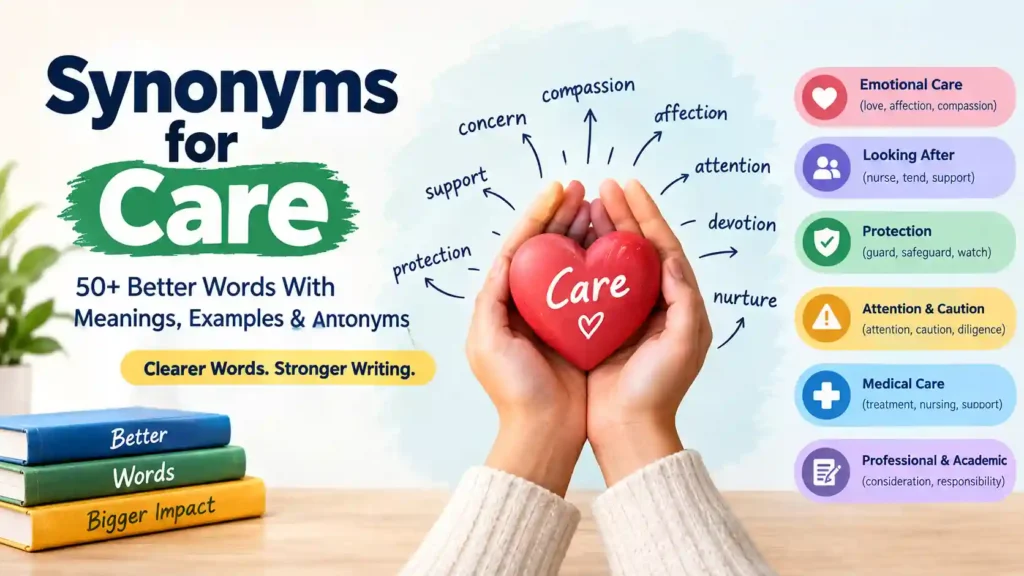

Synonyms for Care (noun, verb) /ker/ (US), /keər/ (UK) means concern, attention, protection, or affection for someone or something. As a verb, it can mean to feel concern, value something, look after someone, or want something.
The best synonym depends on the meaning. Concern, attention, compassion, affection, protection, caution, support, and devotion can all replace care in the right context, but they do not all mean exactly the same thing.
Quick Answer
The best synonym for care depends on your sentence:
- Concern — when you feel worried or interested.
- Attention — when you focus on something.
- Affection — when you show warm feelings.
- Compassion — when you care about someone’s suffering.
- Devotion — when your care is deep and lasting.
- Protection — when care means keeping someone safe.
- Caution — when care means avoiding danger or mistakes.
- Support — when care means helping someone.
- Nursing — when care involves looking after a sick person.
- Diligence — when care means careful and consistent effort.
There is no single replacement that works in every sentence. Care has several meanings, so choose the word that matches your exact intent.
Direct Synonyms for Care by Meaning
The table below focuses on established synonyms and close lexical alternatives. Words that change the meaning are marked as near-synonyms or contextual alternatives rather than being presented as exact replacements.
| Synonym | Specific Meaning | Synonym | Specific Meaning |
| Concern | Interest or worry about someone | Attention | Focus given to someone or something |
| Regard | Respect or positive concern | Consideration | Thought given to others or details |
| Caution | Care used to avoid danger | Diligence | Careful and steady effort |
| Watchfulness | Careful attention for possible problems | Vigilance | Alert attention to possible danger |
| Attentiveness | Active notice of needs or details | Heed | Careful attention to advice or risk |
| Protection | Action that keeps someone safe | Custody | Care or control of a person |
| Guardianship | Legal or responsible protection | Supervision | Watching and managing someone’s actions |
| Keeping | Responsibility for looking after something | Charge | Responsibility or control over something |
| Management | Organizing and controlling something | Responsibility | Duty to look after something |
| Affection | Warm feelings toward someone | Fondness | Strong liking or warm feeling |
| Compassion | Concern for another’s suffering | Solicitude | Deep concern for someone’s welfare |
| Devotion | Deep and lasting dedication | Tenderness | Gentle and affectionate care |
| Nurturing | Supporting growth and well-being | Support | Help given to someone in need |
| Aid | Practical help or assistance | Assistance | Help provided to someone |
| Help | Action that makes things easier | Nursing | Professional or personal sick care |
| Treatment | Medical care for a condition | Attention | Focus given to patient needs |
| Upkeep | Care that maintains condition | Maintenance | Work that keeps something working |
| Tending | Looking after a person or thing | Looking after | Taking responsibility for someone’s needs |
| Mindfulness | Careful awareness of something | Thoughtfulness | Care shown through consideration |
| Prudence | Wise care that avoids problems | Forethought | Thinking about future needs or risks |
| Meticulousness | Extremely careful attention | Conscientiousness | Careful sense of duty |
| Painstakingness | Care involving great effort | Scrupulousness | Very careful attention to standards |
| Regard | Respect or consideration | Interest | Concern or curiosity about something |
| Worry | An anxious form of care | Anxiety | Uneasy concern about possible problems |
Cambridge lists words such as carefulness, caution, diligence, attention, attentiveness, concern, consideration, solicitude, and conscientiousness among words related to the noun care. Collins also separates its senses into concern, custody, caution, attention, and worry.
Where Care Comes From
Parts of Speech: Noun and verb
Syllable: One syllable
Pronunciation: /ker/ in US English; /keər/ in UK English
Origin: Care comes from Old English caru/cearu, meaning “sorrow,” “anxiety,” “grief,” or “trouble.” It developed through Middle English into meanings linked with concern, attention, protection, and responsibility.
Prefix/Suffix Breakdown: Care is a simple root word. It does not contain a productive English prefix or suffix.
The historical development is important because the modern word has several connected meanings. Its older sense involved sorrow or mental burden, while later meanings included attention, protection, responsibility, and concern. The word is Germanic in origin rather than derived from Latin cura.
Care as Concern or Interest
When care means feeling that something matters, the closest choices are concern, regard, interest, mind, value, and be concerned about.
Concern /kən-SURN/
Meaning: A feeling that someone or something matters to you.
- I care about my team’s success.
- I have a strong concern for my team’s success.
Regard /ri-GARD/
Meaning: Respect, attention, or positive feeling toward someone.
- She cares deeply about her students.
- She has great regard for her students.
Interest /IN-trist/
Meaning: Attention or curiosity about something.
- He cares about environmental issues.
- He has a strong interest in environmental issues.
Value /VAL-yoo/
Meaning: To consider someone or something important.
- We care about honest work.
- We value honest work.
Mind /mind/
Meaning: To care about or be bothered by something.
- Do you care if I leave early?
- Do you mind if I leave early?
Note: Mind often works in questions and negative statements. It is not a universal replacement for care.
Care as Love or Affection
When care means warm personal feeling, stronger words include affection, fondness, devotion, tenderness, compassion, and love.
Affection /ə-FEK-shən/
Meaning: Warm feelings of liking or love.
- She cares deeply for her grandmother.
- She feels deep affection for her grandmother.
Fondness /FOND-nəs/
Meaning: Warm liking for someone or something.
- He cares a lot for his old teacher.
- He has great fondness for his old teacher.
Devotion /di-VOH-shən/
Meaning: Deep and lasting love or dedication.
- Her care for her family is strong.
- Her devotion to her family is clear.
Compassion /kəm-PASH-ən/
Meaning: Concern for someone who is suffering.
- The nurse cared for the frightened patient.
- The nurse showed great compassion for the frightened patient.
Tenderness /TEN-dər-nəs/
Meaning: Gentle affection and kindness.
- She cared for the child with great warmth.
- She treated the child with tenderness.
Care as Looking After Someone
When care means looking after a person or animal, use tend, nurse, look after, attend to, support, protect, or provide for, depending on the situation.
Tend /tend/
Meaning: To look after someone or something.
- She cares for the plants every morning.
- She tends the plants every morning.
Nurse /nurs/
Meaning: To care for someone who is sick or injured.
- The nurse cared for the patient.
- The nurse nursed the patient through recovery.
Look After /look AF-ter/
Meaning: To take responsibility for someone’s needs.
- Can you care for the children tonight?
- Can you look after the children tonight?
Attend To /ə-TEND too/
Meaning: To deal with someone’s needs or a task.
- The doctor cared for the patient’s needs.
- The doctor attended to the patient’s needs.
Support /sə-PORT/
Meaning: To help someone emotionally or practically.
- Her family cared for her during recovery.
- Her family supported her during recovery.
Care in Medical and Nursing Contexts
In medical writing, care is broad. The best replacement depends on what the healthcare professional actually provides.
Useful medical alternatives include:
- Treatment — medical action used to manage a condition.
- Nursing — professional care given by nurses.
- Patient support — practical or emotional help.
- Medical attention — professional attention to a health problem.
- Assistance — help with needs or tasks.
- Supervision — monitoring a patient’s condition or actions.
- Management — planned control of a condition or treatment.
- Therapy — treatment intended to improve a health condition.
- Aftercare — care given after treatment or a procedure.
- Monitoring — watching a patient’s condition over time.
For example:
- Medical care → medical treatment
- Patient care → patient support or clinical care
- Nursing care → nursing
- Postoperative care → postoperative management or aftercare
- Emergency care → emergency medical treatment
- Home care → home-based care or home support
Do not replace care with treatment in every medical sentence. Care can include protection, monitoring, comfort, support, and daily assistance, while treatment usually refers to an intervention for a medical condition.
Care as Attention or Carefulness
When care means doing something carefully, the strongest alternatives include attention, caution, diligence, precision, vigilance, prudence, and meticulousness.
Attention /ə-TEN-shən/
Meaning: Focus given to a person, task, or detail.
- She completed the report with care.
- She completed the report with close attention.
Caution /KAW-shən/
Meaning: Care used to avoid danger or mistakes.
- Handle the equipment with care.
- Handle the equipment with caution.
Diligence /DIL-i-jəns/
Meaning: Careful and persistent effort.
- He completed the task with care.
- He completed the task with diligence.
Vigilance /VIJ-ə-ləns/
Meaning: Alert attention to possible danger.
- The team must take care during the inspection.
- The team must maintain vigilance during the inspection.
Meticulousness /mə-TIK-yə-ləs-nəs/
Meaning: Extremely careful attention to detail.
- She prepared the records with great care.
- She prepared the records with meticulousness.
Care in Professional Writing
For a professional email, report, resume, or workplace document, the best alternative depends on what you want to express.
Instead of “care about”
Use:
- value
- prioritize
- recognize the importance of
- remain committed to
- show concern for
- take an interest in
Example:
Weak: We care about customer satisfaction.
Professional: We prioritize customer satisfaction.
Instead of “take care of”
Use:
- manage
- handle
- oversee
- coordinate
- support
- assist
- address
- resolve
Example:
I will take care of the request.
More professional:
I will handle the request.
Instead of “careful”
Use:
- thorough
- diligent
- attentive
- precise
- meticulous
- conscientious
Care in an Essay
In an essay, avoid repeating care when a more precise word shows your meaning.
If you mean concern
Use concern.
The issue has raised serious concern among parents.
If you mean importance
Use significance or importance.
The policy has great significance for young workers.
If you mean attention
Use attention.
The study requires careful attention to detail.
If you mean responsibility
Use responsibility or duty.
Teachers have a responsibility to protect students.
If you mean compassion
Use compassion.
The program reflects compassion for vulnerable families.
If you mean effort
Use diligence or effort.
The researcher completed the work with diligence.
These choices make academic writing more precise because they identify the exact type of care being discussed.
Better Words for Caring
Caring usually describes a person who shows concern, kindness, or support.
Good alternatives include:
- compassionate — shows concern for suffering
- kind — treats others well
- considerate — thinks about other people’s needs
- supportive — provides help and encouragement
- nurturing — helps others grow and feel safe
- attentive — notices and responds to needs
- thoughtful — considers other people’s feelings
- empathetic — understands another person’s feelings
- devoted — strongly committed to someone
- compassionate — deeply concerned about another’s well-being
What Is a Better Word Than “Caring”?
There is no single best replacement.
- Use compassionate for kindness toward someone who is struggling.
- Use supportive when someone gives practical or emotional help.
- Use considerate when someone thinks about other people’s needs.
- Use nurturing when someone helps another person grow.
- Use devoted when the feeling is deep and lasting.
Words for Deep Care
If you mean deep care, stronger choices include:
- Devotion — deep and lasting dedication.
- Affection — strong warm feeling.
- Compassion — deep concern for suffering.
- Solicitude — intense concern for another’s welfare.
- Tenderness — gentle and loving care.
- Love — deep personal affection.
- Regard — strong respect or concern.
Example:
Her devotion to her family remained strong through every challenge.
Words for Great Care
If you mean great care as careful attention, use:
- utmost care
- close attention
- meticulous attention
- painstaking attention
- exceptional diligence
- extreme caution
- careful consideration
- scrupulous attention
If you mean great care for a person, use:
- deep concern
- devotion
- compassion
- tenderness
- affection
- solicitude
Another Word for Care for Others
For caring about other people, useful words include:
- compassion
- concern
- kindness
- empathy
- consideration
- support
- affection
- generosity
- thoughtfulness
- benevolence
The exact choice depends on the action.
Concern focuses on someone’s welfare.
Compassion focuses on suffering.
Empathy focuses on understanding feelings.
Kindness focuses on good treatment.
Support focuses on helping.
Affection focuses on warm feelings.
Another Word for “Take Care”
“Take care” has several meanings, so the replacement changes with context.
When you mean “look after someone”
Use:
- look after
- care for
- tend
- nurse
- attend to
- support
Example:
She takes care of her elderly father.
→ She looks after her elderly father.
When you mean “be careful”
Use:
- be careful
- be cautious
- stay alert
- use caution
- watch out
Example:
Take care on the wet floor.
→ Be careful on the wet floor.
When you mean “handle something”
Use:
- handle
- manage
- oversee
- deal with
- address
- resolve
Example:
I will take care of the problem.
→ I will handle the problem.
When you mean a farewell
“Take care” can simply be replaced with:
- Stay safe.
- Stay well.
- All the best.
- See you soon.
- Have a good day.
Care Synonyms for Love
When care expresses love, the closest choices are:
- affection
- fondness
- devotion
- tenderness
- love
- regard
- attachment
Care is broader than love. You can care about a person without being romantically in love with them.
For example:
I care deeply about my friend.
This does not necessarily mean:
I love my friend romantically.
That distinction matters in personal writing.
Care Synonyms and Antonyms
The main opposites of care change with its meaning.
If Care Means Concern
Opposites include:
- indifference
- unconcern
- apathy
- disregard
Example:
Her concern for the issue was clear.
→ Her indifference to the issue was clear.
If Care Means Attention
Opposites include:
- inattention
- neglect
- carelessness
- disregard
Example:
The equipment requires careful handling.
→ Carelessness may damage the equipment.
If Care Means Protection
Opposites include:
- abandonment
- neglect
- exposure
- endangerment
Example:
The child was placed in protective care.
→ The child was left in a state of neglect.
Common Traps & Nuance Distinctions
Small differences matter when choosing a synonym for care.
Care vs. Concern
Care can mean concern, but it can also mean protection, attention, affection, or responsibility.
Concern usually focuses on worry, interest, or regard.
I care about my sister.
I have concern for my sister’s safety.
Care vs. Worry
Worry is usually negative and suggests anxiety.
I care about my friend.
This can be warm and positive.
I worry about my friend.
This suggests fear that something may go wrong.
Care vs. Attention
Attention focuses on where someone directs their mind or effort.
She paid attention to the instructions.
Care can include attention, but it also suggests concern or responsibility.
Care vs. Compassion
Compassion means concern for someone who is suffering.
The nurse showed compassion for the patient.
You would not normally replace every use of care with compassion.
Care vs. Affection
Affection means warm personal feeling.
He has great affection for his grandfather.
Care can express affection, but it can also mean practical responsibility.
Care vs. Caution
Caution means care taken to avoid danger.
Handle the glass with care.
Handle the glass with caution.
These can be close in this context, but caution puts more focus on avoiding risk.
Care vs. Treatment
In healthcare, care is broader than treatment.
Care may include monitoring, comfort, assistance, protection, and daily support.
Treatment usually refers to a medical intervention for a health condition.
Care vs. Concern in an Essay
Do not use concern when you mean practical help.
The nurse provided care to the patient.
Better:
The nurse provided support and treatment to the patient.
But:
The study raises concern about patient safety.
Here, concern means worry or a serious issue.
When NOT to Use a Synonym for Care
Do not replace care simply because another word looks more advanced.
- Avoid love when you only mean responsibility.
- Avoid worry when you mean affection.
- Avoid treatment when you mean general support.
- Avoid caution when you mean emotional concern.
- Avoid compassion when you only mean attention to detail.
- Avoid attention when you mean deep affection.
- Avoid devotion when the relationship is casual.
- Avoid custody unless legal or formal control is involved.
- Avoid nursing unless the context involves nursing or hands-on care.
The safest approach is to identify the meaning first, then choose the synonym.
Five Strong Synonyms for Care
If you need five strong alternatives, these cover five important meanings:
- Concern — emotional or serious interest.
- Attention — focused care or consideration.
- Compassion — concern for suffering.
- Devotion — deep and lasting care.
- Diligence — careful and persistent effort.
These are not interchangeable in every sentence. Each represents a different shade of meaning.
Quick Synonym Finder
| If you mean… | Use… |
| Care about someone | concern, regard, affection |
| Care deeply | devotion, compassion, affection |
| Care for a patient | nursing, treatment, support |
| Care for children | look after, tend, nurture |
| Care about an issue | concern, interest, regard |
| Careful work | diligence, attention, precision |
| Great care | utmost care, meticulous attention |
| Professional care | support, management, assistance |
| Care in nursing | nursing, patient care, clinical support |
| Care in an essay | concern, attention, consideration |
| Care and love | affection, devotion, tenderness |
| Care for others | compassion, empathy, kindness |
| Take care of a task | handle, manage, address |
| Take care = be careful | be cautious, stay alert |
| Take care = goodbye | stay safe, stay well |
Frequently Asked Questions
What is a better word for care?
The best word depends on the meaning. Concern works for emotional interest, attention for focused effort, compassion for concern about suffering, protection for safety, and devotion for deep personal care.
What is a better word than caring?
Useful alternatives include compassionate, considerate, supportive, nurturing, attentive, thoughtful, empathetic, and devoted. Choose the word that describes the type of caring you mean.
What is a deeper word for “care”?
For deep personal care, devotion, affection, compassion, tenderness, and solicitude are strong choices. Devotion often suggests the strongest long-term commitment.
What is another word for great care?
For careful work, use utmost care, meticulous attention, painstaking attention, diligence, or scrupulous attention. For deep personal concern, use devotion, compassion, or solicitude.
What is another word for care in an essay?
For academic writing, useful choices include concern, attention, consideration, responsibility, diligence, and regard. The best option depends on the sentence.
What is a care synonym in medical writing?
Depending on the context, use treatment, nursing, medical attention, patient support, clinical management, monitoring, assistance, or aftercare. Care is broader than many of these terms.
What is another word for care in nursing?
Common context-specific alternatives include nursing, patient support, patient management, assistance, monitoring, treatment, and clinical care. Do not treat these as exact synonyms because each describes a different part of nursing work.
What is another word for caring and loving?
Affectionate, devoted, tender, compassionate, nurturing, and loving can express caring and loving behavior. Devoted suggests strong and lasting commitment.
How can I say “take care”?
If you mean be careful, say “be careful,” “stay safe,” or “use caution.” And if you mean look after someone, use “care for,” “look after,” or “tend.” If you mean handle something, use “manage,” “handle,” or “address.”
What are five strong synonyms for care?
Five strong choices are concern, attention, compassion, devotion, and diligence. Each fits a different meaning, so choose according to context.
Conclusion
The best synonym for care depends on what you mean: concern for emotional interest, attention for focus, compassion for suffering, protection for safety, devotion for deep personal feeling, and diligence for careful effort. In medical and nursing writing, use precise terms such as treatment, nursing, support, monitoring, or management when they describe the exact service. For essays and professional writing, replacing care with a more precise word can make your meaning clearer without making the writing harder to read.