
Synonyms for cosmos (noun) (/ˈkɒz.mɒs/, US /ˈkɑːz.moʊs/) include universe, world, creation, and macrocosm. The best choice depends on whether you mean the whole universe, the world, creation, or an ordered whole.
The word cosmos usually means the universe viewed as an ordered or harmonious system. In some contexts, it can also mean a complete system or a state of order and harmony.
What is another word for Cosmos
The best synonym for cosmos is universe. Other close alternatives include world, creation, and macrocosm, but each has a different meaning or tone.
Words such as nature, existence, reality, order, and harmony can relate to cosmos in specific contexts, but they are not exact synonyms. Galaxy, solar system, and outer space are related terms, not synonyms, because they describe parts or aspects of the wider cosmos.
What Does Cosmos Mean?
Cosmos is a noun meaning the universe, especially when viewed as an ordered and harmonious whole. It can also describe a system marked by order and harmony.
In simple terms, cosmos = the universe viewed as an organized whole.
The word often has a more philosophical, literary, or grand tone than the neutral word universe.
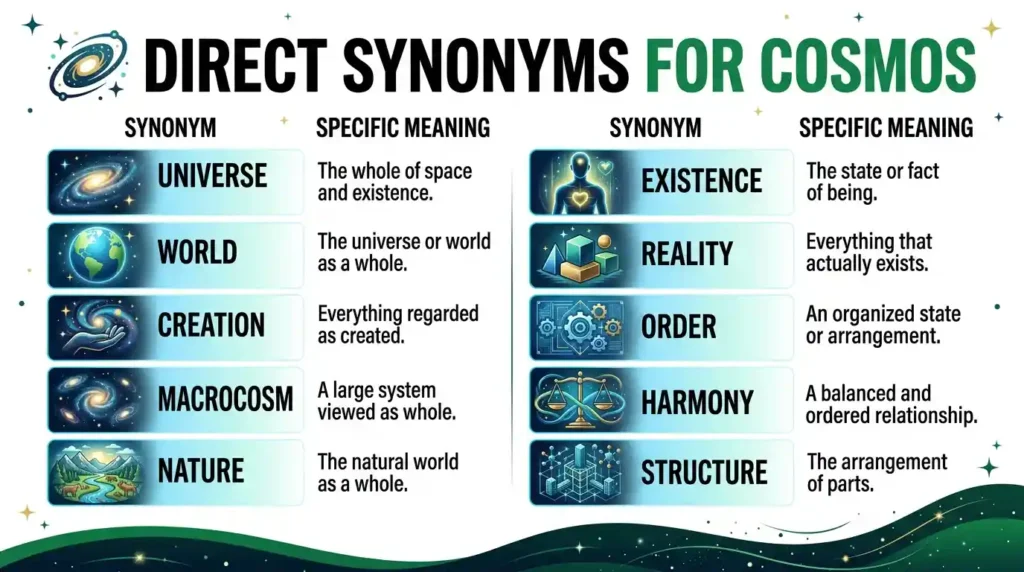
Direct Synonyms for Cosmos
| Synonym | Specific Meaning | Synonym | Specific Meaning |
| Universe | The whole of space and existence | World | The universe or world as a whole |
| Creation | Everything regarded as created | Macrocosm | A large system viewed as whole |
| Nature | The natural world as a whole | Existence | The state or fact of being |
| Reality | Everything that actually exists | Order | An organized state or arrangement |
| Harmony | A balanced and ordered relationship | Structure | The arrangement of parts |
Lexical accuracy note: Universe is the strongest direct substitute for cosmos. World, creation, and macrocosm can work as close contextual alternatives. Nature, existence, reality, order, harmony, and structure apply only to particular senses or contexts.
Where Cosmos Comes From
Parts of Speech: Noun
Syllable: cos-mos
Origin: Cosmos comes from Greek kosmos, meaning “order,” “arrangement,” or “ornament.” Ancient Greek usage developed from the idea of an ordered arrangement to the idea of the ordered universe.
Prefix/Suffix Breakdown: cosm- comes from Greek kosmos. The same root appears in cosmic, cosmology, cosmogony, and cosmopolitan.
The Best Synonyms for Cosmos by Meaning
Choosing the right synonym depends on what you mean by cosmos.
Universe (/ˈjuː.nɪ.vɜːrs/)
Meaning: The whole of space, matter, energy, and existence.
Examples:
- Scientists study the universe to understand its origins.
- New observations help us learn more about the universe.
Why it works: Universe is the clearest and safest replacement for cosmos in general and scientific writing.
World (/wɜːrld/)
Meaning: The world or universe considered as a whole.
Examples:
- Ancient thinkers tried to explain the order of the world.
- The philosopher explored humanity’s place in the world.
Why it works: World can replace cosmos in some contexts, but it can also mean Earth or human society.
Creation (/kriˈeɪʃən/)
Meaning: Everything regarded as something that was created.
Examples:
- The poem celebrates the beauty of creation.
- The writer reflects on humanity’s place in creation.
Why it works: Creation can refer to the entire created universe, especially in religious or theological writing.
Macrocosm (/ˈmækroʊˌkɑːzəm/)
Meaning: A large system viewed as a complete whole.
Examples:
- The city became a macrocosm of modern society.
- The philosopher viewed humanity as part of a larger macrocosm.
Why it works: Macrocosm has a specialized philosophical and systems-based meaning. It is not always a simple replacement for cosmos.
Nature (/ˈneɪtʃər/)
Meaning: The natural world and its physical processes.
Examples:
- The writer sees humans as part of nature.
- The book explores humanity’s relationship with nature.
Why it works: Nature overlaps with cosmos when discussing the natural world as a whole, but it does not normally mean the entire universe.
Existence (/ɪɡˈzɪstəns/)
Meaning: The state or fact of being or existing.
Examples:
- The philosopher questioned the meaning of existence.
- The theory raises questions about human existence.
Why it works: Existence is an abstract alternative. It works best when cosmos refers to all that exists.
Reality (/riˈæləti/)
Meaning: Everything that actually exists or is real.
Examples:
- The theory changed how scientists understood reality.
- The novel explores different ideas about reality.
Why it works: Reality is broader and more abstract than cosmos.
Order (/ˈɔːrdər/)
Meaning: A state of organization or arrangement.
Examples:
- Ancient thinkers searched for order in nature.
- The theory explains how order develops in complex systems.
Why it works: Order fits the older meaning of cosmos as an organized or harmonious whole. It is not a synonym for the physical universe in every context.
Harmony (/ˈhɑːrməni/)
Meaning: A balanced relationship among different parts.
Examples:
- The philosopher imagined the universe as a form of harmony.
- The system depends on the harmony of its parts.
Why it works: Harmony captures the ordered and balanced sense associated with cosmos.
Structure (/ˈstrʌktʃər/)
Meaning: The way parts are arranged within a whole.
Examples:
- Scientists study the large-scale structure of the universe.
- The model explains the structure of the cosmic system.
Why it works: Structure relates to the organized aspect of cosmos, but it does not mean the universe itself.
Related Words That Are Not Exact Synonyms
Many online thesauruses group words with cosmos because they are semantically related. That does not make them interchangeable.
Galaxy
A galaxy is a huge system of stars, gas, dust, and other matter.
A galaxy is part of the cosmos, so it is not an exact synonym.
Solar System
The solar system consists of the Sun and objects that orbit it.
It is only one small part of the cosmos.
Outer Space
Outer space refers to the region beyond Earth’s atmosphere.
It does not necessarily mean the entire universe.
Heavens
Heavens can mean the sky, outer space, or a religious realm.
Its meaning depends heavily on context.
Firmament
Firmament is a literary, historical, or religious term for the sky or heavens.
It is not a modern scientific synonym for cosmos.
Infinity
Infinity describes something without an end or limit.
It does not specifically mean the universe.
Multiverse
A multiverse is a hypothetical collection of multiple universes.
It is not a standard synonym for cosmos.
Cosmos vs. Universe
Cosmos and universe are often interchangeable, but their tone can differ.
- Universe sounds neutral and scientific.
- Cosmos can sound philosophical, literary, or grand.
- Cosmos can also highlight the idea of order and harmony.
Example:
Scientists study the universe.
This sounds neutral and scientific.
Philosophers have questioned humanity’s place in the cosmos.
This sounds more philosophical and expansive.
Cosmos vs. World
World has several meanings. It can refer to Earth, human society, or the universe.
Cosmos usually points to the wider universe or an ordered whole.
Use world for everyday language. Use cosmos when you want a broader or more philosophical tone.
Cosmos vs. Space
Space usually means the physical expanse in which objects exist, especially beyond Earth’s atmosphere.
Cosmos refers to the universe as a whole.
A simple distinction is:
- Space = the expanse
- Cosmos = the universe as an ordered whole
- Universe = the totality of the physical universe
Cosmos vs. Galaxy
A galaxy is only one component of the cosmos.
For example, the Milky Way is a galaxy. The cosmos includes the Milky Way and everything beyond it.
Therefore, galaxy is a narrower term, not a synonym for cosmos.
When Not to Use Cosmos
Do not use cosmos when a more precise word gives the reader a clearer meaning.
Avoid using it:
- For a single galaxy.
- For the solar system.
- When you mean Earth alone.
- When you specifically mean outer space.
- When you mean only plants, animals, and natural processes.
- When reality is the intended philosophical concept.
- When creation could introduce an unintended religious meaning.
- In highly technical writing when universe is more precise.
Also, cosmos has other dictionary meanings. It can refer to a type of flowering plant. This article focuses on the universe sense.
Synonyms for Cosmos in Academic Writing
For academic writing, choose the word that matches the exact idea.
- Universe — best for neutral scientific writing.
- Cosmos — useful for philosophical or broad cosmic discussion.
- Macrocosm — useful for systems and philosophical writing.
- Existence — useful for abstract philosophical discussion.
- Reality — useful for discussions of what exists or what is real.
- Structure — useful when discussing organization within the universe.
Example
Neutral academic:
Scientists continue to study the universe.
Philosophical:
The cosmos represents an ordered whole.
Systems-focused:
The macrocosm contains many interconnected systems.
Synonyms for Cosmos in Creative Writing
Creative writing often uses cosmos to create a sense of mystery, scale, or wonder.
- Cosmos — grand and philosophical
- Universe — vast and neutral
- Heavens — poetic or religious
- Firmament — literary and archaic
- Creation — spiritual or theological
- World — simple and flexible
- Macrocosm — symbolic and philosophical
Example
She looked into the cosmos and wondered what lay beyond the stars.
A more neutral version is:
She looked into the universe and wondered what lay beyond the stars.
Synonyms for Cosmos in Scientific Writing
Universe is normally the strongest choice for scientific writing.
Use:
- Universe for the total physical universe.
- Observable universe for the portion that can be observed from Earth.
- Cosmos when a broader or less technical tone is appropriate.
- Large-scale structure when discussing the organization of matter across cosmic distances.
- Space when referring specifically to a region or expanse.
Avoid using poetic words such as firmament or heavens in technical scientific writing unless the subject is historical, literary, or cultural.
Formal Alternatives to Cosmos
If you need a formal alternative, universe is usually the best choice.
Other options depend on context:
- Universe — formal and neutral
- Macrocosm — formal and philosophical
- Creation — formal and theological
- Existence — formal and abstract
- Reality — formal and philosophical
Do not choose a more complex word simply to make your writing sound formal. Precision matters more than complexity.
Common Traps & Nuance Distinctions
The biggest mistake is treating every related word as a perfect synonym.
- Cosmos vs. universe: Both can mean the whole universe, but cosmos often suggests order.
- Cosmos vs. world: World can mean Earth or human society.
- Cosmos vs. galaxy: A galaxy is only part of the cosmos.
- Cosmos vs. space: Space is an expanse; cosmos is the wider universe.
- Cosmos vs. nature: Nature usually means the natural world.
- Cosmos vs. creation: Creation can have a strong religious meaning.
- Cosmos vs. reality: Reality is a broad philosophical concept.
- Cosmos vs. macrocosm: Macrocosm stresses a large system viewed as a whole.
Opposite Words: Antonyms for Cosmos
Because cosmos has both a universe sense and an order-related sense, it has no single perfect antonym.
Direct or Strong Contextual Antonyms
- Void — an empty or seemingly empty expanse.
- The theory describes a vast cosmic void.
- Nothingness — the absence of anything.
- The philosopher contrasted existence with nothingness.
- Chaos — a state of extreme disorder.
- The myth contrasts cosmic order with chaos.
- Disorder — a lack of organization or arrangement.
- The system moved from order toward disorder.
Operational and Contextual Opposites
- Disorganization — a lack of organized structure.
- The project suffered from disorganization.
- Fragment — a small part separated from a whole.
- The object was only a fragment of a larger system.
- Locality — a limited place or region.
- The research focuses on a small locality.
- Microcosm — a small system representing a larger one.
- The village served as a microcosm of the wider society.
These are contextual opposites, not universal dictionary antonyms for every sense of cosmos.
Frequently Asked Questions
What is the best synonym for cosmos?
Universe is the best general synonym for cosmos. It is clear, accurate, and suitable for scientific, academic, and everyday writing.
What is another word for cosmos in an essay?
Use universe for neutral academic writing, macrocosm for philosophical or systems-based writing, and existence when discussing the broader idea of all that exists.
Is world a synonym for cosmos?
World can be a contextual synonym for cosmos when it means the universe or the totality of existence. However, world can also mean Earth or human society.
Is galaxy a synonym for cosmos?
No. A galaxy is a part of the cosmos, not the whole cosmos. The Milky Way is one galaxy within the universe.
What is a formal synonym for cosmos?
Universe is the strongest formal and neutral alternative. Macrocosm is a more specialized option for philosophical or systems-based writing.
What is the difference between cosmos and universe?
Both can refer to the whole universe. However, cosmos often emphasizes the universe as an ordered or harmonious whole, while universe is more neutral.
Conclusion
The strongest synonym for cosmos is universe, while world, creation, and macrocosm work as close alternatives in specific contexts. Nature, existence, reality, order, harmony, and structure should be treated as contextual alternatives rather than exact synonyms. For accurate writing, avoid using narrower terms such as galaxy, solar system, or outer space as substitutes for the entire cosmos.