
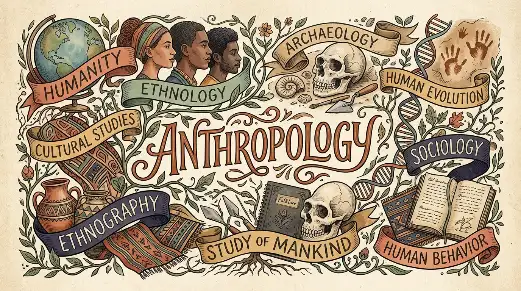

Synonyms for Anthropology mean the systematic study of human beings, their origins, cultures, societies, physical development, and social relationships. It has no widely accepted exact synonym, but useful descriptive alternatives include the study of humanity, the study of human societies, the study of human cultures, the study of human origins, and the study of human behavior.
Choose the study of humanity for a broad explanation, the study of human societies for social structures, and the study of human cultures for traditions, beliefs, and customs.
What Are the Best Synonyms for Anthropology?
- The study of humanity — broad study of human life
- The study of human societies — examination of social organization
- The study of human cultures — exploration of beliefs and traditions
- The study of human origins — research into human beginnings
- The study of human behavior — examination of human actions
- The study of human development — investigation of physical and cultural change
- The scientific study of humans — evidence-based research on humanity
Synonyms for Anthropology: Meaning and Context
| Synonym or alternative | Meaning | Best for |
| Study of humanity | Broad study of human life | General explanations |
| Study of human societies | Examination of social organization | Social structures |
| Study of human cultures | Research into beliefs and customs | Cultural topics |
| Study of human origins | Investigation of human beginnings | Evolution and ancestry |
| Study of human behavior | Examination of human actions | Behavior-focused writing |
| Study of human development | Research into human change | Physical and cultural development |
| Scientific study of humans | Evidence-based study of people | Academic definitions |
| Human sciences | Fields that examine human life | Broad academic categories |
| Sociology | Study of society and social relationships | Social institutions |
| Ethnology | Comparative study of peoples and cultures | Cultural comparison |
What Does Anthropology Mean?
Anthropology is a noun that names an academic discipline concerned with humans and human life. It examines how people developed, how societies work, and how cultures differ across places and periods.
The discipline can investigate language, family relationships, religion, migration, social institutions, material objects, and biological variation. Its scope depends on the branch being studied.
For example, a researcher might examine how a community celebrates a holiday, how ancient human remains reveal past lives, or how families respond to economic change.
Example: Anthropology helped the research team understand how local traditions shaped the community’s response to change.
Anthropology Word Card
- Part of speech: Noun
- US pronunciation (IPA): /ˌæn.θrəˈpɑː.lə.dʒi/
- UK pronunciation (IPA): /ˌæn.θrəˈpɒl.ə.dʒi/
- Plural form: Anthropologies, when referring to distinct systems or approaches
- Related noun: Anthropologist
- Adjective: Anthropological or anthropologic
- Adverb: Anthropologically
- Common spelling variant: No standard US/UK spelling difference
What Is the Difference Between Anthropology and Anthropological?
Anthropology is the name of the field of study. Anthropological is an adjective describing something connected with that field.
- Anthropology explores the relationships between culture and society.
- The researchers used anthropological methods to study community traditions.
Anthropologist means a person who studies anthropology. Anthropologically means from the perspective or methods of anthropology.
What Are the Closest Alternatives to Anthropology?
Because anthropology has no universal one-word replacement, the best alternative depends on the intended meaning.
1. Study of Humanity
Tier: Near-synonym
Meaning: A broad examination of human life and experience.
Tone: General, accessible, and explanatory.
Example: The course introduces students to the study of humanity across different historical periods.
Use this phrase when explaining anthropology to readers who may not know academic terminology. It communicates the broad subject without naming a different discipline.
2. Study of Human Societies
Tier: Near-synonym
Meaning: Examination of how people organize social life.
Tone: Academic and social-science focused.
Example: Her dissertation examines the study of human societies through family networks and community leadership.
This phrase suits discussions of institutions, relationships, social organization, and community practices. However, it may emphasize sociology more than anthropology if cultural or biological questions are absent.
3. Study of Human Cultures
Tier: Near-synonym
Meaning: Research into shared beliefs, practices, and traditions.
Tone: Cultural and descriptive.
Example: The museum’s new program focuses on the study of human cultures through clothing, tools, and oral histories.
Choose this expression when discussing cultural anthropology, traditions, rituals, and everyday practices. It does not fully cover anthropology’s biological or evolutionary branches.
4. Study of Human Origins
Tier: Near-synonym
Meaning: Investigation of humanity’s beginnings and development.
Tone: Scientific and historical.
Example: Fossils and archaeological evidence can support the study of human origins.
This phrase works when the subject concerns evolution, ancestry, early humans, or prehistoric societies. It is too narrow for anthropology research focused on modern communities or contemporary social life.
5. Study of Human Behavior
Tier: Near-synonym
Meaning: Examination of human actions and patterns.
Tone: Broad and analytical.
Example: The project explored the study of human behavior during periods of social change.
This alternative is useful when discussing actions, relationships, and social practices. Psychology, sociology, and other disciplines also study behavior, so the phrase alone does not identify anthropology.
6. Study of Human Development
Tier: Near-synonym
Meaning: Research into changes in human life.
Tone: Scientific and explanatory.
Example: The class considered the study of human development through biological evidence and cultural records.
Use this phrase for physical, historical, and cultural changes over time. Specify the type of development when precision matters because the expression can also refer to psychology, education, or public health.
7. Scientific Study of Humans
Tier: Near-synonym
Meaning: Systematic investigation of human life.
Tone: Formal and academic.
Example: Anthropology is a scientific study of humans that draws on several research methods.
This phrase provides a useful plain-English explanation in essays and introductory materials. It is a description rather than a recognized alternative name for the discipline.
Which Word Should You Use in Different Situations?
The strongest replacement depends on what your sentence needs to emphasize.
| Situation | Best alternative | Reason |
| A general definition | Study of humanity | Broad and easy to understand |
| Traditions and customs | Study of human cultures | Highlights cultural practices |
| Family and community structures | Study of human societies | Emphasizes social organization |
| Evolution and ancestry | Study of human origins | Focuses on beginnings |
| Actions and social patterns | Study of human behavior | Emphasizes human conduct |
| Changes across generations | Study of human development | Highlights change over time |
| A formal academic explanation | Scientific study of humans | Sounds precise and explanatory |
In a university application, research proposal, or scholarly essay, anthropology is usually the clearest term. Descriptive alternatives help explain the subject, but they should not replace the discipline’s name when technical precision matters.
What Are the Main Areas of Anthropology?
Anthropology covers several connected areas. These branches are more precise than general descriptive alternatives when a sentence concerns a specific research topic.
Cultural Anthropology
Cultural anthropology examines how people develop and share beliefs, customs, values, and practices. Researchers may study food, religion, family life, work, or community traditions.
Example: Cultural anthropology helped explain how local customs influenced the festival’s changing role.
Social Anthropology
Social anthropology focuses on relationships, institutions, and patterns of social life. It is particularly useful when discussing how communities organize responsibilities and relationships.
Example: Social anthropology provided a framework for examining kinship and leadership.
Biological Anthropology
Biological anthropology studies humans from a biological and evolutionary perspective. It can examine human variation, adaptation, evolution, and relationships with other primates.
Example: Biological anthropology helped researchers interpret evidence of human adaptation.
Archaeology
Archaeology studies past human life through material evidence, including buildings, tools, objects, and archaeological sites. It often overlaps with anthropology, but it has its own methods and research questions.
Example: Archaeology revealed evidence of how an ancient settlement changed over time.
Linguistic Anthropology
Linguistic anthropology investigates language in its cultural and social settings. It explores how people use language to communicate identity, maintain traditions, and establish relationships.
Example: Linguistic anthropology helped the team understand how language reflected community identity.
These fields are branches or neighboring areas of study, not synonyms for anthropology as a whole.
What Are the Top Five Collocations With Anthropology?
Collocations are word combinations that commonly appear together. They help writers produce natural, precise academic sentences.
| Collocation | Meaning | Example |
| Study anthropology | Learn about the discipline | She plans to study anthropology at university. |
| Anthropology research | Research within the field | The anthropology research examined migration patterns. |
| Anthropology professor | A professor specializing in the field | The anthropology professor discussed cultural change. |
| Anthropology department | An academic unit for the subject | The anthropology department organized a public lecture. |
| Anthropology fieldwork | Research conducted in real-world settings | Their anthropology fieldwork involved interviews and observation. |
Other established combinations include cultural anthropology, forensic anthropology, medical anthropology, and linguistic anthropology. These terms identify particular specializations rather than replacements for the general discipline.
What Is the Difference Between Anthropology and Similar Words?
Several academic terms overlap with anthropology but have distinct meanings.
Anthropology vs. Sociology
Anthropology studies humans, including their cultures, histories, biological development, and social relationships. Sociology focuses more specifically on society, social relationships, institutions, and group behavior.
Example: Anthropology examined the community’s traditions, while sociology analyzed its class structure.
Anthropology vs. Archaeology
Anthropology has a broad focus on human life. Archaeology investigates past societies mainly through material evidence, although its methods and scope vary by tradition.
Example: Anthropology framed the broader research question, while archaeology analyzed the pottery fragments.
Anthropology vs. Ethnology
Anthropology is the wider discipline. Ethnology generally compares peoples and cultures, examining similarities, differences, and cultural patterns.
Example: Anthropology guided the project, while ethnology helped compare customs across communities.
Anthropology vs. Psychology
Anthropology examines humans in cultural, social, historical, and biological contexts. Psychology focuses on mental processes and behavior, including cognition, emotion, and learning.
Example: Anthropology explored the community’s beliefs, while psychology examined individual responses to stress.
Anthropology vs. Humanism
Anthropology is an academic discipline based on systematic research. Humanism is a broad philosophical or ethical outlook that emphasizes human value, agency, or reason, depending on its form.
Example: Anthropology studied community practices, while humanism shaped the essay’s ethical argument.
These distinctions matter because replacing anthropology with a neighboring field can change the scope of a sentence.
What Are the Different Meanings and Spelling Variants of Anthropology?
Anthropology primarily refers to the systematic study of humans. Depending on context, the term may emphasize biological origins, cultural practices, social organization, or the philosophical study of human nature.
In some philosophical contexts, philosophical anthropology examines questions about human nature, human existence, and what distinguishes human beings. This is a specialized use, not a separate spelling of the word.
US and UK English both spell the word anthropology. The main difference is pronunciation, particularly the vowel sound in the stressed syllable.
The word family includes:
- Anthropologist: A person who studies anthropology.
- Anthropological: Relating to anthropology.
- Anthropologic: An alternative adjective form.
- Anthropologically: From an anthropological perspective.
These are related forms, not synonyms for the noun anthropology.
When Should You Not Replace Anthropology?
Avoid replacing anthropology in these situations:
- When naming a degree or department. Use the official subject name, such as anthropology degree, rather than humanity degree.
- When discussing a specialist branch. Use terms such as biological anthropology or linguistic anthropology when the specific area matters.
- When sociology is the actual subject. Do not use anthropology as a substitute if the research focuses specifically on social institutions or group behavior.
- When discussing archaeology alone. Use archaeology if the work concerns material evidence from past societies rather than the broader discipline.
- When writing a formal research paper. Define the discipline clearly instead of relying on vague expressions such as the study of people.
Descriptive alternatives improve readability, but accuracy should come first.
What Are the Antonyms of Anthropology?
Anthropology has no direct antonym because it names an academic discipline rather than a quality with an opposite. However, some contextual contrasts can help explain what the discipline is not.
| Contextual contrast | Type | Difference |
| Nonhuman-focused research | Contextual | Research centered on nonhuman subjects |
| Nonbiological analysis | Contextual | Analysis that excludes biological questions |
| Individual-level analysis | Contextual | Focus on individuals rather than broader cultural patterns |
| Noncultural explanation | Contextual | Explanation that does not emphasize culture |
| Inanimate-object study | Contextual | Study of objects without a primary human focus |
| Purely abstract speculation | Contextual | Reasoning without systematic empirical investigation |
These are contextual contrasts, not dictionary antonyms. Their relevance depends on the research question, and several can overlap with legitimate anthropological methods.
What Is the Origin of Anthropology?
The word anthropology combines the Greek-derived element anthropo-, meaning human or human being, with -logy, meaning a field of study or systematic inquiry. Its structure therefore reflects the discipline’s focus on studying humanity.
Anthropology Synonyms in English
The best alternatives to anthropology in English are descriptive phrases such as the study of humanity, the study of human cultures, the study of human societies, the study of human origins, and the scientific study of humans. Anthropology has no widely accepted exact synonym because it covers several connected areas of human life.
Choose the study of humanity for a general definition, the study of human cultures for traditions and beliefs, and the study of human societies for social relationships and institutions.
Anthropology Synonyms and Antonyms
Anthropology refers to the systematic study of human beings, their cultures, societies, origins, and development. It has descriptive synonyms but no direct antonym because it names an academic discipline rather than a quality with an opposite.
What Are Some Synonyms and Antonyms for Anthropology?
Useful synonyms and alternatives for anthropology include the study of humanity, the study of human cultures, the study of human societies, and the study of human origins. These phrases explain different aspects of the discipline rather than replacing its full meaning.
Anthropology has no exact antonym. However, contextual contrasts include nonhuman-focused research, noncultural analysis, and research that excludes human social life. These expressions describe different research focuses, not formal dictionary antonyms.
What Is an Anthropology Synonym and Antonym?
An anthropology synonym is a word or phrase that expresses a similar idea, such as the study of humanity. An anthropology antonym would express the opposite meaning, but no established direct antonym exists for this academic field.
For precise writing, use anthropology when naming the discipline. Use descriptive alternatives when explaining its focus, and avoid presenting related subjects such as sociology or archaeology as exact synonyms.
Words Similar to Anthropology
Words and phrases similar to anthropology include ethnology, ethnography, archaeology, sociology, and the study of humanity. These terms have different meanings and should be selected according to the subject being discussed.
Anthropology studies humans from cultural, social, biological, historical, and other perspectives. Ethnography focuses on describing people and their ways of life, while ethnology generally compares cultures. Archaeology investigates past human societies through material evidence, and sociology focuses on social relationships and institutions.
What Is Anthropology in Simple Words?
Anthropology is the study of human beings and how they live. It explores people’s cultures, traditions, relationships, origins, and development. Anthropologists may study ancient remains, family structures, languages, beliefs, or everyday activities to understand human life.
For example, an anthropologist might investigate how a community celebrates a festival or how traditions change between generations.
What Is Anthropology Also Known As?
Anthropology is often described as the study of humanity or the study of humans. Other explanatory phrases include the study of human cultures, human societies, and human origins.
These expressions describe aspects of anthropology rather than serving as official alternative names. In academic writing, anthropology remains the clearest term for the discipline.
Anthropology in a Sentence
Anthropology can be used in a sentence to describe the study of human life, cultures, societies, and origins.
Example: Anthropology helped the students understand how cultural traditions influence community relationships.
Anthropology Sentence Examples
Here are additional examples showing how anthropology works in different contexts:
- Education: She chose anthropology because she wanted to understand human cultures.
- Research: The team used anthropology to examine changes in community traditions.
- History: Anthropology can help researchers interpret evidence about past human societies.
- Culture: His anthropology project explored the meaning of traditional ceremonies.
- Career: Studying anthropology prepared her to investigate social and cultural questions.
Applied Anthropology Synonyms
Applied anthropology is the use of anthropological knowledge and methods to address practical problems in communities, organizations, and other real-world settings. It has no exact synonym, but descriptive alternatives include practical anthropology, applied anthropological research, and anthropology in practice.
The phrase practical anthropology can communicate the general idea, but it is not always interchangeable with the formal term applied anthropology. The best choice depends on whether the writing discusses a recognized field or simply explains how anthropological methods are used.
Example: Applied anthropology helped the organization understand local needs before introducing a community program.
Social Anthropology Synonyms
Social anthropology examines social relationships, institutions, and patterns of community life. Descriptive alternatives include the study of social relationships, the study of social organization, and the anthropological study of society.
These phrases explain the field’s focus but are not exact synonyms. Social anthropology is a recognized area of anthropology, while sociology is a related discipline with its own theories and research traditions.
Example: Social anthropology provided a framework for studying family relationships and community leadership.
Human Anthropology Synonyms
The phrase human anthropology is often redundant because anthropology already focuses on human beings. If you want a clearer alternative, consider the study of humanity, the study of human life, or the scientific study of humans.
For formal writing, anthropology is usually sufficient. If the intended meaning concerns a particular branch, use a more precise term such as biological anthropology, cultural anthropology, or social anthropology.
Example: The course introduced students to anthropology through studies of human culture and development.
Anthropologist Synonyms
An anthropologist is a person who studies human beings, their cultures, societies, origins, or development. There is no single exact replacement for the word, but descriptive alternatives include anthropology researcher, researcher of human cultures, and scholar of human societies.
The most appropriate phrase depends on the person’s actual role. Not every sociologist, archaeologist, historian, or cultural researcher is an anthropologist.
What Is a Synonym for Anthropologist?
A useful descriptive alternative for anthropologist is researcher of human cultures. Other options include anthropology researcher and scholar of human societies. These phrases describe related work, but they may not capture every branch of anthropology.
In academic or professional writing, use anthropologist when the person’s discipline is known. Choose a descriptive phrase when you need to explain the person’s work to a general audience.
Example: The anthropologist documented local traditions through interviews and field observations.
What Are Some Synonyms for Anthropologists?
Possible descriptive alternatives for anthropologists include anthropology researchers, researchers of human cultures, and scholars of human societies. These phrases are useful when explaining the work of specialists who study human life.
Related professionals may include ethnographers, archaeologists, and cultural researchers, but their roles differ. Use these titles only when they accurately describe the person’s training or research methods.
Example: The anthropologists compared community traditions to understand how cultural practices changed over time.
What Is a Synonym for Anthropological?
Anthropological means related to anthropology or the study of human beings. Possible alternatives include related to anthropology, concerning human cultures, and focused on human societies, depending on the sentence.
There is no single replacement that fits every use. For example, anthropological research could become research related to anthropology, while anthropological evidence might require a more specific phrase explaining the evidence’s cultural, social, or biological focus.
Example: The team used anthropological methods to investigate local customs.
Anthropology Antonyms
Anthropology has no established direct antonym because it names a field of study. Nevertheless, contextual contrasts can help explain what a particular anthropological investigation does not focus on.
| Contextual contrast | Meaning |
| Nonhuman-focused research | Research centered on nonhuman subjects |
| Noncultural analysis | Analysis that excludes cultural factors |
| Inanimate-object study | Research focused on objects rather than people |
| Nonbiological analysis | Analysis that does not examine biological processes |
| Purely abstract speculation | Reasoning without systematic empirical investigation |
| Individual-only analysis | An approach that excludes broader social patterns |
FAQs About Synonyms for Anthropology
What is another word for anthropology?
There is no universally accepted exact synonym for anthropology. Expressions such as the study of humanity, the study of human cultures, and the study of human societies can explain its meaning. Choose the phrase that matches your subject, and retain anthropology when naming the academic discipline.
Is sociology a synonym for anthropology?
Sociology is a related discipline, not a synonym for anthropology. Sociology focuses on society, institutions, and social relationships, while anthropology also examines culture, human origins, and biological development. The subjects overlap, but they ask different questions and use different approaches depending on the research area.
What is a simple definition of anthropology?
Anthropology is the study of human beings, including their cultures, societies, origins, and development. In simple terms, it helps explain how people live, how communities change, and how human groups differ. Its exact focus depends on the branch of anthropology being studied.
What is the difference between anthropology and ethnology?
Anthropology is the broader study of humans and human life. Ethnology generally compares peoples and cultures to identify similarities, differences, and patterns. Ethnology can form part of anthropological research, but the two terms are not interchangeable in every academic context.
What adjective comes from anthropology?
The most common adjective is anthropological, meaning related to anthropology. For example, anthropological research means research connected with the discipline. Anthropologic is another accepted adjective form, while anthropologist names a person who studies the field.
Conclusion: Synonyms for Anthropology
Anthropology has no widely accepted exact synonym, so descriptive alternatives are usually the safest choice. Use the study of humanity, the study of human societies, or the study of human cultures according to the intended meaning. In academic writing, keep anthropology when precision matters and use related terms only when their specific meanings fit.