
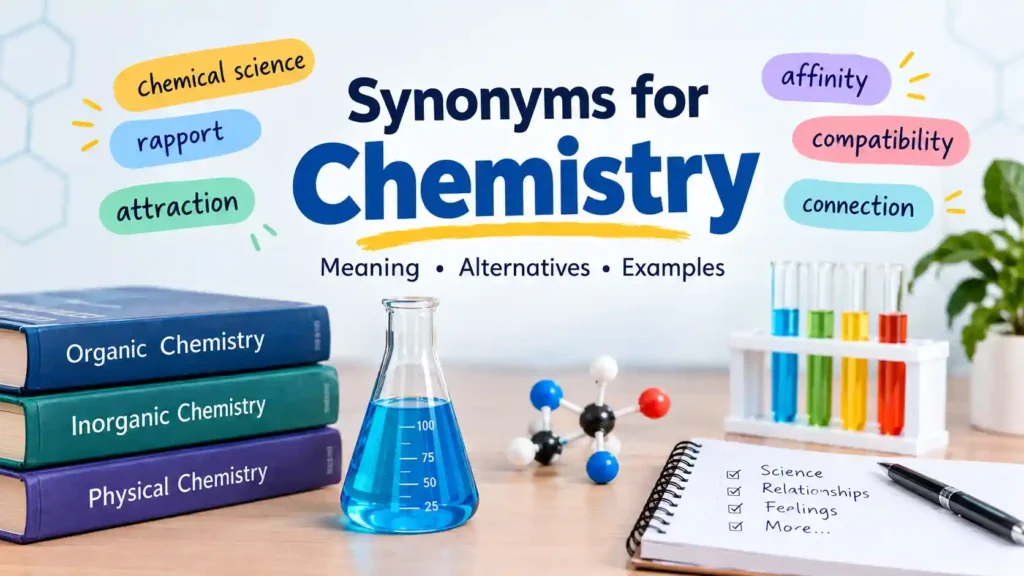

Synonyms for Chemistry mean the scientific study of substances and their properties and reactions, or the natural connection between people. The best alternatives depend on the context: rapport, affinity, attraction, interaction, and chemical composition are useful near-synonyms for particular meanings of chemistry.
Choose chemical composition when discussing what a substance contains, rapport when describing a comfortable relationship, and attraction when emphasizing romantic or personal interest.
- Rapport — mutual understanding and connection
- Affinity — a natural liking or bond
- Attraction — interest that draws people together
- Interaction — the way people or things affect one another
- Chemical composition — the substances and elements present
- Compatibility — the ability to work well together
- Chemical properties — characteristics affecting chemical behavior
These alternatives are not interchangeable in every sentence. Chemistry has scientific and figurative meanings, so the right word depends on what you want to express.
Synonyms for Chemistry: Comparison Table
| Synonym | Meaning (3–6 words) | Best for |
| Chemical composition | Substances and elements present | Scientific descriptions |
| Chemical properties | Characteristics of a substance | Laboratory and research writing |
| Rapport | Mutual understanding and connection | Relationships and teamwork |
| Affinity | Natural liking or attraction | Personal or intellectual connections |
| Attraction | Interest that draws people together | Romantic or interpersonal contexts |
| Interaction | Mutual influence between people or things | Relationships and scientific processes |
| Compatibility | Ability to work well together | Relationships and teams |
| Chemical science | Scientific study of substances | Educational explanations |
| Chemical reactions | Changes involving interacting substances | Scientific processes |
| Molecular structure | Arrangement of atoms within molecules | Chemistry education |
What Does Chemistry Mean?
Chemistry is a noun with several connected meanings. It refers primarily to a branch of science, but it can also describe the composition of a material or the connection between people.
What Is Chemistry in Science?
In science, chemistry studies substances, their properties, their composition, and how they react or combine. It helps explain processes such as rusting, combustion, digestion, and the formation of new materials.
Example: The students used chemistry to understand why the metal changed color during the experiment.
What Does Chemistry Mean in Relationships?
In relationships, chemistry describes a natural connection between people. It may involve attraction, easy conversation, shared understanding, or a sense that two people work well together.
Example: The new business partners had excellent chemistry and quickly developed a successful working relationship.
What Does Chemistry Mean When Describing a Substance?
Chemistry can also refer to the composition and behavior of a particular material or system. In this sense, the word often appears in scientific and technical writing.
Example: Researchers examined the chemistry of the soil before selecting crops for the field.
Word Card: Chemistry
| Feature | Details |
| Part of speech | Noun |
| US pronunciation | /ˈkem.ə.stri/ |
| UK pronunciation | /ˈkem.ɪ.stri/ |
| Plural form | Chemistries |
| Word family | Chemist, chemical, chemically, chemistry |
| Common usage | Scientific study, material properties, personal connection |
Chemistry is generally used as an uncountable noun when referring to the academic subject or a relationship dynamic. The plural chemistries can describe different chemical systems or distinct kinds of interpersonal dynamics.
What Are the Best Synonyms for Chemistry?
The most useful alternatives depend on whether chemistry refers to science, substances, or relationships.
1. Chemical Composition
Tier: Near-synonym
Chemical composition means the substances, elements, or compounds that make up a material. Use it when you need a precise scientific expression rather than the broader word chemistry.
Example: The laboratory report identified the chemical composition of the sample.
2. Chemical Properties
Tier: Near-synonym
Chemical properties describe how a substance behaves during chemical changes, including how it reacts with other materials. This term suits scientific explanations of substances.
Example: The researchers recorded the chemical properties of the new compound.
3. Rapport
Tier: Near-synonym
Rapport means a comfortable relationship based on mutual understanding, trust, or ease of communication. It is particularly useful when chemistry describes how people connect.
Example: The teacher established rapport with the class during the first week.
4. Affinity
Tier: Near-synonym
Affinity describes a natural liking, attraction, or connection. It can refer to people, ideas, interests, or certain scientific relationships.
Example: Their shared affinity for classical music helped them become friends.
5. Attraction
Tier: Near-synonym
Attraction describes the interest or appeal that draws people toward each other. It is appropriate when chemistry specifically refers to romantic or personal interest.
Example: The characters felt an immediate attraction when they first met.
6. Interaction
Tier: Near-synonym
Interaction describes the way two or more people, substances, or systems affect one another. It emphasizes what happens between them rather than the quality of their connection.
Example: The experiment demonstrated an interaction between the two compounds.
7. Compatibility
Tier: Near-synonym
Compatibility means that people, systems, or substances can exist or function together successfully. It is useful when chemistry suggests that individuals work well as a pair or team.
Example: Their compatibility made the long-term project easier to manage.
8. Chemical Science
Tier: Near-synonym
Chemical science is a descriptive expression for the scientific field concerned with substances and their behavior. In ordinary academic writing, chemistry is more concise and conventional.
Example: She chose chemistry because she enjoyed learning how materials change.
What Are Other Words Similar to Chemistry?
The following terms are useful in specific contexts, but they should not all be treated as direct synonyms.
| Word or phrase | Tier | Meaning | Example |
| Rapport | Near-synonym | Mutual understanding | The colleagues developed rapport. |
| Affinity | Near-synonym | Natural connection | They shared an affinity for art. |
| Attraction | Near-synonym | Personal or romantic interest | Their attraction was obvious. |
| Compatibility | Near-synonym | Ability to work together | Their compatibility improved teamwork. |
| Chemical composition | Near-synonym | Makeup of a material | The test revealed its chemical composition. |
| Chemical properties | Near-synonym | Behavior of a substance | The report listed its chemical properties. |
| Interaction | Near-synonym | Mutual influence | The interaction changed the outcome. |
| Molecular structure | Related word | Arrangement of atoms | The molecular structure explained the result. |
| Chemical reaction | Related word | Process that changes substances | The chemical reaction released heat. |
| Substance | Related word | A type of material | The substance dissolved in water. |
These terms expand vocabulary without suggesting that every word has the same meaning as chemistry.
What Are the Best Synonyms for Chemistry in Different Situations?
What Word Can Replace Chemistry in a Relationship?
Use rapport for mutual understanding, affinity for a natural connection, attraction for romantic interest, and compatibility for people who function well together.
For example, “The team has great chemistry” could become “The team works well together.” The best replacement depends on whether you mean trust, attraction, or cooperation.
What Word Can Replace Chemistry in Science?
Use chemical composition when describing what a substance contains, chemical properties when explaining how it behaves, and chemical reactions when discussing changes involving substances.
For example, “The chemistry of the sample was examined” might become “The chemical composition of the sample was examined” if composition is the intended meaning.
What Word Can Replace Chemistry in Academic Writing?
In academic writing, avoid replacing chemistry with a vague term such as science when you mean the specific discipline. Use chemistry for the field itself and more precise expressions for individual concepts.
For instance, write “The study examines chemical reactions” rather than “The study examines chemistry” when reactions are the actual focus.
What Are the Different Meanings of Chemistry?
Chemistry has several established meanings:
- Scientific discipline: The study of substances, their properties, and their reactions.
- Material composition: The chemical makeup and behavior of a particular substance.
- Interpersonal connection: A natural feeling of attraction or understanding between people.
- General makeup or dynamics: The combination of elements that shapes a group, system, or situation.
The word has no commonly accepted US-versus-UK spelling difference. The principal spelling is chemistry, and its plural form is chemistries.
What Is the Word Family of Chemistry?
- Chemist: A person who studies or works with chemistry.
- Chemical: An adjective relating to chemistry, or a noun for a substance used in or produced by a chemical process.
- Chemically: An adverb describing something in terms of chemistry or chemical processes.
- Chemistries: The plural form of chemistry, used for different chemical systems or kinds of interpersonal dynamics.
These related forms belong to the same word family but do not serve as direct synonyms.
What Are the Five Common Collocations With Chemistry?
Collocations are words that frequently appear together. These examples are useful for natural writing and search intent.
| Collocation | Meaning | Example |
| Study chemistry | Learn the scientific subject | She plans to study chemistry in college. |
| Chemistry experiment | A practical scientific test | The chemistry experiment tested the solution. |
| Chemistry laboratory | A place for chemistry work | The chemistry laboratory has new equipment. |
| Chemical reaction | A process involving chemical change | The chemical reaction produced a gas. |
| Chemistry between people | A natural interpersonal connection | The chemistry between the actors felt convincing. |
Using familiar collocations makes explanations clearer and helps readers understand the intended meaning.
What Words Are Commonly Confused With Chemistry?
Chemistry vs. Chemical
Chemistry is the scientific field or a type of connection between people. A chemical is a substance or something related to chemical processes.
Example: She studied chemistry and handled each chemical carefully.
Chemistry vs. Compatibility
Chemistry often describes a spontaneous connection or attraction. Compatibility focuses on whether people or things can function well together.
Example: They felt instant chemistry, but their different goals made long-term compatibility difficult.
Chemistry vs. Rapport
Chemistry can include attraction, excitement, and interpersonal energy. Rapport emphasizes mutual understanding and comfortable communication.
Example: The interviewer’s rapport with the candidate helped the conversation flow naturally.
When Should You Not Use Chemistry?
Avoid these common mistakes:
- Using chemistry as a synonym for every relationship quality. Chemistry does not necessarily mean trust, loyalty, or long-term compatibility.
- Replacing the science with a vague term. Use chemistry when referring to the specific academic discipline, not simply science.
- Using attraction when you mean teamwork. Attraction suggests appeal or interest, while teamwork describes cooperative effort.
- Using chemical composition to mean an entire scientific discipline. Composition refers to what a material contains, not the whole field.
- Assuming chemistry guarantees a successful relationship. Two people may feel a strong connection but still have conflicting values or goals.
What Are the Antonyms of Chemistry?
Chemistry does not have one universal antonym. The opposite depends on the intended meaning.
| Antonym or contrasting term | Context |
| Antipathy | Strong dislike between people |
| Aversion | A feeling of dislike or avoidance |
| Incompatibility | Inability to work well together |
| Discord | Conflict or lack of harmony |
| Estrangement | A state of emotional distance |
| Repulsion | A force or feeling that pushes away |
| Disconnection | Lack of connection or communication |
What Is the Origin of Chemistry?
The word chemistry developed from earlier forms such as chymistry and chimistry, and is connected to the word chemist. Its recorded history in English reaches back several centuries. The modern word refers to the scientific discipline as well as figurative connections between people.
What Are Other Names for Chemistry?
Other names for chemistry depend on whether the word refers to science or a connection between people. In science, terms such as chemical science describe the field. In relationships, words such as rapport, affinity, and attraction describe different aspects of chemistry between people.
The following alternatives fit different contexts:
- Chemical science: The scientific study of substances and their changes.
- Rapport: A comfortable connection based on mutual understanding.
- Affinity: A natural liking or connection.
- Attraction: Interest that draws people toward each other.
- Compatibility: The ability to work or function well together.
- Chemical composition: The substances and elements present in a material.
- Chemical properties: Characteristics that determine how a substance behaves.
For example, you could say, “The two colleagues have excellent rapport” instead of “The two colleagues have excellent chemistry” when you want to emphasize their comfortable communication.
What Are Chemistry Synonyms in English?
Chemistry synonyms in English vary according to context. There is no single exact synonym that replaces chemistry in every sentence.
For scientific writing, chemical science is a descriptive alternative. For interpersonal connections, rapport, affinity, attraction, and compatibility express related ideas.
Examples:
- Chemistry in science: She studies chemistry at university.
- Chemical science: She studies chemical science at university.
- Chemistry between people: The new coworkers have great chemistry.
- Rapport between people: The new coworkers developed excellent rapport.
Use the original word when referring to the academic discipline. Choose a more specific alternative when describing a particular relationship or scientific concept.
What Are 50 Words Related to Chemistry?
The following 50 words and phrases relate to chemistry. Some are scientific terms, while others describe the field’s branches, processes, materials, and applications. These are related vocabulary words, not 50 interchangeable synonyms.
| No. | Word | Meaning |
| 1 | Chemist | A person who studies or works in chemistry |
| 2 | Chemical | A substance or something relating to chemistry |
| 3 | Molecule | Two or more atoms bonded together |
| 4 | Atom | A basic unit of an element |
| 5 | Element | A pure substance defined by its atoms |
| 6 | Compound | A substance containing chemically combined elements |
| 7 | Mixture | Two or more substances physically combined |
| 8 | Reaction | A process that changes substances |
| 9 | Reagent | A substance used in a chemical test or reaction |
| 10 | Solvent | A substance that dissolves another substance |
| 11 | Solute | A substance dissolved in a solvent |
| 12 | Solution | A uniform mixture of substances |
| 13 | Acid | A substance with characteristic acidic behavior |
| 14 | Base | A substance with characteristic basic behavior |
| 15 | Salt | An ionic compound |
| 16 | Bond | An attraction holding atoms or ions together |
| 17 | Ion | An electrically charged atom or group |
| 18 | Electron | A negatively charged subatomic particle |
| 19 | Proton | A positively charged subatomic particle |
| 20 | Neutron | An electrically neutral subatomic particle |
| 21 | Isotope | A form of an element with a particular neutron count |
| 22 | Formula | A symbolic representation of a chemical substance |
| 23 | Equation | A symbolic representation of a chemical reaction |
| 24 | Catalyst | A substance that increases reaction rate |
| 25 | Oxidation | A process involving electron loss |
| 26 | Reduction | A process involving electron gain |
| 27 | Synthesis | The formation of a substance from simpler materials |
| 28 | Decomposition | The breakdown of a substance |
| 29 | Equilibrium | A state where opposing processes balance |
| 30 | Kinetics | The study of reaction rates |
| 31 | Thermodynamics | The study of energy and its transformations |
| 32 | Stoichiometry | Calculating quantities in chemical reactions |
| 33 | Titration | A method for determining concentration |
| 34 | Precipitate | A solid formed from a solution |
| 35 | Concentration | The amount of a substance in a mixture |
| 36 | Solubility | The ability of a substance to dissolve |
| 37 | Polarity | Unequal distribution of electrical charge |
| 38 | Valence | An atom’s combining capacity |
| 39 | Organic chemistry | The study of carbon compounds |
| 40 | Inorganic chemistry | The study of many non-organic compounds |
| 41 | Analytical chemistry | The identification and measurement of substances |
| 42 | Physical chemistry | The study of physical principles in chemical systems |
| 43 | Biochemistry | The chemistry of living systems |
| 44 | Environmental chemistry | The study of chemical processes in the environment |
| 45 | Green chemistry | Designing chemical products and processes to reduce harm |
| 46 | Polymer | A substance made of repeating molecular units |
| 47 | Crystal | A solid with an ordered structure |
| 48 | pH | A measure related to acidity and basicity |
| 49 | Spectroscopy | The study of interactions between matter and electromagnetic radiation |
| 50 | Chromatography | A technique for separating mixture components |
This vocabulary is useful for students, science writers, and readers learning chemistry terminology. If you need true synonyms rather than related words, narrow the list to alternatives for a specific meaning of chemistry.
What Is Another Word for Good Chemistry?
Another word for good chemistry depends on the relationship. Rapport describes easy communication, affinity suggests a natural connection, attraction emphasizes personal interest, and compatibility highlights how well two people fit together.
Here are useful alternatives:
- Strong rapport: A comfortable and trusting connection.
- Natural affinity: An effortless sense of connection.
- Mutual attraction: Interest shared by two people.
- Excellent compatibility: A good fit in values or behavior.
- Easy connection: A relationship that develops naturally.
- Mutual understanding: The ability to understand one another.
- Positive dynamic: A productive and pleasant interaction.
Examples:
- “The new coworkers have great chemistry” becomes “The new coworkers have strong rapport.”
- “There was good chemistry between the actors” becomes “There was a natural connection between the actors.”
- “The partners have good chemistry” becomes “The partners work together with excellent compatibility.”
Choose rapport for communication, attraction for romantic interest, and compatibility for long-term suitability.
What Is Another Word for Chemistry Love?
When chemistry refers to romantic love, useful alternatives include attraction, romantic connection, affinity, and romantic spark. Each expression describes a different part of a relationship.
- Attraction: Romantic or physical interest.
- Romantic connection: A bond involving romantic feelings.
- Romantic spark: An exciting initial sense of attraction.
- Affection: Warmth and fondness toward someone.
- Passion: Strong romantic or emotional intensity.
- Intimacy: Emotional closeness or personal familiarity.
For example, “They felt chemistry from their first meeting” could become “They felt an immediate romantic spark.”
However, chemistry and love are not identical. Chemistry can develop quickly, while love often involves deeper emotional commitment, trust, and shared experience.
What Are Synonyms for Chemistry Between People?
Synonyms for chemistry between people include rapport, affinity, attraction, connection, and compatibility. The best choice depends on whether the relationship involves friendship, romance, professional teamwork, or mutual understanding.
| Alternative | Best use | Example |
| Rapport | Comfortable communication | The interviewer built rapport with the candidate. |
| Affinity | Natural liking | They shared an affinity for creative work. |
| Attraction | Romantic or personal interest | Their attraction was clear to everyone. |
| Connection | A meaningful interpersonal bond | They formed a connection over shared interests. |
| Compatibility | A good fit | Their compatibility helped the partnership succeed. |
| Understanding | Mutual awareness of feelings or ideas | They developed a strong understanding of each other. |
| Synergy | Combined efforts produce a stronger result | The team’s synergy improved the final project. |
These terms overlap with chemistry but do not have exactly the same meaning. Use the word that describes the specific quality you want to communicate.
What Words Describe Chemistry With Someone?
Words that describe chemistry with someone include natural, effortless, magnetic, exciting, comfortable, intense, playful, and mutual. Choose adjectives that reflect the kind of connection rather than relying on the word chemistry alone.
Examples of descriptive phrases include:
- Natural connection: The relationship develops without forced conversation.
- Magnetic attraction: The people feel strongly drawn to each other.
- Effortless rapport: Conversation feels easy and comfortable.
- Intellectual connection: The people enjoy exchanging ideas.
- Emotional connection: The people feel understood and supported.
- Playful chemistry: Humor and teasing create an enjoyable dynamic.
- Intense attraction: The connection feels powerful or exciting.
- Mutual understanding: Both people understand each other’s perspectives.
Example sentence: “Their effortless rapport and playful connection made the group conversation enjoyable.”
In professional writing, collaborative, harmonious, and productive may describe positive chemistry within a team more precisely.
What Are Synonyms for “Have Chemistry”?
The phrase have chemistry means to share a natural connection, attraction, or easy interpersonal dynamic. Alternatives include connect naturally, share a spark, get along well, have rapport, and feel an affinity.
Examples:
- “The actors have chemistry” becomes “The actors share a natural connection.”
- “The couple has chemistry” becomes “The couple feels a strong mutual attraction.”
- “The teammates have chemistry” becomes “The teammates work together effortlessly.”
- “We have chemistry” becomes “We connect naturally.”
- “The presenters have chemistry” becomes “The presenters have excellent rapport.”
For romantic contexts, share a spark or feel mutual attraction works well. For workplace relationships, work well together or have rapport sounds more precise.
What Is Another Word for Chemistry in Science?
In science, chemistry is the branch of science concerned with substances, their composition, structure, properties, and reactions. There is no exact synonym that covers the whole discipline in every context. Chemical science is a descriptive alternative, while terms such as chemical analysis refer to narrower activities.
Related scientific terms include:
- Chemical science: A descriptive name for the discipline.
- Chemical analysis: Identifying or measuring substances.
- Chemical composition: The elements and compounds in a material.
- Chemical properties: Characteristics that influence a substance’s behavior.
- Chemical reactions: Processes in which substances change.
- Molecular science: A broader expression concerning molecules and their behavior.
Example: “The students studied chemistry” can be rewritten as “The students studied chemical science,” although chemistry remains the more common and concise academic term.
Avoid using chemical reaction or chemical composition as direct replacements for the entire field. These expressions refer to specific concepts within chemistry.
What Are Synonyms for Organic Chemistry?
Organic chemistry is the branch of chemistry that primarily studies carbon-containing compounds, including their structures, properties, reactions, and preparation. It does not have a universally accepted exact synonym.
Useful related expressions include:
- Organic compound chemistry: A descriptive phrase for the chemistry of organic compounds.
- Carbon-compound chemistry: An explanatory phrase emphasizing carbon-containing substances.
- Organic synthesis: The preparation of organic compounds.
- Organic reaction chemistry: The study of reactions involving organic compounds.
- Organometallic chemistry: A related field studying compounds with bonds between carbon and metals.
These terms are not interchangeable. For example, organic synthesis is a subfield or activity within organic chemistry, not a synonym for the entire discipline.
Example: “Her research focuses on organic chemistry” could become “Her research focuses on the reactions and structures of carbon-containing compounds” when a more explanatory phrase is useful.
What Are Green Chemistry Synonyms?
Green chemistry refers to designing chemical products and processes that reduce or eliminate hazardous substances and minimize waste. It is also called sustainable chemistry in many contexts, although the terms may have different scopes depending on the organization or application.
Related terms include:
- Sustainable chemistry: Chemistry designed with environmental and resource impacts in mind.
- Environmentally responsible chemistry: An explanatory phrase emphasizing reduced environmental harm.
- Pollution prevention in chemistry: Approaches that reduce pollution at its source.
- Safer chemical design: Designing substances and processes to reduce hazards.
- Waste-minimizing chemistry: Chemical processes designed to produce less waste.
Example: “The company adopted green chemistry principles” could become “The company adopted sustainable chemistry practices.”
Use green chemistry when referring to the established field and its principles. Avoid assuming that every environmentally focused chemical process automatically meets the criteria of green chemistry.
What Are Synonyms for Chemist?
A chemist is a person who studies chemistry or works in a field that applies chemical knowledge. There is no single synonym suitable for every chemist because job titles depend on training, responsibilities, and specialization.
Possible alternatives include:
- Chemical scientist: A broad description of a scientist working in chemistry.
- Research chemist: A chemist who conducts scientific investigations.
- Analytical chemist: A specialist who identifies and measures substances.
- Organic chemist: A specialist in organic compounds.
- Laboratory scientist: A scientist who works in a laboratory; not necessarily a chemist.
- Chemical researcher: A person who researches chemical substances or processes.
- Chemistry specialist: A general description of someone with chemistry expertise.
Example: “The chemist analyzed the sample” could become “The analytical chemist analyzed the sample” when the person’s specialization is known.
Do not use chemical engineer as a universal synonym for chemist. Chemical engineers generally focus on designing and operating processes that produce or transform materials at scale, while chemists often focus on composition, properties, and reactions.
What Is Another Word for a Chemical?
The noun chemical refers to a substance with a defined chemical composition. Depending on the context, alternatives include substance, compound, reagent, chemical agent, and material. These words have different meanings and are not always interchangeable.
- Substance: A particular kind of matter.
- Compound: A substance made from chemically combined elements.
- Reagent: A substance used in a chemical reaction or test.
- Chemical agent: A substance that produces a particular effect.
- Material: Matter used or considered for a particular purpose.
- Ingredient: A component used to make a mixture or product.
Example: “The chemical was added to the solution” could become “The reagent was added to the solution” if the substance was specifically being used in a chemical test or reaction.
Use substance for a broad alternative. Use compound only when the material is a chemical compound, and reagent when its experimental role is relevant.
What Is the Symbol for Chemistry?
Chemistry does not have one universal chemical symbol. Instead, chemists use symbols for elements, formulas for compounds, and notation for reactions and laboratory measurements.
Common examples include:
- H: The chemical symbol for hydrogen.
- O: The chemical symbol for oxygen.
- Na: The chemical symbol for sodium.
- H₂O: The chemical formula for water.
- CO₂: The chemical formula for carbon dioxide.
- →: A symbol commonly used to show the direction of a chemical reaction.
A chemical symbol identifies an element, while a chemical formula represents the composition of a substance. For example, H₂O shows that a water molecule contains hydrogen and oxygen atoms.
If you are asking about a symbol for the school subject or discipline of chemistry, there is no single standardized symbol used universally. Laboratory glassware, molecular diagrams, and atom illustrations are common visual representations, but they are not official universal symbols for chemistry.
What Is Another Word for Brain Chemistry?
Brain chemistry is an informal expression for chemical processes in the brain, including the activity of neurotransmitters, hormones, and other signaling molecules. Depending on the context, alternatives include brain neurochemistry, neurochemical activity, and neurotransmitter signaling.
Useful related expressions include:
- Neurochemistry: The study of chemical processes in the nervous system.
- Neurochemical activity: Chemical activity involving the nervous system.
- Neurotransmitter signaling: Communication involving chemical messengers between nerve cells.
- Neurochemical balance: A common descriptive phrase for the regulation of chemical signaling, though it can be vague without context.
- Brain chemical signaling: A plain-English description of chemical communication in the brain.
Example: “Researchers investigated brain chemistry during sleep” could become “Researchers investigated neurochemical activity during sleep.”
These expressions have different levels of specificity. Neurochemistry names a scientific field, while neurotransmitter signaling refers to a particular process. Avoid using brain chemistry as a complete explanation for a person’s mood or behavior without considering the wider biological and environmental context.
What Are Five Synonym Words for Chemistry?
Five useful alternatives for chemistry are chemical science, rapport, affinity, attraction, and compatibility. However, these terms apply to different meanings of the word rather than serving as exact synonyms in every situation.
| Word | Meaning | Best context |
| Chemical science | The scientific study of substances | Academic science |
| Rapport | Comfortable mutual understanding | Communication and teamwork |
| Affinity | A natural connection or liking | Personal relationships |
| Attraction | Interest that draws people together | Romance and interpersonal relationships |
| Compatibility | The ability to function well together | Relationships and collaboration |
Frequently Asked Questions About Synonyms for Chemistry
What Are the Best Synonyms for Chemistry?
The best synonyms for chemistry depend on the meaning. Chemical composition and chemical properties suit scientific contexts, while rapport, affinity, and attraction work for interpersonal connections. None is a perfect replacement in every sentence, so choose the term that preserves the original meaning.
What Is Another Word for Chemistry Between Two People?
Rapport, affinity, attraction, and compatibility can describe aspects of chemistry between people. Rapport emphasizes mutual understanding, affinity suggests a natural connection, attraction highlights personal interest, and compatibility describes how well two people function together.
What Is a Synonym for Chemistry in Science?
There is no exact universal synonym for chemistry as a scientific discipline. Chemical science is a descriptive alternative, while chemical composition, chemical properties, and chemical reactions refer to specific aspects of the field. Choose the most precise expression for the scientific concept you are describing.
Is Affinity the Same as Chemistry?
Affinity and chemistry overlap, but they are not identical. Affinity usually describes a natural liking, similarity, or connection. Chemistry can describe a broader interpersonal dynamic, including attraction and ease of interaction. In science, chemistry also refers to a discipline that affinity cannot replace.
What Is the Opposite of Chemistry Between People?
There is no single exact opposite of interpersonal chemistry. Antipathy, aversion, discord, and incompatibility can express different forms of dislike, conflict, or poor fit. Choose antipathy for strong dislike, discord for conflict, and incompatibility for people who do not work well together.
Can Chemistry Mean Attraction?
Yes. Chemistry can describe the noticeable attraction or connection between people, especially in romantic contexts. However, chemistry can also involve humor, communication, intellectual connection, or teamwork. If you mean romantic interest specifically, attraction is often the more precise word.
Final Words: Synonyms for Chemistry
The best synonyms for chemistry depend on whether you mean scientific study, material composition, or an interpersonal connection. Use precise terms such as chemical composition in scientific writing and rapport, affinity, or attraction when describing relationships. Choosing a context-appropriate alternative keeps your writing clear, accurate, and natural.