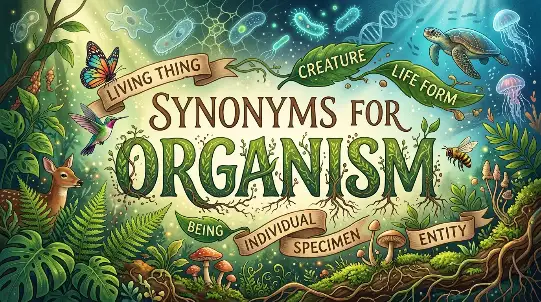

Organism means a living thing, such as a plant, animal, fungus, or microorganism. Common synonyms for organism include living thing, creature, being, and life form. Other terms, such as biological entity and living entity, work well in scientific or formal writing. The best word depends on the context and the type of organism you want to describe.
The word organism usually refers to an individual living thing. However, it can also describe an organized system or body, such as an institution or organization. Not every related biological word is a true synonym, so choosing the right term matters.
What Are the Best Synonyms for Organism?
The best everyday synonyms for organism are living thing, creature, being, life form, and living entity.
- Living thing: The clearest choice for general writing.
- Creature: A natural choice when referring to an animal or living being.
- Being: A broad term for a living individual.
- Life form: Useful in science, biology, and discussions about life.
- Living entity: A formal alternative for scientific or technical contexts.
These words have similar meanings, but they are not always interchangeable. For example, creature often suggests an animal, while living thing can describe an animal, plant, fungus, or microorganism.
30 Most Useful Synonyms and Related Terms for Organism
The following list distinguishes direct synonyms and near-synonyms from related scientific terms. This distinction helps you choose words that fit your sentence accurately.
| No. | Word or phrase | Classification | Meaning or best use |
| 1 | Living thing | Close synonym | Any individual form of life |
| 2 | Creature | Near-synonym | A living being, often an animal |
| 3 | Being | Near-synonym | An individual that is alive |
| 4 | Life form | Near-synonym | A form or type of life |
| 5 | Living entity | Near-synonym | A distinct living individual |
| 6 | Biological entity | Near-synonym | An entity recognized in biology |
| 7 | Individual | Contextual near-synonym | One organism considered separately |
| 8 | Body | Informal, context-dependent | A living individual or physical body |
| 9 | Thing | Informal, broad alternative | A general term for an object or being |
| 10 | Organic being | Descriptive alternative | A living being made of organic matter |
| 11 | Physiological unit | Related technical term | A unit considered by its functions |
| 12 | Organic structure | Related biological term | A structure associated with living systems |
| 13 | Animal | Specific type | A member of the animal kingdom |
| 14 | Plant | Specific type | A member of the plant kingdom |
| 15 | Microorganism | Specific type | An organism usually too small to see unaided |
| 16 | Microbe | Common term for a specific type | A microscopic organism or biological agent |
| 17 | Bacterium | Specific type | A single bacterial cell |
| 18 | Fungus | Specific type | An organism such as yeast or a mushroom |
| 19 | Human being | Specific type | A member of the human species |
| 20 | Cell | Related biological term | The basic structural unit of life |
| 21 | Species | Related classification term | A group of organisms with shared characteristics |
| 22 | Specimen | Related scientific term | An individual collected for study |
| 23 | Unicellular organism | Specific type | An organism made of one cell |
| 24 | Multicellular organism | Specific type | An organism made of many cells |
| 25 | Aquatic organism | Specific type | An organism that lives in water |
| 26 | Model organism | Scientific category | An organism used in research |
| 27 | Autotrophic organism | Functional category | An organism that produces its own food |
| 28 | Genetically modified organism | Scientific category | An organism altered through genetic engineering |
| 29 | Organized body | Figurative alternative | A structured group or organization |
| 30 | Network | Figurative, context-dependent | An interconnected system or structure |
Important: The first several entries are the most useful alternatives in ordinary writing. The remaining entries include related terms and specific biological categories. For example, bacterium is not a synonym for every organism; it names one particular kind of organism.
The Top 10 Synonyms for Organism Explained
1. Living Thing
Meaning: Anything that is alive.
Living thing is usually the best plain-English replacement for organism. It is easy to understand and covers animals, plants, fungi, and microorganisms.
Example: Every living thing needs suitable conditions to survive.
Best for: School assignments, general explanations, and beginner-friendly science writing.
2. Creature
Meaning: A living being, often an animal.
Creature is a natural alternative when you want a more conversational or descriptive tone. Readers often associate it with animals, although the word can have broader uses.
Example: The forest provides shelter for many small creatures.
Best for: Nature writing, storytelling, and informal explanations.
3. Being
Meaning: An individual that exists or lives.
Being can replace organism when the sentence focuses on a living individual rather than its biological structure.
Example: Scientists study how each living being responds to its environment.
Best for: General writing, philosophical discussions, and broad descriptions of life.
4. Life Form
Meaning: A form or type of life.
Life form works well when discussing different kinds of life, including unfamiliar or microscopic organisms. It is common in scientific explanations and discussions about possible extraterrestrial life.
Example: Researchers discovered a life form adapted to extreme temperatures.
Best for: Biology, astrobiology, science communication, and discussions of biodiversity.
5. Living Entity
Meaning: A distinct entity that is alive.
Living entity has a formal tone. It can describe an organism when a writer wants to emphasize its existence as a distinct living unit.
Example: The study examined how a living entity interacts with its surroundings.
Best for: Technical writing, research explanations, and formal descriptions.
6. Biological Entity
Meaning: An entity identified in a biological context.
Biological entity is useful in scientific writing, but its scope can depend on the context. It may refer to an organism or another biological unit, so it does not always mean a complete individual organism.
Example: The database records information about each biological entity included in the study.
Best for: Biology databases, scientific documentation, and technical writing.
7. Individual
Meaning: One separate member of a group.
Individual can replace organism when the biological context makes the meaning clear. However, the word can also refer to a person or a single item that is not alive.
Example: Researchers monitored each individual throughout the experiment.
Best for: Research reports, population studies, and scientific observations.
8. Body
Meaning: A physical structure or an individual living body.
Body is a context-dependent alternative. It may refer to an animal’s or person’s physical structure, but it does not always mean a complete organism.
Example: The organism’s body showed several adaptations to cold conditions.
Best for: Anatomy, physiology, and informal descriptions of physical structure.
9. Thing
Meaning: A general word for an object or entity.
Thing is informal and broad. It can replace organism in simple explanations when the living context is obvious, but it lacks scientific precision.
Example: A tiny living thing can play an important role in an ecosystem.
Best for: Everyday conversation and explanations for young learners.
10. Physiological Unit
Meaning: A unit considered in terms of biological function.
Physiological unit is a technical phrase, not a general synonym for organism. Scientists may use it to describe a functional unit in a biological system, and the intended meaning depends on the subject.
Example: The researcher examined how the functional unit responded to changes in temperature.
Best for: Specialized scientific contexts where the functional meaning is clear.
Synonyms for Organism in Different Contexts
The right alternative depends on what you are describing and who will read your writing.
| Context | Recommended word | Example |
| Simple English | Living thing | A living thing needs energy to survive. |
| Animal description | Creature | The creature moved into its shelter. |
| General discussion of life | Being | Every being interacts with its surroundings in some way. |
| Scientific explanation | Life form | The lake supports many life forms. |
| Formal biological writing | Biological entity | Each biological entity was recorded in the database. |
| Population research | Individual | Each individual was observed separately. |
| Microbiology | Microorganism | The microorganism grew under controlled conditions. |
| Bacterial research | Bacterium | The bacterium was examined under a microscope. |
| Plant biology | Plant | The plant adapted to limited sunlight. |
| Figurative organizational meaning | Organization | The institution operates as a complex organization. |
Synonyms for a Human Organism
When referring specifically to a human organism, suitable alternatives include human being, person, individual, and living being. The best choice depends on the sentence.
- Human being: A broad term for a member of the human species.
- Person: A common word for an individual human.
- Individual: A formal term used in research or general writing.
- Living being: A broad expression that can include humans and other forms of life.
Example: The study followed each human participant over several months.
In a medical or biological context, human organism may be more precise than person. These terms overlap, but they do not carry exactly the same meaning in every context.
Synonyms for a Living Organism
Use living thing for a simple explanation, life form for a discussion of different kinds of life, or biological entity in a formal scientific context.
Example: Scientists documented each living organism found in the sample.
Avoid replacing living organism with cell unless you mean a cell specifically. A cell is a basic unit of life, but many organisms contain numerous cells.
Synonyms for a Unit of an Organism
The best term depends on what the phrase unit of an organism means in your sentence.
- Cell: The basic structural and functional unit of life.
- Individual: One complete organism considered separately.
- Physiological unit: A unit considered for its biological functions.
- Biological unit: A broad technical expression whose meaning depends on context.
Example: The cell is the basic structural unit of a multicellular organism.
A cell is not generally a synonym for an entire organism. Some organisms consist of one cell, while others contain many cells that work together.
Organism: Meaning, Word Forms, and Pronunciation
Definition: An organism is an individual living thing that carries out the processes associated with life.
US pronunciation: /ˈɔːrɡəˌnɪzəm/
Part of speech: Noun
Plural: Organisms
Related word: Organismic (an adjective used in specialized contexts)
Example sentences:
- A single-celled organism can survive without the complex organs found in animals.
- Each organism responds to its environment in different ways.
- The scientists studied the organisms living in the pond.
The word organism usually refers to a complete living individual, although scientific usage can vary with the field and context.
Words Often Confused With Organism
Some biological terms relate closely to organism, but they do not mean the same thing.
| Word | Meaning | Difference from organism |
| Animal | A member of the animal kingdom | An animal is one type of organism. |
| Microorganism | An organism usually too small to see unaided | It refers to a particular size-related group of organisms. |
| Cell | A basic structural unit of life | A cell may form an entire organism or be part of one. |
| Species | A biological classification group | A species includes organisms rather than naming one individual. |
| Specimen | A sample or individual collected for study | A specimen is defined by its role in observation or research. |
| Entity | Something that exists as a distinct unit | An entity may be living or nonliving. |
Knowing these differences helps you avoid inaccurate substitutions in schoolwork, articles, and scientific reports.
When Not to Use a Synonym for Organism
Although several words overlap with organism, they are not interchangeable in every sentence.
- Do not use animal for every organism. Plants, fungi, and bacteria are also organisms.
- Do not use cell when you mean a complete multicellular organism. A cell is usually only one part of that organism.
- Do not use species to mean one individual. A species is a classification group.
- Avoid thing in formal scientific writing. It is too broad to communicate a precise biological meaning.
- Use creature carefully in technical writing. The word often suggests an animal and may sound informal.
- Use biological entity only when its scope is clear. The phrase may refer to biological units other than complete organisms.
- Do not use network as a biological synonym without context. It may describe interconnected relationships or a figurative organizational structure, not a living individual.
For most general sentences, living thing is the safest alternative. For technical writing, keep organism when it expresses the biological meaning more precisely.
Antonyms and Contrasting Terms for Organism
The word organism has no single direct antonym that works in every context. However, several terms contrast with it.
| Contrasting term | Meaning | How it contrasts |
| Nonliving thing | Something that is not alive | Direct conceptual contrast |
| Inanimate object | An object without life | Contrasts with a living individual |
| Nonliving matter | Matter that is not alive | Contrasts with living systems |
| Abiotic factor | A nonliving part of an environment | Contrasts with the biotic, or living, component |
| Dead organism | An organism that has died | Describes a formerly living organism |
| Lifeless body | A body without signs of life | Contrasts with a living body |
| Artificial object | An object made by humans or machines | Often contrasts with a natural living organism |
These are contextual contrasts, not perfect antonyms. For example, dead organism still refers to something that was once alive, while nonliving thing can describe something that was never alive.
Frequently Asked Questions About Synonyms for Organism
1. What is the synonym of the word organism?
The closest everyday synonym for organism is living thing. Other useful alternatives include creature, being, and life form. In scientific writing, living entity or biological entity may also fit. Choose the term that matches your intended meaning, because some alternatives are broader or more informal than organism.
2. What are five good synonyms for organism?
Five useful alternatives are living thing, creature, being, life form, and living entity. Living thing is the clearest general choice, while creature often suggests an animal. Being is broad, life form suits scientific discussions, and living entity works in more formal contexts.
3. What is another term for a human organism?
Common alternatives include human being, person, individual, and living being. In everyday writing, person is usually the most natural choice. In biological or medical writing, human organism may be more precise when the sentence focuses on the body’s biological functions rather than a person’s social identity.
4. What is another word for a living organism?
Living thing is the simplest alternative to living organism. You can also use life form or living being, depending on the sentence. In scientific writing, keep organism when precision matters, especially when distinguishing a complete living individual from a cell, tissue, species, or biological sample.
5. What does organism mean in simple words?
An organism is any individual living thing. Examples include a person, dog, tree, mushroom, or bacterium. Organisms differ in size and structure, but they carry out life processes. Some consist of a single cell, while others contain many cells that perform different functions.
6. What are some synonyms for “unit of organism”?
Possible terms include cell, individual, biological unit, and physiological unit, but they mean different things. A cell is the basic structural unit of life. An individual may refer to one complete organism, while the other phrases depend on the scientific context. Use the term that matches the specific unit you mean.
Conclusion
The best synonyms for organism include living thing, creature, being, and life form, but each word suits a different context. Use living thing for clear, everyday writing and choose more precise biological terms when discussing cells, species, or specific groups of organisms. When accuracy matters, keep the organism rather than replacing it with a related word that changes the meaning.