
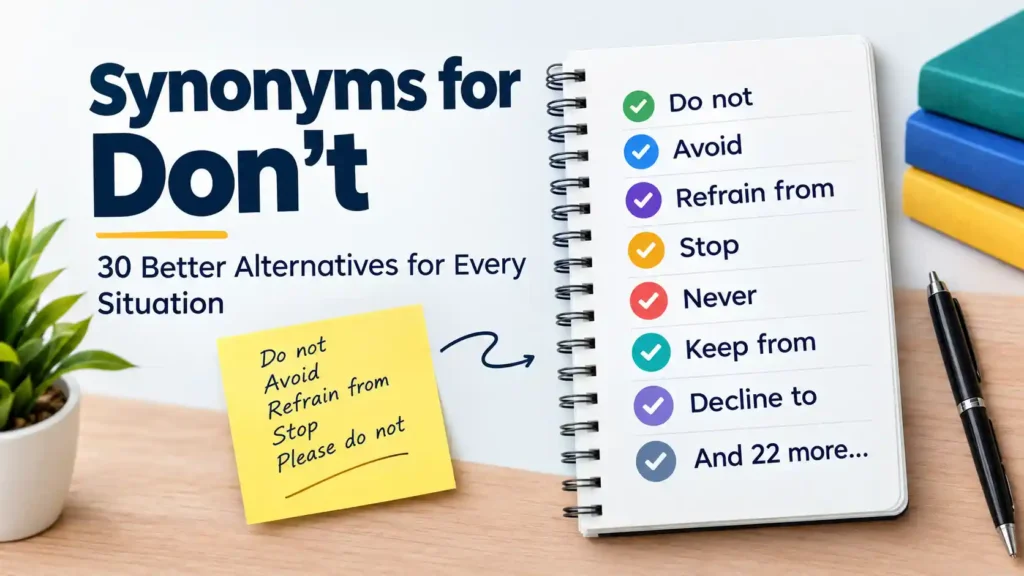

Synonym for Don’t means “do not.” It is a contraction used to express negation, refusal, or a negative instruction. The closest equivalent is do not. Other useful alternatives include avoid, refrain from, stop, and please do not, depending on the sentence and intended tone.
Choose do not for formal writing, avoid to discourage an action, and refrain from for polite or professional instructions.
- Do not — express a direct negative.
- Avoid — stay away from an action.
- Refrain from — deliberately hold back.
- Stop — end an ongoing action.
- Please do not — make a polite request.
- Never — prohibit an action at all times.
- Keep from — prevent an action from happening.
Powerful Don’t Synonym Table
| Synonym | Meaning (3–6 words) | Best for |
| Do not | The full, uncontracted form | Formal writing |
| Avoid | Stay away from an action | Advice and prevention |
| Refrain from | Deliberately choose not to act | Professional instructions |
| Stop | Bring an action to an end | Ongoing behavior |
| Please do not | Make a polite negative request | Emails and requests |
| Never | At no time or under any circumstances | Strong prohibitions |
| Keep from | Prevent yourself from acting | Self-control |
| Resist | Refuse to give in | Temptation |
| Decline to | Choose not to do something | Formal refusal |
| Refuse to | Firmly reject an action | Strong refusal |
| Abstain from | Deliberately avoid participating | Formal contexts |
| Omit | Leave something out | Instructions and editing |
| Skip | Choose not to do something | Casual situations |
| Forgo | Decide to go without something | Formal writing |
| Discontinue | Stop an existing activity | Business and processes |
| Cease | Bring an action to an end | Formal instructions |
| Desist from | Stop doing something | Formal warnings |
| Refrain | Hold back from acting | Formal requests |
| Shun | Deliberately avoid someone or something | Social contexts |
| Steer clear of | Avoid a person or situation | Conversational advice |
| Stay away from | Keep a safe distance | Warnings |
| Hold back from | Stop yourself from acting | Self-restraint |
| Resist the urge to | Fight the desire to act | Advice |
| Do without | Manage without having something | Needs and resources |
| Lack | Not having something available | Describing absence |
| Fail to | Not complete an expected action | Responsibilities |
| Choose not to | Make a deliberate negative choice | Neutral explanations |
| Decide against | Choose not to proceed | Decisions |
| Decline | Politely say no to something | Invitations and offers |
| Withhold | Keep something from being given | Information or permission |
Word Card: What Does Don’t Mean?
- Part of speech: Contraction of the auxiliary verb do and the adverb not.
- US pronunciation: /doʊnt/
- UK pronunciation: /dəʊnt/
- Full form: Do not
- Related forms: Do, does, did, don’t, doesn’t, didn’t
- Common spelling: Don’t
- Informal spelling: Dont (nonstandard without the apostrophe)
30 Alternatives to Don’t: Meanings, Tone, and Examples
The following alternatives are grouped by how people use them. Replace don’t only when the new wording preserves the original meaning.
1. Do Not — Exact Equivalent
Meaning: The full form of don’t.
Example: Do not open the door until the meeting ends.
2. Avoid — Near-Synonym
Meaning: Stay away from an action or situation.
Example: Avoid checking your phone during the presentation.
3. Refrain From — Near-Synonym
Meaning: Deliberately hold back from an action.
Example: Please refrain from using your phone during the examination.
4. Stop — Near-Synonym
Meaning: Bring an action to an end.
Example: Stop interrupting your classmates.
5. Please Do Not — Near-Synonym
Meaning: Make a courteous negative request.
Example: Please do not share this document without permission.
6. Never — Near-Synonym
Meaning: At no time.
Example: Never share your password with strangers.
7. Keep From — Near-Synonym
Meaning: Prevent yourself from doing something.
Example: Keep yourself from reacting before you understand the situation.
8. Resist — Near-Synonym
Meaning: Fight an urge or pressure.
Example: Resist the urge to reply while you are angry.
9. Decline To — Near-Synonym
Meaning: Choose not to perform an action.
Example: She declined to comment on the proposal.
10. Refuse To — Near-Synonym
Meaning: Firmly decide not to act.
Example: He refused to sign the incomplete agreement.
11. Abstain From — Near-Synonym
Meaning: Deliberately avoid an activity.
Example: Members agreed to abstain from voting on the issue.
12. Omit — Near-Synonym
Meaning: Leave something out.
Example: Do not include personal details; omit them from the report.
13. Skip — Near-Synonym
Meaning: Choose not to do something.
Example: Skip the introduction if the audience already knows the topic.
14. Forgo — Near-Synonym
Meaning: Decide to go without something.
Example: We decided to forgo the extra meeting.
15. Discontinue — Near-Synonym
Meaning: Stop an activity or process.
Example: Discontinue the service if the customer requests cancellation.
16. Cease — Near-Synonym
Meaning: Stop an action or activity.
Example: The company must cease operations during the inspection.
17. Desist From — Near-Synonym
Meaning: Stop doing something, often after a warning.
Example: The notice asked the company to desist from making misleading claims.
18. Refrain — Near-Synonym
Meaning: Hold back from an action.
Example: Refrain from making comments until everyone has spoken.
19. Shun — Near-Synonym
Meaning: Deliberately avoid a person or thing.
Example: She chose to shun online arguments.
20. Steer Clear Of — Near-Synonym
Meaning: Keep away from a risky situation.
Example: Steer clear of unverified links in suspicious emails.
21. Stay Away From — Near-Synonym
Meaning: Keep a distance from someone or something.
Example: Stay away from the construction area.
22. Hold Back From — Near-Synonym
Meaning: Prevent yourself from acting.
Example: Hold back from sending the message until you have reviewed it.
23. Resist the Urge To — Near-Synonym
Meaning: Fight a strong desire to act.
Example: Resist the urge to interrupt while your colleague explains the plan.
24. Do Without — Near-Synonym
Meaning: Manage without a particular thing.
Example: We can do without unnecessary decorations.
25. Lack — Related Word
Meaning: Not have something.
Example: The report lacks the details needed for approval.
Usage warning: Lack is not a direct replacement for don’t. It describes absence.
26. Fail To — Near-Synonym
Meaning: Not complete an expected action.
Example: Do not forget to submit the form. Alternatively: Avoid failing to submit the form.
27. Choose Not To — Near-Synonym
Meaning: Deliberately decide against an action.
Example: I choose not to discuss private matters at work.
28. Decide Against — Near-Synonym
Meaning: Make a decision not to proceed.
Example: We decided against launching the product this month.
29. Decline — Near-Synonym
Meaning: Politely turn down an offer or invitation.
Example: She declined the invitation because she had another commitment.
30. Withhold — Near-Synonym
Meaning: Keep something from being given or shared.
Example: Do not release the results yet. Alternatively: Withhold the results until the review is complete.
Which Alternative Should You Use in Different Situations?
| Situation | Best choice | Example |
| Formal writing | Do not | Do not distribute this file. |
| Professional request | Please refrain from | Please refrain from side conversations. |
| Friendly advice | Avoid | Avoid staying up too late. |
| Firm warning | Never | Never enter the restricted area. |
| Ending ongoing behavior | Stop | Stop making unnecessary changes. |
| Declining an invitation | Decline | I must decline the invitation. |
| Resisting temptation | Resist | Resist the urge to overspend. |
| Leaving information out | Omit | Omit the duplicate paragraph. |
| Ending a service | Discontinue | Discontinue the service next month. |
| Choosing not to participate | Abstain from | Abstain from the vote. |
What Are the Different Meanings and Forms of Don’t?
The meaning of don’t depends on the sentence. It can express a negative action, a refusal, or a negative statement about a habit or preference.
- Negative instruction: “Don’t touch the equipment.”
- Negative habit: “I don’t drink coffee.”
- Negative opinion: “I don’t like that design.”
- Lack of knowledge: “I don’t know the answer.”
- Lack of desire: “I don’t want to leave.”
- Lack of concern: “I don’t care about the result.”
Is Don’t Different From Doesn’t and Didn’t?
Yes. These forms use different subjects or time references.
| Form | Function | Example |
| Don’t | Present negative with I, you, we, or they | They don’t agree. |
| Doesn’t | Present negative with he, she, or it | She doesn’t agree. |
| Didn’t | Past negative with any subject | She didn’t agree yesterday. |
| Do not | Full form of don’t | Do not enter. |
| Does not | Full form of doesn’t | He does not agree. |
| Did not | Full form of didn’t | They did not attend. |
In standard English, use doesn’t rather than don’t with a third-person singular subject such as he, she, or it.
What Words Are Commonly Confused With Don’t?
Don’t vs. Doesn’t
Don’t works with I, you, we, and they in standard present-tense sentences. Doesn’t works with he, she, and it.
Example: They don’t live here, but she doesn’t live here either.
Don’t vs. Didn’t
Don’t expresses present-tense negation, while didn’t expresses past-tense negation.
Example: I don’t drive to work today. I didn’t drive yesterday.
Don’t vs. Can’t
Don’t expresses negation; can’t expresses inability or lack of permission.
Example: I don’t swim regularly. I can’t swim well.
Don’t vs. Won’t
Don’t usually describes present negation or gives an instruction. Won’t commonly expresses future negation or unwillingness.
Example: I don’t use that app. I won’t use it tomorrow.
Don’t vs. Isn’t
Don’t is the negative form of do in a sentence. Isn’t is the contraction of is not.
Example: I don’t understand the question. The question isn’t clear.
When Should You Not Replace Don’t?
Avoid these common mistakes when choosing an alternative.
- Don’t change the meaning. “Don’t enter” is a direct prohibition; “avoid entering” can sound like advice.
- Don’t use formal expressions everywhere. “Refrain from” may sound stiff in a casual conversation.
- Don’t confuse inability with refusal. “Can’t” means someone is unable or not permitted; it does not always mean they choose not to act.
- Don’t use “never” for a temporary restriction. It may make a limited instruction sound permanent.
- Don’t forget sentence structure. “Don’t share” is grammatical, but “refrain from share” is not. Use “refrain from sharing.”
What Are the Antonyms of Don’t?
Because don’t expresses negation, its opposite depends on the sentence.
| Antonym or opposite expression | Type | Example |
| Do | Direct contextual opposite | Don’t wait; do begin now. |
| Do so | Contextual opposite | If you want to help, do so. |
| Proceed | Contextual opposite | Don’t stop; proceed carefully. |
| Continue | Contextual opposite | Don’t discontinue the service; continue it. |
| Allow | Contextual opposite | Don’t prohibit access; allow entry. |
| Accept | Contextual opposite | Don’t reject the offer; accept it. |
| Include | Contextual opposite | Don’t omit the section; include it. |
| Participate | Contextual opposite | Don’t abstain; participate in the discussion. |
These are contextual opposites rather than universal antonyms. Choose the opposite that fits the original sentence.
What Is the Origin of Don’t?
Don’t developed as a contraction of do not. It has a long history in English, and modern dictionaries identify it as the standard contraction of do not. Collins Dictionary and Dictionary.com provide additional usage and historical information.
Frequently Asked Questions
1. What can I say instead of “don’t”?
You can say do not, avoid, refrain from, stop, or please do not, depending on your sentence. Use do not when you need the full form. Choose avoid for advice and refrain from for polite instructions. No single alternative replaces don’t naturally in every context.
2. What is a better word for “do not”?
Do not is already the standard full form of don’t. If you need a different expression, consider avoid, refrain from, or decline to. Each has a different purpose: avoid discourages an action, refrain from suggests self-control, and decline to expresses a choice not to act.
3. How do you say “not” in a fancy way?
There is no single fancy replacement for not. Depending on the sentence, you might use never, without, neither, or a negative verb construction. For example, “not available” can become “unavailable.” Choose the wording that preserves your meaning instead of replacing not mechanically.
4. What is a formal word for “don’t”?
The most appropriate formal form is usually do not. For instructions, refrain from or desist from may fit. For a refusal, use decline to or refuse to. The best choice depends on whether you are giving an instruction, requesting restraint, or explaining a decision.
5. What can I use instead of don’t?
Use do not for a direct equivalent, avoid for advice, stop to end an action, or please do not for a polite request. For example, “Don’t interrupt” could become “Please do not interrupt.” Always check whether the alternative preserves the original tone and meaning.
6. What’s another word for “do not”?
Do not is the expanded form of don’t, so it is the closest equivalent. Other expressions, such as avoid and refrain from, may work in specific sentences. For example, “Don’t use your phone” can become “Please refrain from using your phone” in a more formal setting.
7. What can I use instead of isn’t?
Use is not as the direct expanded form of isn’t. Depending on the sentence, isn’t may also be replaced by a word such as unavailable, incorrect, or unlikely. For example, “The information isn’t correct” can become “The information is incorrect.” The best alternative depends on the intended meaning.
8. What is another word for “don’t have”?
The best alternative depends on the meaning. Use lack when something is missing, be without when someone does not possess something, or do not own when discussing ownership. For example, “I don’t have enough time” can become “I lack sufficient time,” although the second version sounds more formal.
Conclusion
The best synonyms for don’t depend on your purpose, tone, and sentence structure. Use do not as the direct equivalent, and choose expressions such as avoid, refrain from, or decline to only when their meanings fit. Careful word choice makes your writing clearer, more natural, and more effective.