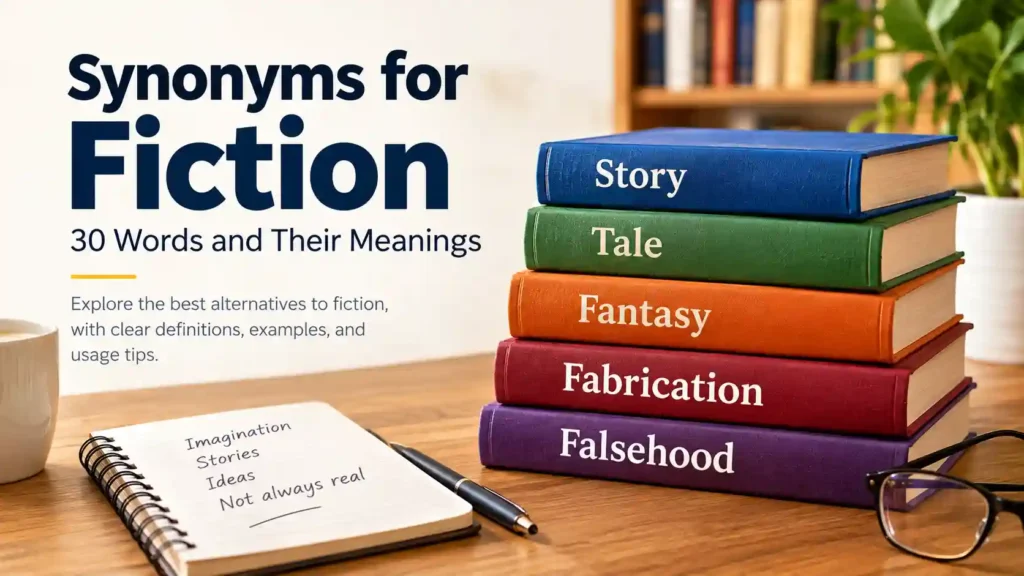

Synonyms for Fiction mean imaginative literature or an invented account that is not presented as factual truth. The five useful synonyms are story, tale, fantasy, fabrication, and falsehood. Story and tale describe narratives, fantasy emphasizes imagination, fabrication suggests deliberate invention, and falsehood refers to an untrue statement.
Choose story for a general narrative, fantasy for an imaginative world or possibility, and fabrication for information someone deliberately invents, especially to mislead others.
- Story — a narrative about connected events
- Tale — an account of particular events
- Fantasy — an imaginative or unreal idea
- Fabrication — deliberately invented information
- Falsehood — a statement that is untrue
- Fable — a story that teaches a lesson
- Myth — a traditional cultural narrative
- Novel — a long work of fiction
Powerful List of Synonyms for Fiction
| Synonym | Meaning | Best for |
| Story | A narrative of connected events | General storytelling |
| Tale | A narrative about particular events | Traditional stories |
| Fantasy | Imaginative or unreal ideas | Imaginary worlds |
| Fabrication | Deliberately invented information | Misleading claims |
| Falsehood | A statement that is untrue | False claims |
| Fable | A story that teaches a lesson | Moral storytelling |
| Myth | A traditional or cultural narrative | Folklore and beliefs |
| Novel | A long work of prose fiction | Book-length literature |
| Legend | A traditional story about notable people or events | Folklore |
| Romance | A story centered on love or adventure | Romantic literature |
| Yarn | An informal, entertaining story | Casual conversation |
| Untruth | A statement that is not true | Incorrect claims |
| Lie | A false statement intended to deceive | Deliberate dishonesty |
| Invention | Something created or made up | Invented accounts |
| Make-believe | Pretend events or situations | Imaginative play |
| Figment | Something existing only in imagination | Imaginary ideas |
| Concoction | Something assembled or invented | Invented explanations |
| Tall tale | A highly exaggerated story | Humorous storytelling |
| Cock-and-bull story | An unbelievable explanation | Informal skepticism |
| Urban legend | A circulating story of uncertain truth | Modern folklore |
| Fictitious account | An account of invented events | Creative writing |
| Fictional narrative | A narrative based on imagined events | Literary analysis |
| Fictional account | An account describing invented events | Imaginary reports |
| Imaginary story | A story about invented events | Simple explanations |
| Work of fiction | A creative literary work | Books and literature |
| Fairy tale | A traditional story with magical elements | Children’s literature |
| Fantasy story | A story involving imagined worlds | Fantasy literature |
| Fanciful tale | An imaginative or unrealistic story | Creative descriptions |
| Made-up story | A story someone has invented | Everyday conversation |
| Figment of the imagination | Something created by the mind | Imaginary beliefs |
Accuracy note: These alternatives have different meanings. A novel is a specific form of fiction, a fable often teaches a lesson, and a lie implies an intention to deceive. Choose the word that fits your sentence instead of treating every entry as an exact substitute.
What Does Fiction Mean?
Fiction is a noun that describes imaginative literature, such as novels and short stories. It can also refer to an invented account or an idea that people accept despite its lack of factual support.
For example, a mystery novel is fiction even if its setting resembles a real city. In another context, someone might call an unsupported claim “fiction” to emphasize that it is not true.
Fiction Word Card
- Word: Fiction
- Part of speech: Noun
- American English IPA: /ˈfɪkʃən/
- British English IPA: /ˈfɪkʃən/
- Plural: Fictions
- Adjective: Fictional
- Adverb: Fictionally
- Related nouns: Fictionist, fictioneer (less common)
Verb note: Fiction is not ordinarily used as a verb in standard contemporary English. Use invent, imagine, fabricate, or fictionalize when you need to describe an action.
30 Synonyms for Fiction: Meanings and Examples
1. Story
Tier: Near-synonym.
A story presents connected events, whether real or imaginary. It is one of the most natural alternatives to fiction in everyday writing.
Example: Her latest story follows a musician searching for her family.
2. Tale
Tier: Near-synonym.
A tale often sounds traditional, entertaining, or imaginative.
Example: The grandfather told a tale about a hidden kingdom.
3. Fantasy
Tier: Near-synonym.
Fantasy emphasizes imaginative ideas and can describe a literary genre involving magical or extraordinary events.
Example: The series combines fantasy with family drama.
4. Fabrication
Tier: Near-synonym.
A fabrication is something deliberately invented, especially information intended to mislead.
Example: Investigators discovered that the witness’s account was a fabrication.
5. Falsehood
Tier: Near-synonym.
A falsehood is an untrue statement, particularly when the discussion concerns facts or honesty.
Example: The report exposed the falsehood behind the accusation.
6. Fable
Tier: Near-synonym.
A fable is a short narrative that commonly teaches a moral lesson.
Example: The children discussed the lesson in the fable.
7. Myth
Tier: Near-synonym.
A myth can describe a traditional cultural narrative or, in everyday usage, a widely believed but false idea.
Example: The documentary challenged the myth that success comes overnight.
8. Novel
Tier: Near-synonym.
A novel is a long work of prose fiction. It is a specific literary form rather than a substitute for every kind of fiction.
Example: Her first novel explores life in a coastal town.
9. Legend
Tier: Near-synonym.
A legend is a traditional story associated with a notable person, place, or event.
Example: Local legend tells of a traveler who vanished in the mountains.
10. Romance
Tier: Near-synonym.
Romance can describe a literary genre centered on love, relationships, or adventure.
Example: The historical romance follows two rivals who fall in love.
11. Yarn
Tier: Near-synonym.
Yarn is an informal word for a story, often one that entertains or exaggerates events.
Example: He shared a funny yarn about his first job.
12. Untruth
Tier: Near-synonym.
An untruth is something that is not true, whether or not the speaker intends to deceive.
Example: The article corrected an untruth about the school.
13. Lie
Tier: Near-synonym.
A lie is a false statement made with the intention of deceiving someone.
Example: She admitted that her explanation was a lie.
14. Invention
Tier: Near-synonym.
Invention can describe something created by the imagination or an invented story or explanation.
Example: The supposed meeting was an invention designed to attract attention.
15. Make-believe
Tier: Near-synonym.
Make-believe refers to pretending or imagining situations that are not real.
Example: The children turned the living room into a make-believe castle.
16. Figment
Tier: Near-synonym.
A figment is something that exists only in someone’s imagination.
Example: The mysterious voice turned out to be a figment of his imagination.
17. Concoction
Tier: Near-synonym.
A concoction is something assembled or invented, sometimes with the purpose of misleading others.
Example: The elaborate excuse was a concoction of half-truths.
18. Tall tale
Tier: Near-synonym.
A tall tale is an exaggerated story containing implausible events.
Example: His tale about catching a giant fish became a family joke.
19. Cock-and-bull story
Tier: Near-synonym.
This informal expression describes an unbelievable story or explanation.
Example: Nobody believed his cock-and-bull story about the missing keys.
20. Urban legend
Tier: Near-synonym.
An urban legend is a circulating story whose truth is uncertain or disputed.
Example: The abandoned hospital story became a local urban legend.
21. Fictitious account
Tier: Near-synonym.
A fictitious account describes events that did not actually happen.
Example: The magazine labeled the fictitious account as creative writing.
22. Fictional narrative
Tier: Near-synonym.
A fictional narrative is a story built around imagined characters, events, or situations.
Example: The assignment required a fictional narrative with a clear ending.
23. Fictional account
Tier: Near-synonym.
A fictional account describes invented events rather than presenting itself as a factual record.
Example: The teacher asked students to write a fictional account of life on Mars.
24. Imaginary story
Tier: Near-synonym.
An imaginary story presents events or characters created through imagination.
Example: The young reader created an imaginary story about a talking fox.
25. Work of fiction
Tier: Near-synonym.
A work of fiction is a creative literary work based on imagined events or characters.
Example: The author described her latest book as a work of fiction.
26. Fairy tale
Tier: Near-synonym.
A fairy tale is a traditional story that often includes magical events or extraordinary characters.
Example: The children enjoyed a fairy tale about a sleeping princess.
27. Fantasy story
Tier: Near-synonym.
A fantasy story presents imagined worlds, unusual powers, or extraordinary events.
Example: The writer developed a fantasy story about a kingdom beneath the sea.
28. Fanciful tale
Tier: Near-synonym.
A fanciful tale emphasizes imagination and may include unrealistic or unusual details.
Example: He entertained the group with a fanciful tale about a talking mountain.
29. Made-up story
Tier: Near-synonym.
A made-up story is an informal expression for a narrative someone has invented.
Example: The teacher explained that the characters came from a made-up story.
30. Figment of the imagination
Tier: Near-synonym.
A figment of the imagination describes something imagined rather than established as real.
Example: The creature he described was a figment of his imagination.
Which Synonym for Fiction Fits Each Situation?
| Situation | Best word | Reason |
| General storytelling | Story | Broad and natural |
| Traditional narrative | Tale | Suggests an entertaining or traditional account |
| Magical or unreal events | Fantasy | Emphasizes imaginative elements |
| Long prose book | Novel | Names a specific literary form |
| Traditional moral lesson | Fable | Suggests a teaching purpose |
| Cultural traditional narrative | Myth | Reflects cultural stories or beliefs |
| Deliberately invented evidence | Fabrication | Emphasizes deliberate invention |
| Intentionally deceptive statement | Lie | Highlights the intention to deceive |
| Incorrect claim | Falsehood | Focuses on lack of truth |
| Exaggerated anecdote | Tall tale | Suggests implausible details |
| Informal storytelling | Yarn | Sounds conversational |
| Imaginary literary work | Work of fiction | Fits books and creative writing |
What Are Synonyms for Nonfiction?
Nonfiction refers to writing intended to present real people, events, experiences, or information. It differs from fiction because it aims to describe reality rather than invent a narrative.
Common alternatives and related expressions include:
- Factual writing: Writing based on facts and real events.
- Factual account: A description intended to report what happened.
- Informational writing: Writing that explains a subject or shares knowledge.
- Documentary writing: Writing that records or examines real people, events, or conditions.
- True story: An account presented as based on actual events.
- Nonfiction literature: Published works intended to present real information or experiences.
Example: A biography is nonfiction because it describes a real person’s life, although the author may use storytelling techniques.
These expressions are related but not identical. Informational writing often explains a subject, while a true story focuses on events presented as real.
In American English, nonfiction is commonly written as one word. Non-fiction is also used as a variant.
What Are Synonyms for Fiction Romance?
Fiction romance describes imaginative storytelling in which a romantic relationship usually plays a central role.
Useful alternatives include:
- Romantic fiction: Fiction focused on romantic relationships.
- Romance novel: A novel centered on a romantic relationship.
- Love story: A narrative about love and relationships.
- Romantic narrative: A story emphasizing romance.
- Romantic tale: An expressive or traditional-sounding story about love.
- Romantic drama: A story exploring emotional or relationship conflicts.
Example: Her new romance novel follows two childhood friends who reconnect years later.
Use romantic fiction for the broader category, romance novel for a book-length work, and love story for a general description.
Remember that romance is a type of fiction, not a universal synonym for fiction. Mystery, science fiction, historical fiction, and literary fiction describe other categories.
What Are Some Slang Synonyms for Fiction?
In casual conversation, people use informal expressions to describe invented stories, exaggerated accounts, or claims they do not believe.
| Expression | Meaning | Tone |
| Yarn | An entertaining story | Informal and friendly |
| Tall tale | A highly exaggerated story | Humorous |
| Made-up story | An invented narrative | Plain and informal |
| Cock-and-bull story | An unbelievable explanation | Skeptical |
| Fairy tale | An imaginary or unrealistic account | Figurative or dismissive |
| Bunch of baloney | Something considered nonsense or untrue | Very informal |
| Load of rubbish | Something considered false or nonsensical | Informal; common in British English |
Examples:
- He told us a funny yarn about his first day at work.
- Her explanation sounded like a tall tale.
- Nobody believed his cock-and-bull story about the missing report.
These expressions are not interchangeable in every situation. Yarn often describes entertaining storytelling, while cock-and-bull story suggests an implausible explanation.
For formal writing, choose fiction, fabrication, falsehood, or invented account when those terms accurately express your meaning.
What Is Another Word for a Fictional Character?
A fictional character is a person, animal, or other figure created for a story, play, film, or another imaginative work.
Common alternatives include:
- Imaginary character: A character that exists in the imagination.
- Invented character: A character created by a writer.
- Made-up character: An informal expression for a character that is not real.
- Fictional figure: A figure created for an imaginative work.
- Story character: A character who appears in a narrative.
- Literary character: A character in a literary work.
Example: Sherlock Holmes is a fictional character created for detective stories.
Some related words describe a character’s role rather than whether the character is fictional:
- Protagonist: The central character in a story.
- Antagonist: A character or force that opposes the protagonist.
- Narrator: The voice or figure that tells the story.
- Supporting character: A character who plays a secondary role.
For SEO and natural writing, imaginary character and fictional figure are useful alternatives. Use protagonist or antagonist only when discussing a character’s specific role.
What Is Another Word for Fictional?
Fictional is an adjective that describes a person, place, event, or situation created through imagination rather than presented as an actual occurrence.
| Alternative | Meaning | Best use |
| Imaginary | Existing in the imagination | Imaginary places or friends |
| Invented | Created rather than reported as real | Invented characters or accounts |
| Made-up | Created or fabricated; informal | Everyday explanations |
| Fictitious | Invented rather than real | Fictitious names or accounts |
| Unreal | Not real or not realistic | Unreal situations |
| Hypothetical | Assumed for discussion or reasoning | Examples and theoretical situations |
| Pretend | Imagined or acted out | Children’s play and role-play |
| Imagined | Formed in the mind | Imagined events or possibilities |
Examples:
- The author created an imaginary island for her novel.
- The detective discovered that the suspect had used an invented name.
- The report contained a fictitious account of the incident.
- The teacher presented a hypothetical situation for discussion.
The alternatives have different meanings. Hypothetical describes something assumed for discussion, not necessarily something created for a story. Fictitious often suits formal writing about invented details.
Fictional vs. Fictitious: What Is the Difference?
Fictional usually describes something created for a story or imaginative work. Fictitious often emphasizes that a person, detail, or account is invented rather than real.
For example, a fictional detective belongs to a novel, while a fictitious address might be an invented address used on a form.
What Is a Seven-Letter Synonym for Fiction?
Fantasy is a seven-letter word that can serve as a synonym for fiction in certain contexts. It describes imaginative ideas, unreal situations, or a literary genre involving elements beyond ordinary reality.
However, fantasy is not a perfect substitute for fiction in every sentence. Fiction is the broader category and includes realistic stories, historical novels, mysteries, and many other forms of imaginative writing.
Example: The bookstore placed the fantasy novel beside other works of fiction.
If you are solving a crossword puzzle or word game, check the clue and surrounding letters before choosing an answer.
Fiction Synonyms and Antonyms
Fiction has several synonyms, but the best choice depends on whether it refers to imaginative literature or something invented and untrue.
What Are the Best Synonyms for Fiction?
The most useful options include story, tale, fantasy, fabrication, falsehood, fable, narrative, and novel.
- Use story for a general narrative.
- Use tale for an entertaining or traditional account.
- Use fantasy for imaginative worlds or unreal possibilities.
- Use fabrication for deliberately invented information.
- Use falsehood for a statement that is not true.
- Use fable for a story that teaches a lesson.
- Use narrative for an organized account of events.
- Use novel for a long work of prose fiction.
For general writing, story is often the easiest alternative. Choose fabrication or falsehood when the emphasis is on something untrue.
What Are the Antonyms of Fiction?
An antonym is a word with an opposite meaning. The appropriate opposite of fiction depends on the context.
| Antonym | Type | Meaning |
| Fact | Direct | Something that is true or established |
| Truth | Direct | What corresponds to reality |
| Reality | Direct | The actual state of things |
| Nonfiction | Direct | Writing intended to present real information |
| Actuality | Contextual | The state of being real |
| Authenticity | Contextual | The quality of being genuine |
| Accuracy | Contextual | Correctness of information |
| Evidence | Contextual | Information that supports a claim |
Example: A fictional account describes imagined events, while a factual account aims to describe what actually happened.
Nonfiction is the clearest contrast for a literary category. Truth and fact are more suitable when fiction means an untrue statement.
What Are the Different Meanings of Fiction?
Fiction as imaginative literature
This is the most common literary meaning. Fiction includes novels, short stories, and other narratives built around imagined characters, settings, or events. A fictional work can still draw on real places, historical events, and personal experiences.
Fiction as an invented account
Fiction can also describe a made-up story or explanation. In this sense, fabrication, invention, and falsehood may fit, depending on whether the emphasis falls on deliberate invention or factual inaccuracy.
Fiction as an accepted but untrue idea
Sometimes people use fiction to describe an assumption treated as true for convenience, even when it lacks a factual basis. In legal contexts, the word can have a specialized meaning and should not be replaced casually with lie.
Can fiction be used as a verb?
In standard contemporary English, fiction functions primarily as a noun. Writers should normally choose a more precise verb:
- Invent: Create a story or idea.
- Imagine: Form a mental picture or possibility.
- Fabricate: Invent information, often deceptively.
- Fictionalize: Adapt real people or events into fictional form.
The related adjective is fictional, as in “a fictional character.” The adverb fictionally exists but is less common.
When Should You Avoid Using These Synonyms?
- Do not replace fiction with novel in every context. Short stories and other literary forms can also be fiction.
- Do not call every fictional work a lie. Fiction does not automatically involve an intention to deceive.
- Do not use fantasy for every invented narrative. Realistic fiction may contain no fantastic elements.
- Do not treat myth as a universal substitute. The word can carry cultural, historical, or religious significance.
- Do not use fabrication when no deception is implied. The term often suggests deliberately constructed information rather than ordinary creative writing.
What Is the Origin of Fiction?
The word fiction entered English through French from Latin fictio, associated with making or shaping something. Its historical roots connect the idea of invention with the act of forming something. Modern English uses the word for imaginative literature and invented or untrue accounts.
Frequently Asked Questions About Synonyms for Fiction
What is another word for fiction?
Story is a useful general synonym for fiction when discussing a narrative. Tale is another natural option, while fantasy works when imagination or unreal events are central. If fiction means a deliberately invented false account, fabrication may be more precise.
What are five good synonyms for fiction?
Five useful synonyms for fiction are story, tale, fantasy, fabrication, and falsehood. Story and tale refer to narratives, fantasy emphasizes imagination, fabrication suggests deliberately invented information, and falsehood means an untrue statement. Choose according to whether you mean literature or something that is not true.
What are five strong synonyms for fiction?
For expressive writing, fabrication, falsehood, fantasy, tale, and invention can be strong alternatives in the right context. Fabrication and falsehood sound critical when discussing inaccurate claims, while fantasy, tale, and invention suit imaginative storytelling. The strongest synonym is the one that communicates your exact meaning and tone.
What are some synonyms for a fiction story?
Useful alternatives for a fiction story include story, tale, narrative, fictional account, and work of fiction. A short story is a relatively brief fictional work, while a novel is a longer work of prose fiction. Choose the term that matches the format and purpose of the writing.
What does fiction mean in simple words?
Fiction means a story made from imagined people, events, or places. Writers may draw ideas from real life, but the events in a fictional story are not necessarily true. For example, a novel about a detective solving an invented crime is fiction.
What is the difference between fiction and nonfiction?
Fiction presents imagined stories, while nonfiction aims to describe real people, events, experiences, or information. A fantasy novel is fiction because it presents an imagined world. A biography is nonfiction because it describes the life of a real person, although both can use storytelling techniques.
What is the difference between fiction and fantasy?
Fiction is a broad category of imaginative literature. Fantasy is a narrower term that often describes stories involving magical, supernatural, or extraordinary elements. A realistic family drama can be fiction without being fantasy.
What is the difference between fiction and a lie?
Fiction is commonly created for storytelling or entertainment and does not need to deceive readers. A lie is a false statement intended to mislead someone. A novel openly labeled as fiction is not normally a lie, even though its events are invented.
What is another word for fictional?
Common alternatives for fictional include imaginary, invented, made-up, fictitious, and imagined. Imaginary emphasizes something formed in the mind, while fictitious often describes an invented person, name, or account. The best choice depends on the sentence and intended meaning.
What is another word for a fictional character?
An imaginary character, invented character, or fictional figure can describe a character created for a story. Protagonist and antagonist are related terms, but they identify particular character roles rather than serving as general synonyms for fictional character.
What are some synonyms for fiction in academic writing?
In academic writing, narrative, fictional narrative, and work of fiction may fit literary discussions. For a false claim, terms such as falsehood or fabrication may be more precise. Choose the word that matches the argument rather than substituting synonyms mechanically.
What are some slang synonyms for fiction?
Informal alternatives include yarn, tall tale, made-up story, and cock-and-bull story. Yarn often describes an entertaining story, while tall tale suggests exaggeration. Cock-and-bull story usually expresses disbelief about an implausible explanation.
What is a seven-letter synonym for fiction?
Fantasy is a seven-letter word that can fit some uses of fiction, particularly when discussing imaginative literature or unreal situations. However, it is not a universal synonym because fiction also includes realistic novels, mysteries, and historical stories.
What is the opposite of fiction?
The opposite depends on context. Nonfiction contrasts with fiction as a literary category, while fact, truth, and reality contrast with fiction when it means something invented or untrue.
Conclusion
Fiction describes imaginative literature and, in other contexts, invented or untrue accounts. Its useful synonyms include story, tale, fantasy, fabrication, and falsehood, but each carries a different meaning. Choose the alternative that matches your context to make your writing clearer, more accurate, and more effective.