
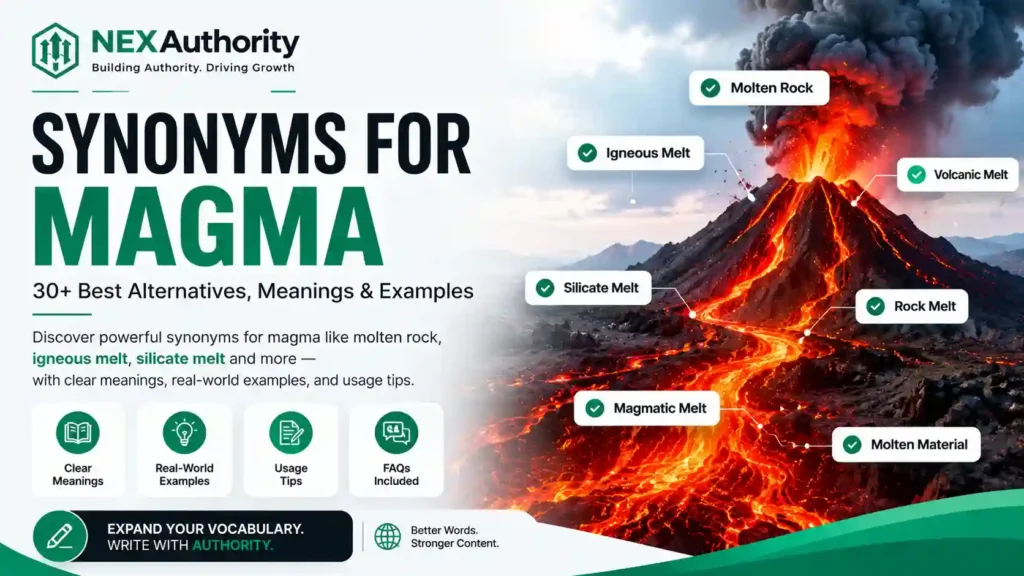

Synonyms for Magma (noun) (/ˈmæɡmə/) — molten or partially molten rock and mineral material found beneath Earth’s surface, often containing crystals and dissolved gases.
The best synonym for magma is molten rock in general writing, while melt, silicate melt, igneous melt, and partial melt offer more specialized alternatives. The right replacement depends on scientific precision, audience, and context.
What Is Another Word for Magma?
The most common alternatives to magma are molten rock, rock melt, molten material, underground molten rock, volcanic melt, igneous melt, silicate melt, and magmatic material. However, some are related geological terms rather than exact synonyms.
Unique 30 Magma Synonyms at a Glance
| Synonym | Specific Meaning | Synonym | Specific Meaning |
| 1. Molten rock | Rock melted by intense underground heat | 16. Rock melt | Rock transformed into molten material |
| 2. Molten material | Heated material existing in liquid form | 17. Silicate melt | Melt dominated by silicate components |
| 3. Igneous melt | Melt capable of forming igneous rocks | 18. Geological melt | Naturally occurring geological molten material |
| 4. Molten rock mass | Large mass of underground molten rock | 19. Subterranean melt | Molten material located underground |
| 5. Rock magma | Descriptive term for molten rock | 20. Magmatic melt | Melt associated with magmatic processes |
| 6. Molten stone | Plain-language description of melted rock | 21. Molten mineral material | Heated mineral-rich molten substance |
| 7. Molten geological material | Melted material within Earth’s crust | 22. Partially molten rock | Rock containing molten and solid portions |
| 8. Underground molten rock | Molten rock beneath Earth’s surface | 23. Partial melt | Melt produced from some minerals |
| 9. Subsurface molten rock | Molten rock below the surface | 24. Crustal melt | Melt generated within Earth’s crust |
| 10. Volcanic melt | Melt associated with volcanic activity | 25. Mantle melt | Melt generated within Earth’s mantle |
| 11. Igneous material | Material associated with igneous processes | 26. Magmatic material | Material associated with magma |
| 12. Molten mass | Large mass of molten matter | 27. Magma body | Concentrated underground magma accumulation |
| 13. Molten rock material | General description of magma | 28. Melt | Technical shorthand for molten material |
| 14. Underground melt | Molten material beneath ground | 29. Silicate-rich melt | Melt abundant in silicate components |
| 15. Fused rock material | Rock material altered by intense heat | 30. Molten rock substance | General description of molten rock |
SEO Quick Tip: Molten rock is the safest general replacement for magma. Scientific terms such as partial melt, mantle melt, and crustal melt should only be used when their narrower meanings are intended.
Where Does the Word Magma Come From?
Parts of Speech: Noun
Syllable: mag-ma
Pronunciation: /ˈmæɡmə/
Origin: English magma comes through Latin magma from Ancient Greek mágma (μάγμα), meaning “thick substance,” “paste,” or “mixture.” The Greek word is associated with mássō, meaning “to knead” or “to work together.”
Prefix/Suffix Breakdown: Magma has no productive English prefix or suffix. Its Greek origin conveys the idea of a thick or worked substance, which developed into the modern geological meaning of molten material beneath Earth’s surface.
What Are the Best Synonyms for Magma?
The best synonym for magma changes according to search intent, writing style, and technical context. Use broad terms for general readers and specialized geological terminology when precision matters.
1. Molten Rock (/ˈmoʊltən rɑːk/)
Meaning: Rock heated until it becomes partly or completely molten.
Examples:
- Scientists detected molten rock beneath the volcano.
- The eruption pushed molten rock toward the surface.
2. Molten Material (/ˈmoʊltən məˈtɪəriəl/)
Meaning: Material transformed into a molten state by extreme heat.
Examples:
- Researchers measured the temperature of the molten material.
- The chamber contained extremely hot molten material.
3. Igneous Melt (/ˈɪɡniəs melt/)
Meaning: Molten material involved in forming igneous rock.
Examples:
- The igneous melt slowly crystallized underground.
- Scientists analyzed the chemistry of the igneous melt.
4. Molten Rock Mass (/ˈmoʊltən rɑːk mæs/)
Meaning: A substantial accumulation of molten rock.
Examples:
- The volcano developed a large molten rock mass.
- Researchers investigated the underground molten rock mass.
5. Rock Magma (/rɑːk ˈmæɡmə/)
Meaning: A descriptive expression emphasizing magma’s rocky composition.
Examples:
- The researchers modeled movement through the rock magma.
- Heat affected the surrounding rock magma.
6. Molten Stone (/ˈmoʊltən stoʊn/)
Meaning: A simple, vivid description of melted rock.
Examples:
- The documentary showed streams of molten stone.
- The novelist described a cavern filled with molten stone.
7. Molten Geological Material (/ˈmoʊltən ˌdʒiːəˈlɑːdʒɪkəl məˈtɪəriəl/)
Meaning: Geological material that has become molten.
Examples:
- The instruments detected molten geological material.
- Scientists studied the movement of molten geological material.
8. Underground Molten Rock (/ˌʌndərˈɡraʊnd ˈmoʊltən rɑːk/)
Meaning: Molten rock occurring beneath Earth’s surface.
Examples:
- Pressure forced underground molten rock upward.
- Scientists tracked the movement of underground molten rock.
9. Subsurface Molten Rock (/ˈsʌbsɜːrfɪs ˈmoʊltən rɑːk/)
Meaning: Molten rock located below Earth’s surface.
Examples:
- Seismic readings revealed subsurface molten rock.
- The study mapped subsurface molten rock beneath the region.
10. Volcanic Melt (/vɑːlˈkænɪk melt/)
Meaning: Molten geological material associated with volcanic activity.
Examples:
- The eruption released volcanic melt.
- Scientists examined the composition of the volcanic melt.
11. Igneous Material (/ˈɪɡniəs məˈtɪəriəl/)
Meaning: Material associated with igneous rock formation.
Examples:
- The region contains abundant igneous material.
- Cooling igneous material produced crystalline rock.
12. Molten Mass (/ˈmoʊltən mæs/)
Meaning: A large mass of intensely heated molten material.
Examples:
- Pressure built above the molten mass.
- The fictional volcano contained a vast molten mass.
13. Molten Rock Material (/ˈmoʊltən rɑːk məˈtɪəriəl/)
Meaning: A broad description of magma as melted rock.
Examples:
- The chamber contained molten rock material.
- The eruption transported molten rock material upward.
14. Underground Melt (/ˌʌndərˈɡraʊnd melt/)
Meaning: Molten geological material beneath the surface.
Examples:
- Scientists modeled the movement of the underground melt.
- Pressure accumulated around the underground melt.
15. Fused Rock Material (/fjuːzd rɑːk məˈtɪəriəl/)
Meaning: Rock material fused by intense heat.
Examples:
- The experiment created fused rock material.
- The sample contained intensely heated fused rock material.
16. Rock Melt (/rɑːk melt/)
Meaning: Rock that has undergone melting.
Examples:
- The laboratory produced rock melt at high temperatures.
- Researchers examined the composition of the rock melt.
17. Silicate Melt (/ˈsɪlɪkeɪt melt/)
Meaning: Molten material primarily composed of silicate components.
Examples:
- Scientists measured the viscosity of the silicate melt.
- Crystals formed as the silicate melt cooled.
18. Geological Melt (/ˌdʒiːəˈlɑːdʒɪkəl melt/)
Meaning: Naturally occurring molten geological material.
Examples:
- The research focused on geological melt deep underground.
- Heat and pressure can produce geological melt.
19. Subterranean Melt (/ˌsʌbtəˈreɪniən melt/)
Meaning: Molten material existing below Earth’s surface.
Examples:
- The study examined subterranean melt.
- The volcanic system contained subterranean melt.
20. Magmatic Melt (/mæɡˈmætɪk melt/)
Meaning: Molten material involved in magmatic processes.
Examples:
- The magmatic melt began crystallizing.
- Researchers analyzed its chemical composition.
21. Molten Mineral Material (/ˈmoʊltən ˈmɪnərəl məˈtɪəriəl/)
Meaning: Molten material containing mineral components.
Examples:
- The chamber contained molten mineral material.
- Cooling changed the structure of the molten mineral material.
22. Partially Molten Rock (/ˈpɑːrʃəli ˈmoʊltən rɑːk/)
Meaning: Rock containing both solid and molten portions.
Examples:
- The mantle can contain partially molten rock.
- The experiment produced partially molten rock.
23. Partial Melt (/ˈpɑːrʃəl melt/)
Meaning: Melt formed when only some minerals in rock melt.
Examples:
- Researchers found evidence of partial melt.
- Temperature influenced the amount of partial melt produced.
24. Crustal Melt (/ˈkrʌstəl melt/)
Meaning: Molten material generated within Earth’s crust.
Examples:
- The granite originated from crustal melt.
- Scientists investigated the source of the crustal melt.
25. Mantle Melt (/ˈmæntəl melt/)
Meaning: Melt generated from material in Earth’s mantle.
Examples:
- The volcanic system may involve mantle melt.
- Scientists studied the chemistry of mantle melt.
26. Magmatic Material (/mæɡˈmætɪk məˈtɪəriəl/)
Meaning: Material associated with magma and magmatic processes.
Examples:
- The intrusion contained unusual magmatic material.
- Researchers analyzed the magmatic material.
27. Magma Body (/ˈmæɡmə ˈbɑːdi/)
Meaning: A concentrated underground accumulation of magma.
Examples:
- Scientists identified a possible magma body.
- The magma body changed beneath the volcano.
28. Melt (/melt/)
Meaning: Technical shorthand for molten geological material.
Examples:
- The melt began crystallizing.
- Researchers measured the temperature of the melt.
29. Silicate-Rich Melt (/ˈsɪlɪkeɪt rɪtʃ melt/)
Meaning: Melt containing abundant silicate components.
Examples:
- The volcano produced a silicate-rich melt.
- The chemistry of the silicate-rich melt affected its viscosity.
30. Molten Rock Substance (/ˈmoʊltən rɑːk ˈsʌbstəns/)
Meaning: General description of molten rock material.
Examples:
- The eruption transported molten rock substance upward.
- The chamber contained heated molten rock substance.
Another Word for Magma: Best Choice by Context
Not every synonym for magma works equally well. Use the following context-based guide when choosing another word.
| Search Intent / Context | Best Alternative | Why It Works |
| General definition | Molten rock | Simple and immediately understandable |
| School assignment | Molten rock | Clear for students and general readers |
| Academic writing | Melt / igneous melt | More technical and precise |
| Scientific geology | Silicate melt | Highlights chemical composition |
| Volcanology | Volcanic melt | Connects directly to volcanic processes |
| Mantle studies | Mantle melt | Identifies the geological source |
| Crustal studies | Crustal melt | Specifies the melt’s origin |
| Partial melting | Partial melt | Describes a specific geological process |
| Creative writing | Molten stone | Vivid and easy to visualize |
| Plain English | Molten rock | Most accessible alternative |
| Technical report | Melt | Concise scientific terminology |
| SEO content | Molten rock / underground molten rock | Matches common explanatory searches |
Magma Synonyms for an Essay
When looking for a synonym for magma in an essay, prioritize accuracy over forced vocabulary variation.
Formal alternatives
- Molten rock
- Igneous melt
- Silicate melt
- Magmatic melt
- Geological melt
- Underground molten rock
Example
Instead of repeating:
Magma rises through cracks in Earth’s crust. Magma can eventually reach the surface.
You could write:
Molten rock can rise through fractures in Earth’s crust. This magmatic material may eventually reach the surface.
The second sentence adds variation without pretending that every related term is a perfect synonym.
Magma Synonyms for Creative Writing
Creative writers have more freedom to replace Synonyms for Magma with descriptive expressions.
Useful choices include:
- Molten stone
- Molten mass
- Fiery rock
- Glowing rock
- Underground fire
- Liquid stone
- Burning rock
These are primarily descriptive expressions, not strict scientific synonyms.
Creative example
Beneath the mountain, a river of molten stone churned through the darkness.
For a fantasy or literary scene, molten stone or liquid stone can create a stronger visual image than repeatedly using magma.
Formal Synonyms for Magma
If you need a formal or academic alternative, choose terminology according to the exact scientific meaning.
Best formal choices:
- Molten rock
- Igneous melt
- Silicate melt
- Magmatic melt
- Geological melt
- Partial melt
- Crustal melt
- Mantle melt
Avoid using an obscure term merely to sound sophisticated. In scientific writing, precision is more valuable than vocabulary variation.
Magma vs. Lava: What Is the Difference?
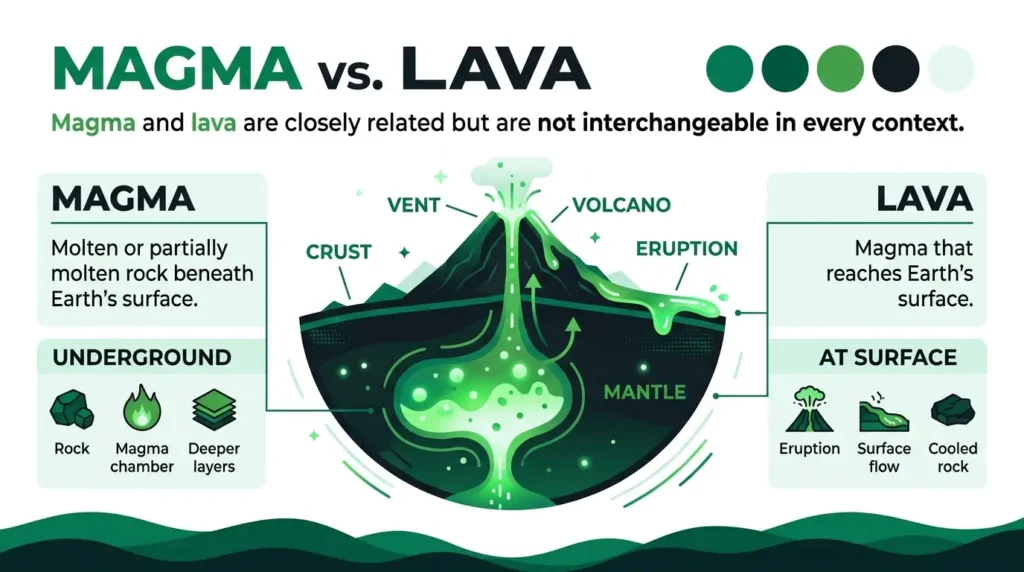
Magma and lava are closely related but are not interchangeable in every context.
- Magma: molten or partially molten rock beneath Earth’s surface.
- Lava: magma that reaches Earth’s surface.
Example
Magma accumulated beneath the volcano before the eruption.
After reaching the surface:
Lava flowed down the volcano’s slope.
Therefore, lava is not a direct synonym for magma when describing its underground location.
Magma vs. Melt
Magma generally refers to naturally occurring molten or partially molten material beneath Earth’s surface, while melt is often used in geology to describe the liquid component of a magmatic system.
For general readers, magma is usually clearer. For technical geological writing, melt can be more precise depending on the context.
Magma vs. Molten Rock
Molten rock is the closest plain-English synonym for magma.
However, the phrase can oversimplify magma because natural magma may contain solid crystals and dissolved gases in addition to liquid material.
Use molten rock when clarity matters more than technical detail.
Magma vs. Partial Melt
A partial melt occurs when only some minerals in a rock melt rather than the entire rock becoming liquid.
Therefore:
Magma = broader geological concept
Partial melt = more specific melting condition
Do not automatically replace magma with partial melt unless the sentence concerns partial melting.
Magma vs. Silicate Melt
Silicate melt emphasizes the chemical composition of the molten material. Since most terrestrial magma is silicate-rich, the terms can overlap substantially, but silicate melt is more composition-focused.
Use it when discussing mineral chemistry, viscosity, crystallization, or geochemical processes.
When NOT to Use a Synonym for Magma
Replacing a keyword with a synonym is not always an improvement.
Do not use:
- Lava when the material is still underground.
- Mantle melt unless the melt originates in the mantle.
- Crustal melt unless the melt is generated in the crust.
- Partial melt when referring to magma generally.
- Silicate melt when chemical composition is irrelevant.
- Molten stone in highly technical scientific writing.
- Fiery rock as though it were a formal geological term.
The strongest writing uses synonyms for meaningful variation, not keyword substitution for its own sake.
Opposite Words: Antonyms for Magma
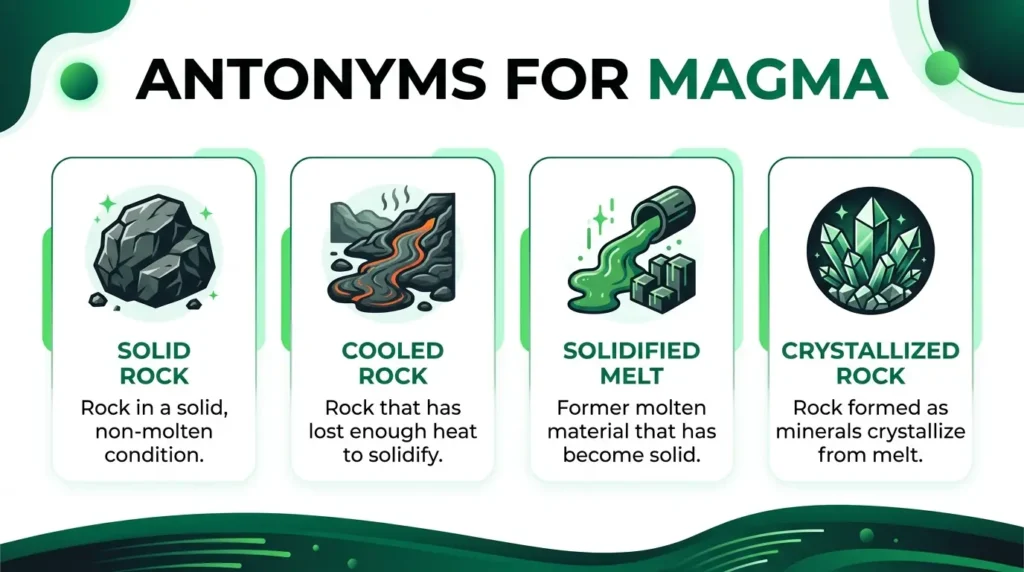
Because magma describes a geological substance, it does not have one exact dictionary antonym. Its practical opposites relate to solidification, cooling, and geological state.
Direct Physical-State Opposites
- Solid rock — Rock in a solid, non-molten condition.
Example: The magma eventually cooled into solid rock. - Cooled rock — Rock that has lost enough heat to solidify.
Example: The once-molten material became cooled rock. - Solidified melt — Former molten material that has become solid.
Example: The solidified melt formed a new layer of igneous rock. - Crystallized rock — Rock formed as minerals crystallize from melt.
Example: Cooling produced crystallized rock.
Contextual Opposites
- Host rock — Existing rock surrounding an intrusion.
- Country rock — Pre-existing rock around an igneous intrusion.
- Cold rock — General physical contrast with extremely hot molten material.
- Solid mineral — A solid-state contrast to molten mineral material.
Frequently Asked Questions About Magma Synonyms
What is another word for magma?
The simplest synonym for magma is molten rock. Depending on context, alternatives include melt, igneous melt, silicate melt, volcanic melt, and magmatic material.
What is a synonym for magma in an essay?
For an essay, Synonyms for Magma, molten rock is usually the clearest alternative. Academic writers can use igneous melt, silicate melt, or magmatic melt when those terms accurately describe the geological context.
What is the scientific synonym for magma?
There is no single perfect scientific synonym in every context. Melt, igneous melt, silicate melt, and magmatic melt are common technical alternatives, each carrying slightly different implications.
Is molten rock another word for magma?
Yes, molten rock is the closest plain-English equivalent of Synonyms for Magma. However, magma can contain crystals and dissolved gases, so the phrase is a simplified description rather than a complete scientific definition.
Is lava another word for magma?
No. Lava is magma that has reached Earth’s surface. Magma generally refers to molten or partially molten rock beneath the surface.
What is the opposite of magma?
There is no exact antonym for magma, but solid rock, cooled rock, crystallized rock, and solidified melt provide useful physical-state contrasts.
What are good synonyms for magma in creative writing?
Creative writers can use descriptive phrases such as molten stone, liquid stone, fiery rock, glowing rock, or molten mass. These Synonyms for Magma are evocative alternatives rather than strict geological synonyms.
What is the difference between magma and molten rock?
Magma is the geological term for naturally occurring molten or partially molten material beneath Earth’s surface. Molten rock is a simpler descriptive phrase intended for general audiences.
Conclusion
The best general synonym for magma is molten rock, while melt, igneous melt, silicate melt, and magmatic melt work better in technical or academic contexts. For precise geological writing, terms such as partial melt, crustal melt, and mantle melt should only be used when their specific meanings apply. For creative writing, expressions such as molten stone and molten mass offer vivid alternatives, but they should not be presented as strict scientific equivalents.