
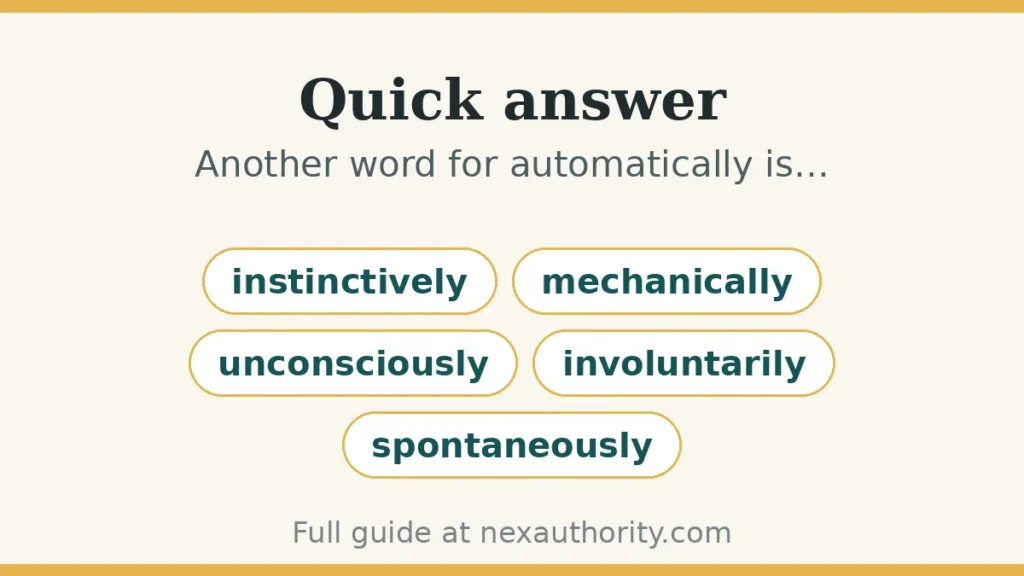
Automatically means done by a machine or system without human intervention, or done by a person without thinking about it, and in technical and formal writing the word needs a precise match for the process you describe. The closest synonyms are instinctively, mechanically, unconsciously, involuntarily, and spontaneously, each covering a different shade of acting without conscious control.
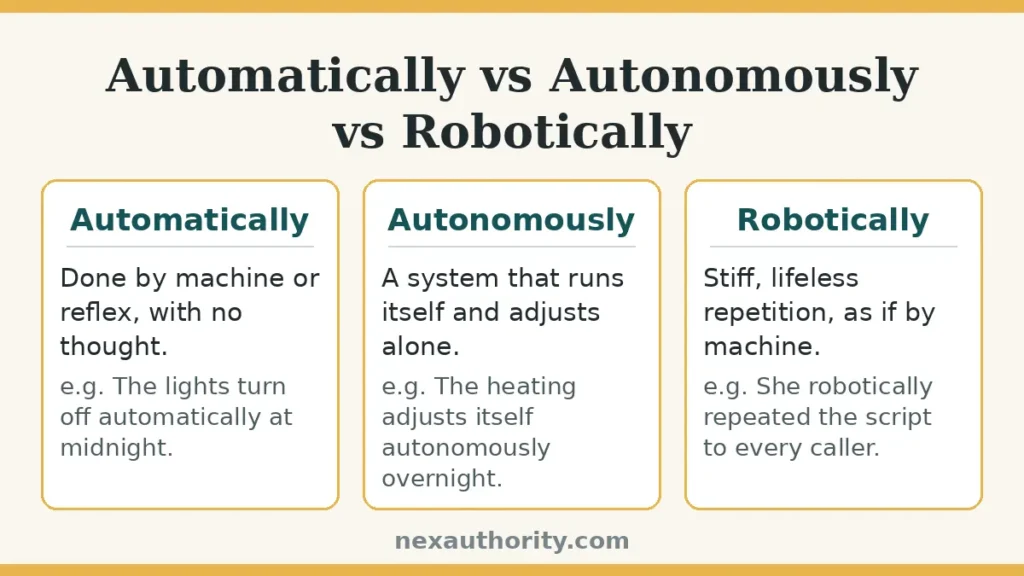
Choose mechanically when a machine or system does the work with no person involved. Choose autonomously when a system runs itself and makes its own adjustments. Choose instinctively when a person acts from habit, with no thought at all.
- Instinctively — acting from natural impulse, without thought
- Mechanically — done like a machine, without a person
- Unconsciously — done with no awareness of doing it
- Involuntarily — done without will or choice
- Spontaneously — happening on its own, without a plan
- Reflexively — done as a reflex, without deciding
Synonyms for Automatically: Full Tiered Table
| Synonym | Tier | Meaning (3-6 words) | Best for |
|---|---|---|---|
| Instinctively | Exact | From impulse, no thought | Human reactions, habits |
| Mechanically | Exact | Like a machine, no person | Machines, routine work |
| Unconsciously | Exact | With no awareness | Habits, psychology |
| Involuntarily | Exact | Without will or choice | Reflexes, body reactions |
| Spontaneously | Exact | On its own, unplanned | Feelings, crowds, ideas |
| Reflexively | Near | As a reflex, instant | Body reactions, sport |
| Habitually | Near | By force of habit | Daily routines, manners |
| Unthinkingly | Near | Without any thought | Careless acts, mistakes |
| Impulsively | Near | On a sudden urge | Snap choices, feelings |
| Robotically | Near | Stiffly, like a machine | Work, scripts, routine |
| Autonomously | Near | On its own, self-governing | Machines, systems, teams |
| Unwittingly | Near | Without knowing it | Mistakes, slips, secrets |
| Mindlessly | Near | With mind switched off | Repetition, boredom |
| Naturally | Near | As part of normal course | Rules, processes, results |
| Inevitably | Near | Bound to happen, certain | Rules, outcomes, logic |
| Routinely | Related | As a regular routine | Work, schedules, habits |
| Regularly | Related | At set times | Schedules, payments |
| Systematically | Related | By a fixed system | Work, research, plans |
| Programmed | Related | Set by code in advance | Software, machines |
| Automated | Related | Run by machines | Factories, offices |
| Unmanned | Related | With no people aboard | Drones, stations, vehicles |
| Hands-free | Related | Needing no hands | Phones, cars, tools |
| Self-regulating | Related | Adjusting itself | Machines, systems, bodies |
| Perfunctorily | Related | Done with little care | Routine tasks, duty |
| By rote | Related | By memory, no thought | Learning, drills, scripts |
Automatically Word Card
- Part of speech: adverb
- Pronunciation: UK /ˌɔː.təˈmæt.ɪ.kli/, US /ˌɑː.t̬əˈmæt̬.ɪ.kli/
- Word forms: automatically (adverb); automatic (adjective), automate (verb), automation (noun)
- Register: neutral; B2 level in the Cambridge English Vocabulary Profile
Top 10 Synonyms for Automatically in Detail
Instinctively
Instinctively means acting from natural impulse, without stopping to think. It is the best swap when a person reacts from habit or gut feeling. “She instinctively reached for the rail as the bus swerved.” Use it for reflexes, habits, and snap reactions. Avoid it for machines, since instinct belongs to living things.
Mechanically
Mechanically means done like a machine, without thought or choice. It fits devices and people who act without feeling, as if on rails. “He mechanically signed each letter without reading it.” Use it when the action is regular, repeated, and empty of thought. Avoid it for machines, since automatically is plainer.
Unconsciously
Unconsciously means done with no awareness of doing it at all. It is the closest word when the mind is switched off, not just quick. “She unconsciously tapped her pen through the meeting.” Use it for habits that run below thought. Avoid it for machines, which have no mind to be unaware with.
Involuntarily
Involuntarily means done without will or choice, so the person could not have stopped it. It is stronger, since it stresses a lack of control rather than habit. “He involuntarily flinched as the door slammed.” Use it for reflexes, cries, and reactions the body makes on its own. Avoid it for routine machine tasks.
Spontaneously
Spontaneously means happening on its own, without a plan or outside cause. It suits sudden laughter, applause, and uninvited ideas. “The crowd spontaneously broke into song.” Use it when the action is free and unplanned rather than set by a machine. Avoid it for set routines, where automatically or routinely fits better.
Reflexively
Reflexively means done as a reflex, a fast body response to a sudden change. It is the sharpest word when the body acts before the mind can catch up. “She reflexively caught the falling glass.” Use it for flinches, catches, and blinks. Avoid it for slow habits, since a reflex is instant.
Habitually
Habitually means done by force of habit, over and over, until no thought is needed. It fits the everyday sense, from morning routines to old mannerisms. “He habitually checked his phone before breakfast.” Use it when the action repeats daily and runs on rails. Avoid it for one-off reactions, since habit needs time.
Unthinkingly
Unthinkingly means done without thought at all, often carelessly. It carries a hint of blame that automatically does not, as if the person should have paused. “She unthinkingly agreed to the plan.” Use it when thoughtlessness causes a mistake. Avoid it for skilled habits, where ease comes from practice, not carelessness.
Impulsively
Impulsively means done on a sudden urge, without pausing to weigh the result. It shares the speed but adds a rush of feeling behind the act. “He impulsively bought the ticket and never looked back.” Use it for snap choices driven by mood or desire. Avoid it for calm routines, since an impulse is sudden.
Robotically
Robotically means done stiffly and without feeling, exactly like a machine. It is a vivid, modern swap when a person moves or speaks in a blank, hollow way. “She robotically repeated the script to every caller.” Use it for lifeless repetition at work or on the phone. Avoid it for skilled habits, which feel natural.
Best Word by Situation
| Situation | Best pick | Why |
|---|---|---|
| Technical manual | Mechanically | Precise for machines and systems |
| Software documentation | Autonomously | Standard for self-running systems and code that runs programmatically |
| Formal report | Robotically | Clear for lifeless, machine-like repetition |
| Academic writing | Unconsciously | Standard term for actions below awareness |
| Business email | Habitually | Clear for work done by force of habit |
All Meanings of Automatically
Automatically as by a machine
When a machine does something automatically, it works on its own, with no person guiding it. “The heating turns off automatically at ten.” This is the oldest technical sense, tied to factories, computers, and appliances.
Automatically as without thinking
When a person does something automatically, they act without thinking about it, usually from habit. “I automatically put my hand out to catch it.” The action feels easy because practice has worn a path for it. This is the sense learners use most in speech.
Automatically as by rule
When something happens automatically, it follows from the rules, with no special decision needed. “Members are automatically entitled to free entry.” In law and business, the outcome is fixed in advance.
Common Collocations for Automatically
Five natural combinations:
- automatically generated — “The report was automatically generated at dawn.”
- automatically saved — “Your work is automatically saved every minute.”
- automatically renewed — “The subscription is automatically renewed each year.”
- automatically entitled — “Members are automatically entitled to free entry.”
- automatically updated — “The app is automatically updated every week.”
Words People Confuse With Automatically
Spontaneously
Spontaneously means unplanned and free, while automatically means without thought or human control. A machine closes a door automatically, but a crowd sings spontaneously. Spontaneously: “The audience spontaneously rose to its feet.” Automatically: “The doors closed automatically behind them.”
Mechanically
Mechanically means like a machine, stiff and without feeling, while automatically can be smooth and skilled. A practised driver brakes automatically; a bored clerk stamps forms mechanically. Mechanically: “He mechanically nodded through the meeting.” Automatically: “Her fingers found the keys automatically.”
Habitually
Habitually means done by force of habit over time, while automatically can also describe a machine or a one-off reflex. A habit needs weeks to form; an automatic reaction needs a second. Habitually: “He habitually drank coffee at dawn.” Automatically: “She automatically ducked as the ball flew past.”
When NOT to Use Automatically
Five common mistakes, each with a wrong example and a corrected one.
- Using automatically for a planned decision. Wrong: “She automatically planned the whole trip.” Corrected: “She carefully planned the whole trip.”
- Using automatically for work done by hand. Wrong: “The form was filled in automatically by hand.” Corrected: “The form was filled in by hand.”
- Using automatically for a rare one-off event. Wrong: “The comet automatically appeared once in seventy years.” Corrected: “The comet appeared once in seventy years.”
- Using automatically for slow, careful thinking. Wrong: “He automatically solved the puzzle after hours of thought.” Corrected: “He finally solved the puzzle after hours of thought.”
- Using automatically when you mean automated. Wrong: “Billing runs automatically from invoice to payment.” Corrected: “Billing is automated from invoice to payment.”
Antonyms of Automatically by Context
These name acting by hand, by choice, or on purpose.
| Antonym | Type | Context |
|---|---|---|
| Manually | Direct | Done by hand, not machine |
| Deliberately | Direct | Chosen on purpose |
| Consciously | Direct | With full awareness |
| Intentionally | Contextual | Meant to happen |
| Willingly | Contextual | Done by free choice |
| By hand | Contextual | Without a machine |
| Thoughtfully | Contextual | After careful thought |
| On purpose | Contextual | Planned, not by habit |
Origin of the Word Automatically
Automatically grows from automatic, from Greek automatos, meaning “self-moving, self-thinking”, built from autos, “self”. The adverb is recorded from 1834, as machines began to work on their own in the early age of steam. The machine sense came first; the habit sense followed as people compared human habit to clockwork.

Frequently Asked Questions
What is another word for automatically in technical writing?
Mechanically is the closest word for automatically in technical writing when a machine does the work, and autonomously fits a system that runs itself. Robotically suits stiff, lifeless repetition, while habitually fits daily routines. Instinctively works when a person acts from habit.
What does automatically mean?
Automatically means done by a machine on its own, without human control, or done by a person without thinking. It also means happening as part of the normal process. By default, a scheduled backup runs automatically. The word is an adverb, so it describes how an action happens.
What is the difference between automatically and autonomously?
Automatically means without thought or human control, often because a machine or a routine runs the show. Autonomously means a system governs itself and makes its own adjustments, like a self-driving car. A door can close automatically, but only a smart system acts autonomously.
What is the opposite of automatically?
The main automatically antonyms are manually and deliberately. Manually fits when a person does the work by hand instead of a machine, as in “switch it to manual”. Deliberately fits when the act is chosen on purpose, with full thought, instead of running on habit or routine.
How do you use automatically in a sentence?
Use automatically when a machine works on its own or a person acts without thinking, placing it before the main verb. Two examples: “The lights turn off automatically at midnight.” And: “I automatically reached for my keys as I left the house.”
Is automatically an adverb?
Yes, automatically is an adverb. It comes from the adjective automatic, meaning working on its own, plus the ending -ly. As an adverb it answers how an action happens, as in “the file saved automatically”, and it never changes form.
Conclusion
Mechanically is the best overall synonym for automatically in technical writing when a machine or system does the work, and autonomously fits systems that run themselves. Robotically is the sharpest choice for stiff, lifeless repetition done as if by a machine. For the full dictionary definition, see automatically at the Cambridge Dictionary.