
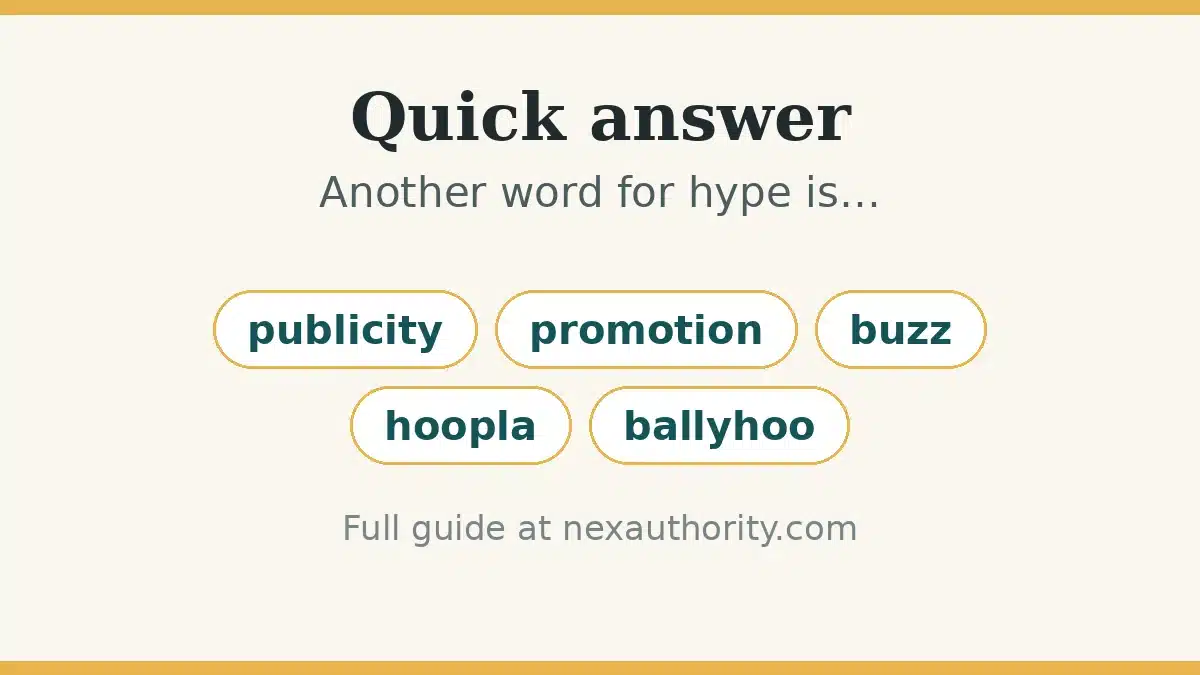
Hype means exaggerated publicity or promotion meant to build excitement, and the right synonym depends on your register: marketers say one thing, everyday speakers say another. The closest synonyms are publicity, promotion, buzz, hoopla, and ballyhoo, each covering a different corner of the word’s meaning.
Choose publicity for formal and marketing writing, where the media attention is the point. Choose promotion for the organised marketing effort behind a launch. Choose buzz for everyday talk, where the excited feeling matters most.
- Publicity — attention given by the media
- Promotion — organised effort to sell something
- Buzz — excited talk and anticipation
- Hoopla — loud, sensational promotion
- Ballyhoo — noisy, extravagant publicity
- Puffery — exaggerated praise in advertising
- Buildup — gradual rise in excitement
Synonyms for Hype: Full Tiered Table
| Synonym | Tier | Meaning (3-6 words) | Best for |
|---|---|---|---|
| Publicity | Exact | Attention given by media | News, launches, films |
| Promotion | Exact | Organised effort to sell | Marketing, products, events |
| Buzz | Exact | Excited talk, anticipation | Launches, trends, social media |
| Hoopla | Exact | Loud sensational promotion | Events, shows, launches |
| Ballyhoo | Exact | Noisy extravagant publicity | Show business, launches |
| Puffery | Near | Exaggerated praise in ads | Advertising, sales talk |
| Buildup | Near | Gradual rise in excitement | Films, sports, launches |
| Excitement | Near | Feeling of eager enthusiasm | Everyday, events, launches |
| Anticipation | Near | Eager expectation of something | Launches, fans, releases |
| Fanfare | Near | Showy public display | Openings, ceremonies, launches |
| Sensation | Near | Great public interest, excitement | Stars, products, news |
| Fervor | Near | Intense passionate feeling | Fans, causes, launches |
| Frenzy | Near | Wild uncontrolled excitement | Crowds, sales, launches |
| Razzmatazz | Near | Showy glamorous excitement | Entertainment, slang, events |
| Brouhaha | Near | Noisy excited fuss | Scandals, launches, debates |
| Advertising | Related | Paid messages to sell | Marketing, business writing |
| Marketing | Related | Selling and promoting goods | Business, formal writing |
| Public relations | Related | Managing a public image | Business, formal writing |
| Campaign | Related | Organised course of promotion | Elections, products, launches |
| Plug | Related | Informal mention to promote | Slang, media, casual writing |
| Exaggeration | Related | Statement beyond the truth | Writing, criticism, debate |
| Mania | Related | Excessive unreasonable enthusiasm | Fads, crowds, trends |
| Craze | Related | Short-lived popular fashion | Trends, slang, products |
| Commotion | Related | Noisy confused disturbance | Crowds, scenes, events |
| Spotlight | Related | Focused public attention | Stars, news, launches |
Hype Word Card
- Part of speech: noun (uncountable); also verb, hype up; adjective (slang)
- Pronunciation: UK /haɪp/, US /haɪp/
- Word forms: hype (noun, verb), hypes, hyped, hyping; hyped up (adjective)
- Register: informal; publicity and promotion suit formal and marketing writing, buzz and hoopla suit everyday talk
Top 10 Synonyms for Hype in Detail
Publicity
Publicity means the attention something gets from newspapers, television, and the internet. It is the closest swap for hype when you mean the media exposure itself. “The film got so much publicity that tickets sold out in a day.” Use it when the media attention matters most. Avoid it when you mean the excited feeling, where buzz or excitement sounds more natural.
Promotion
Promotion means the organised work of making people aware of a product, event, or idea so they will buy it or take notice. “The book’s promotion included radio interviews and a reading tour.” Use it for planned marketing that builds awareness and engagement rather than noise. Avoid it when the promotion is dishonest or absurdly overblown, where hype fits better.
Buzz
Buzz means the excited word-of-mouth talk and interest that builds around something before it happens. It is the closest swap for hype when you mean the feeling. “There is a real buzz around the new phone before its launch.” Use it for genuine, organic excitement shared by fans or buyers. Avoid it for a paid advertising push, where promotion or publicity is the plainer word.
Hoopla
Hoopla means loud, showy promotion full of noise and fuss, hinting the excitement is over the top. “The opening came with all the usual hoopla: banners, music, and cameras.” Use it when the promotion feels like a show in itself. Avoid it in formal writing, where publicity or promotion is safer.
Ballyhoo
Ballyhoo means noisy, extravagant publicity, often with a fairground or show-business flavour. It is an old-fashioned word with colour. “The circus arrived with a wave of ballyhoo across the town.” Use it when you want a vivid, old-style word for loud promotion. Avoid it for quiet campaigns or serious news, where it would sound out of place.
Puffery
Puffery means exaggerated praise used to sell something, the kind no reasonable buyer takes literally. “The advert’s puffery called the soap the finest in the world.” Use it when the praise itself is the point. Avoid it for the excitement around a launch, where buzz or buildup fits better, and for whole campaigns use overpromotion or sensationalism.
Buildup
Buildup means the slow rise in excitement and attention before an event or release. It often covers weeks of trailers, interviews, and talk before a film, a match, or a launch. “The buildup to the final match lasted for weeks.” Use it when the excitement grows over time. Avoid it for a sudden burst of noise, where hoopla or frenzy sounds more natural.
Excitement
Excitement means the feeling of eager enthusiasm about something that is about to happen. It is the plainest swap for the feeling side of hype. “The excitement in the hall was impossible to miss.” Use it when the feeling is honest, real, and organic. Avoid it when the feeling was manufactured by false claims, where hype is sharper.
Anticipation
Anticipation means the eager expectation of something that is coming. It is quieter than hype, with no hint of exaggeration. “Fans waited in anticipation for the album to drop.” Use it when the looking forward matters most. Avoid it when the talk is loud and overblown, where hype or hoopla fits better.
Fanfare
Fanfare means a showy public display, often with music and ceremony, that draws attention to something. It suits ribbons cut, bands playing, and crowds gathering for a first look. “The new store opened with a great deal of fanfare.” Use it for grand openings and ceremonies. Avoid it for the online chatter around a product, where buzz is the usual word.
Best Word by Situation
| Situation | Best pick | Why |
|---|---|---|
| Marketing copy | Promotion | The standard term for a planned campaign |
| Formal writing | Publicity | Neutral, standard term for media attention |
| Press release | Publicity | Clean and professional; no slang |
| Everyday conversation | Buzz | Short, warm, widely understood |
| Creative writing | Hoopla | Vivid and noisy; suits scenes and shows |

All Meanings of Hype
Hype as exaggerated publicity
Hype most often names exaggerated publicity, loud promotion that makes something seem bigger than it is. “There was a lot of hype before the film came out.” It warns that the noise may outrun the thing itself.
Hype as excitement and anticipation
Hype also names the excited feeling promotion creates, the eager talk before something arrives. “The hype around the concert was huge.” Close to buzz, it can sound warm rather than doubtful.
Hype as a verb (to hype, hype up)
As a verb, hype means to promote something with exaggerated publicity: to publicize, push, or talk it up. “We had to hype the film to attract the financiers.” Hype up means the same for a crowd: “The coach hyped up the team before the match.”
Hype as slang for excellent
In slang, hype also works as an adjective meaning excellent. “The new track has some really hype vocals.” This sense is informal music slang.
Common Collocations for Hype
Five natural combinations:
- hype up — “The presenter hyped up the crowd before the show.”
- media hype — “The media hype around the trial lasted for weeks.”
- hype machine — “The hype machine went into overdrive before the launch.”
- live up to the hype — “The film more than lived up to the hype.”
- all hype and no substance — “The gadget turned out to be all hype and no substance.”
Words People Confuse With Hype
Publicity
Publicity is the attention something gets from the media, good or bad, while hype is exaggerated promotion meant to build excitement. Publicity: “The charity got welcome publicity.” Hype: “The charity did not need hype.”
Buzz
Buzz is the excited talk people share among themselves; hype is the promotion that often starts it. Buzz: “Word of mouth created a buzz around the cafe.” Hype: “The launch relied on hype, not on buzz.”
Promotion
Promotion is the planned work of selling or spreading the word; hype is promotion pushed to an exaggerated level. Promotion: “The tour’s promotion was steady and honest.” Hype: “The tour’s hype promised a show it could not deliver.”
When NOT to Use Hype
Four common mistakes, each with a wrong and a corrected example.
- Calling ordinary advertising hype. Wrong: “The bakery put out hype for its new loaf.” Corrected: “The bakery put out an advert for its new loaf.”
- Calling honest excitement hype. Wrong: “The children felt hype about the snow.” Corrected: “The children felt excited about the snow.”
- Using hype as a formal adjective. Wrong: “Our hype product leads the market.” Corrected: “Our leading product tops the market.”
- Using hype for the product itself. Wrong: “The new hype was a great phone.” Corrected: “The new phone was great, despite all the hype.”
Antonyms of Hype by Context
These name the lack of noise or praise.
| Antonym | Type | Context |
|---|---|---|
| Understatement | Direct | Playing something down |
| Silence | Direct | No noise or talk at all |
| Disregard | Direct | Ignoring something entirely |
| Obscurity | Contextual | Nobody knows about it |
| Downplaying | Contextual | Reducing the praise |
| Letdown | Contextual | Reality below the promise |
| Apathy | Contextual | No interest at all |
Origin of the Word Hype
Hype is a back-formation of hyperbole, Greek for exaggeration, with roots in underworld slang: hype meant to swindle by overcharging (1926), from hyper, a short-change con man (1914), from hyper-, over, to excess. The verb dates from 1937 and the noun from 1967.
Frequently Asked Questions
What is another word for hype in marketing?
Promotion is the standard marketing word for hype, naming the organised effort behind a launch; publicity fits the media attention. Buzz suits the excited talk that follows; fanfare suits the showy display around an opening. Hoopla and ballyhoo work when the promotion is loud and showy.
What does hype mean?
Hype means exaggerated publicity or promotion that builds excitement around something. As a verb it means to promote something in that exaggerated way. The word always carries a hint that the claims may outrun the facts. In slang it can also mean excellent.
What is the difference between hype and publicity?
Publicity is any media attention, good or bad; hype is publicity pushed to an exaggerated level to build excitement. A story can get publicity without hype. Hype always carries the sense that the noise is bigger than the thing itself.
What are the antonyms of hype?
The main hype antonyms are understatement and silence, since hype is loud and overblown. Disregard and obscurity fit when something gets no attention at all. Downplaying and apathy work when praise or interest is missing. In short, quiet words stand against hype.
How do you use hype in a sentence?
Use hype for exaggerated promotion or the excitement it creates, always naming the thing being promoted. Two examples: “There was a lot of hype before the film came out.” And: “The band hyped up the crowd before the first song.”
Can I use hype in professional writing?
Use it sparingly in professional writing. In creative fields and internal messages it can pass, but formal reports, investor papers, and academic work need plainer words. Choose publicity for media attention, promotion for the campaign, or visibility and awareness for the result you want to measure.
Conclusion
Publicity is the best overall synonym for hype in formal and marketing writing, while buzz is the warmest swap for the excitement itself in everyday talk. Promotion fits the marketing effort, and hoopla suits loud, showy promotion in creative writing. For the full dictionary definition, see hype at the Cambridge Dictionary.