
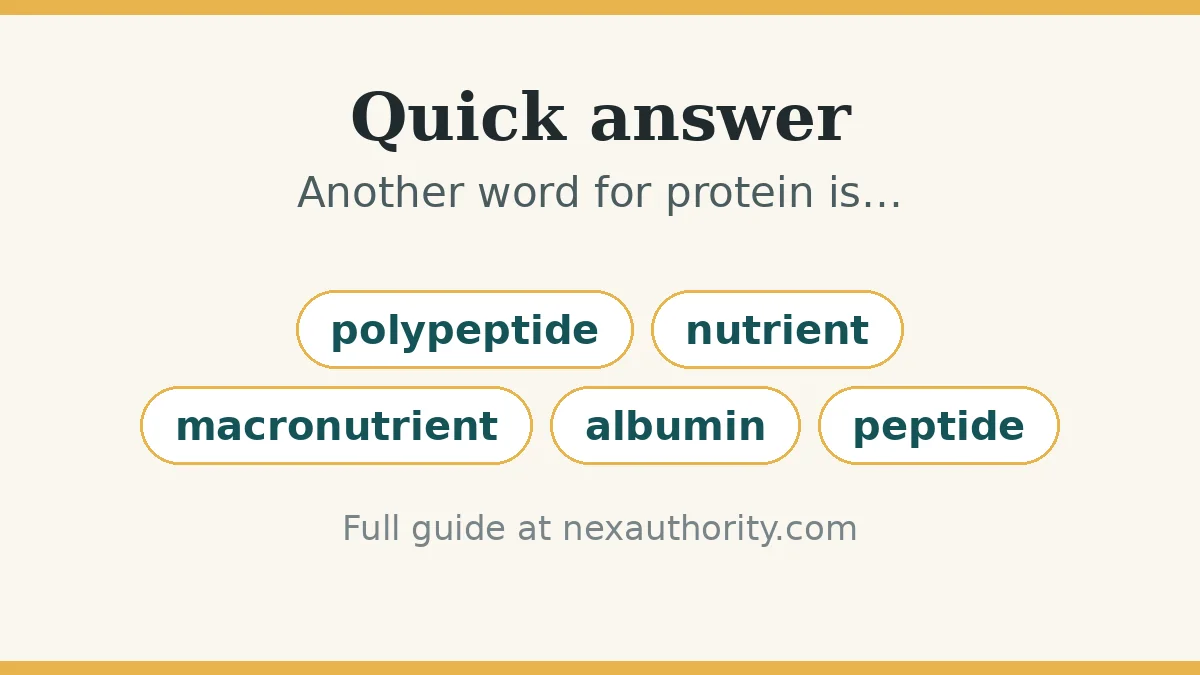
Protein means a molecule made of chains of amino acids, the nutrient, or a food rich in it, and in nutrition writing it depends on whether you mean the molecule, the nutrient, or the food. The closest synonyms are polypeptide, nutrient, macronutrient, albumin, and peptide, each covering a corner of the word’s meaning.
Choose nutrient for protein as food, one of three macronutrients. Choose macronutrient when protein sits beside carbohydrate and fat. Choose polypeptide for the molecule in science writing.
- Polypeptide — a chain of amino acids
- Nutrient — a substance that nourishes
- Macronutrient — a nutrient needed in bulk
- Albumin — a simple water-soluble protein
- Peptide — a short amino-acid chain
- Collagen — the protein in skin and bones
- Casein — the main protein in milk
Synonyms for Protein: Full Tiered Table
| Synonym | Tier | Meaning (3-6 words) | Best for |
|---|---|---|---|
| Polypeptide | Exact | Chain of amino acids | Science, biology |
| Proteid | Exact | Old term for protein | Historical writing |
| Albumin | Exact | Simple water-soluble protein | Science, blood, eggs |
| Globulin | Exact | Class of simple proteins | Science, blood, immunity |
| Albumen | Exact | Protein of egg white | Cooking, science |
| Macromolecule | Near | Very large molecule | Science, textbooks |
| Biopolymer | Near | Polymer made by life | Science, textbooks |
| Peptide | Near | Short amino-acid chain | Science, supplements |
| Nutrient | Near | Substance that nourishes body | Everyday, diet, health |
| Macronutrient | Near | Nutrient needed in bulk | Diet, fitness, health |
| Enzyme | Near | Protein that speeds reactions | Science, digestion |
| Collagen | Near | Protein in skin, bones | Health, beauty, joints |
| Casein | Near | Main protein in milk | Nutrition, dairy, fitness |
| Whey | Near | Protein from milk serum | Fitness, supplements |
| Amino acid | Near | Unit that builds proteins | Science, nutrition |
| Building block | Related | Basic unit of something | Everyday, teaching |
| Antibody | Related | Protein that fights infection | Science, health |
| Hormone | Related | Chemical messenger in body | Science, health |
| Keratin | Related | Protein in hair, nails | Beauty, biology |
| Gelatin | Related | Protein from boiled collagen | Cooking, food, science |
| Gluten | Related | Protein in wheat dough | Cooking, baking, diet |
| Fibrin | Related | Protein that forms clots | Science, blood |
| Proteome | Related | All proteins of an organism | Science, research |
| Haemoglobin | Related | Protein that carries oxygen | Science, blood |
| Protein powder | Related | Powdered protein supplement | Fitness, diet, shakes |
Protein Word Card
- Part of speech: noun (countable and uncountable)
- Pronunciation: UK /ˈprəʊ.tiːn/, US /ˈproʊ.tiːn/
- Word forms: protein (noun), proteins (plural)
- Register: neutral; nutrition, health, and diet writing
Top 10 Synonyms for Protein in Detail
Polypeptide
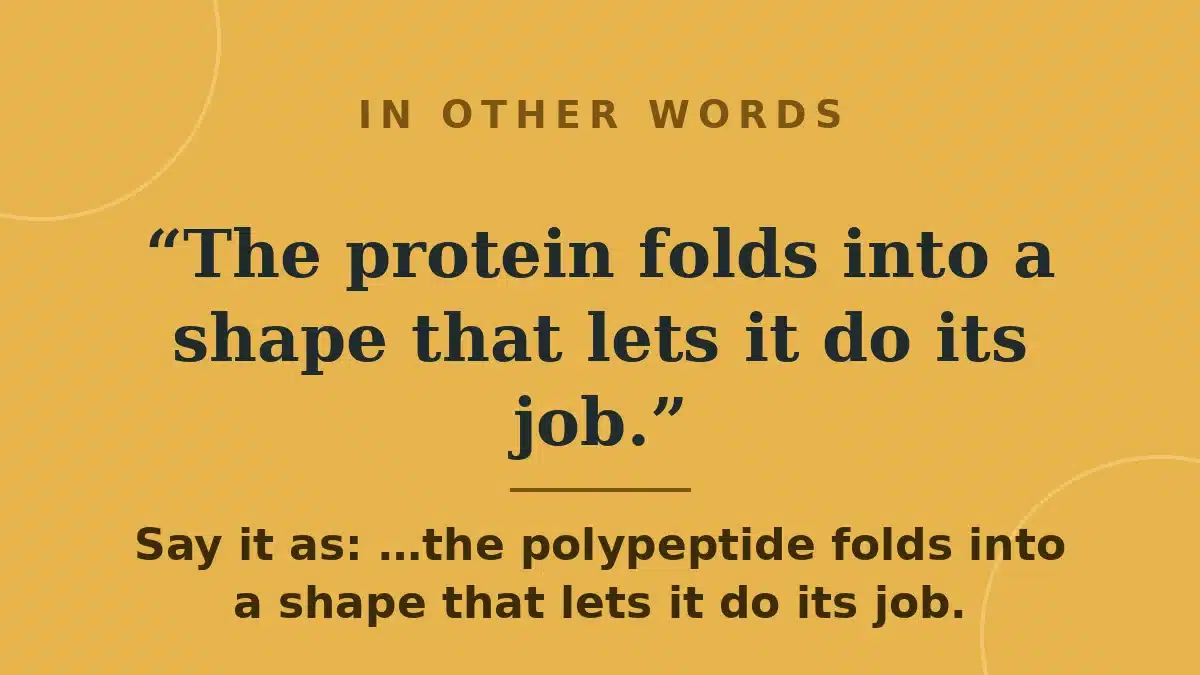
Polypeptide means an unfolded chain of amino acids joined by peptide bonds, and it is the closest scientific swap for protein. Nearly every protein is a polypeptide, though a short chain may not count. “The lab studied how the polypeptide folds into its working shape.” Use it in science writing. Avoid it for food, where nutrient is clearer.
Proteid
Proteid is an old word for protein, used in 19th-century books. A committee in 1907 fixed protein as the standard name, so proteid survives mostly in old texts. “The old paper calls the substance a proteid.” Use it only when quoting old science. Avoid it in modern writing, where protein is the expected word.
Albumin
Albumin means a simple protein that dissolves in water and is clotted by heat, found in egg white, milk, and blood. It is the best swap for one named protein. “Albumin in the blood carries hormones around the body.” Use it in science and health writing. Avoid it as a general word.
Globulin
Globulin means a class of simple proteins that dissolve in weak salt water, not pure water. Many work in the blood, including antibodies, also called immunoglobulins, that fight infection. “Globulin levels in the blood can show how the immune system is coping.” Use it for this class of proteins. Avoid it in everyday writing.
Albumen
Albumen means the white of an egg, the part that is almost pure protein and water. It is also the old science name for the protein itself. “Beat the albumen until it forms stiff peaks.” Use it in cooking and old texts about eggs. Avoid it for proteins in general; it belongs to eggs alone.
Macromolecule
Macromolecule means a very large molecule, usually a polymer of many smaller units. Proteins are macromolecules, along with DNA and starch. “A protein is a macromolecule built from amino acids.” Use it when the size of the molecule matters. Avoid it for protein as food, where nutrient or macronutrient fits better.
Biopolymer
Biopolymer means a polymer produced by a living thing, such as protein, DNA, or cellulose. It groups proteins, including glycoproteins, with other natural polymers. “Proteins are the most varied biopolymers in the cell.” Use it for the chemistry of living things. Avoid it in diet writing, where it sounds needlessly technical.
Peptide
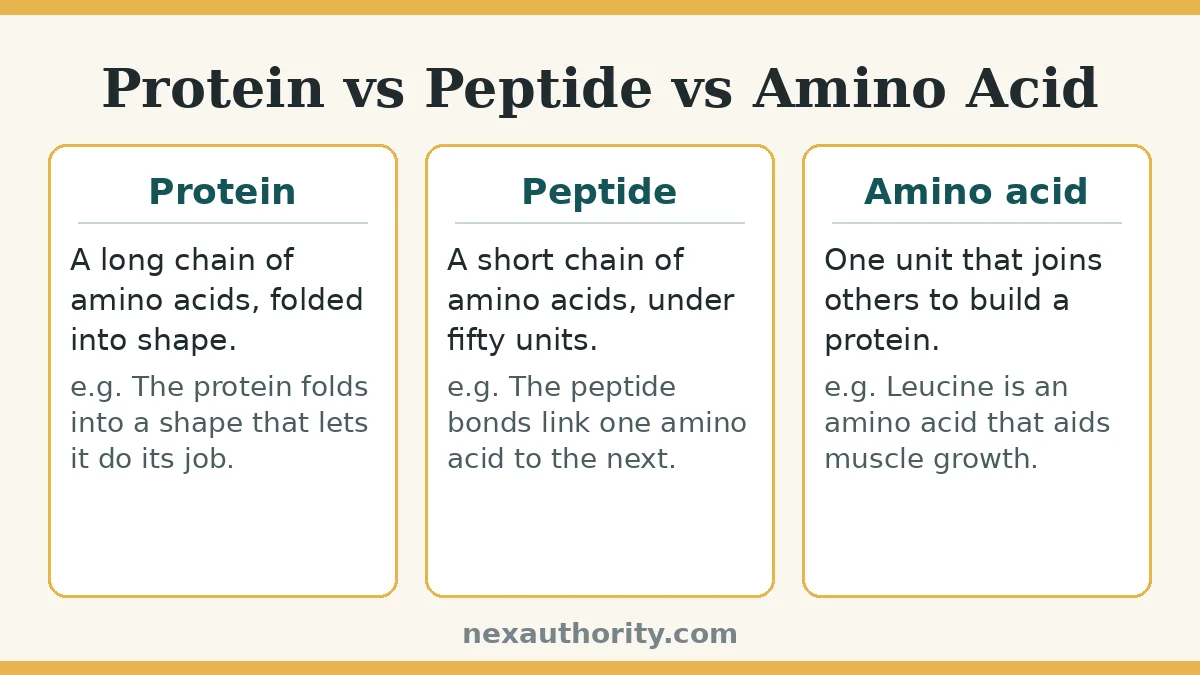
Peptide means a short chain of amino acids, usually under about fifty units, while a protein is a long folded chain. “The peptide bonds link one amino acid to the next.” Use it when the short chain or the bond matters. Avoid it as a straight swap for protein; a peptide is shorter and simpler.
Nutrient
Nutrient, close to nutriment, means a substance that gives nourishment and keeps the body growing and working. Protein is one of the main nutrients, along with carbohydrate and fat. “Protein is a nutrient the body needs every day.” Use it in everyday and health writing. Avoid it when the molecule matters, where polypeptide is sharper.
Macronutrient
Macronutrient means a nutrient the body needs in bulk; there are only three: protein, carbohydrate, and fat. “Of the three macronutrients, protein is the one that builds muscle.” Use it in diet, fitness, and health writing. Avoid it when you mean a single protein molecule, where polypeptide is the right word.
Best Word by Situation
| Situation | Best pick | Why |
|---|---|---|
| Nutrition article | Nutrient | Plain, clear for food and diet writing |
| Diet and fitness writing | Macronutrient | Standard term for the three big nutrients |
| Science writing | Polypeptide | Precise term for the molecule |
| Beauty and joints writing | Collagen | Standard term for the skin-and-bones protein |
| Supplement guide | Whey | Standard term for milk-serum protein powder |
All Meanings of Protein
Protein as a molecule
Protein most often names a large molecule made of long chains of amino acids. “The protein folds into a shape that lets it do its job.” Enzymes, antibodies, and hormones such as insulin are all proteins, each with its own shape and job.
Protein as a nutrient
Protein also names the nutrient, the part of food that builds and repairs tissue. “You need enough protein in your diet to stay strong.” This is the sense most people meet first, on labels.
Protein as a food
Protein can also name a food rich in it, such as meat, fish, eggs, or tofu — animal protein or plant protein. “Add lean protein to the plate, such as chicken or beans.” Here the word stands for the food.
Protein as a supplement
In everyday talk, protein often means a protein powder or shake taken after exercise. “He drinks a protein after every workout.” This is shorthand for a product.
Common Collocations for Protein
Five natural combinations:
- protein powder — “She mixes protein powder into her morning smoothie.”
- high-protein diet — “A high-protein diet helps many people feel full.”
- protein shake — “He had a protein shake after the gym.”
- complete protein — “Eggs are a complete protein, with all nine essential amino acids.”
- protein synthesis — “Sleep supports protein synthesis.”
Words People Confuse With Protein
Peptide
Peptide is a short chain of amino acids, while a protein is a long folded chain. Peptide: “The peptide has only twelve amino acids.” Protein: “The protein has hundreds and a fixed shape.”
Amino acid
Amino acid is one unit that joins others to build a protein, the finished chain. Amino acid: “Leucine is an amino acid that aids muscle growth.” Protein: “The steak is rich in protein, built from amino acids.”
Enzyme
Enzyme is a protein that speeds up a reaction, while not every protein is an enzyme. Enzyme: “The enzyme breaks down starch in the mouth.” Protein: “The antibody is a protein, but it is not an enzyme.”
When NOT to Use Protein
Four common mistakes, each with a wrong and a corrected example.
- Calling a single amino acid a protein. Wrong: “Leucine is the protein that builds muscle.” Corrected: “Leucine is the amino acid that builds muscle.”
- Calling a vitamin a protein. Wrong: “Vitamin C is a protein your body needs.” Corrected: “Vitamin C is a vitamin your body needs.”
- Calling a low-protein food a protein. Wrong: “Bread is a good protein.” Corrected: “Bread is a carbohydrate food, not a protein.”
- Using protein for nitrogen in fertiliser. Wrong: “This fertiliser is high in protein.” Corrected: “This fertiliser is high in nitrogen.”
Antonyms of Protein by Context
Protein has no true opposite. These name what it is not, in food and in the body.
| Antonym | Type | Context |
|---|---|---|
| Carbohydrate | Contextual | Another macronutrient |
| Fat | Contextual | Another macronutrient |
| Sugar | Contextual | Quick energy, no building |
| Starch | Contextual | Stored plant energy |
| Lipid | Contextual | Fat molecule, not protein |
| Non-protein | Direct | Anything without protein |
| Empty calorie | Contextual | Energy with no nutrients |
Origin of the Word Protein
Protein was coined in 1838 by Dutch chemist Gerhard Johan Mulder, from French protéine and Greek prōteios, first quality, from prōtos, first. It entered English in 1844; a committee in 1907 fixed its modern meaning as a class of compounds found in all living things, and set aside the older word proteid.
Frequently Asked Questions
What is another word for protein in nutrition writing?
Nutrient is the plainest word for protein in nutrition writing when you mean food, and macronutrient fits when protein sits beside carbohydrate and fat. Complete protein suits a food with all nine essential amino acids, while polypeptide belongs in science writing about the molecule.
What does protein mean?
Protein means a large molecule made of chains of amino acids that builds and repairs body tissue. It also means the nutrient, or a food rich in it, like meat, fish, or eggs. In everyday talk it can mean a protein powder or shake.
What is the difference between a protein and a peptide?
A peptide is a short chain of amino acids, usually under about fifty units, while a protein is a long chain folded into a fixed shape. Every protein is a polypeptide, but not every polypeptide is a protein. Length and folded shape set a protein apart.
Is collagen a protein?
Yes, collagen is a protein, the most abundant one in the human body, found in skin, bones, and tendons. It gives tissue its strength and shape. Collagen is an incomplete protein, though, since it lacks the amino acid tryptophan, so it cannot be your only protein source.
What foods are high in protein?
Meat, fish, eggs, and dairy are the richest protein sources, with chicken, salmon, and Greek yogurt at the top. Plant protein sources include beans, lentils, tofu, chickpeas, and nuts. A meal pairing grains with beans covers daily protein intake and all nine essential amino acids.
What is the adjective form of protein?
Proteinaceous is the adjective for protein. It means made of protein or like protein, so you can write about proteinaceous foods or proteinaceous tissue in science writing. It is rare in everyday and nutrition writing, where protein itself or protein-rich does the job. Use it only when the adjective form fits the sentence.
Conclusion
Nutrient is the best overall synonym for protein in nutrition writing when you mean protein as food, and macronutrient fits diet writing best. Polypeptide suits the molecule itself, and albumin fits a specific simple protein. For the full dictionary definition, see protein at the Cambridge Dictionary.