
Undead means dead but still moving and acting as if alive, usually through magic or supernatural force, and in horror and fantasy writing it is the umbrella word for every creature that refuses to stay in the grave, from the walking dead to the reanimated corpse. The closest synonyms are zombie, vampire, revenant, ghost, and living dead, each naming a different kind of risen dead for your story.
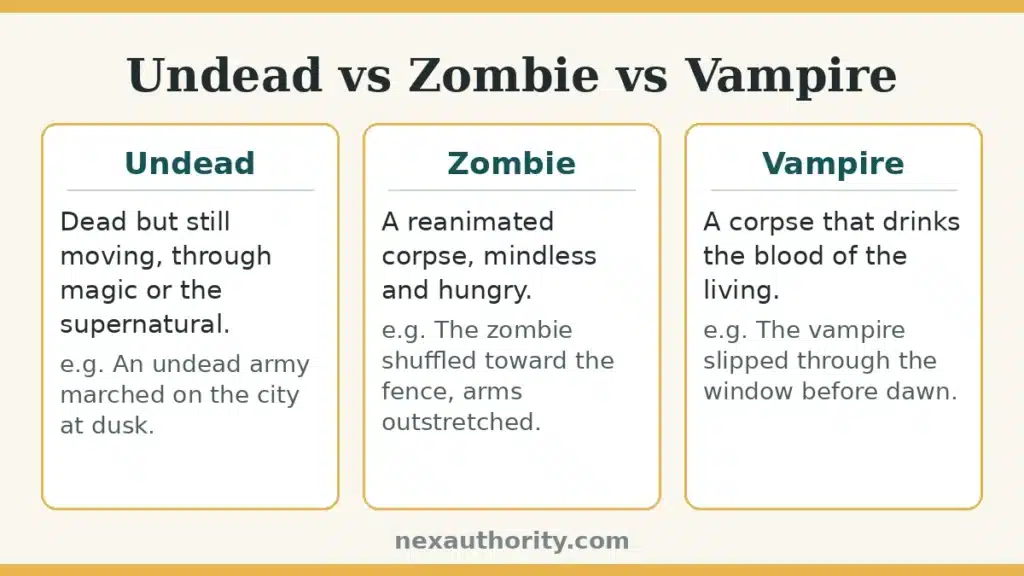
Choose zombie for a mindless corpse that hungers. Choose vampire when the creature drinks blood and fears the sun. Choose revenant when the dead return for revenge.
- Zombie — a reanimated corpse, mindless and hungry
- Vampire — a blood-drinking corpse that lives at night
- Revenant — a dead person returned, often for revenge
- Ghost — the spirit of a dead person
- Living dead — dead people still walking
- Ghoul — a grave-robbing monster

Synonyms for Undead: Full Tiered Table
| Synonym | Tier | Meaning (3-6 words) | Best for |
|---|---|---|---|
| Zombie | Exact | Reanimated corpse, mindless | Horror, films, games |
| Vampire | Exact | Blood-drinking risen corpse | Horror, fantasy, films |
| Revenant | Exact | Dead person who returns | Horror, folklore, gothic |
| Ghost | Exact | Spirit of a dead person | Horror, stories, folklore |
| Living dead | Exact | Dead people still moving | Horror, films, games |
| Ghoul | Near | Grave-robbing flesh eater | Horror, folklore, games |
| Wraith | Near | Pale shadowy spirit | Gothic, fantasy, poetry |
| Specter | Near | Frightening ghostly figure | Literature, horror, formal |
| Phantom | Near | Ghostly unreal appearance | Stories, theatre, songs |
| Apparition | Near | Spirit that suddenly appears | Stories, horror, formal |
| Mummy | Near | Preserved corpse, reanimated | Horror, films, museums |
| Skeleton | Near | Animated bones of dead | Games, horror, fantasy |
| Nosferatu | Near | Vampire, old literary name | Horror, films, literature |
| Walker | Near | Shuffling reanimated corpse | Games, horror, TV |
| Draugr | Near | Norse undead of barrows | Myth, games, fantasy |
| Demon | Related | Evil supernatural being | Horror, folklore, religion |
| Monster | Related | Frightening unnatural creature | Horror, stories, films |
| Fiend | Related | Cruel evil being | Horror, fantasy, literature |
| Spirit | Related | Non-physical being or soul | Religion, stories, folklore |
| Shade | Related | Shadow of dead person | Poetry, myth, literature |
| Poltergeist | Related | Noisy troublesome ghost | Horror, folklore, films |
| Banshee | Related | Wailing Irish spirit | Folklore, horror, fantasy |
| Lich | Related | Undead wizard, fantasy | Games, fantasy, fiction |
| Wight | Related | Barrow spirit, old word | Fantasy, Tolkien, games |
| Corpse | Related | Dead body, not moving | Forensic, horror, formal |
Undead Word Card
- Part of speech: adjective; also noun (the undead)
- Pronunciation: UK /ʌnˈded/, US /ʌnˈded/
- Word forms: undead (adjective); noun: the undead
- Register: neutral in horror and fantasy; rare elsewhere
Top 10 Synonyms for Undead in Detail
Zombie
Zombie means a dead body brought back to life, usually without a mind of its own. It is the first word most writers reach for. “The zombie shuffled toward the fence, arms outstretched.” Use it for shambling corpses in horror stories and films. Avoid it when the creature can think or plan.
Vampire
Vampire means a corpse that drinks the blood of the living. It is the best-known kind of undead, made famous by Bram Stoker’s Dracula. “The vampire slipped through the window before dawn.” Use it when the creature is cunning, charming, and shuns the sun. Avoid it for mindless corpses, since a vampire thinks and schemes.
Revenant
Revenant means a dead person who returns to the world of the living, often with unfinished business. The word comes from French revenir, “to come back”. “The revenant haunted the hall where he had been betrayed.” Use it when the return has a purpose. Avoid it for creatures that rise with no reason.
Ghost
Ghost means the spirit of a dead person. Unlike a zombie or vampire, a ghost has no solid body, so it can pass through walls. “A ghost drifted down the stairs at midnight.” Use it when the dead one is a spirit, not a walking corpse. Avoid it when the creature has flesh.
Living dead
Living dead means people who are dead yet still walk as if they were alive. The phrase names the whole group. “The living dead filled the streets by nightfall.” Use it for a general term rather than one kind of creature. Avoid it for a ghost, since the phrase points to a crowd.
Ghoul
Ghoul means a monster that haunts graveyards and feeds on the dead. It comes from Arabic ghul, a demon, and reached English through tales of grave robbers. “A ghoul crouched beside the tombstones.” Use it for a creature tied to graves and rot. Avoid it for a spirit, since a ghoul is always hungry.
Wraith
Wraith means a ghost or spirit, a pale, shadowy figure. The word is Scots in origin and carries a cold, eerie feel for gothic stories. “A wraith glided across the moor.” Use it when the spirit is silent and hard to see. Avoid it for a solid corpse, since a wraith has no body.
Specter
Specter means a ghost, especially one that looks frightening. The American spelling is specter; British writing uses spectre. “The specter of the old captain still walks the pier.” Use it for a formal, literary word for a haunting spirit. Avoid it for a walking corpse, since a specter has no flesh.
Phantom
Phantom means a ghost or spirit that seems real but is not. The word comes from Greek phantasma, an appearance, and fits stage, story, and song. “The phantom of the opera haunted the theatre.” Use it when the spirit is a vision. Avoid it for a corpse, since a phantom is all shadow.
Apparition
Apparition means a ghost or spirit that appears to someone. The word stresses the moment of appearing, so it suits a startling sight. “An apparition stood at the foot of her bed.” Use it when the ghost appears, then fades. Avoid it for a creature that stays, since an apparition is a brief sight.
Best Word by Situation
| Situation | Best pick | Why |
|---|---|---|
| Short horror story | Zombie | The classic shambling corpse; readers picture it at once |
| Gothic novel | Wraith | Cold, eerie, and suited to slow dread |
| Fantasy epic | Vampire | Cunning, charming, and tied to old legends |
| Screenplay or game text | Living dead | Plain collective term; clear in stage directions |
| Folk-horror tale | Revenant | A dead person returned with a purpose |
| Tabletop game | Skeleton | Bony, rattling, and easy to picture in a dungeon |
All Meanings of Undead
Undead as an adjective
As an adjective, undead describes a dead being that moves and acts as if alive. “The undead knight raised his sword.”
Undead as a noun
As a noun, undead appears as the undead, naming the whole group at once. “The undead rose from their graves at midnight.” Use it when you mean every kind of reanimated being together.
Undead in games and horror fiction
In games and horror fiction, undead is a category, not a single monster. Zombies, vampires, skeletons, and ghosts all sit under it, often raised by a necromancer. In Dungeons & Dragons they form a whole monster type.
Undead in folklore
In folklore, the undead appear in most cultures, from Norse draugar and Slavic vampires to the Chinese jiangshi. The fear is the same everywhere: the dead refusing to rest. Bram Stoker’s Dracula fixed the modern sense in 1897.
Common Collocations for Undead
Five natural combinations:
- undead army — “The undead army marched through the valley.”
- undead horde — “An undead horde pressed against the gates.”
- rise of the undead — “The rise of the undead began at midnight.”
- undead creature — “Each undead creature feared the dawn.”
- army of the undead — “An army of the undead filled the streets.”
Words People Confuse With Undead
Zombie
Zombie is one kind of undead, a reanimated corpse that hungers. Undead is the wider term that also covers vampires, ghosts, and mummies. Zombie: “The zombie groaned and reached for the fence.” Undead: “The undead filled the graveyard.”
Vampire
Vampire is an undead creature that drinks blood and shuns the sun. All vampires are undead, but not all undead are vampires. Vampire: “The vampire bowed in the dark.” Undead: “The undead gathered in the hall.”
Immortal
Immortal means never dying, while undead means already dead but still moving. A god is immortal; a zombie is undead. Immortal: “The gods were immortal.” Undead: “The undead knight had died a hundred years before.”
When NOT to Use Undead
Four common mistakes, each with a wrong and a corrected example.
- Calling a tired person undead. Wrong: “He looked undead after the long drive.” Corrected: “He looked half dead after the long drive.”
- Using undead for someone asleep. Wrong: “She lay undead on the sofa all afternoon.” Corrected: “She lay fast asleep on the sofa all afternoon.”
- Using undead for a god that never died. Wrong: “The mountain gods were undead.” Corrected: “The mountain gods were immortal.”
- Using undead for a machine that starts again. Wrong: “The old engine came back undead.” Corrected: “The old engine started up again.”
Antonyms of Undead by Context
These name the living, or the dead at rest.
| Antonym | Type | Context |
|---|---|---|
| Living | Direct | Alive and breathing |
| Alive | Direct | Not dead at all |
| Mortal | Contextual | Able to die, still living |
| Breathing | Contextual | With breath and a heartbeat |
| Dead and buried | Contextual | A corpse that stays at rest |
| At rest | Contextual | The dead, undisturbed |
Origin of the Word Undead
Undead comes from un-, “not”, plus dead, first recorded around 1400 as undede, meaning “still living, not slain”. The modern sense grew from Bram Stoker’s Dracula in 1897, where “the Un-Dead” named vampires. The wider use came later, and science now raises the dead too, as in Frankenstein.
Frequently Asked Questions
What is another word for undead in horror writing?
Zombie is the closest word for undead when you mean a reanimated corpse, and vampire fits blood-drinkers. Revenant is best when a dead person returns with a purpose, while ghost fits a spirit with no body. Living dead is the plain general term for the whole crowd.
What does undead mean in a horror story?
In a horror story, undead means dead but still moving and acting as if alive, usually through magic or a curse. It covers corporeal beings such as vampires and zombies, and incorporeal ones such as ghosts, and it works as an adjective, as in an undead army, or as a noun, as in the undead.
What is the difference between undead and zombie?
Undead is the broad term for anything dead that still moves, while a zombie is just one kind of undead. A zombie is a reanimated corpse, usually mindless and hungry. Vampires, ghosts, and mummies are undead too, but none of them is a zombie.
Are vampires undead?
Yes, vampires are undead. A vampire is a corpse that rises from the grave to drink the blood of the living, the classic undead creature. Bram Stoker used “the Un-Dead” for vampires in Dracula, published in 1897, and that book fixed the modern meaning.
Which undead word is best for a scary scene?
Zombie is the safest pick for a scary scene, since every reader pictures a shambling, rotting corpse at once. Wraith suits slow, cold dread in gothic writing, while revenant fits a ghost with unfinished business. Save vampire for a creature that thinks, schemes, and charms its victims.
How do you use undead in a sentence?
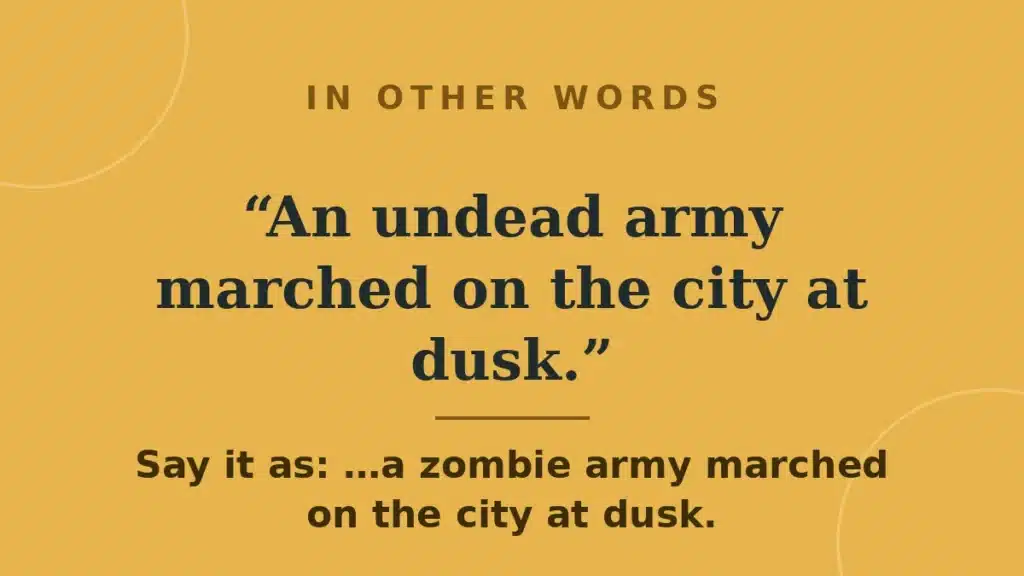
Use undead for a dead being that still moves, as an adjective before a noun or as a noun with the. Two examples: “An undead army marched on the city at dusk.” And: “The old castle was said to be home to the undead.”
Conclusion
Zombie is the best overall synonym for undead in horror writing when you mean a reanimated corpse, and vampire fits the blood-drinking kind. Revenant is the sharpest choice when the dead return with a purpose, so save it for ghosts with unfinished business. For the full dictionary definition, see undead at Merriam-Webster.