
Times means repeated occasions on which something happens, a number multiplied by another number, or a period in history. The closest synonyms for the word itself are occasions, instances, occurrences, repetitions, and episodes, each covering a different corner of the word’s meaning.
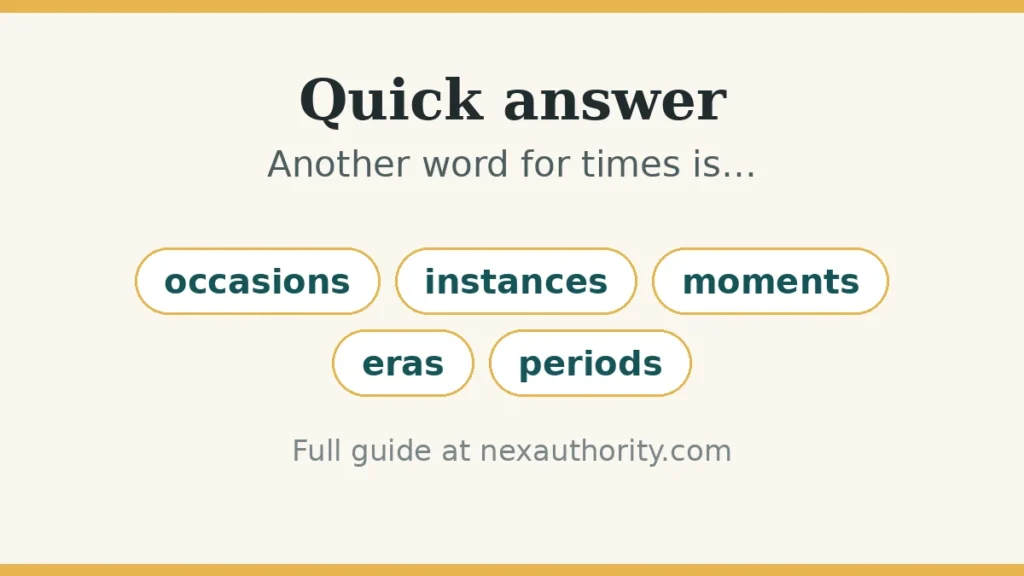
Choose occasions for events counted one by one, as in visits. Choose instances for single cases in writing or records. Choose repetitions when the same act happens again and again, as in practice or drills.
- Occasions — single events, counted one by one
- Instances — single cases in writing or records
- Occurrences — events that happen, often unplanned
- Repetitions — the same act done again
- Episodes — single events in a longer story
- Moments — brief periods or points in time
Synonyms for Times: Full Tiered Table
| Synonym | Tier | Meaning (3-6 words) | Best for |
|---|---|---|---|
| Occasions | Exact | Single events, counted one by one | Visits, meetings, events |
| Instances | Exact | Single cases in records | Formal, academic writing |
| Occurrences | Exact | Events that happen | Reports, formal writing |
| Repetitions | Exact | Same act done again | Practice, drills, training |
| Episodes | Exact | Single events in a story | Stories, medical writing |
| Moments | Near | Brief periods or points | Everyday, literary writing |
| Periods | Near | Stretches of time | History, general writing |
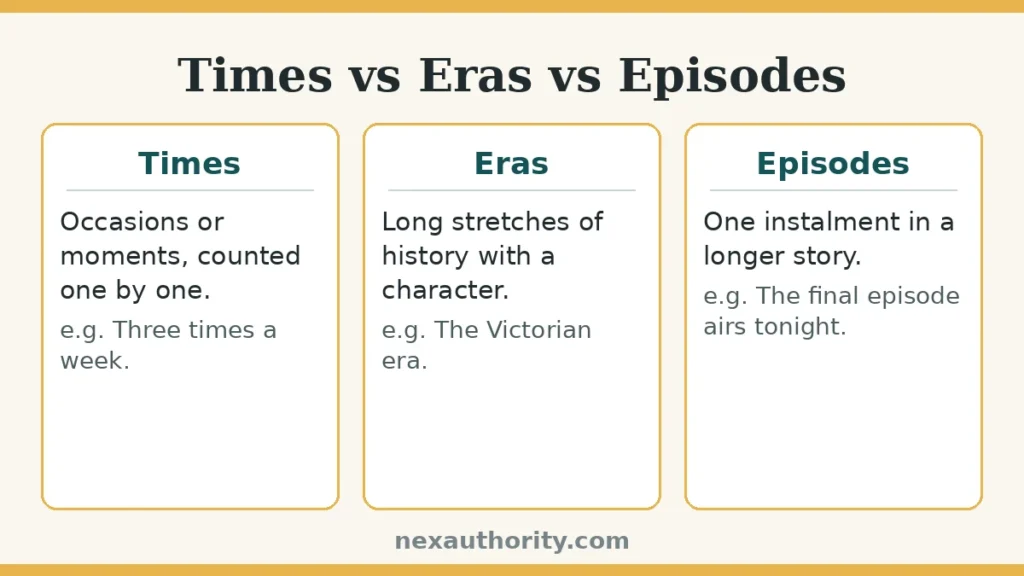
| Eras | Near | Long distinct periods | History, formal writing |
| Epochs | Near | Marked periods in history | Academic, formal writing |
| Spells | Near | Runs of time or weather | Everyday, British writing |
| Intervals | Near | Gaps between events | Music, sports, formal writing |
| Phases | Near | Stages in a process | Science, project writing |
| Stint | Near | Fixed period of work | Jobs, army, projects |
| Stretches | Near | Unbroken runs of time | Everyday writing |
| Cycles | Near | Rounds that repeat | Science, economics |
| Durations | Related | Lengths of time | General writing |
| Lifetimes | Related | Spans of a life | General, literary writing |
| Ages | Related | Long periods of history | History, formal writing |
| Generations | Related | Groups born together | Social, historical writing |
| Multiplication | Related | Times as times tables | Math, school writing |
| Hours | Related | Units of sixty minutes | Everyday writing |
| Minutes | Related | Units of sixty seconds | Everyday writing |
| Years | Related | Units of twelve months | General writing |
| Decades | Related | Periods of ten years | History, general writing |
| Centuries | Related | Periods of one hundred years | History, formal writing |
Times Word Card
- Part of speech: noun (plural of time); preposition in multiplication
- Pronunciation: US /taɪmz/, UK /taɪmz/
- Word forms: times, timed, timing, timeless
- Register: neutral; standard in math and comparisons
Top 10 Synonyms for Times in Detail
Occasions
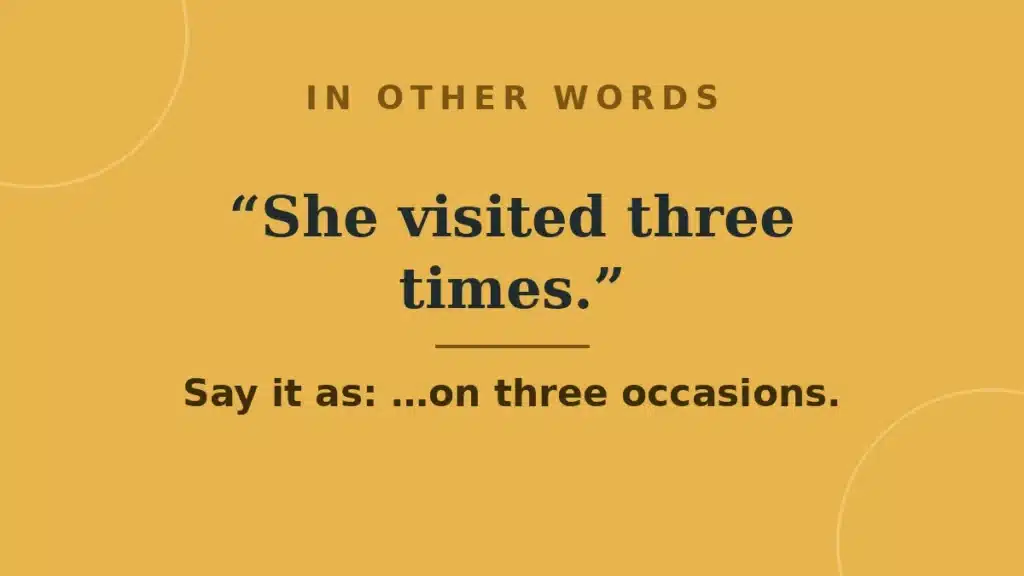
Occasions means single events counted one by one, such as visits, meetings, or celebrations. It is the everyday counting word, warm, plain, and clear. “On three separate occasions, the package arrived late.” Use it when events are counted as units. Avoid it for multiplication, where times itself does the work.
Instances
Instances means single cases or examples, often in writing, records, or research. It is formal and precise, the word of reports and studies. “The study found only two instances of the error in ten years.” Use it for cases cited as evidence. Avoid it for casual talk about visits or outings.
Occurrences
Occurrences means events that happen, often without planning, and it suits reports and formal writing. It sounds much cooler and more distant than occasions. “Occurrences of flooding rose sharply after the storm.” Use it for events recorded in data and reports. Avoid it for happy personal events, where occasions sounds warmer and kinder.
Repetitions
Repetitions means the same act done again, often in daily practice, drills, or training sessions. It stresses sameness, not just mere counting. “Ten repetitions of the exercise build strength in the shoulder.” Use it when sameness, practice, and training are the point. Avoid it for single one-off events that never repeat.
Episodes
Episodes means single events that form part of a longer story, illness, or series, and the good times of a life are episodes too. It suits medical writing, history, and television. “She described one episode of dizziness that lasted an hour.” Use it when the event belongs to a larger sequence, not for plain counting.
Moments
Moments means brief periods or single points in time, often with feeling attached. It is the literary and everyday word for short, vivid slices of time. “There were moments when the whole room fell silent.” Use it for brief, felt periods. Avoid it for math, where it says nothing about numbers.
Periods
Periods means stretches of time with a beginning and an end, such as a school term or a phase of history. A stint is a fixed period of work, as in a stint in the army. “The house stood empty for long periods in winter.” Use it for stretches with clear bounds, not for single counted events.
Eras
Eras means long, distinct periods marked by a person, style, or event, such as the Victorian era, while an eon is longer still. It is formal, implying a break from what came before. “The steam train defined an era of travel.” Use it for long periods with a clear character. Avoid it for short or ordinary stretches.
Epochs
Epochs means marked periods in history or science, often opened by a discovery or event. It is the most formal word here, common in academic writing. “The discovery opened a new epoch in medicine.” Use it for turning points in history or science. Avoid it for everyday talk, where periods fits better.
Spells
Spells means runs of time or weather, often short, as in a cold spell or a spell of silence. It is everyday and slightly British in flavor. “We had a dry spell that lasted six weeks.” Use it for runs of weather or mood. Avoid it for counted events or multiplication.
Best Word by Situation
| Situation | Best pick | Why |
|---|---|---|
| Formal writing | Instances | Precise, formal register; standard in reports |
| Academic writing | Occurrences | Neutral term for events recorded in data |
| Business email | Occasions | Plain counting word; clear in schedules and visits |
| Everyday conversation | Occasions | Widely understood, warm, one word |
| Creative writing | Moments | Brief, felt slices of time suit scenes |
| Music writing | Tempo | Waltz time and three-four time |
| Life stories and memoirs | Experiences | Good times are lived experiences |
All Meanings of Times
Times as repeated occasions
In its most common use, times counts how often something happens: three times, the first time. The plural marks each repeat as a unit, and “How many times have you visited Rome?” asks for a count.
Times as multiplication
In math, times is a preposition meaning multiplied by: two times two equals four, three times six is eighteen. It also serves in comparisons — she earns five times as much as he does — and the sense is scaling, not counting.
Times as comparisons of amount
Tied to multiplication, times shows the difference between two amounts by scaling one of them. “Ten times better” means much better, stated as a multiple, and “three times the size” means threefold. This use is informal for judgments, and exact for measured ratios.
Times as periods or eras
As the plural of time, times also names stretches of history: in ancient times, in modern times, in hard times. “The times” can mean the current age, as in a sign of the times, and “at times” means sometimes.
Times as musical tempo
In music, time names the beat pattern of a piece: waltz time is three beats to the bar. Players say a piece is ‘in three-four time’, and tempo, rhythm, beat, and measure are the working words. The sense is pattern, not counting.
Common Collocations for Times
Five natural combinations:
- three times a day — “Take one tablet three times a day with food.”
- time after time — “Time after time, the old bridge survived the floods.”
- at times — “At times, the work felt endless.”
- good times — “We had good times on that road trip.”
- ten times better — “The new plan is ten times better than the last one.”
Words People Confuse With Times
Time
Time is the singular flow measured in minutes and years; times counts or multiplies. Time: “Time passes quickly on holiday.” Times: “We went back three times.”
Sometimes
Sometimes is an adverb meaning now and then; times is a plural noun or preposition. Sometimes: “Sometimes the shop closes early.” Times: “The shop closed three times last week.”
Double
Double means twice as much; times covers any number. Double: “The recipe makes a double batch.” Times: “The recipe makes four times the usual batch.”
When NOT to Use Times
Four common mistakes, each with a wrong example and a corrected one.
- Saying “one times”. One takes the singular. Wrong: “I visited the museum one times.” Corrected: “I visited the museum one time.”
- Using times for clock time. Readings use the singular. Wrong: “What times is the meeting?” Corrected: “What time is the meeting?”
- Writing “three times more than” for exact claims. It is ambiguous: threefold or fourfold. Wrong: “Sales rose three times more than last year.” Corrected: “Sales rose to three times last year’s level.”
- Mixing “at times” with “at the time.” At times means sometimes. Wrong: “At times, she was only nineteen.” Corrected: “At the time, she was only nineteen.”
Antonyms of Times by Context
These antonyms name a single occurrence, or none at all.
| Antonym | Type | Context |
|---|---|---|
| Once | Direct | A single occurrence |
| Never | Direct | Zero occurrences |
| Rarely | Contextual | Very few occurrences |
| Seldom | Contextual | Few occurrences, formal tone |
| Single | Contextual | One instance only |
| One-off | Contextual | Happening only once |
| Unrepeated | Contextual | Not done again |
| First-time | Contextual | Done for the first time |
Origin of the Word Times
Times comes from time, Old English tima, meaning a space of time. It traces to a Germanic root, from an older root meaning to divide. The repeated-instance sense, as in how many times, dates to the mid-1300s. The multiplied-by sense grew from phrases counting favors many times over.
Frequently Asked Questions
What is another word for times?
Occasions is the closest everyday word for times when events are counted one by one, as in visits. Instances fits formal writing, and repetitions fits the same act done again. Pick the word that matches the count: events, cases, or repeats.
What does times mean?
The times definition has three parts: repeated occasions, a number multiplied by another number, and stretches of history. In counting, times marks each repeat. In math, it links numbers. In history, it names periods, as in ancient times or hard times.
What are the antonyms of times?
The main times antonyms are once and never: once names a single occurrence, and never names zero. Rarely and seldom fit when something happens few times, and one-off names an event that happens only once. Each one answers the counting sense, not the math sense.
How do you use times in a sentence?
Use times for counted repeats, multiplication, or periods, with a number beside it. Two models: “We met four times last month.” And: “Six times four equals twenty-four.” Keep the sense clear: a count needs a number, and a period needs a name.
Is it “one time” or “one times”?
One time is correct. One takes the singular, and the plural times starts at two: two times, three times, many times. The same rule holds in phrases: the first time, not the first times. Keep one time for a single event, and times above one.
What does “good times” mean?
Good times means enjoyable experiences, often shared with friends or family — holidays, nights out, and days you still talk about years later. It is warm and informal, and it always points to the past. Use it for memories, not for a single event.
Conclusion
Occasions is the best overall synonym for times when events are counted one by one. For formal records, instances fits better; for practice and drills, repetitions is the pick. For the full dictionary definition, see times at the Cambridge Dictionary.