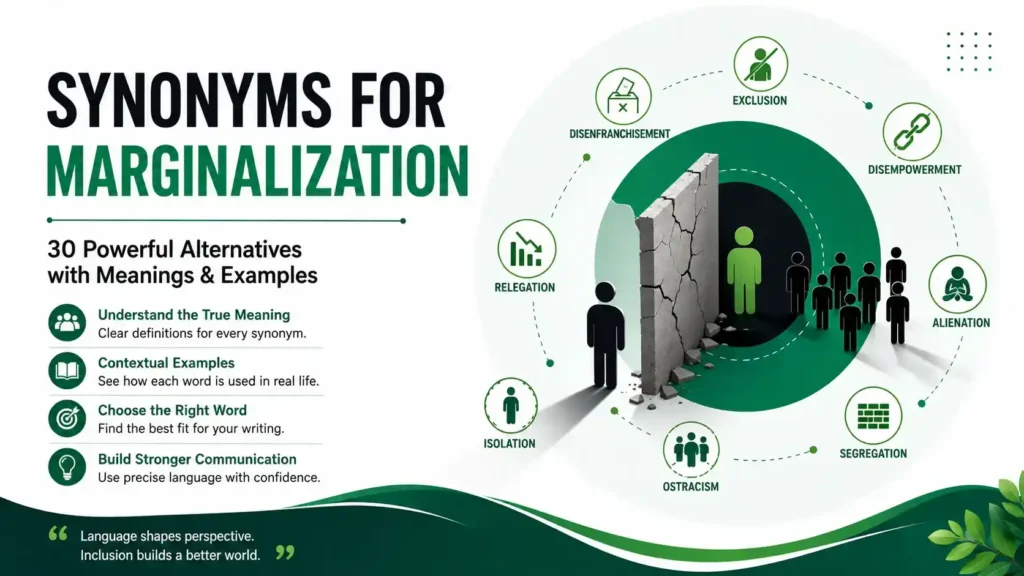

Synonyms for marginalization (noun) (/ˌmɑːrdʒɪnələˈzeɪʃən/) describe the process of pushing a person, group, idea, or community to the edge of society, power, or participation. The closest alternatives include social exclusion, exclusion, disempowerment, disenfranchisement, alienation, ostracism, and relegation.
In social, academic, workplace, and political writing, the best synonym depends on what is being lost: access, power, rights, status, belonging, or visibility. Major reference sources confirm that exclusion, disempowerment, and disenfranchisement are especially close alternatives, while terms such as discrimination and oppression overlap but are not always interchangeable.
What Is Another Word for Marginalization?
The best general synonyms for marginalization are social exclusion when people or groups are pushed outside full participation in society. Use disempowerment when the loss of power matters, disenfranchisement when rights or political participation are denied, and ostracism when someone is deliberately rejected or shunned.
For an essay, the strongest choices are usually social exclusion, exclusion, disempowerment, disenfranchisement, alienation, segregation, and relegation. The exact choice should match the mechanism of marginalization. The ILO, UNESCO, and U.S. National Library of Medicine all connect marginalization with exclusion and restricted participation.
30 Synonyms for Marginalization by Meaning and Context
| Synonym | Specific Meaning | Synonym | Specific Meaning |
| 1. Social exclusion | Removal from full social participation | 16. Banishment | Forced removal from a community |
| 2. Exclusion | Being kept outside a group | 17. Expulsion | Being formally forced out |
| 3. Disempowerment | Loss of power or influence | 18. Barring | Preventing access or participation |
| 4. Disenfranchisement | Denial of rights or political voice | 19. Noninclusion | Failure to include someone |
| 5. Alienation | Separation from social belonging | 20. Devaluation | Treating someone as less valuable |
| 6. Ostracism | Deliberate social rejection | 21. Downgrading | Moving someone to lower status |
| 7. Relegation | Moving someone to lesser importance | 22. Belittlement | Making someone seem less important |
| 8. Isolation | Separation from social contact | 23. Disparagement | Speaking of someone as inferior |
| 9. Sidelining | Removing someone from influence | 24. Denigration | Attacking someone’s value or reputation |
| 10. Segregation | Separating groups from participation | 25. Deprivation | Denial of needed resources |
| 11. Oppression | Systematic abuse of power | 26. Powerlessness | Lack of effective social power |
| 12. Rejection | Refusal to accept someone | 27. Stigmatization | Marking someone as socially inferior |
| 13. Shunning | Deliberately avoiding someone | 28. Othering | Defining people as outsiders |
| 14. Ostracization | Act of socially excluding someone | 29. Subordination | Placing someone below others |
| 15. Relegation | Assigning lower social importance | 30. Marginalisation | British spelling of marginalization |
The strongest lexical matches come from thesaurus and terminology sources. WordHippo groups terms such as ostracism, exclusion, isolation, sidelining, relegation, disenfranchisement, alienation, and disempowerment under distinct senses of marginalization. Thesaurus gives disempowerment, exclusion, and oppression as strong matches.
Where Marginalization Comes From
Parts of Speech: Noun
Syllable: mar-gin-al-i-za-tion
Pronunciation: /ˌmɑːrdʒɪnələˈzeɪʃən/
Origin: Marginalization comes from marginalize + -ation. Marginalize developed from marginal, which ultimately comes from Latin margo, meaning “edge” or “margin,” with French influence in the development of marginal. The modern social meaning developed from the idea of placing someone at the “edge.”
- Prefix/Suffix Breakdown: margin + -al + -ize + -ation. Margin gives the idea of an edge; -al means “relating to”; -ize forms a verb; -ation forms a noun describing an action or process.
- Greek origin: There is no Greek root in marginalization. Its core historical root is Latin.
1. Social Exclusion (/ˈsoʊʃəl ɪkˈskluːʒən/)
Meaning: A process that prevents people or groups from full participation in society.
Examples:
- “Social exclusion can limit access to education.”
- “The policy increased social exclusion among poor families.”
This is often the best formal synonym for social marginalization. The ILO lists marginalization as an alternative label for social exclusion.
2. Exclusion (/ɪkˈskluːʒən/)
Meaning: The act of keeping someone outside a group, system, or activity.
Examples:
- “The rule led to the exclusion of migrant workers.”
- “Her exclusion from the meeting reduced her influence.”
3. Disempowerment (/ˌdɪsɪmˈpaʊərmənt/)
Meaning: The removal or weakening of power, control, or influence.
Examples:
- “Economic barriers can cause political disempowerment.”
- “The policy created a sense of disempowerment.”
Use this when loss of power is central. Academic and policy sources frequently connect disempowerment with marginalization.
4. Disenfranchisement (/ˌdɪsɪnˈfræntʃaɪzmənt/)
Meaning: Denial of political rights, participation, or representation.
Examples:
- “Voter restrictions caused political disenfranchisement.”
- “The group experienced decades of disenfranchisement.”
This is more specific than marginalization.
5. Alienation (/ˌeɪliəˈneɪʃən/)
Meaning: A feeling or condition of separation from society or belonging.
Examples:
- “Social isolation increased her alienation.”
- “The policy created alienation among young workers.”
6. Ostracism (/ˈɑːstrəsɪzəm/)
Meaning: Deliberate rejection or exclusion from a social group.
Examples:
- “He faced ostracism after speaking against the group.”
- “Ostracism can damage a person’s sense of belonging.”
7. Relegation (/ˌreləˈɡeɪʃən/)
Meaning: Moving someone or something to a lower position.
Examples:
- “The department’s relegation reduced its influence.”
- “Women faced relegation to lower-status roles.”
8. Isolation (/ˌaɪsəˈleɪʃən/)
Meaning: Separation from others or normal social contact.
Examples:
- “Physical isolation made participation harder.”
- “The community experienced years of social isolation.”
9. Sidelining (/ˈsaɪdlaɪnɪŋ/)
Meaning: Removing someone from an active role or influence.
Examples:
- “The decision resulted in the sidelining of local voices.”
- “She felt sidelined during the discussion.”
10. Segregation (/ˌseɡrəˈɡeɪʃən/)
Meaning: Separation of groups within society.
Examples:
- “Residential segregation limited access to services.”
- “The law enforced racial segregation.”
11. Oppression (/əˈpreʃən/)
Meaning: Sustained unfair control or abuse of power.
Examples:
- “The community protested against systemic oppression.”
- “Oppression restricted their political choices.”
Oppression is stronger than marginalization. It implies oppressive power or treatment.
12. Rejection (/rɪˈdʒekʃən/)
Meaning: Refusal to accept a person, group, or idea.
Examples:
- “Repeated rejection caused social withdrawal.”
- “The group’s rejection from the institution became controversial.”
13. Shunning (/ˈʃʌnɪŋ/)
Meaning: Deliberately avoiding or refusing contact.
Examples:
- “She experienced shunning after leaving the group.”
- “Social shunning can create isolation.”
14. Ostracization (/ˌɑːstrəsəˈzeɪʃən/)
Meaning: The process of deliberately excluding someone socially.
Examples:
- “The employee faced ostracization at work.”
- “Ostracization made participation difficult.”
15. Banishment (/ˈbænɪʃmənt/)
Meaning: Forced removal from a place or community.
Examples:
- “The leader ordered his banishment.”
- “Banishment separated him from his community.”
16. Expulsion (/ɪkˈspʌlʃən/)
Meaning: Formal removal from a group or institution.
Examples:
- “Her expulsion ended her membership.”
- “The student challenged the unfair expulsion.”
17. Barring (/ˈbɑːrɪŋ/)
Meaning: Preventing someone from entering or participating.
Examples:
- “Barring certain groups created unequal access.”
- “The rule barred workers from key benefits.”
18. Noninclusion (/ˌnɑːnɪnˈkluːʒən/)
Meaning: Failure to include a person or group.
Examples:
- “The noninclusion of rural voices weakened the report.”
- “The event faced criticism for noninclusion.”
19. Devaluation (/ˌdiːvæljuˈeɪʃən/)
Meaning: Treating someone or something as less valuable.
Examples:
- “The policy contributed to the devaluation of their work.”
- “Cultural devaluation can weaken community identity.”
20. Downgrading (/ˈdaʊnɡreɪdɪŋ/)
Meaning: Moving someone or something to a lower status.
Examples:
- “The restructuring caused the downgrading of the role.”
- “The group resisted the downgrading of its status.”
21. Belittlement (/bɪˈlɪtəlmənt/)
Meaning: Treatment that makes someone seem unimportant.
Examples:
- “Constant belittlement reduced her confidence.”
- “The comments felt like deliberate belittlement.”
22. Disparagement (/dɪˈspærɪdʒmənt/)
Meaning: Negative treatment that lowers someone’s perceived value.
Examples:
- “The speech contained disparagement of minority groups.”
- “Public disparagement damaged his reputation.”
23. Denigration (/dɪˌneɡˈreɪʃən/)
Meaning: Unfairly portraying someone as inferior or worthless.
Examples:
- “The campaign involved the denigration of migrants.”
- “Cultural denigration can affect identity.”
24. Deprivation (/ˌdeprəˈveɪʃən/)
Meaning: Being denied resources, opportunities, or basic needs.
Examples:
- “Economic deprivation limited educational opportunities.”
- “Resource deprivation increased social disadvantage.”
25. Powerlessness (/ˈpaʊərləsnəs/)
Meaning: A condition of having little effective power.
Examples:
- “Political exclusion created a sense of powerlessness.”
- “Workers reported feelings of powerlessness.”
26. Stigmatization (/ˌstɪɡmətəˈzeɪʃən/)
Meaning: Labeling someone as socially undesirable or inferior.
Examples:
- “Stigmatization can reinforce social exclusion.”
- “The illness became a source of stigmatization.”
27. Othering (/ˈʌðərɪŋ/)
Meaning: Treating people as fundamentally different outsiders.
Examples:
- “The media narrative encouraged othering.”
- “Othering can reinforce social boundaries.”
Recent academic work describes social marginalization as a context-dependent process of “othering” that can restrict access to education, health care, and employment.
28. Subordination (/səˌbɔːrdəˈneɪʃən/)
Meaning: Placing a person or group below others in power or status.
Examples:
- “The system reinforced the subordination of women.”
- “Economic structures can produce social subordination.”
29. Marginalisation (/ˌmɑːrdʒɪnəlaɪˈzeɪʃən/)
Meaning: The British English spelling of marginalization.
Examples:
- “The report examines social marginalisation.”
- “Marginalisation affects access to resources.”
The meaning is the same; marginalization is standard American spelling, while marginalisation is standard British spelling.
30. Marginality (/ˌmɑːrdʒɪˈnæləti/)
Meaning: The condition of existing at the social or cultural edge.
Examples:
- “The study examines cultural marginality.”
- “Economic marginality affected access to services.”
Unlike marginalization, marginality describes a condition or position rather than the process of creating it.
Common Traps & Nuance Distinctions Synonyms for Marginalization
These terms overlap, but they are not perfect replacements in every sentence.
- Marginalization vs. social exclusion: Marginalization stresses being pushed toward the social edge. Social exclusion stresses restricted participation. The two are closely connected and are often used together.
- Marginalization vs. discrimination: Discrimination means unfair treatment based on a characteristic or status. Marginalization can result from discrimination but is broader.
- Marginalization vs. oppression: Oppression implies sustained abuse or domination of power. Marginalization may occur without the stronger meaning of oppression.
- Marginalization vs. disenfranchisement: Disenfranchisement focuses on rights, especially political rights. Marginalization can affect social, economic, cultural, and political life.
- Marginalization vs. alienation: Alienation often describes separation or loss of belonging. Marginalization highlights social position and reduced access or influence.
- Marginalization vs. isolation: Isolation means separation from others. A person can be isolated without being structurally marginalized.
- Marginalization vs. relegation: Relegation emphasizes being moved to a lower rank or level of importance.
- Marginalization vs. stigmatization: Stigmatization involves negative labeling. It can be one mechanism that produces marginalization.
- Marginalization vs. othering: Othering creates an “us versus them” boundary. It can contribute to marginalization. Academic research specifically links the two concepts.
When NOT to Use a Synonyms for Marginalization
Do not swap these words without checking the exact meaning.
- Do not use disenfranchisement unless rights or participation have been denied.
- Do not use oppression when you only mean reduced visibility or influence.
- Do not use ostracism unless deliberate social rejection is involved.
- Do not use isolation when the problem is structural exclusion.
- Do not use discrimination if there is no unfair treatment based on a protected or social characteristic.
- Do not use deprivation unless access to resources, needs, or opportunities is being denied.
- Do not use stigmatization unless negative labeling or social stigma is involved.
- Do not use marginality when you need to describe the active process of pushing someone to the margins.
This precision matters in academic and policy writing because research shows that “marginalization” itself has been defined in many different ways. A recent review synthesized it as a context-dependent process of systematic exclusion and resulting disadvantage.
Opposite Words: Antonyms for “Marginalization”
The best antonym depends on whether the focus is social belonging, power, access, or status.
Direct Antonyms:
- Inclusion — bringing people into full participation.
“The new policy promotes inclusion.” - Integration — bringing groups into a shared social system.
“Integration improved participation.” - Empowerment — increasing people’s power and agency.
“Training supported women’s empowerment.” - Acceptance — welcoming someone as part of a group.
“The community showed acceptance.”
Operational & Contextual Opposites:
- Representation — having a meaningful voice or presence.
“The board needs better representation.” - Participation — taking part in social or political activity.
“The program increased participation.” - Recognition — treating someone as valuable or important.
“The award gave the group public recognition.” - Belonging — feeling accepted as part of a community.
“The initiative created a stronger sense of belonging.”
FAQs Synonyms for Marginalization
What are the best synonyms for marginalization?
Social exclusion is one of the closest formal synonyms, especially when a person or group is denied full participation in society. Disempowerment and disenfranchisement are more precise when loss of power or rights is the focus.
What is another word for marginalization in an essay?
Use social exclusion, disempowerment, disenfranchisement, alienation, relegation, segregation, or ostracism, depending on the exact argument. Social exclusion is usually the safest academic alternative.
What are formal synonyms for marginalization?
Strong formal choices include social exclusion, disempowerment, disenfranchisement, alienation, relegation, and subordination. For policy writing, social exclusion is especially useful because international terminology sources use it as an alternative label for marginalization. (ILO Metadata)
Is discrimination the same as marginalization?
No. Discrimination is unfair treatment based on a characteristic or status. Marginalization is the broader process of being pushed away from power, resources, participation, or social importance. Discrimination can cause or reinforce marginalization.
What is the opposite of marginalization?
The clearest opposites are inclusion, integration, empowerment, acceptance, participation, representation, recognition, and belonging. The best choice depends on what form of marginalization is being discussed.
Conclusion
The best synonyms for marginalization are social exclusion, exclusion, disempowerment, disenfranchisement, alienation, ostracism, and relegation, but each highlights a different form of disadvantage. For academic and professional writing, choose social exclusion for restricted participation, disempowerment for lost influence, and disenfranchisement for denied rights. For social and cultural contexts, alienation, ostracism, segregation, othering, and stigmatization provide more precise meaning.