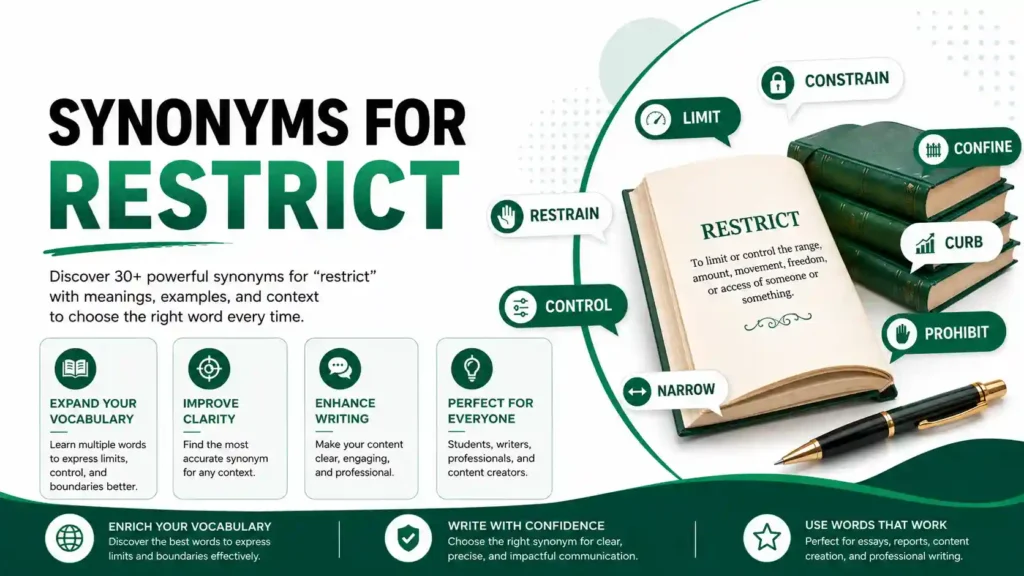

Synonyms for Restrict (verb) (rɪˈstrɪkt) mean to limit, control, confine, or reduce someone’s or something’s freedom, movement, access, amount, or scope. Cambridge defines it as limiting actions or movement, or limiting the amount, size, or growth of something.
Its word family includes restriction, restricted, restrictive, restrictively, and restrictiveness. The best synonym depends on whether you mean setting a limit, controlling access, reducing freedom, or holding something back.
What are the Synonyms for Restrict
The closest synonyms for restrict are:
- limit,
- confine,
- constrain,
- restrain,
- circumscribe,
- curb,
- Curtail,
- narrow,
- control,
- regulate.
Use limit for a general boundary, confine for keeping something within bounds, constrain for limiting choices or freedom, restrain for holding someone or something back, and prohibit only when you mean officially forbidding something.
30 Synonyms for Restrict by Meaning and Context
These are the strongest direct or near-direct alternatives, with the main nuance that separates each word. Major thesaurus sources identify limit, confine, circumscribe, constrain, restrain, curb, curtail, narrow, cap, bar, constrict, and related terms within the semantic field of restrict.
| Synonym | Specific Meaning | Synonym | Specific Meaning |
| 1. Limit | Set a maximum or clear boundary | 16. Constrict | Make narrower or more tightly confined |
| 2. Confine | Keep within a limited area | 17. Curb | Control or reduce something undesirable |
| 3. Constrain | Limit freedom, choice, or action | 18. Curtail | Reduce something in length or scope |
| 4. Restrain | Hold back action or movement | 19. Narrow | Reduce range, scope, or options |
| 5. Circumscribe | Set strict defined boundaries | 20. Cap | Set a maximum permitted amount |
| 6. Control | Manage or regulate something | 21. Bar | Prevent access or participation |
| 7. Regulate | Control through rules or standards | 22. Block | Stop access, movement, or progress |
| 8. Suppress | Prevent something from developing | 23. Inhibit | Prevent or slow an action or process |
| 9. Curtail | Cut something shorter or smaller | 24. Hinder | Make progress or action more difficult |
| 10. Impede | Slow or obstruct progress | 25. Hamper | Interfere with effective progress |
| 11. Obstruct | Block movement or progress | 26. Bind | Place under limiting conditions |
| 12. Tighten | Make rules or limits stricter | 27. Cramp | Restrict freedom, space, or movement |
| 13. Hold down | Keep something from increasing | 28. Hem in | Surround and limit movement or choice |
| 14. Lessen | Make something smaller or weaker | 29. Straiten | Restrict or make circumstances difficult |
| 15. Repress | Hold back expression or activity | 30. Qualify | Limit or modify the scope of something |
Where “Restrict” Comes From
Parts of Speech: Verb; normally transitive
Syllable: re-strict — 2 syllables
Origin: Restrict comes from Latin restrictus, the past participle of restringere, meaning “to bind fast” or “draw tight.” English adopted the word through its historical development in English and related French/Latin forms.
Prefix/Suffix Breakdown: re- means “back” or “again,” while stringere means “draw tight” or “bind.” The root is also connected with English words such as strain and constrict. 30 Synonyms for Restrict With Meanings and Examples
The examples below show how each synonym changes the meaning slightly. This matters because restrict is not interchangeable with every word in the same semantic group.
1. Limit — /ˈlɪmɪt/
Meaning: To set a maximum, boundary, or point beyond which something cannot go.
- The school limited class sizes to 25 students.
- We need to limit our spending this month.
2. Confine — /kənˈfaɪn/
Meaning: To keep someone or something within a particular space, range, or boundary.
- Please confine your comments to the topic.
- The injury confined him to bed.
3. Constrain — /kənˈstreɪn/
Meaning: To restrict freedom, choices, resources, or possible actions.
- A small budget constrained the project.
- The rules constrain what employees can do.
4. Restrain — /rɪˈstreɪn/
Meaning: To hold back or prevent someone or something from acting freely.
- She tried to restrain her anger.
- Guards restrained the man.
5. Circumscribe — /ˈsɜːrkəmskraɪb/
Meaning: To restrict something within clearly defined limits.
- The contract circumscribes their authority.
- The law circumscribes the agency’s powers.
6. Control — /kənˈtroʊl/
Meaning: To manage, regulate, or keep something within desired limits.
- The device controls the temperature.
- New rules control access to the building.
7. Regulate — /ˈreɡjəleɪt/
Meaning: To control something through rules, laws, or standards.
- The agency regulates financial markets.
- New laws regulate online advertising.
8. Suppress — /səˈpres/
Meaning: To prevent something from being expressed, spreading, or developing.
- The government tried to suppress the report.
- The medicine suppresses the immune response.
9. Curtail — /kɜːrˈteɪl/
Meaning: To reduce something, especially its amount, duration, or scope.
- The company curtailed unnecessary spending.
- The storm curtailed outdoor activities.
10. Impede — /ɪmˈpiːd/
Meaning: To slow or obstruct progress, movement, or development.
- Heavy traffic impeded our progress.
- High costs can impede growth.
11. Obstruct — /əbˈstrʌkt/
Meaning: To block movement, access, action, or progress.
- The fallen tree obstructed the road.
- The error obstructed the investigation.
12. Tighten — /ˈtaɪtən/
Meaning: To make rules, controls, or restrictions stricter.
- The city tightened parking rules.
- The bank tightened its lending standards.
13. Hold Down — /hoʊld daʊn/
Meaning: To prevent something from increasing or becoming larger.
- The policy aims to hold down costs.
- Competition helps hold down prices.
14. Lessen — /ˈlesən/
Meaning: To make something smaller, weaker, or less severe.
- The new plan lessened the burden.
- Exercise can lessen stress.
15. Repress — /rɪˈpres/
Meaning: To hold back feelings, thoughts, activity, or expression.
- He tried to repress his anger.
- The regime repressed political opposition.
16. Constrict — /kənˈstrɪkt/
Meaning: To make something narrower, tighter, or more restricted.
- The bandage was too tight and constricted blood flow.
- High taxes can constrict economic activity.
17. Curb — /kɜːrb/
Meaning: To control or reduce something unwanted or excessive.
- The law aims to curb pollution.
- The company took steps to curb costs.
18. Curtail — /kɜːrˈteɪl/
Meaning: To cut back or reduce something substantially.
- The firm curtailed production.
- We had to curtail the meeting.
19. Narrow — /ˈnæroʊ/
Meaning: To reduce the range, scope, number, or choices available.
- The search narrowed the list to three candidates.
- The policy narrows access to the program.
20. Cap — /kæp/
Meaning: To set an upper limit on an amount or number.
- The law caps rent increases.
- The company capped annual bonuses.
21. Bar — /bɑːr/
Meaning: To prevent someone from entering, participating, or doing something.
- The rules bar visitors from entering.
- His record barred him from the position.
22. Block — /blɑːk/
Meaning: To stop access, movement, communication, or progress.
- The wall blocked the entrance.
- The policy blocks unauthorized access.
23. Inhibit — /ɪnˈhɪbɪt/
Meaning: To prevent, discourage, or slow an action or process.
- Fear can inhibit creativity.
- The rules may inhibit innovation.
24. Hinder — /ˈhɪndər/
Meaning: To make an action or process more difficult.
- Poor planning hindered the project.
- Bad weather hindered rescue efforts.
25. Hamper — /ˈhæmpər/
Meaning: To interfere with or obstruct effective progress.
- Lack of funds hampered the project.
- Heavy snow hampered travel.
26. Bind — /baɪnd/
Meaning: To place someone under a rule, condition, or obligation.
- The agreement binds both parties.
- The contract binds the company to its promise.
27. Cramp — /kræmp/
Meaning: To restrict freedom, space, movement, or activity.
- The small room cramped our movement.
- Strict rules cramp creative freedom.
28. Hem In — /hem ɪn/
Meaning: To surround something and leave limited space or freedom.
- Tall walls hemmed in the garden.
- Strict rules hem in young designers.
29. Straiten — /ˈstreɪtən/
Meaning: To restrict or place someone in difficult circumstances.
- The crisis straitened the family’s finances.
- Limited resources straitened the organization.
30. Qualify — /ˈkwɑːləfaɪ/
Meaning: To limit, modify, or make a statement less absolute.
- She qualified her earlier statement.
- The report qualifies its conclusions.
Common Traps & Nuance Distinctions of Synonyms for Restrict
The biggest mistake is treating every word meaning “restrict” as interchangeable. Limit, restrict, confine, constrain, and circumscribe are especially close, but each carries a different focus. Merriam-Webster notes that limit sets a point or boundary, restrict suggests narrowing or tightening, confine suggests stronger restraint, and circumscribe emphasizes clearly defined boundaries.
- Restrict vs. Limit: Limit sets a boundary or maximum. Restrict often suggests controlling access, freedom, or activity.
Example: The hotel limits bookings to 100 rooms. The hotel restricts access to guests. - Restrict vs. Confine: Confine suggests keeping something within a particular place or narrow range.
Example: The study was restricted to adults. The patient was confined to bed. - Restrict vs. Constrain: Constrain often focuses on limited choices, resources, or freedom.
Example: Time restricted the project. A small budget constrained the team. - Restrict vs. Restrain: Restrain often means holding back an action, person, emotion, or impulse.
Example: The law restricts access. The officer restrained the suspect. - Restrict vs. Prohibit: Prohibit means officially or legally forbid something. It is stronger than ordinary restrict.
Example: The law restricts parking after 6 p.m. The law prohibits parking on the street. - Restrict vs. Hinder: Hinder means make progress difficult. It does not necessarily impose a formal limit.
Example: Rules restrict access. Bad weather hinders travel. - Restrict vs. Curtail: Curtail emphasizes cutting something back, often sharply.
Example: The policy restricts access. Budget cuts curtailed services.
When NOT to Use “Restrict”
Do not use restrict when a more precise verb expresses the idea.
- Use prohibit when something is completely forbidden.
- Use hinder when something simply makes progress harder.
- Use reduce when the main idea is making something smaller.
- Use prevent when the action is stopped completely.
- Use confine when something is kept within a physical or defined area.
- Use restrain when someone or something is being held back from acting.
- Use curtail when something is cut back in amount, duration, or scope.
This distinction improves both natural English and formal writing.
Opposite Words: Antonyms for “Restrict”
The best antonym depends on what is being restricted.
Direct Antonyms
- Allow — give permission or freedom.
The policy allows visitors to enter. - Permit — officially give permission.
The rules permit remote work. - Free — release from limits or control.
The new system frees users from unnecessary limits. - Release — let someone or something go free.
The company released the information.
Operational & Contextual Opposites
- Expand — make something larger or broader.
The company expanded access. - Broaden — increase range, scope, or choice.
The program broadened its eligibility. - Widen — make something wider or less narrow.
The policy widened access. - Encourage — support or promote an action.
The new rules encourage innovation.
Merriam-Webster’s current thesaurus lists exceed, expand, broaden, widen, overextend, and overreach among antonyms or near-antonyms of restrict.
FAQs Synonyms for Restrict
What is the best synonym for restrict?
Limit is the best general synonym. Confine, constrain, restrain, circumscribe, curb, and curtail are better when you need a more precise meaning.
What is a formal synonym for restrict?
For formal writing, use constrain, confine, circumscribe, curtail, regulate, or restrain, depending on the context.
What is another word for restrict in an essay?
Good essay alternatives include limit, constrain, restrict, curtail, circumscribe, inhibit, and narrow. Choose based on whether you mean limits on scope, freedom, development, or access.
Is “limit” the same as “restrict”?
They overlap, but they are not always identical. Limit often establishes a maximum or boundary. Restrict more often suggests narrowing, controlling, or reducing freedom or access.
What is the difference between restrict and prohibit?
Restrict means to limit or control something. Prohibit means to officially forbid it. Therefore, something can be restricted without being completely prohibited.
Conclusion
The best synonym for restrict depends on the exact context: use limit for a general boundary, confine for a defined space, constrain for limited choices, restrain for holding back action, and curtail for cutting something down. For formal writing, circumscribe, regulate, inhibit, and constrict offer more precise alternatives, while curb, narrow, cap, and bar work well in specific practical contexts. Choosing the word that matches the exact kind of restriction makes your writing clearer, more natural, and more precise.