

Synonyms for hue (noun) — /hjuː/ — hue means a color or a particular variation of a color. It can also describe the overall character or appearance of something in figurative use.
The strongest direct synonyms are color, shade, tone, and tint. Words such as tinge, coloration, cast, undertone, chroma, and coloring are related terms that fit only in certain contexts.
What Is the Best Synonym for Hue?
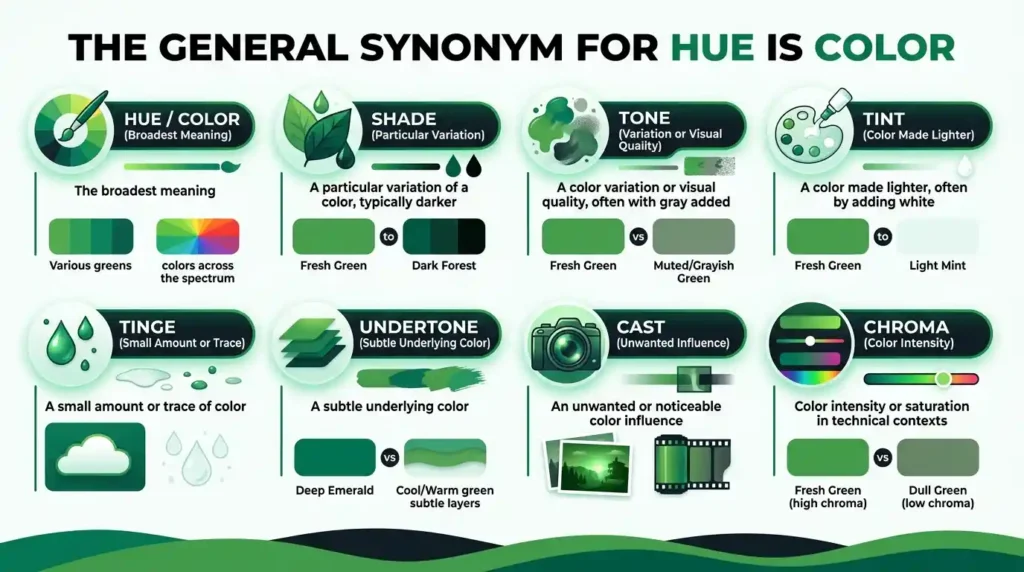
The best general synonym for hue is color.
Use:
- color for the broadest meaning
- shade for a particular variation of a color
- tone for a color variation or visual quality
- tint for a color made lighter, often by adding white
- tinge for a small amount or trace of color
- undertone for a subtle underlying color
- cast for an unwanted or noticeable color influence
- chroma for color intensity in technical contexts
Do not treat all of these as exact replacements. Shade, tint, tone, tinge, undertone, and chroma have more specific meanings.
Direct Synonyms for Hue
Major dictionary sources identify color, shade, tone, and tint as the strongest direct synonyms for hue.
| Synonym | Specific Meaning | Synonym | Specific Meaning |
| Color | General term for a visual color | Shade | A particular variation of a color |
| Tone | A particular quality of a color | Tint | A lighter variation of a color |
These four are the safest replacements when the sentence simply refers to color.
Related Color Terms
These words are related to hue but should not be presented as exact synonyms in every context.
| Word | Specific Meaning |
| Tinge | A slight or small amount of color |
| Coloration | The overall coloring of something |
| Coloring | The color or pattern of an object |
| Cast | A noticeable color influence over something |
| Undertone | A subtle color beneath the main color |
| Chroma | The strength or purity of a color |
| Chromaticity | Technical description of color independent of brightness |
| Value | The lightness or darkness of a color |
| Lightness | How light or dark a color appears |
| Saturation | The strength or intensity of a color |
| Pigmentation | Color produced by pigment |
Where Hue Comes From
Parts of Speech: Noun
Syllable: hue
Origin: Hue comes from Middle English hewe, from Old English hīw, meaning appearance, color, or form. Merriam-Webster records its first known use before the 12th century.
- Prefix/Suffix Breakdown: Hue does not have a productive modern English prefix and suffix. Its core comes from the Old English noun hīw, which developed through Middle English into modern hue.
1. Color
Color is the broadest and safest synonym for hue. It works in everyday, professional, academic, and creative writing.
Meaning: The general visual quality produced by color.
- Example: The wall has a warm blue color.
- Example: The fabric comes in several colors.
2. Shade
Shade is one of the closest alternatives to hue. It usually refers to a particular variation of a color.
Meaning: A particular variation of a color.
- Example: She chose a darker shade of green.
- Example: The paint comes in several shades of blue.
3. Tone
Tone can refer to a particular quality or variation of a color. It can also describe the overall visual effect of a color.
Meaning: A particular quality or variation of color.
- Example: The room uses soft earth tones.
- Example: The painting has a warm golden tone.
4. Tint
Tint refers to a lighter version of a color.
Meaning: A lighter variation of a color.
- Example: The designer used a pale pink tint.
- Example: Add a blue tint to the image.
5. Tinge
Tinge means a small amount or slight trace of color.
Meaning: A slight amount of a color.
- Example: The sky had a pink tinge.
- Example: The leaves showed a yellow tinge.
6. Coloration
Coloration refers to the overall color or color pattern of something.
Meaning: The overall coloring of something.
- Example: The bird’s bright coloration attracts attention.
- Example: The fish has unusual coloration.
7. Coloring
Coloring can refer to the colors or color pattern of an object, person, or image.
Meaning: The color or pattern of colors.
- Example: The bird has striking coloring.
- Example: The artist changed the coloring of the illustration.
8. Cast
Cast describes a noticeable color influence over an image, surface, or object.
Meaning: A visible influence of one color.
- Example: The photograph has a blue cast.
- Example: Warm lighting gave the room a yellow cast.
9. Undertone
Undertone describes a subtle color that exists beneath or within the main visible color.
Meaning: A subtle underlying color.
- Example: The gray paint has a blue undertone.
- Example: Her skin has a warm undertone.
10. Chroma
Chroma is a technical color term that refers to the strength or purity of a color.
Meaning: The strength or purity of color.
- Example: The designer reduced the chroma of the red.
- Example: High-chroma colors appear vivid.
11. Chromaticity
Chromaticity is a technical term used in color science to describe the chromatic quality of a color separately from brightness.
Meaning: Technical measure of chromatic color quality.
- Example: The study measured the chromaticity of the light.
- Example: The display showed different chromaticity values.
12. Saturation
Saturation describes the strength or intensity of a color.
Meaning: The strength or intensity of color.
- Example: Increase the saturation to make the blue stronger.
- Example: The image has low color saturation.
13. Lightness
Lightness describes how light or dark a color appears.
Meaning: The degree of lightness or darkness.
- Example: The two colors have different lightness levels.
- Example: Adjust the lightness before changing the hue.
14. Value
Value is a technical art and design term for the lightness or darkness of a color.
Meaning: The lightness or darkness of color.
- Example: The artist changed the value of the blue.
- Example: Strong value contrast makes the subject stand out.
15. Pigmentation
Pigmentation refers to coloring produced by pigments, especially in skin, plants, animals, or materials.
Meaning: Color produced by natural or added pigments.
- Example: The flower has unusual pigmentation.
- Example: The artist studied the pigmentation of the material.
Hue Synonyms by Context
The best alternative depends on what you mean by hue.
| Context | Best Choice | Why |
| General writing | Color | Broadest and most natural |
| Specific color variation | Shade | Clear and common |
| Color quality | Tone | Describes color character |
| Lighter color | Tint | More precise |
| Small amount of color | Tinge | Shows a slight trace |
| Overall color pattern | Coloration | Describes overall coloring |
| Photo color influence | Cast | Common in image editing |
| Subtle underlying color | Undertone | Useful in design and beauty |
| Color intensity | Saturation | Technical and precise |
| Color purity | Chroma | Technical color science |
| Light/dark quality | Value | Common in art and design |
| Pigment-based color | Pigmentation | Biological/material context |
Synonyms for Hue in Art
In art writing, the most useful alternatives are:
- Color — broad and general
- Shade — a variation of a color
- Tone — a color quality or variation
- Tint — a lighter color
- Chroma — color strength or purity
- Value — lightness or darkness
- Saturation — color intensity
Example:
Original:
- The artist used a rich blue hue.
Possible alternatives:
- The artist used a rich blue color.
- The artist used a deep blue shade.
- The artist used a highly saturated blue tone.
Each version creates a slightly different meaning.
Synonyms for Hue in Writing
For general writing, use simple words first.
Best choices:
- Color
- Shade
- Tone
- Tint
- Tinge
For literary writing, hue itself can be useful because it has a more descriptive and slightly formal tone.
Example:
The sunset filled the sky with a golden hue.
Possible rewrite:
The sunset filled the sky with a golden color.
The second sentence is simpler. The original sounds more literary.
Synonyms for Hue in Photography
Photography uses several terms that are related to hue but are not interchangeable.
- Color — general color information
- Tint — a color variation
- Cast — an unwanted overall color influence
- Tone — tonal or color quality
- Saturation — color intensity
- Lightness — perceived light or dark level
Example:
The photo has a blue hue.
If the blue is unwanted:
The photo has a blue cast.
If the blue is too strong:
The blue saturation is too high.
These are more precise than simply replacing hue with another color word.
Synonyms for Hue in Design
For graphic design, use the term that matches the property being changed.
- Hue — basic color category
- Shade — darker variation
- Tint — lighter variation
- Tone — modified color quality
- Saturation — color strength
- Value — lightness or darkness
- Chroma — color purity or strength
This distinction is important because changing hue is not the same as changing saturation or lightness.
When Not to Use a Synonym for Hue
Do not replace hue with a related color term without checking the exact meaning.
- Do not use shade when you mean the basic color category.
- Do not use tint for every color variation. A tint specifically refers to a lighter version of a color.
- Do not use saturation as a synonym for hue. Saturation concerns color intensity.
- Do not use value as a direct synonym. Value concerns lightness and darkness.
- Do not use undertone when you simply mean the main visible color.
- Do not use chroma in general writing unless the technical meaning is intended.
- Do not use pigmentation for ordinary digital colors. It refers to pigment-based coloring.
- Do not use cast unless one color visibly influences the overall appearance.
Common Traps & Nuance Distinctions
Hue vs. Color
Color is the broad everyday term. Hue can refer more specifically to the color category or a particular color variation. Merriam-Webster defines hue as both color and a gradation of color.
Hue vs. Shade
Shade usually refers to a particular variation of a color. Hue can refer to the color itself or its position within the color spectrum.
Hue vs. Tint
A tint is a lighter version of a color. Therefore, every tint is a color variation, but not every hue is a tint.
Hue vs. Tone
Tone has several meanings. In color contexts, it can refer to a particular quality or variation of color. It should not automatically replace hue.
Hue vs. Saturation
Hue identifies the color family, such as red, green, or blue. Saturation describes how strong or vivid that color is.
Hue vs. Value
Value describes how light or dark a color is. It is different from hue.
Hue vs. Tinge
A tinge is a small amount or slight trace of color. It is useful when the color is subtle.
Word Family of Hue
- Hue — noun
- Hues — plural noun
- Hued — adjective, usually used in compounds such as blue-hued
- Hueless — adjective meaning without hue or color
Opposite Words: Antonyms for Hue
There is no single perfect everyday antonym for hue because hue is a color property. In technical and visual contexts, the closest opposites involve the absence of color.
Direct or Technical Opposites
- Achromatism — absence of color
The design uses achromatism rather than bright hues. - Colorlessness — lack of visible color
The material appears almost colorless.
Contextual Opposites
- Monochrome — using one color or a limited color range
The image uses a monochrome design. - Neutrality — reduced or absent strong color influence
The palette has a neutral quality.
A black-and-white image is often called achromatic, but black and white are not simply “opposites” of hue. The relationship is technical rather than lexical.
Frequently Asked Questions
What is the best synonym for hue?
Color is the best broad synonym. Shade, tone, and tint are also strong alternatives, but each can carry a more specific meaning.
What is another word for hue in art?
Color, shade, tone, tint, chroma, and value can work in art writing. Choose the term based on whether you mean color category, variation, intensity, or lightness.
What is a formal synonym for hue?
Color, shade, tone, and tint are the safest choices. Hue itself is already a standard formal and literary term.
What is a synonym for hue in photography?
Color is the broadest choice. Cast is better when describing an unwanted overall color influence, while saturation describes color intensity rather than hue.
Is shade the same as hue?
Not exactly. Hue can refer to a color or color category, while shade usually refers to a particular variation of a color. The terms overlap, but they are not always interchangeable.
Conclusion
The strongest synonyms for hue are color, shade, tone, and tint. Use tinge, coloration, cast, or undertone when you need a more specific description, and reserve technical terms such as chroma, saturation, value, and chromaticity for contexts where their exact meanings matter. For clear everyday writing, color is usually the safest replacement; for precise color description, choose the term that matches the visual property you mean.