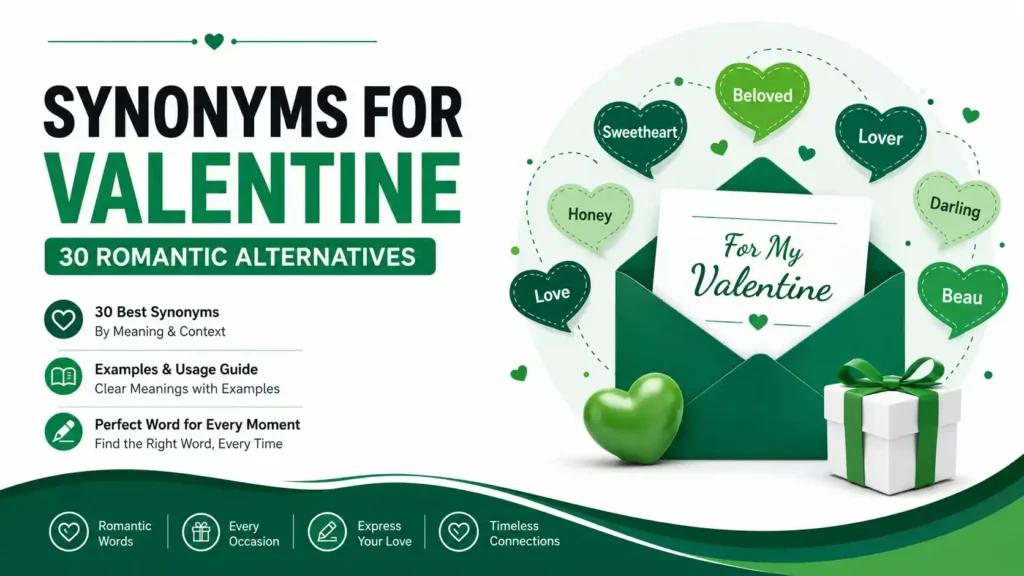

Synonyms for Valentine (noun) (/ˈvælənˌtaɪn/) are words that can describe a romantic partner, sweetheart, or a person chosen for Valentine’s Day. The word can also mean a card, gift, or message that shows love or affection.
Quick definition: The closest everyday synonym for valentine is sweetheart when you mean a person. For a romantic partner, lover, beloved, boyfriend, or girlfriend may fit. For a Valentine’s message, love note, love letter, or greeting card is more precise.
What Is Another Word for Valentine?
The best Synonyms for Valentine depends on what valentine means in your sentence:
| Meaning | Best synonym |
| Romantic person | sweetheart |
| Person you love | beloved |
| Romantic partner | lover |
| Male romantic partner | boyfriend or beau |
| Female romantic partner | girlfriend |
| Affectionate name | darling, dear, or love |
| Person who admires someone | admirer |
| Person seeking romance | suitor |
| Valentine’s message | love note or love letter |
| Valentine’s card | greeting card |
Dictionary and thesaurus sources consistently group sweetheart, lover, beloved, boyfriend, girlfriend, beau, admirer, suitor, darling, and love with valentine.
30 Synonyms for Valentine by Meaning and Intent
These are the most useful Synonyms for Valentine, direct or context-matched alternatives found across major dictionary and thesaurus sources. Some are informal, old-fashioned, or literary, so context matters.
| Synonym | Specific Meaning | Synonym | Specific Meaning |
| 1. Sweetheart | Loved romantic partner or special person | 16. Honey | Warm informal term of affection |
| 2. Lover | Person involved in romantic love | 17. Steady | Regular romantic partner |
| 3. Beloved | Person deeply loved or cherished | 18. Flame | Romantic interest or partner |
| 4. Boyfriend | Male romantic partner | 19. Truelove | Person regarded as true love |
| 5. Girlfriend | Female romantic partner | 20. Inamorata | Female romantic beloved |
| 6. Darling | Affectionate name for someone loved | 21. Inamorato | Male romantic beloved |
| 7. Love | Affectionate name for a loved person | 22. Beau | Boyfriend or male romantic partner |
| 8. Dear | Affectionate name for someone valued | 23. Swain | Archaic romantic admirer or lover |
| 9. Dearest | Strong affectionate form of dear | 24. Paramour | Romantic lover, often secretive |
| 10. Admirer | Person attracted to or fond of someone | 25. Suitor | Person seeking romantic relationship |
| 11. Loved one | Person deeply cared for | 26. Wooer | Person trying to win affection |
| 12. Honey | Informal affectionate term | 27. Fiancé | Engaged male romantic partner |
| 13. Companion | Person sharing close companionship | 28. Fiancée | Engaged female romantic partner |
| 14. Lady love | Woman who is romantically loved | 29. Lovebird | Person in a romantic relationship |
| 15. Gentleman friend | Male romantic companion | 30. Bae | Modern informal romantic partner |
Major thesauruses support most of these terms, while marking words such as beau, swain, paramour, inamorata, inamorato, and bae by age, rarity, or register.
Where Valentine Comes From
Parts of Speech: Noun
Syllable: val-en-tine
Pronunciation: /ˈvælənˌtaɪn/
Origin: Valentine entered English through Middle English valentyn, from Old French Valentin, ultimately from Latin Valentinus. The Latin name is linked to valens, meaning “strong” or “healthy.”
- Prefix/Suffix Breakdown: The modern word is not normally analyzed as an English prefix + suffix construction. Valentinus comes from Latin valens, related to strength and being strong.
- The romantic sense developed in medieval English and French culture. Choosing a sweetheart around Valentine’s Day was associated with courtly traditions by the 14th–15th centuries.
1. Sweetheart (/ˈswiːtˌhɑːrt/)
Meaning: A person you love or a romantic partner.
Examples:
- “She is my childhood sweetheart.”
- “He planned a dinner for his sweetheart.”
Best context: The safest everyday replacement for valentine when referring to a person.
2. Lover (/ˈlʌvər/)
Meaning: A person involved in a romantic relationship.
Examples:
- “He wrote a poem for his lover.”
- “She introduced him as her lover.”
Best context: Romantic writing and adult relationships.
3. Beloved (/bɪˈlʌvd/)
Meaning: Someone who is deeply loved.
Examples:
- “She dedicated the poem to her beloved.”
- “He returned home to his beloved.”
Best context: Formal, poetic, and literary writing.
4. Boyfriend (/ˈbɔɪˌfrend/)
Meaning: A male romantic partner.
Examples:
- “My boyfriend gave me flowers.”
- “She asked her boyfriend to dinner.”
Best context: Clear modern everyday English.
5. Girlfriend (/ˈɡɜːrlˌfrend/)
Meaning: A female romantic partner.
Examples:
- “His girlfriend loves Valentine’s Day.”
- “She bought a card for her girlfriend.”
Best context: Clear modern everyday English.
6. Darling (/ˈdɑːrlɪŋ/)
Meaning: An affectionate name for someone loved.
Examples:
- “Happy Valentine’s Day, darling.”
- “Come here, darling.”
Best context: Warm personal messages.
7. Love (/lʌv/)
Meaning: An affectionate name for a loved person.
Examples:
- “Thank you, love.”
- “My love sent me flowers.”
Best context: Personal and conversational English.
8. Dear (/dɪr/)
Meaning: An affectionate name for someone valued.
Examples:
- “My dear sent me a card.”
- “Thank you, dear, for the gift.”
Best context: Warm but less strongly romantic language.
9. Dearest (/ˈdɪrəst/)
Meaning: A very affectionate form of dear.
Examples:
- “My dearest, I miss you.”
- “She wrote to her dearest.”
Best context: Romantic letters and expressive writing.
10. Admirer (/ədˈmaɪərər/)
Meaning: A person attracted to or fond of someone.
Examples:
- “She received flowers from a secret admirer.”
- “He was one of her greatest admirers.”
Best context: When affection may exist without an established relationship.
11. Loved One (/ˌlʌvd ˈwʌn/)
Meaning: A person who is deeply cared for.
Examples:
- “She bought a gift for a loved one.”
- “Spend Valentine’s Day with your loved ones.”
Best context: Romantic, family, or close personal relationships.
12. Honey (/ˈhʌni/)
Meaning: An informal affectionate name.
Examples:
- “Happy Valentine’s Day, honey.”
- “She called her partner honey.”
Best context: Casual speech and affectionate messages.
13. Companion (/kəmˈpænjən/)
Meaning: A person who shares close company or life.
Examples:
- “He has been her trusted companion for years.”
- “She spent the evening with her companion.”
Best context: Neutral writing when lover sounds too direct.
14. Lady Love (/ˌleɪdi ˈlʌv/)
Meaning: A woman who is romantically loved.
Examples:
- “He wrote a song for his lady love.”
- “The hero returned to his lady love.”
Best context: Romantic or old-fashioned writing.
15. Gentleman Friend (/ˌdʒentəlmən ˈfrend/)
Meaning: A male friend with romantic implications.
Examples:
- “She arrived with her gentleman friend.”
- “Her gentleman friend sent flowers.”
Best context: Traditional or older usage.
16. Honey (/ˈhʌni/)
Meaning: A familiar term used to show affection.
Examples:
- “Thank you, honey.”
- “Her honey surprised her with dinner.”
Best context: Informal speech.
17. Steady (/ˈstedi/)
Meaning: A regular or established romantic partner.
Examples:
- “She arrived with her steady.”
- “He has had the same steady for years.”
Best context: Informal and somewhat old-fashioned English.
18. Flame (/fleɪm/)
Meaning: A person who is a romantic interest.
Examples:
- “She met an old flame at dinner.”
- “His former flame sent a message.”
Best context: Informal references to romantic interests, especially past ones.
19. Truelove (/ˈtruːlʌv/)
Meaning: A person regarded as one’s true love.
Examples:
- “He believed he had found his truelove.”
- “The poem celebrates her truelove.”
Best context: Poetic or literary writing.
20. Inamorata (/ˌɪnəmɔːˈrɑːtə/)
Meaning: A woman who is loved romantically.
Examples:
- “The poet wrote about his inamorata.”
- “His inamorata inspired several poems.”
Best context: Rare, literary, or sophisticated writing.
21. Inamorato (/ˌɪnəmɔːˈrɑːtoʊ/)
Meaning: A man who is loved romantically.
Examples:
- “The novel introduces her mysterious inamorato.”
- “She wrote to her inamorato.”
Best context: Rare and literary writing.
22. Beau (/boʊ/)
Meaning: A boyfriend or male romantic partner.
Examples:
- “She arrived with her beau.”
- “Her beau sent roses.”
Best context: Old-fashioned, elegant, or literary English.
23. Swain (/sweɪn/)
Meaning: An old word for a lover or young admirer.
Examples:
- “The poem describes a faithful swain.”
- “The maiden waited for her swain.”
Best context: Archaic or poetic writing.
24. Paramour (/ˈpærəmʊr/)
Meaning: A romantic lover, often suggesting a secret affair.
Examples:
- “The story centers on her mysterious paramour.”
- “The king met his paramour in secret.”
Best context: Literary writing. Avoid it for a normal partner because it can suggest secrecy.
25. Suitor (/ˈsuːtər/)
Meaning: A person seeking someone’s romantic affection.
Examples:
- “She rejected the wealthy suitor.”
- “Several suitors competed for her attention.”
Best context: Courtship, historical writing, or formal contexts.
26. Wooer (/ˈwuːər/)
Meaning: A person trying to win someone’s love.
Examples:
- “The young wooer wrote her poems.”
- “Her wooer brought flowers.”
Best context: Literary, historical, or playful writing.
27. Fiancé (/fiˌɑːnˈseɪ/)
Meaning: A man who is engaged to be married.
Examples:
- “She spent Valentine’s Day with her fiancé.”
- “Her fiancé bought the card.”
Best context: When engagement is part of the meaning.
28. Fiancée (/fiˌɑːnˈseɪ/)
Meaning: A woman who is engaged to be married.
Examples:
- “He surprised his fiancée with flowers.”
- “His fiancée chose the restaurant.”
Best context: When engagement is specifically known.
29. Lovebird (/ˈlʌvˌbɜːrd/)
Meaning: An affectionate term for a person in love.
Examples:
- “The two lovebirds spent the weekend together.”
- “Those lovebirds are always smiling.”
Best context: Informal and playful writing.
30. Bae (/beɪ/)
Meaning: Modern informal slang for a romantic partner.
Examples:
- “I bought a gift for my bae.”
- “My bae planned our Valentine’s dinner.”
Best context: Casual online speech, texting, and social media. Collins identifies bae as informal U.S. usage.
Common Traps & Nuance Distinctions of Synonyms for Valentine
The biggest mistake is treating every word listed as a perfect replacement for valentine. The exact meaning changes with context.
- Valentine vs. sweetheart: Valentine often points specifically to a person connected with Valentine’s Day. Sweetheart is a general term for a loved person.
- Valentine vs. lover: Lover describes a romantic relationship. It does not carry the Valentine’s Day meaning.
- Valentine vs. admirer: An admirer may like someone without being their partner.
- Valentine vs. boyfriend/girlfriend: These identify an established relationship. Valentine does not always imply one.
- Valentine vs. beloved: Beloved emphasizes deep affection and works well in literary writing.
- Valentine vs. paramour: Paramour can imply a secret or illicit romantic relationship.
- Valentine vs. fiancé/fiancée: These words specifically indicate engagement.
- Valentine vs. love note: A love note is a message. A valentine can be a person, card, gift, or affectionate work.
When NOT to Use a Synonyms for Valentine
Do not replace valentine automatically.
- Use boyfriend/girlfriend only when the person’s relationship is known.
- Avoid lover when you want a neutral term.
- Avoid paramour unless a secret or illicit relationship is intended.
- Avoid swain and beau in normal modern professional writing unless the style is deliberate.
- Avoid bae in academic essays, formal reports, and professional documents.
- Do not use sweetheart for a Valentine’s card when you actually mean the card itself.
- Do not use love note to describe the person receiving the note.
Opposite Words: Antonyms for “Valentine”
There is no single perfect antonym for valentine because the word can mean either a loved person or an affectionate message. Antonyms therefore depend on context.
Direct Antonyms:
- Enemy — a person who opposes you.
“He treated his enemy with respect.” - Foe — a person regarded as an opponent.
“The hero faced his foe.” - Hater — someone who strongly dislikes another person.
“The speaker ignored the hater.” - Adversary — a person or group in opposition.
“The team defeated its adversary.”
Operational & Contextual Opposites:
- Insult — offensive language instead of affection.
“The card became an insult.” - Slight — an act showing disrespect or disregard.
“She viewed the remark as a slight.” - Barb — a sharp or hurtful comment.
“His message contained a cruel barb.” - Put-down — a remark intended to make someone feel inferior.
“The joke sounded like a put-down.”
Merriam-Webster’s thesaurus groups insult, barb, affront, slight, and put-down among opposites for the tribute/message sense, while enemy and foe function as opposites for the loved-person sense.
FAQs Synonyms for Valentine
What is the best synonym for Valentine?
Sweetheart is usually the best general synonym when valentine means a person you love. Lover, beloved, boyfriend, girlfriend, and darling can be better depending on the relationship and tone.
What is another word for Valentine in a romantic context?
Good choices include sweetheart, lover, beloved, darling, love, beau, and romantic partner. For modern everyday English, sweetheart is one of the closest choices.
What is another word for a Valentine card?
Use greeting card, Valentine’s card, love note, love letter, or love message. A valentine can itself mean a card or message expressing affection.
What are some formal synonyms for Valentine?
For formal or literary writing, beloved is often the strongest choice. Loved one can also work when you need a neutral and respectful term.
What is a cute synonyms for Valentine?
For a cute or casual tone, try sweetheart, darling, honey, love, lovebird, sweetie, or bae. The last option is slang and is best kept to informal communication.
Conclusion
The best synonym for Valentine depends on meaning, relationship, and tone. Use sweetheart for the closest everyday romantic meaning, beloved for literary writing, boyfriend/girlfriend for clear modern relationships, and darling, love, or honey for affectionate speech. For a Valentine’s message, choose a love note, love letter, or greeting card instead. Major dictionary and thesaurus sources support these distinctions, while older terms such as swain, beau, inamorata, and paramour should be used only when their special tone is intended.