
Synonyms for flammable (adjective) (FLAM-uh-buhl) are words that describe something that can catch fire or burn easily. The strongest direct synonyms are combustible and inflammable. Ignitable is a close alternative, while incendiary has a more specific meaning.
For safety and warning text, flammable is usually the clearest choice. Inflammable has the same meaning, despite the misleading appearance of the prefix in-.
What Is a Synonym for Flammable?
The best synonyms for flammable are combustible and inflammable. Ignitable is a close alternative that focuses on the ability to catch fire. Burnable is broader, while incendiary usually means capable of causing or starting a fire.
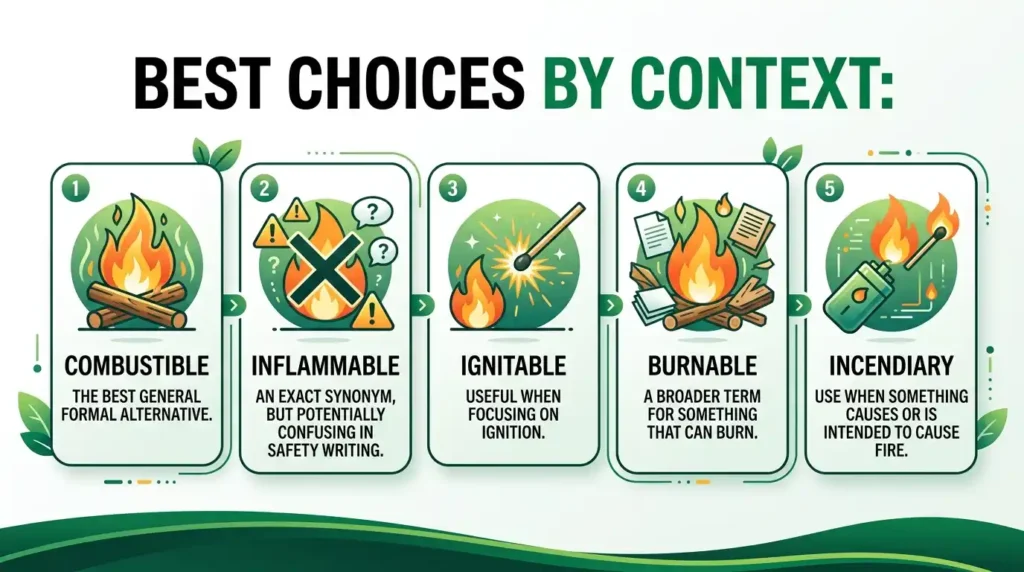
Best choices by context:
- Combustible — the best general formal alternative.
- Inflammable — an exact synonym, but potentially confusing in safety writing.
- Ignitable — useful when focusing on ignition.
- Burnable — a broader term for something that can burn.
- Incendiary — use when something causes or is intended to cause fire.
Direct Synonyms and Closest Alternatives for Flammable
| Synonym | Specific Meaning | Synonym | Specific Meaning |
| Combustible | Capable of catching fire and burning | Inflammable | Capable of catching fire easily |
| Ignitable | Capable of being set on fire | Burnable | Capable of being burned |
Lexical Accuracy Note
Combustible and inflammable are the strongest direct alternatives to flammable.
Ignitable is a close synonym because it describes something that can be ignited.
Burnable is broader. It means capable of being burned but does not always suggest that something catches fire easily.
Incendiary is deliberately excluded from the direct-synonym table because its meaning is more specific. It often describes something that causes, starts, or is designed to start a fire.
Where Flammable Comes From
Parts of Speech: adjective; related noun flammability.
Syllable: flam-ma-ble
Origin: Flammable comes from Latin flammare, meaning “to set on fire,” from flamma, meaning “flame.” The English word dates to the early 19th century.
Prefix/Suffix Breakdown: flam- + -able. The root flam- relates to flame or fire. The suffix -able means “capable of.”
Flammable Synonyms and Their Meanings
The best alternative depends on whether you mean general combustibility, easy ignition, or the ability to cause fire.
1. Combustible (kəm-BUS-tuh-buhl)
Meaning: Capable of catching fire and burning.
- Gasoline vapor is highly combustible.
- Keep combustible materials away from open flames.
Nuance: This is the strongest general formal alternative to flammable. However, technical and regulatory definitions can differ by context, so the two words are not always interchangeable.
2. Inflammable (in-FLAM-uh-buhl)
Meaning: Capable of catching fire easily.
- The warehouse contained highly inflammable materials.
- Store inflammable liquids away from heat.
Nuance: Inflammable means the same thing as flammable. The prefix in- does not mean “not” in this word.
For safety labels, flammable is usually clearer because readers may wrongly assume that inflammable means “not flammable.”
3. Ignitable (ig-NY-tuh-buhl)
Meaning: Capable of being set on fire.
- The material contains highly ignitable fibers.
- Keep ignitable substances away from sparks.
Nuance: Ignitable focuses on whether something can be ignited. It is more technical and less common in everyday speech than flammable.
4. Burnable (BURN-uh-buhl)
Meaning: Capable of being burned.
- Remove all burnable material from the area.
- Keep burnable waste away from the furnace.
Nuance: Burnable is broader than flammable. It does not necessarily mean that something catches fire easily.
Contextual Alternatives That Are Not Exact Synonyms
Some terms are useful in specific contexts but should not replace flammable in every sentence.
Incendiary (in-SEN-dee-air-ee)
Meaning: Capable of causing or starting a fire.
- Investigators found an incendiary device.
- The material had incendiary properties.
Nuance: Incendiary often suggests that something causes or is intended to cause fire. It does not simply mean “easily catches fire.”
Combustive (kəm-BUS-tiv)
Meaning: Relating to or promoting combustion.
- The process involved a combustive reaction.
- Engineers studied the material’s combustive properties.
Nuance: This is a specialized technical term. It is not a normal everyday substitute for flammable.
Related Words That Are Not Synonyms
These words may appear near flammable in thesaurus results, but they have different meanings.
- Explosive — capable of exploding.
- Volatile — likely to evaporate or change rapidly; it can also describe instability.
- Hazardous — presenting a danger or risk.
- Dangerous — likely to cause harm.
- Fiery — relating to or resembling fire.
- Fire-prone — likely to experience or develop fires.
- Combustion — the process of burning.
- Flammability — the quality or degree of being flammable.
A substance can be hazardous without being flammable. It can also be volatile without being flammable. These distinctions matter in technical and safety writing.
Common Traps & Nuance Distinctions
Knowing the difference between closely related fire terms helps you choose the safest and most accurate word.
Flammable vs. Inflammable
Flammable and inflammable mean the same thing.
Both describe something that can catch fire easily.
The liquid is flammable.
The liquid is inflammable.
The second sentence does not mean that the liquid cannot catch fire.
Flammable vs. Combustible
Both words relate to materials that can burn.
Flammable commonly emphasizes the ability to catch fire easily.
Combustible has a broader focus on the ability to burn.
The fuel is flammable.
The wood is combustible.
In everyday language, they may overlap. In technical or regulatory writing, use the term required by the relevant standard.
Flammable vs. Ignitable
Flammable describes something that can catch fire easily.
Ignitable emphasizes the ability to be ignited.
The two words overlap, but ignitable is more focused on the ignition process.
Flammable vs. Incendiary
Flammable means capable of catching fire.
Incendiary often means capable of causing or starting a fire.
The liquid is flammable.
Police found an incendiary device.
These words should not normally be treated as interchangeable.
Flammable vs. Explosive
These terms describe different hazards.
Flammable means capable of catching fire.
Explosive means capable of exploding.
A material can be flammable without being explosive.
Flammable vs. Volatile
Volatile often describes a substance that evaporates easily.
Flammable describes its ability to catch fire.
A substance may be both volatile and flammable, but the words do not mean the same thing.
When Not to Use Flammable
Do not use flammable when you only mean that something is dangerous or unstable.
Choose a more precise term:
- Use combustible when you mean capable of burning.
- Use ignitable when you mean capable of being ignited.
- Use incendiary when something causes or is intended to cause fire.
- Use explosive when you specifically mean capable of exploding.
- Use volatile when you mean prone to rapid evaporation or instability.
- Use hazardous when you mean dangerous in a broad sense.
- Use fire-resistant when something resists fire.
- Use flame-retardant when something is designed to slow the spread of flames.
Do not use inflammable to mean “not flammable.” It means flammable.
Opposite Words: Antonyms for Flammable
The clearest opposites describe materials that do not ignite easily or do not burn.
Direct Antonyms
- Nonflammable — not capable of catching fire easily.
Example: The container uses nonflammable material. - Noncombustible — not capable of igniting and burning.
Example: The building uses noncombustible materials. - Incombustible — not capable of combustion.
Example: The structure contains incombustible materials. - Unburnable — not capable of being burned.
Example: The material was considered unburnable under the test conditions.
Operational & Contextual Opposites
- Fire-resistant — able to resist fire for a defined period or degree.
Example: The doors are fire-resistant. - Flame-retardant — designed to slow the spread of flames.
Example: The fabric has a flame-retardant treatment. - Flameproof — designed to prevent ignition or withstand specified fire conditions.
Example: The equipment has a flameproof enclosure. - Fireproof — designed or rated to withstand fire under specified conditions.
Example: The safe has a fireproof lining.
These are not perfect dictionary antonyms in every context. Some describe fire resistance rather than complete inability to burn.
FAQs about Synonyms for Flammable
What is the best synonym for flammable?
Combustible is the best general synonym for flammable. Inflammable is also an exact synonym, while ignitable is a close alternative.
Is inflammable the same as flammable?
Yes. Inflammable and flammable have the same meaning. Inflammable does not mean “not flammable.” The word comes from a form related to setting something on fire.
What is a formal synonym for flammable?
Combustible is the strongest formal alternative in many contexts. Ignitable can also work in technical writing when the focus is on ignition.
What is another word for flammable in safety writing?
Flammable is usually the clearest choice for safety warnings. Combustible can be appropriate when it matches the relevant technical or regulatory definition.
Is explosive a synonym for flammable?
No. Explosive and flammable describe different properties. A material can catch fire without exploding, so explosive should not normally replace flammable.
Conclusion
The strongest synonyms for flammable are combustible and inflammable, with ignitable as a close alternative. Burnable is broader, while incendiary and combustive have more specialized meanings and should not be treated as exact synonyms. For safety, technical, academic, and professional writing, flammable is usually the clearest choice.