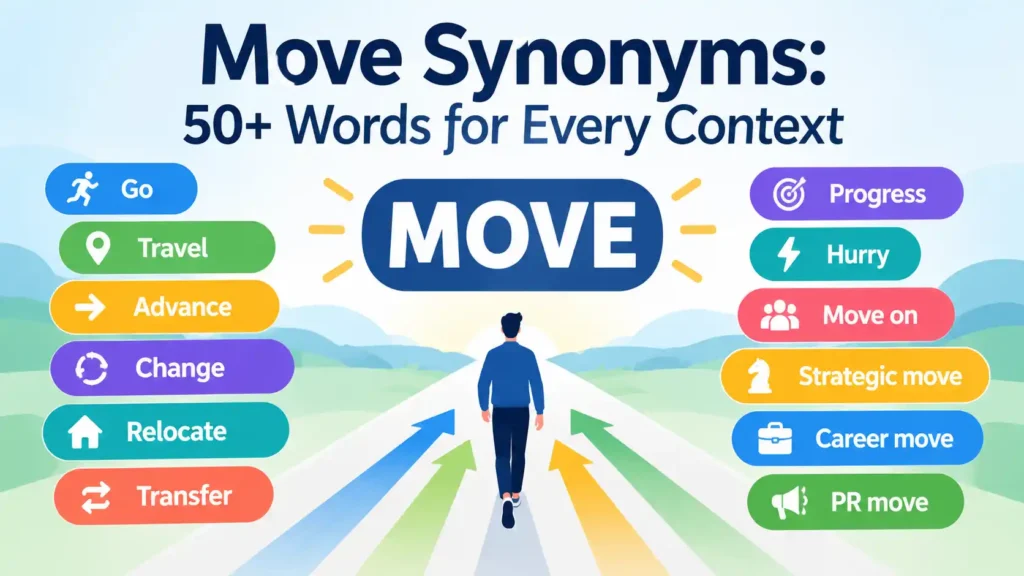

Move synonyms (verb, noun) — /muːv/ — means to change position, go from one place to another, cause something to change position, or take action toward a goal. As a noun, move can mean an action, decision, change of location, or turn in a game.
The best synonym depends on what you mean by move. For physical movement, use words such as go, travel, shift, advance, proceed, or relocate. For an action or decision, use step, action, measure, tactic, maneuver, or strategy.
Best General Synonyms for Move
The best general synonyms for move are go, shift, change, travel, advance, proceed, act, relocate, transfer, and progress.
Use a more precise word when the context matters:
- Move forward: advance, progress, proceed, continue
- Move away: leave, depart, withdraw, retreat
- Move quickly: hurry, rush, speed, race
- Move slowly: creep, crawl, inch, trudge
- Move around: circulate, roam, wander, travel
- Move on: continue, proceed, carry on, advance
- Move in: enter, relocate, settle
- Move out: leave, depart, vacate, relocate
- Move up: rise, advance, ascend, climb
- Strategic move: tactic, maneuver, measure, strategy
- Career move: career step, transition, change, advancement
- Power move: bold action, assertion, strategic maneuver
- Move the needle: make an impact, drive progress, produce results
Best Synonyms for Move by Meaning and Intent
| Synonym | Specific Meaning | Synonym | Specific Meaning |
| Go | Travel from one place to another | Travel | Move from place to place |
| Shift | Change position or location | Change | Become or make something different |
| Advance | Move forward toward a goal | Proceed | Continue in a direction |
| Progress | Move toward improvement or completion | Walk | Move on foot |
| March | Walk with steady, firm steps | Stir | Move slightly or begin moving |
| Budge | Move slightly from a position | Transfer | Move something to another place |
| Transport | Carry something from place to place | Carry | Take something somewhere |
| Relocate | Move to a new place | Leave | Go away from a place |
| Depart | Leave a place formally | Withdraw | Move back or away |
| Retreat | Move back from a position | Migrate | Move to another region |
| Circulate | Move throughout an area or group | Roam | Move without a fixed route |
| Wander | Move without a clear destination | Drift | Move slowly without control |
| Hurry | Move or act with speed | Rush | Move with great speed |
| Race | Move very quickly toward something | Creep | Move very slowly and quietly |
| Crawl | Move slowly close to ground | Trudge | Walk slowly with heavy steps |
| Inch | Move forward very slowly | Glide | Move smoothly and easily |
| Step | Move by placing one foot forward | Stride | Walk with long confident steps |
| Act | Take action | Proceed | Continue with an action |
| Initiate | Begin an action or process | Undertake | Begin and accept responsibility |
| Transfer | Move from one position to another | Reposition | Put in a new position |
| Relocate | Establish in a new location | Switch | Change from one option to another |
| Maneuver | Make a planned strategic move | Tactic | Action used to achieve an aim |
| Measure | Deliberate action taken for a goal | Step | Action forming part of a plan |
| Action | Something done to achieve a result | Initiative | New action designed to achieve something |
| Strategy | Overall plan for achieving a goal | Gambit | Strategic action with calculated risk |
Where Move Comes From
Parts of Speech: Verb and noun
Syllable: One syllable
Pronunciation: /muːv/
Origin: Move entered English through Middle English forms such as moven and meven, from Anglo-French mover, ultimately from Latin movēre, meaning “to move.”
Prefix/Suffix Breakdown: There is no productive English prefix or suffix in the basic word move. Its historical root comes from Latin mov-, associated with movement or changing position.
The word developed from physical movement to wider meanings such as changing jobs or homes, taking action, making a strategic decision, influencing emotions, and formally proposing something.
Direct Synonyms for Move
The following are the strongest direct alternatives when move means changing position, location, or direction.
Go /ɡoʊ/
Meaning: Travel or pass from one place to another.
- She went to the front door.
- We should go before the traffic gets worse.
Shift /ʃɪft/
Meaning: Change position, direction, or location, often slightly.
- He shifted his chair closer to the table.
- The wind shifted during the night.
Travel /ˈtrævəl/
Meaning: Move from one place to another, often over some distance.
- They traveled across the country by train.
- She travels often for work.
Advance /ədˈvæns/
Meaning: Move forward toward a place, goal, or stage.
- The soldiers advanced toward the city.
- The project has advanced much faster than expected.
Proceed /prəˈsiːd/
Meaning: Continue moving or continue with an action.
- Please proceed to the next room.
- The team proceeded with the plan.
Progress /prəˈɡres/
Meaning: Move forward toward improvement or completion.
- The project is progressing well.
- She progressed from trainee to manager.
Transfer /trænsˈfɜːr/
Meaning: Move someone or something from one place or position to another.
- The company transferred him to another office.
- Please transfer the files to the new folder.
Relocate /ˌriːləʊˈkeɪt/
Meaning: Move to a different home, office, or location.
- The family relocated to Canada.
- The company relocated its headquarters.
Walk /wɔːk/
Meaning: Move on foot.
- We walked to the station.
- She walked across the room.
March /mɑːrtʃ/
Meaning: Walk with regular, deliberate steps.
- The soldiers marched toward the town.
- The protesters marched through the city.
Stir /stɜːr/
Meaning: Move slightly, especially after being still.
- He did not stir when I entered.
- The baby stirred in her sleep.
Budge /bʌdʒ/
Meaning: Move slightly, often with effort.
- The heavy table would not budge.
- He refused to budge from his position.
Synonyms for Move Forward
When move forward means making progress, the best alternatives are advance, progress, proceed, continue, develop, improve, and press on.
- Advance — move toward a goal or higher stage.
- Progress — develop or improve over time.
- Proceed — continue with an action or plan.
- Continue — keep doing something.
- Press on — continue despite difficulty.
- Develop — grow or move toward a more advanced state.
- Improve — become better.
Examples:
- The company needs to advance its technology.
- We can now proceed with the next stage.
Synonyms for Move Along
Move along usually means continuing forward or telling someone to keep going. Good alternatives include proceed, continue, go on, carry on, move on, press on, and make your way.
- Proceed — continue toward a place or action.
- Continue — keep going.
- Go on — continue, often conversational.
- Carry on — continue doing something.
- Press on — continue despite difficulty.
- Make your way — travel toward a destination.
Examples:
- We should proceed to the next room.
- They carried on despite the delay.
Synonyms for Move Slowly
When something moves slowly, choose the word that shows how it moves.
- Creep — move slowly and quietly.
- Crawl — move very slowly.
- Inch — move forward by tiny amounts.
- Trudge — walk slowly with effort.
- Plod — walk slowly and heavily.
- Drift — move slowly without a clear direction.
- Meander — follow a winding or indirect route.
- Shuffle — walk with short steps.
Examples:
- The traffic crawled through the city.
- The old truck crept up the hill.
Synonyms for Move Quickly
For fast physical movement, use hurry, rush, race, speed, dash, sprint, bolt, or hasten.
- Hurry — move faster because of limited time.
- Rush — move very quickly, often urgently.
- Race — move quickly in competition or haste.
- Dash — move quickly for a short distance.
- Sprint — run at top speed for a short distance.
- Bolt — leave or run away suddenly.
- Hasten — make something happen sooner or move faster.
Examples:
- We hurried to catch the train.
- She dashed across the street before the light changed.
Synonyms for Move Around
When move around means traveling from place to place, use circulate, roam, wander, travel, walk around, get around, or move about.
- Circulate — move through different areas or groups.
- Roam — travel without a fixed route.
- Wander — move without a clear destination.
- Travel — go from one place to another.
- Get around — travel between places.
- Move about — change position or travel within an area.
Examples:
- Guests circulated around the room.
- We wandered around the old town.
Synonyms for Move Away and Move Away From
When move away means leaving a person or place, use leave, depart, withdraw, retreat, relocate, or go away.
For move away from, use withdraw from, retreat from, leave, depart from, pull away from, distance yourself from, or shift away from, depending on context.
Examples:
- She relocated to another city.
- The crowd withdrew from the entrance.
- The company is shifting away from traditional advertising.
Do not use relocate when you only mean moving a few steps away. Relocate normally suggests a significant change of place, such as a home, office, or business.
Synonyms for Move On
Move on has several meanings.
- For continuing physically, use proceed, continue, go on, or carry on.
- For leaving a situation emotionally, use let go, move past, recover, accept, or put it behind you.
- For changing to a new subject, use change the subject, turn to, or proceed to.
Examples:
- Let’s move on to the next topic.
- After the setback, she decided to move on.
Synonyms for Move In
When move in means beginning to live or work in a place, use relocate, settle in, take up residence, enter, or establish yourself.
- Relocate — move to a new location.
- Settle in — become comfortable in a new place.
- Take up residence — begin living somewhere; formal.
- Establish yourself — begin living or working successfully in a place.
Examples:
- They moved in last Saturday.
- The family relocated to a larger home.
Synonyms for Move Out
When move out means leaving a home, office, or building, use leave, depart, vacate, relocate, clear out, or move away.
- Vacate — leave a property, often in formal language.
- Depart — leave a place.
- Relocate — move to another place.
- Clear out — leave completely; informal.
Examples:
- The tenants vacated the apartment in June.
- We relocated after five years in the city.
Synonyms for Move Up
When move up means reaching a higher position, use rise, advance, ascend, climb, progress, or be promoted.
- Rise — reach a higher level.
- Advance — progress to a higher stage.
- Ascend — move upward; often formal.
- Climb — move upward or reach a higher position.
- Be promoted — move to a higher job level.
Examples:
- She advanced to a senior management role.
- He was promoted after three years with the company.
Synonyms for Move Past
When move past means physically going beyond something, use pass, go beyond, proceed past, or go by.
When it means overcoming a problem, use overcome, get past, move beyond, recover from, or put behind you.
Examples:
- The car passed the checkpoint.
- She worked hard to get past the setback.
Synonyms for Move To
The best synonym for move to depends on the object.
- For a new location: relocate to, transfer to, go to, migrate to, settle in, or move into.
- For a new topic: turn to, shift to, proceed to, or transition to.
- For a new job or role: transfer to, transition to, switch to, or advance to.
Examples:
- They relocated to Toronto.
- The discussion then shifted to costs.
Synonyms for Move the Needle
Move the needle is an idiom. It means to create a noticeable or meaningful effect.
Strong contextual alternatives include:
- Make an impact
- Drive progress
- Produce results
- Create measurable change
- Make a difference
- Improve outcomes
- Generate meaningful results
- Have a significant effect
Examples:
- The new campaign made a measurable impact on sales.
- Small changes did not produce meaningful results.
Do not treat move the needle as a literal synonym for physical movement. It is a business and performance expression.
Strategic Move Synonyms
When move means a planned action designed to achieve a goal, the best alternatives are strategy, tactic, maneuver, measure, step, initiative, action, gambit, or calculated decision.
Strategic move
Use strategy for a broad plan.
Example:
Expanding into Asia was a strategic move.
Tactical move
Use tactic for a specific action within a broader plan.
Example:
Offering a discount was a tactical move to win customers.
Calculated move
Use calculated decision when the action is deliberate and carefully considered.
Example:
Hiring an experienced executive was a calculated move.
Bold move
Use bold action or daring move when the action involves confidence or risk.
Example:
Launching the product early was a bold move.
Power Move Synonyms
Power move is an informal expression for an action that shows confidence, authority, influence, or control.
Depending on the context, alternatives include:
- Power play
- Bold move
- Strong move
- Strategic maneuver
- Assertive action
- Show of strength
- Influential move
Example:
Buying the competitor was a major power move.
Power move is not a universal synonym for move. It carries an added sense of power or influence.
Dance Move Synonyms
For dance move, use terms that describe a specific physical action:
- Step
- Movement
- Motion
- Maneuver
- Sequence
- Gesture
- Choreographic movement
Example:
She learned a new dance step for the performance.
A step is often the most natural replacement for dance move.
Career Move Synonyms
A career move means a change or decision that affects someone’s career.
Useful alternatives include:
- Career step
- Career transition
- Career change
- Professional move
- Job change
- Career advancement
- Professional advancement
- Career decision
Example:
Taking the management role was an important career move.
For a resume or formal writing, career transition, professional advancement, or career progression can sound more precise than career move.
PR Move Synonyms
A PR move means an action intended to influence public perception or media attention.
Contextual alternatives include:
- Public-relations strategy
- Publicity tactic
- Communications strategy
- Reputation-management action
- Media strategy
- Publicity move
- Image-building effort
Example:
The public apology was seen as a reputation-management move.
Best Move Synonyms
When best move means the wisest action, use:
- Best course of action
- Wise choice
- Right decision
- Optimal step
- Best option
- Prudent action
- Smart move
- Sound decision
Example:
Leaving early was the best course of action.
Bad Move Synonyms
When bad move means an unwise decision, use:
- Poor decision
- Mistake
- Error
- Misstep
- Poor choice
- Unwise action
- Wrong move
- Blunder
Example:
Ignoring the warning was a serious mistake.
Misstep works especially well when the mistake is a smaller strategic or social error.
Stupid Move Synonyms
Stupid move is informal and judgmental. More precise alternatives include:
- Foolish decision
- Unwise choice
- Poor judgment
- Reckless decision
- Blunder
- Misjudgment
- Serious mistake
Use reckless decision when the problem involves unnecessary risk. Use misjudgment when someone made a poor assessment.
Forced to Move Synonyms
When someone must move because of pressure or circumstances, use:
- Forced to relocate
- Required to leave
- Compelled to move
- Driven from
- Displaced
- Evicted — when legally removed from a property
- Uprooted — when the move causes major disruption
Example:
The residents were forced to relocate after the flood.
Do not use evicted unless a person is removed from property through a legal or housing process.
To Not Move Synonyms
When to not move means remaining still, use:
- Stay still
- Remain still
- Hold still
- Stay put
- Remain stationary
- Stand still
- Stay in place
- Remain fixed
Example:
Please remain still while the doctor examines you.
Unable to Move Synonyms
When someone or something cannot move, use:
- Immobile
- Stationary
- Motionless
- Paralyzed — only when medically or technically accurate
- Stuck
- Fixed
- Unable to budge
- Incapacitated — when unable to act or function
Example:
The vehicle was stuck in the mud.
Do not use paralyzed as a casual synonym for unable to move when a medical meaning is not intended.
Every Move Synonyms
Every move means every action, change, or movement someone makes.
Contextual alternatives include:
- Every action
- Every step
- Every movement
- Everything someone does
- Each maneuver
- Every decision
Example:
The camera followed his every move.
Your Move Synonyms
Your move usually means it is now someone’s turn to act or decide.
Alternatives include:
- Your turn
- Your decision
- Your choice
- The next step is yours
- It is up to you
Example:
I’ve made my offer. Now it’s your move.
Next Move Synonyms
For next move, use:
- Next step
- Next action
- Next decision
- Next course of action
- What comes next
- Next strategy
- Next tactic
Example:
The team is still deciding its next move.
Easy-to-Move Synonyms
When something is easy to move, use:
- Portable
- Lightweight
- Mobile
- Movable
- Easy to transport
- Easy to shift
- Manoeuvrable / maneuverable
Portable works best for objects designed to be carried. Movable simply means that an object can be moved.
On the Move Synonyms
On the move can mean physically traveling or actively changing.
For physical travel:
- Traveling
- Moving
- In transit
- On the road
- Traveling from place to place
For activity or change:
- Active
- Developing
- Changing
- Progressing
- Advancing
Example:
The company is on the move and opening new offices.
Common Traps & Nuance Distinctions
The word move is broad. A narrower synonym can change the meaning, tone, or level of certainty.
Move vs. Go
Go usually focuses on traveling from one place to another. Move can focus on changing position.
- Go to the kitchen.
- Move the chair to the kitchen.
Move vs. Shift
Shift often suggests a change in position, direction, focus, or responsibility.
- Move the box.
- Shift the box slightly to the left.
Shift often implies a smaller or more specific change.
Move vs. Relocate
Relocate usually refers to a significant change of residence, workplace, or business location.
- We moved to a new apartment.
- The company relocated its headquarters.
Do not use relocate for every small physical movement.
Move vs. Transfer
Transfer means moving a person, object, responsibility, or resource from one place or position to another.
- Transfer the money to this account.
- Move the money to this account.
Both can work, but transfer sounds more precise in financial, administrative, and organizational contexts.
Move vs. Advance
Advance means moving forward, often toward a goal or higher position.
- The crowd moved down the street.
- The project advanced quickly.
Do not replace every use of move with advance.
Move vs. Progress
Progress normally implies improvement or development.
- The patient moved slowly.
- The project progressed slowly.
Physical movement and improvement are different meanings.
Move vs. Act
When move means “take action,” act is often a direct alternative.
- The government needs to move quickly.
- The government needs to act quickly.
Move vs. Maneuver
Maneuver suggests a planned or skillful action, often in a competitive situation.
- The company made a move.
- The company made a strategic maneuver.
The second sentence adds a stronger sense of planning.
When Not to Use Move
Avoid replacing a precise word with move when the exact action matters.
- Use relocate when someone changes residence or business location.
- Use transfer when something changes hands, departments, accounts, or positions.
- Use advance when the key idea is forward progress.
- Use progress when the key idea is improvement or development.
- Use rush when speed and urgency matter.
- Use creep when slow and quiet movement matters.
- Use withdraw when someone intentionally moves back or away.
- Use vacate when someone formally leaves a property.
- Use maneuver when an action is planned for a strategic purpose.
- Use motivate or inspire when move means causing someone to act.
- Use touch or affect when move means causing an emotional response.
This distinction matters because dictionaries treat move as a highly polysemous word with separate meanings for physical movement, relocation, action, strategy, emotional influence, formal proposals, and other uses.
Opposite Words: Antonyms for “Move”
The best antonym depends on the meaning of move.
Direct Antonyms
- Stay — remain in the same place.
Example: She decided to stay at home. - Remain — continue to be in the same place or state.
Example: The building remained unchanged. - Stop — cease moving or acting.
Example: The bus stopped outside the station. - Freeze — stop moving completely.
Example: The system froze during the update.
Operational & Contextual Opposites
- Stay put — remain where you are.
Example: Stay put until help arrives. - Stand still — remain physically motionless.
Example: Please stand still. - Retain — keep something rather than transfer it.
Example: The company retained control. - Settle — stop moving and establish a stable position.
Example: The family settled in the new town.
Vocabulary resources also identify stand still and stay as key opposites for physical movement and relocation.
Which Move Synonym Should You Use?
Different searches signal different needs.
“What are synonyms for move?”
Use broad alternatives such as go, shift, travel, change, advance, proceed, relocate, and transfer.
“Move synonym for an essay”
Choose formal words based on meaning:
- Advance
- Proceed
- Progress
- Shift
- Transfer
- Relocate
- Undertake
- Initiate
Avoid slang such as dash, bolt, pack your bags, or get moving in formal academic writing.
“Another word for move on”
Use continue, proceed, carry on, advance, progress, or move forward.
For emotional contexts, use let go, move past, recover, or put it behind you.
“Move synonym for a resume”
Use the precise career term:
- Transitioned
- Advanced
- Transferred
- Relocated
- Progressed
- Promoted
- Advanced to
- Moved into
For example:
Weak: Moved into a leadership role.
Stronger: Advanced to a leadership role.
“Move synonym in an essay”
The strongest choice depends on the sentence. Use advance for progress, shift for change, proceed for continuation, transfer for movement between positions, and relocate for a change of place.
Word Family of Move
- move — base verb and noun
- moves — present-tense verb or plural noun
- moved — past tense and past participle
- moving — present participle
- movement — the act or process of moving
- mover — a person or thing that moves
- movable — able to be moved
- immovable — unable or unwilling to move
- motion — movement or formal proposal in some contexts
- removal — the act of taking something away
- relocation — the act of moving to a new place
- countermove — an action taken in response to another move
Frequently Asked Questions
What is the best synonym for move?
The best synonym depends on the meaning. Go, shift, travel, advance, proceed, relocate, transfer, and change are strong choices for common uses. For an action or decision, use step, action, measure, tactic, or maneuver.
What is another word for move forward?
Good synonyms for move forward include advance, progress, proceed, continue, carry on, press on, and move ahead. Use progress when improvement matters and proceed when simply continuing matters.
What is a synonym for move away?
Common alternatives include leave, depart, withdraw, retreat, relocate, go away, and move out. Use relocate for a change of residence or workplace and withdraw for intentional movement away from a person, place, or position.
What is a synonym for move quickly?
Use hurry, rush, race, dash, sprint, speed, bolt, or hasten. Rush suggests urgency, while sprint specifically means running at high speed for a short distance.
What is a synonym for a strategic move?
Use tactic, maneuver, measure, strategic action, initiative, gambit, or calculated decision. Strategy usually refers to a broader plan, while tactic refers to a specific action within that plan.
Conclusion
The best synonym for move depends on the exact meaning: go, travel, shift, advance, proceed, relocate, transfer, and progress cover the main movement and change senses. For business and decision-making, use action, step, measure, tactic, maneuver, initiative, or strategic move. For specific phrases such as move forward, move away, move quickly, move on, move in, move out, and move the needle, choose the alternative that preserves the original context and tone. Precise word choice makes your writing clearer, more natural, and more effective.