

Synonyms for meritocracy (noun) (mer-i-TOK-rə-see) are words or phrases that describe a system where people gain positions, rewards, or status based mainly on merit, ability, or achievement rather than wealth, family ties, or favoritism.
The closest established synonym is “merit system.” Other terms, such as meritocratic system and merit-based system, are close alternatives, while terms such as performance-based system and achievement-based system are more specific contextual alternatives.
What is another word for Meritocracy
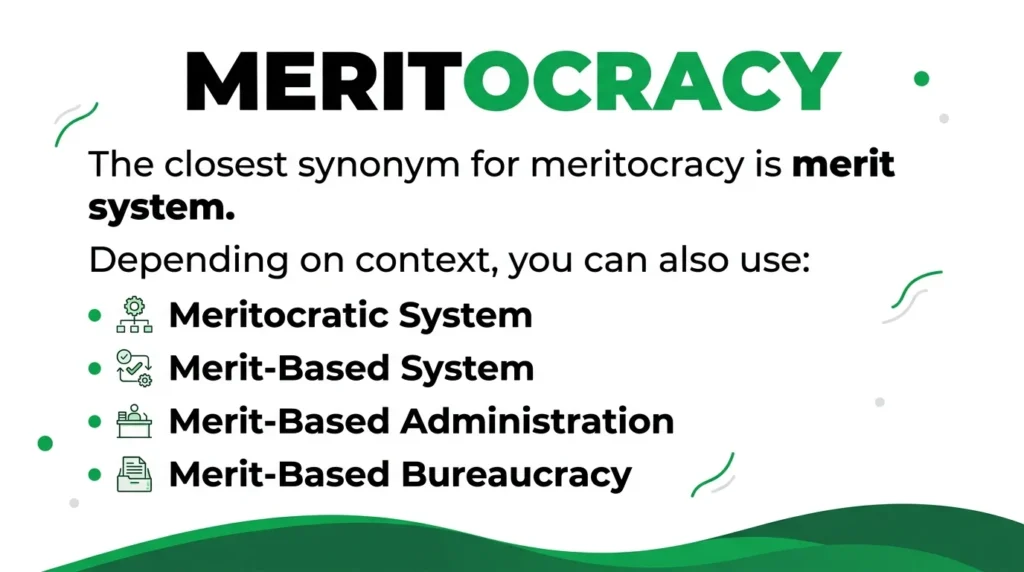
The closest synonym for meritocracy is merit system. Depending on context, you can also use meritocratic system, merit-based system, merit-based administration, or merit-based bureaucracy.
For precise writing, do not treat words such as technocracy, aristocracy, equality, talent, performance, or achievement as exact synonyms. They describe related ideas or narrower concepts.
Direct Synonyms and Closest Alternatives for Meritocracy
| Synonym | Specific Meaning | Synonym | Specific Meaning |
| Merit system | Advancement based on ability and achievement | Meritocratic system | System organized around merit-based advancement |
| Merit-based system | System that rewards demonstrated merit | Merit-based administration | Administration based on competence and merit |
| Merit-based bureaucracy | Bureaucracy based on ability and merit | Meritocratic bureaucracy | Bureaucracy organized around merit-based selection |
Lexical Accuracy Note
Merit system is the strongest established synonym and closest practical replacement for meritocracy, especially when discussing employment, government, or institutional advancement.
The other terms are near-synonyms or contextual equivalents, not interchangeable with meritocracy in every sentence.
Terms such as performance-based system, achievement-based system, ability-based system, competence-based system, and talent-based system are better treated as contextual alternatives because each focuses on one particular measure of merit.
Where Meritocracy Comes From
Parts of Speech: noun; meritocratic is the related adjective; meritocrat is the related noun.
Syllable: mer-it-oc-ra-cy
Origin: Meritocracy combines merit with -cracy, from Greek kratos, meaning “power” or “rule.” The modern English word emerged in the 20th century and became strongly associated with Michael Young’s 1958 work The Rise of the Meritocracy.
Prefix/Suffix Breakdown: merit + -o- + -cracy. The suffix -cracy indicates a form of rule, government, or social organization.
Meritocracy Synonyms and Near-Synonyms
The right alternative depends on whether you mean a broad social system, government, employment, or a specific method of rewarding people.
Merit System (MER-it SIS-təm)
Meaning: A system that rewards or promotes people based on ability, achievement, or competence.
- The agency introduced a merit system for hiring staff.
- The company replaced personal connections with a merit system for promotions.
Meritocratic System (mer-it-ə-KRAT-ik SIS-təm)
Meaning: A system organized around merit-based selection and advancement.
- The university wants to build a more meritocratic system.
- Critics questioned whether the new meritocratic system treated all applicants equally.
Merit-Based System (MER-it BAYST SIS-təm)
Meaning: A system in which decisions depend on demonstrated merit.
- The scholarship follows a merit-based system.
- The firm uses a merit-based system for promotion.
Merit-Based Administration (MER-it BAYST əd-min-ə-STRAY-shən)
Meaning: Administration that selects and advances people according to merit.
- The reform aimed to create a merit-based administration.
- The country introduced a merit-based administration for civil-service hiring.
Merit-Based Bureaucracy (MER-it BAYST byoo-ROK-rə-see)
Meaning: A bureaucracy that selects officials according to merit.
- The reform sought a more merit-based bureaucracy.
- A merit-based bureaucracy can reduce political favoritism.
Meritocratic Bureaucracy (mer-it-ə-KRAT-ik byoo-ROK-rə-see)
Meaning: A bureaucracy structured around merit-based recruitment and promotion.
- The government promoted a meritocratic bureaucracy.
- A meritocratic bureaucracy emphasizes competence over connections.
Contextual Alternatives, Not Exact Synonyms
These expressions can replace meritocracy in specific contexts, but their meanings are narrower.
Performance-Based System
Meaning: A system that links rewards or advancement to measured performance.
- The company adopted a performance-based system for bonuses.
- Staff promotions now depend on a performance-based system.
Nuance: Performance is one possible measure of merit. It does not cover the full meaning of meritocracy.
Achievement-Based System
Meaning: A system that rewards demonstrated achievements.
- The scholarship uses an achievement-based system.
- The program follows an achievement-based system for awards.
Nuance: Achievement is narrower than merit.
Ability-Based System
Meaning: A system that selects people according to demonstrated ability.
- The employer supports an ability-based system for recruitment.
- The program uses an ability-based system to select candidates.
Nuance: Ability is only one component that may determine merit.
Competence-Based System
Meaning: A system that evaluates people according to demonstrated competence.
- The agency created a competence-based system for promotion.
- Training now follows a competence-based system.
Nuance: Competence focuses on capability, while meritocracy has a broader scope.
Talent-Based System
Meaning: A system that gives opportunities based on recognized talent.
- The academy uses a talent-based system to select students.
- The program follows a talent-based system for young performers.
Nuance: Talent is narrower than merit and does not always include achievement or effort.
Related Terms That Are Not Synonyms
Several words frequently appear in thesaurus results for meritocracy. They are semantically related but should not be presented as direct synonyms.
- Merit — the quality that makes someone or something deserving.
- Achievement — something successfully accomplished.
- Ability — the capacity to do something.
- Talent — a natural or developed aptitude.
- Competence — the ability to perform effectively.
- Performance — how well someone or something performs.
- Equality — the state of having equal status, rights, or treatment.
- Fairness — treatment that is considered just or reasonable.
- Competition — a contest between people or groups.
- Technocracy — government or control by technical experts.
- Democracy — government based on popular participation or representation.
- Aristocracy — rule or influence traditionally linked to inherited rank.
- Elitism — a belief in the importance or superiority of an elite.
- Professionalism — professional conduct or standards.
Important: A thesaurus may return these words because they share semantic territory with meritocracy. That does not make them interchangeable.
Common Traps & Nuance Distinctions
The most common mistake is treating every word connected with merit-based advancement as a synonym for meritocracy.
Meritocracy vs. Merit System
Meritocracy usually refers to a broader social, political, or organizational principle or system in which advancement depends on merit.
Merit system often refers to a formal system or policy for hiring, promotion, or rewards based on merit.
Example:
The country claims to support meritocracy.
The civil service introduced a merit system.
Meritocracy vs. Merit-Based System
These terms are very close.
Meritocracy can name the broader system or social principle.
Merit-based system describes a system that uses merit as the basis for decisions.
Meritocracy vs. Performance-Based System
A performance-based system focuses on measurable results.
A meritocracy can consider performance but may also consider ability, achievement, qualifications, or other forms of merit.
Meritocracy vs. Technocracy
These are not synonyms.
A technocracy emphasizes rule or influence by technical experts.
A meritocracy emphasizes advancement based on merit.
Meritocracy vs. Aristocracy
These concepts can contrast with each other.
Aristocracy traditionally connects status with inherited rank.
Meritocracy connects advancement with merit.
Meritocracy vs. Elitism
These terms also differ.
Meritocracy describes the basis for advancement.
Elitism concerns the power, status, or perceived superiority of an elite.
When Not to Use Meritocracy
Do not use meritocracy when you only mean talent, achievement, ability, performance, or hard work.
Choose the narrower word when appropriate:
- Use merit for deserving quality.
- Use achievement for something accomplished.
- Use performance for measured results.
- Use ability for capacity or skill.
- Use competence for effective capability.
- Use merit system for a formal hiring or promotion structure.
- Use meritocracy for the broader system or principle.
Also, do not use nepotism, cronyism, aristocracy, plutocracy, or technocracy as synonyms for meritocracy. They describe different systems or principles.
Opposite Words: Antonyms for Meritocracy
The best opposite depends on what replaces merit as the basis for advancement.
Direct Contextual Opposites
- Nepotism — favoring relatives over merit.
Example: Nepotism gave the job to a family member. - Cronyism — favoring friends or close associates.
Example: Cronyism influenced several appointments. - Favoritism — giving unfair preference to selected people.
Example: Favoritism weakened trust in the promotion process. - Patronage — granting positions or benefits because of personal or political support.
Example: Political patronage affected public appointments.
Operational & Contextual Opposites
- Spoils system — awarding public positions for political loyalty.
Example: Reformers replaced the spoils system with a merit system. - Hereditary privilege — advantages passed through family lines.
Example: Hereditary privilege gave the family access to power. - Aristocracy — social or political dominance based on inherited rank.
Example: The old aristocracy inherited social power. - Plutocracy — rule or influence dominated by wealthy people.
Example: Critics argued that wealth had created a plutocracy.
Frequently Asked Questions
What is the closest synonym for meritocracy?
Merit system is the closest established synonym, especially in government, employment, and institutional contexts. It describes advancement or rewards based on ability, achievement, or competence.
What is another word for meritocracy in an essay?
Use merit system when you mean a formal system based on merit. Use merit-based system or meritocratic system when those phrases better fit your sentence.
What is a formal synonym for meritocracy?
Merit system is the strongest formal alternative. Merit-based administration is useful when writing about government or public administration.
Is performance-based system a synonym for meritocracy?
No. It is a contextual alternative, not an exact synonym. It focuses specifically on performance, while meritocracy has a broader meaning.
What is the opposite of meritocracy?
Common contextual opposites include nepotism, cronyism, favoritism, patronage, and the spoils system. Hereditary privilege, aristocracy, and plutocracy can describe broader contrasting systems.
Conclusion
The closest synonym for meritocracy is merit system, while meritocratic system, merit-based system, merit-based administration, and merit-based bureaucracy are strong near-synonyms in suitable contexts. Performance-based, achievement-based, ability-based, competence-based, and talent-based systems are narrower contextual alternatives, not exact synonyms. For accurate writing, choose the term that matches whether you mean a broad social principle, an institutional system, or one specific basis for advancement.