
Synonyms for Enigma (noun) (/ɪˈnɪɡ.mə/; US /əˈnɪɡ.mə/) means a person, thing, or situation that is mysterious, puzzling, or difficult to understand.
The best synonyms for enigma are mystery, puzzle, riddle, and conundrum. Problem can work in some contexts, while paradox fits only when the enigma involves seemingly contradictory ideas.
What Are the Best Synonyms for Enigma?
The closest synonyms for enigma are:
- Mystery — something difficult to explain or understand.
- Puzzle — something that requires thought to solve.
- Riddle — a question or statement with a hidden meaning.
- Conundrum — a difficult and confusing problem.
- Problem — a difficult question or situation that needs a solution.
- Paradox — something that seems contradictory or impossible to explain.
For most sentences, mystery is the safest replacement. Use puzzle when solving is central, riddle when there is a hidden question or meaning, and conundrum when the problem is especially difficult. Paradox is not a general synonym because it specifically involves contradiction.
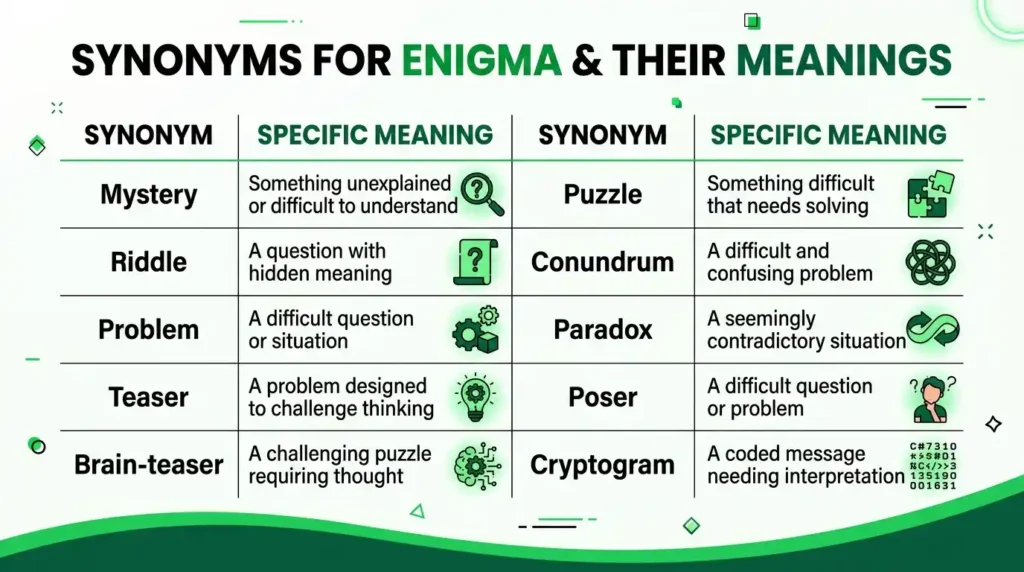
Direct Synonyms for Enigma and Their Meanings
| Synonym | Specific Meaning | Synonym | Specific Meaning |
| Mystery | Something unexplained or difficult to understand | Puzzle | Something difficult that needs solving |
| Riddle | A question with hidden meaning | Conundrum | A difficult and confusing problem |
| Problem | A difficult question or situation | Paradox | A seemingly contradictory situation |
| Teaser | A problem designed to challenge thinking | Poser | A difficult question or problem |
| Brain-teaser | A challenging puzzle requiring thought | Cryptogram | A coded message needing interpretation |
Lexical accuracy: The first four—mystery, puzzle, riddle, and conundrum—are the strongest general alternatives. Problem is broader. Paradox applies to a specific kind of enigma. Teaser, poser, brain-teaser, and cryptogram are narrower contextual alternatives, not universal substitutes. Collins groups mystery, problem, puzzle, and riddle with enigma, while its sense-based entries also connect conundrum and paradox.
Where Enigma Comes From
Parts of Speech: Noun
Syllables: en-ig-ma
Origin: English enigma entered the language through Latin aenigma, from Greek aínigma, meaning a riddle or obscure saying. The Greek form is linked to a verb meaning “to speak in riddles.”
Prefix/Suffix Breakdown: The word comes from Greek aínigma. The ending -ma is a Greek noun-forming suffix referring to the result of an action. Enigma is therefore historically connected with the idea of a riddle or puzzling statement.
The Best Synonyms for Enigma by Meaning
The right synonym depends on why something is difficult to understand.
Mystery (/ˈmɪstəri/)
Meaning: Something unexplained, unknown, or difficult to understand.
Examples:
- The cause of the failure remains a mystery.
- Her sudden decision is still a mystery to her friends.
Nuance: Mystery is the closest broad replacement for enigma. It works for people, events, facts, and situations.
Puzzle (/ˈpʌzəl/)
Meaning: Something difficult that requires thought to solve or understand.
Examples:
- The missing evidence created a puzzle for investigators.
- His strange behavior was a puzzle to everyone.
Nuance: Puzzle suggests that an answer may be found through reasoning.
Riddle (/ˈrɪdəl/)
Meaning: A question, statement, or problem with a hidden meaning or answer.
Examples:
- The inscription was a riddle that took years to solve.
- Her final message sounded like a riddle.
Nuance: Riddle often suggests deliberate concealment, wordplay, or a hidden answer. Cambridge specifically distinguishes riddle as a question-related synonym.
Conundrum (/kəˈnʌndrəm/)
Meaning: A difficult and confusing problem or question.
Examples:
- The company faced a major ethical conundrum.
- Choosing between the two offers was a conundrum.
Nuance: Conundrum often describes a hard choice or problem with no easy answer. Collins lists it prominently among the synonyms of enigma.
Problem (/ˈprɑːbləm/)
Meaning: A difficult question, situation, or task that needs a solution.
Examples:
- The unexplained result became a serious problem.
- Scientists still face the problem of identifying the cause.
Nuance: Problem is broader and less mysterious than enigma. It works when the focus is difficulty rather than mystery.
Paradox (/ˈpærədɑːks/)
Meaning: A statement or situation that seems contradictory or difficult to reconcile.
Examples:
- His success created a strange paradox.
- The case presents a paradox that researchers still debate.
Nuance: Do not use paradox for every mystery. It fits when the mystery involves an apparent contradiction. Collins places paradox under a distinct sense involving contradictory elements.
Teaser (/ˈtiːzər/)
Meaning: A question or problem designed to challenge someone.
Examples:
- The final question was a real teaser.
- The magazine included a difficult teaser.
Nuance: Teaser is more informal and usually describes an intentional challenge.
Poser (/ˈpoʊzər/)
Meaning: A difficult question or problem.
Examples:
- The final exam contained a real poser.
- That legal question is a poser for the court.
Nuance: Poser is a narrower alternative and is more common in British English.
Brain-Teaser (/ˈbreɪn ˌtiːzər/)
Meaning: A challenging puzzle that tests reasoning.
Examples:
- The interview included a tricky brain-teaser.
- She solved the mathematical brain-teaser quickly.
Nuance: This works for deliberate mental challenges, not every mysterious situation.
Cryptogram (/ˈkrɪptəɡræm/)
Meaning: A coded message that requires interpretation.
Examples:
- The old letter contained a cryptogram.
- Researchers spent hours decoding the cryptogram.
Nuance: A cryptogram is much narrower than enigma. It should be used only for a coded or encrypted message.
Related Words That Are Not Exact Synonyms
Some words appear in broad thesaurus lists because they share part of the meaning of enigma. They should not be treated as interchangeable.
Perplexity
Perplexity means a state of confusion or uncertainty.
It describes a mental state, while an enigma is usually the thing causing the confusion.
Enigma:
The scientist remained an enigma.
Perplexity:
The discovery caused great perplexity.
Secret
A secret is information that is hidden or kept unknown.
A secret may be an enigma, but the two words are not equal.
Secret focuses on hidden information.
Enigma focuses on difficulty of understanding.
Ambiguity
Ambiguity means that something has more than one possible meaning or interpretation.
An ambiguous statement can create an enigma, but ambiguity itself is not always an enigma.
Confusion
Confusion describes a lack of clarity or understanding.
An enigma can cause confusion, but the words do not have the same meaning.
Cryptic
Cryptic is an adjective meaning mysterious, obscure, or difficult to understand.
It is related to enigma, but it is not a noun synonym.
Enigma: a noun
Cryptic: an adjective
Cambridge and Collins both separate enigma from the adjective enigmatic and list words such as cryptic, mysterious, puzzling, and inscrutable as adjective-level alternatives.
Enigma vs. Mystery
Enigma and mystery are very close.
- Mystery is more common and neutral.
- Enigma often sounds more literary or sophisticated.
- Enigma can emphasize that something is especially hard to understand.
- Mystery can refer to both the unknown thing and the genre of mystery stories.
Example:
The disappearance remains a mystery.
The scientist’s motives remain an enigma.
Both work, but enigma gives the second sentence a stronger sense of puzzling complexity.
Enigma vs. Puzzle
A puzzle usually suggests that someone can solve it.
An enigma may remain unexplained.
Puzzle:
The detective solved the puzzle.
Enigma:
The man’s motives remain an enigma.
Use puzzle when solving is central. Use enigma when the mystery itself is the focus.
Enigma vs. Riddle
A riddle usually contains a hidden question, clue, or meaning.
An enigma has a broader meaning.
A riddle can be an enigma, but not every enigma is a riddle.
Riddle:
The inscription was a riddle.
Enigma:
Her behavior remains an enigma.
Enigma vs. Conundrum
A conundrum is usually a difficult problem or choice.
An enigma is usually something mysterious or hard to understand.
Conundrum:
The committee faced a difficult conundrum.
Enigma:
The cause of the strange event remains an enigma.
Choose conundrum when the problem or dilemma matters most.
Enigma vs. Paradox
A paradox involves an apparent contradiction.
An enigma does not have to involve contradiction.
Paradox:
The more choices people have, the less satisfied they may feel.
Enigma:
No one could explain why the machine suddenly stopped.
A paradox may be an enigma, but an enigma is not necessarily a paradox.
When Not to Use Enigma
Do not use enigma simply because something is difficult.
Avoid it when:
- You mean an ordinary problem.
- You mean a simple question.
- You mean a hidden secret.
- You mean a person’s confusion.
- You mean a clear contradiction and paradox is more precise.
- You mean a coded message and cryptogram is more precise.
- You mean a deliberate word puzzle and riddle is more precise.
- You mean a difficult choice and conundrum is more precise.
Also, Enigma with a capital E can refer to the historical German encryption machine used during World War II. That is a different sense from the ordinary noun enigma.
Enigma Synonyms for Academic Writing
For academic writing, choose the synonym that matches the exact type of uncertainty.
- Mystery — broad and neutral.
- Problem — useful when a solution is needed.
- Puzzle — useful when reasoning is required.
- Conundrum — useful for difficult problems or choices.
- Paradox — useful for apparent contradictions.
- Riddle — useful for hidden meanings or questions.
Examples
Neutral academic:
The cause of the phenomenon remains a mystery.
Problem-focused:
Researchers face a major problem in explaining the result.
Reasoning-focused:
The findings present a complex puzzle.
Contradiction-focused:
The results create an apparent paradox.
Enigma Synonyms for Formal Writing
If you need a formal alternative to enigma, the best choices are usually:
- Mystery
- Conundrum
- Puzzle
- Problem
- Paradox
Avoid replacing enigma with an unnecessarily obscure word. Clear writing is usually stronger than forced sophistication.
Enigma Synonyms for Creative Writing
Creative writing gives enigma a strong sense of mystery and intrigue.
Good alternatives include:
- Mystery — natural and familiar
- Riddle — secretive and intriguing
- Puzzle — intellectual and investigative
- Conundrum — difficult and complex
- Secret — hidden and personal
- Paradox — strange and contradictory
- Cryptic mystery — deliberately obscure
Example
- Her smile was an enigma.
- Possible alternatives:
- Her smile was a mystery.
- Her smile was a riddle.
- Her smile was a puzzle.
Each creates a slightly different effect.
Enigma Synonyms for Describing a Person
When enigma describes a person, choose the replacement based on what makes the person difficult to understand.
- Mystery — a person who is hard to understand.
- Puzzle — someone whose behavior is confusing.
- Conundrum — someone whose motives create a difficult problem.
- Riddle — someone who seems deliberately hard to read.
- Unknown quantity — someone whose behavior or abilities are uncertain.
Example:
He remains an enigma to his colleagues.
A natural alternative is:
He remains a mystery to his colleagues.
For a person, mystery is usually more natural than problem or paradox.
Common Traps & Nuance Distinctions
The biggest mistake is treating every related thesaurus word as a perfect synonym.
- Enigma vs. mystery: Very close; enigma can sound more literary or intense.
- Enigma vs. puzzle: A puzzle usually suggests something that can be solved.
- Enigma vs. riddle: A riddle usually has a hidden question or answer.
- Enigma vs. conundrum: A conundrum usually involves a difficult problem or choice.
- Enigma vs. problem: Problem is broader and less mysterious.
- Enigma vs. paradox: A paradox requires an apparent contradiction.
- Enigma vs. secret: A secret is hidden information; an enigma is something difficult to understand.
- Enigma vs. perplexity: Perplexity is a state of confusion, not usually the mysterious thing itself.
- Enigma vs. cryptic: Cryptic is an adjective, while enigma is a noun.
Word Family of Enigma
Understanding the word family helps avoid grammatical errors.
- Enigma — noun
- Enigmas — plural noun
- Enigmatic — adjective
- Enigmatically — adverb
Examples:
The case remains an enigma.
The case contains several enigmas.
She gave an enigmatic answer.
He smiled enigmatically.
Dictionary.com records enigmatic and enigmatically as derived forms of enigma.
Opposite Words: Antonyms for “Enigma”
There is no single perfect antonym for enigma. The best opposite depends on whether you mean mystery, obscurity, or difficulty of understanding.
Direct Contextual Antonyms
- Explanation — an account that makes something clear.
- The report finally provided an explanation.
- Answer — a response that resolves a question.
- The investigation produced an answer.
- Solution — a way to resolve a problem.
- The team found a solution.
- Clarity — a state of being easy to understand.
- The new evidence brought clarity.
Operational and Contextual Opposites
- Certainty — a state of being sure.
- The evidence gave researchers certainty.
- Transparency — openness that makes information easy to understand.
- The company promised greater transparency.
- Disclosure — information that was previously hidden.
- The disclosure solved the mystery.
- Explanation — information that removes uncertainty.
- Her explanation cleared up the confusion.
These are contextual opposites, not universal dictionary antonyms.
Frequently Asked Questions
What is the best synonym for enigma?
Mystery is the best broad synonym for enigma. Puzzle, riddle, and conundrum are also strong choices when their specific meanings fit the sentence.
What is another word for enigma in an essay?
Use mystery for a broad formal meaning, puzzle for a problem that needs analysis, conundrum for a difficult issue, and paradox when contradictory ideas are involved.
What is a formal synonym for enigma?
Mystery, conundrum, puzzle, and paradox can all work in formal writing, depending on context. Mystery is the safest general replacement.
Is puzzle a synonym for enigma?
Yes, puzzle can be a synonym for enigma when something is difficult to understand or solve. However, puzzle usually suggests that a solution can be found.
Is riddle a synonym for enigma?
Yes, but only in the relevant sense. A riddle is usually a question, statement, or problem with a hidden meaning or answer, while enigma has a broader meaning.
What is the difference between enigma and conundrum?
An enigma is something mysterious or difficult to understand. A conundrum is usually a difficult problem or choice. Both can describe something perplexing, but conundrum puts more emphasis on the problem itself.
What is the difference between enigma and paradox?
An enigma is mysterious or difficult to understand. A paradox contains an apparent contradiction. Therefore, paradox is a narrower alternative rather than a general synonym.
Conclusion
The strongest synonyms for enigma are mystery, puzzle, riddle, and conundrum, while problem works when the focus is difficulty rather than mystery. Paradox is appropriate only when an apparent contradiction is central, and terms such as teaser, poser, brain-teaser, and cryptogram belong to narrower contexts. For academic, formal, and creative writing, choose the synonym that matches the exact type of mystery, problem, hidden meaning, or contradiction you want to express.