
Synonyms for snacks (noun, plural) (/snæks/) are words and phrases that describe small amounts of food eaten between meals or as a light eating occasion.
The closest alternatives include bites, nibbles, nosh, morsels, tidbits, and light meals. The right choice depends on tone and context.
What is another word for snacks
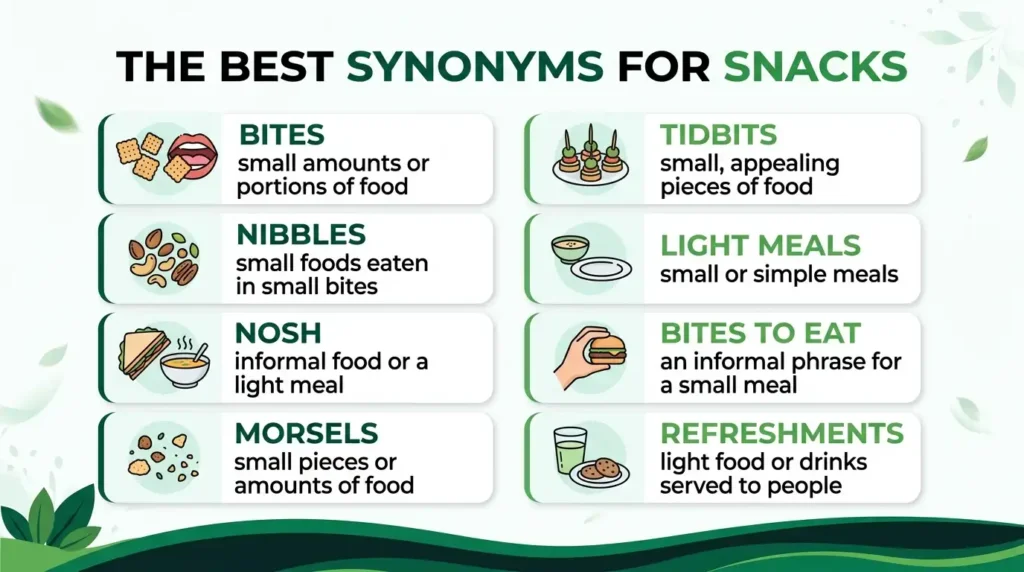
The best synonyms for snacks are:
- Bites — small amounts or portions of food
- Nibbles — small foods eaten in small bites
- Nosh — informal food or a light meal
- Morsels — small pieces or amounts of food
- Tidbits — small, appealing pieces of food
- Light meals — small or simple meals
- Bites to eat — an informal phrase for a small meal
- Refreshments — light food or drinks served to people
- Best general replacement: bites
- Best informal replacement: nosh
- Best party-related replacement: nibbles
- Best formal replacement: light meals
Not all related food terms are exact synonyms. Appetizers, canapés, hors d’oeuvres, and finger food have more specific meanings.
Direct Synonyms and Close Alternatives for Snacks
| Synonym | Specific Meaning | Synonym | Specific Meaning |
| Bites | Small amounts of food eaten casually | Nibbles | Small foods eaten in small bites |
| Nosh | Informal word for food or snack | Morsels | Small pieces or amounts of food |
| Tidbits | Small, appealing pieces of food | Light meals | Small or simple meals |
| Bites to eat | Informal phrase for small food | Refreshments | Light food or drinks served |
Note: These words do not all have exactly the same meaning. Bites, nibbles, and nosh are close alternatives. Morsels and tidbits focus on small pieces of food. Light meals and refreshments work only in suitable contexts.
Where Snacks Comes From
Parts of Speech: Noun; snack is also a verb
Syllable: 1
Origin: Snack comes from Middle English forms related to snacchen and snacche, which referred to biting, snapping, or seizing. The modern food sense developed around the idea of a small bite or portion of food.
Prefix/Suffix Breakdown: Snack has no modern productive prefix or suffix. Snacks adds the regular plural ending -s.
1. Bites /baɪts/
Meaning: Small amounts or portions of food.
Examples:
- We ordered a few bites before the movie.
- The café serves small bites with coffee.
Why it fits: Bites is one of the safest and most natural alternatives to snacks. It works well in everyday English and food writing.
2. Nibbles /ˈnɪbəlz/
Meaning: Small pieces of food eaten in small bites.
Examples:
- We put out some nibbles before dinner.
- The guests enjoyed cheese, nuts, and other nibbles.
Why it fits: Nibbles works especially well for small foods served at gatherings or eaten casually.
3. Nosh /nɒʃ/ or /nɑːʃ/
Meaning: Informal food, snack, or light meal.
Examples:
- Let’s grab some nosh before the show.
- We had a quick nosh after work.
Why it fits: Nosh has a relaxed, informal tone. It works well in conversation and casual writing.
4. Morsels /ˈmɔːrsəlz/
Meaning: Small pieces or amounts of food.
Examples:
- The chef served small morsels of cake.
- Guests sampled several savory morsels.
Why it fits: Morsels focuses on the small size of the food. It can sound more descriptive or literary than snacks.
5. Tidbits /ˈtɪdbɪts/
Meaning: Small pieces or amounts, often attractive or appealing ones.
Examples:
- The table was filled with tasty tidbits.
- We sampled a few sweet tidbits after dinner.
Why it fits: Tidbits can describe small pieces of food, but it can also mean small pieces of information. Context matters.
6. Light Meals /laɪt miːlz/
Meaning: Small or simple meals.
Examples:
- The hotel offers light meals throughout the day.
- We ate light meals during the journey.
Why it fits: Light meals is a useful neutral or formal alternative when snacks means small meals rather than tiny pieces of food.
7. Bites to Eat /baɪts tə iːt/
Meaning: A small meal or amount of food.
Examples:
- We stopped for a few bites to eat.
- Let’s find somewhere for a bite to eat.
Why it fits: This is a natural phrase rather than a single-word synonym. It works especially well in everyday speech.
8. Refreshments /rɪˈfreʃmənts/
Meaning: Light food or drinks served to people.
Examples:
- Refreshments were available after the meeting.
- The event provided drinks and light refreshments.
Why it fits: Refreshments can refer to snacks, but it can also include drinks. It is therefore a contextual alternative, not an exact synonym.
Contextual Alternatives for Snacks
Some words are closely related to snacks but should not be treated as direct synonyms.
Appetizers /ˈæpɪtaɪzərz/
Meaning: Small foods served before a main meal.
Examples:
- We ordered two appetizers before dinner.
- The restaurant offers several vegetarian appetizers.
Difference: An appetizer normally comes before a main meal. A snack can be eaten at any time.
Canapés /ˈkænəpeɪz/
Meaning: Small prepared foods often served at receptions or formal events.
Examples:
- Servers passed canapés during the reception.
- The event offered several elegant canapés.
Difference: A canapé is a specific type of small food. It is not a general replacement for snacks.
Hors d’oeuvres /ɔːr ˈdɜːrvz/
Meaning: Small foods served before or alongside a meal.
Examples:
- Guests enjoyed several hors d’oeuvres.
- The hotel served hot and cold hors d’oeuvres.
Difference: The term is linked to meals and social events. It does not describe every ordinary snack.
Finger Food /ˈfɪŋɡər fuːd/
Meaning: Food designed to be eaten with the hands.
Examples:
- The party served simple finger food.
- Sandwiches made easy finger food for the children.
Difference: Finger food describes how food is eaten. Snack describes a small eating occasion or portion.
Best Synonyms for Snacks by Context
Another Word for Snacks in Everyday English
Use:
- Bites
- Nibbles
- Nosh
- Bites to eat
Bites is the safest neutral choice. Nibbles sounds casual. Nosh has a more informal tone.
Another Word for Snacks in Formal Writing
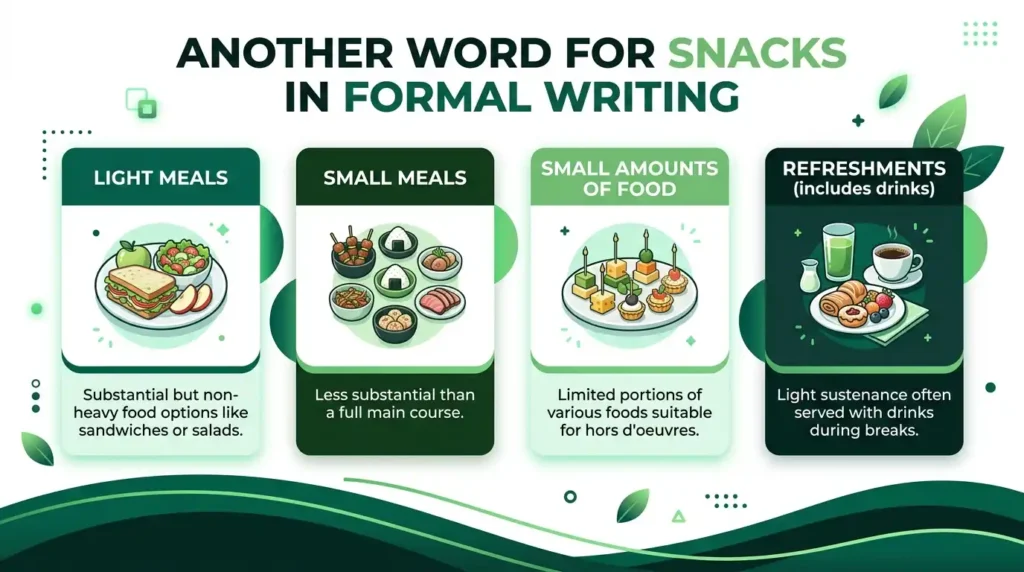
Use:
- Light meals
- Small meals
- Small amounts of food
- Refreshments when drinks are also included
Avoid nosh when you need a formal or academic tone.
Another Word for Snacks in an Essay
Use:
- Light meals
- Small meals
- Small amounts of food
- Between-meal foods
Example:
Children may eat small amounts of food between regular meals.
This sounds more formal than:
Children may eat snacks between regular meals.
Another Word for Snacks at a Party
Use:
- Nibbles
- Refreshments
- Canapés
- Hors d’oeuvres
- Finger food
Use nibbles for a casual event. and canapés or hors d’oeuvres for a formal event.
Another Word for Snacks in Creative Writing
Use:
- Bites — simple and natural
- Nibbles — casual and social
- Morsels — descriptive and sensory
- Tidbits — playful or vivid
- Nosh — relaxed and conversational
Choose the word that matches the mood of the scene.
Common Traps & Nuance Distinctions
Snacks vs. Bites
Snack describes a small eating occasion or portion. Bite can describe a small amount of food or a small meal.
- I packed some snacks for the trip.
- Let’s grab a bite before the movie.
Snacks vs. Nibbles
Nibbles suggests small pieces of food eaten in small amounts. It often sounds casual or social.
- We packed snacks for the hike.
- The host put out nibbles for the guests.
Snacks vs. Nosh
Nosh is informal. It can refer to food, a snack, or a light meal.
- I packed some snacks.
- Let’s get some nosh.
Snacks vs. Morsels
A morsel is a small piece or amount of food. A snack can be a complete small eating occasion.
- The chef served small morsels.
- I brought snacks for the journey.
Snacks vs. Refreshments
Refreshments can include food and drinks. Snacks normally refers to food.
- The hotel provided snacks.
- The hotel provided refreshments.
Snacks vs. Appetizers
An appetizer usually comes before a main meal. A snack does not need to come before a meal.
Snacks vs. Finger Food
Finger food describes the way food is eaten. Snack describes its role as a small eating occasion or portion.
When Not to Use a Synonym for Snacks
Do not replace snacks with a related word when it changes the meaning.
- Do not use appetizers for every snack.
- Do not use refreshments when you mean food only.
- Do not use canapés for ordinary packaged snacks.
- Do not use nosh in formal academic writing.
- Do not use morsels when you mean a complete small meal.
- Do not use tidbits when you need a plain, neutral term.
- Do not use finger food when the way food is eaten does not matter.
- Do not use light meals when you mean very small pieces of food.
- Do not use meal when the portion is clearly much smaller than a normal meal.
Synonyms, Near-Synonyms, and Contextual Alternatives
| Word | Category | Key Difference |
| Bites | Close synonym | Small portions or small meals |
| Nibbles | Close synonym | Small foods eaten in small bites |
| Nosh | Close synonym | Informal food or snack |
| Morsels | Near-synonym | Focuses on small food pieces |
| Tidbits | Near-synonym | Small, appealing pieces |
| Light meals | Contextual alternative | Emphasizes a small meal |
| Bites to eat | Contextual phrase | Means a small meal or snack |
| Refreshments | Contextual alternative | May include drinks |
| Appetizers | Narrow related term | Usually served before a meal |
| Canapés | Narrow related term | Specific small prepared foods |
| Hors d’oeuvres | Narrow related term | Small foods for meals or events |
| Finger food | Related term | Defined by how it is eaten |
Opposite Words: Antonyms for “Snacks”
There is no single perfect antonym for snacks. The clearest contrast is usually meals, because meals are generally larger and more substantial.
Direct Antonyms
- Meals — regular, substantial eating occasions.
We eat three main meals each day. - Main meals — primary meals such as lunch or dinner.
Avoid too many snacks before main meals. - Full meals — substantial meals rather than small portions.
The hotel serves full meals as well as snacks. - Feasts — large and elaborate meals.
The celebration ended with a large feast.
Operational & Contextual Opposites
- Fasting — going without food for a period.
She was fasting before the test. - Starvation — severe lack of food.
The crisis caused widespread starvation. - Lunch — a regular midday meal.
He skipped his snack and ate lunch early. - Dinner — a main evening meal.
We had dinner at eight.
These are contextual opposites rather than exact dictionary antonyms. Meals is the clearest general contrast with snacks.
Frequently Asked Questions
What is another word for snacks?
The strongest alternatives are bites, nibbles, nosh, morsels, tidbits, and light meals. For a neutral everyday choice, bites is usually the safest option.
What is a formal synonym for snacks?
Light meals, small meals, and small amounts of food work well in formal writing. Use refreshments when the context includes drinks.
What is another word for snacks in an essay?
Use light meals, small meals, small amounts of food, or between-meal foods. These options sound more neutral than informal nosh.
What is another word for snacks at a party?
Use nibbles for a casual gathering. Use canapés or hors d’oeuvres for a formal event. Refreshments works when both food and drinks are offered.
Is “nosh” a synonym for snacks?
Yes. Nosh can mean food, a snack, or a light meal. It has an informal tone, so it works best in casual speech and writing.
Conclusion
The strongest synonyms for snacks are bites, nibbles, nosh, morsels, tidbits, and light meals. Use refreshments, appetizers, canapés, or finger food only when their narrower meanings fit the context. For formal writing, choose light meals or small meals; for casual writing, bites, nibbles, and nosh sound more natural. The best synonym is always the one that preserves the original meaning, tone, and context.