
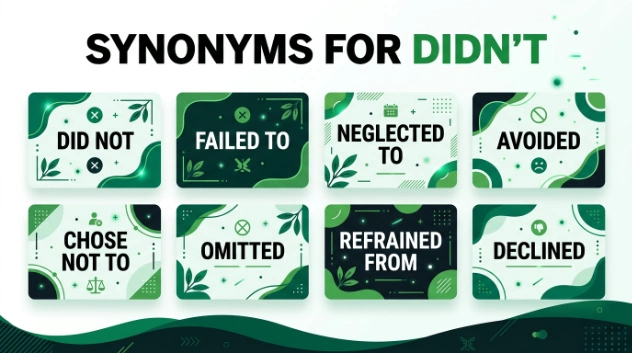

Synonyms for Didn’t (negative auxiliary verb contraction) /ˈdɪdnt/ means did not. It shows that an action or event did not happen in the past. Cambridge and Dictionary.com both define didn’t as the short form of did not.
The exact synonym for didn’t is did not. Other alternatives, such as failed to, refused to, neglected to, was unable to, and could not, can express similar ideas in specific contexts, but they change the meaning or tone.
What Is Another Word for Didn’t?
The most accurate answer to “What is another word for didn’t?” is did not.
Didn’t = did not.
For example:
- I didn’t finish the report.
- I did not finish the report.
Both sentences have the same basic meaning. Use didn’t in normal conversation and informal writing. Use did not when you want a more formal, clear, or emphatic tone. Cambridge identifies didn’t as the short form of did not.
What Are the Best Synonyms for Didn’t?
Because didn’t is a grammatical contraction rather than a normal lexical verb, English does not have exact one-to-one synonyms. Current dictionary and thesaurus results also distinguish the exact form did not from alternatives such as failed to and refused to, which add different meanings.
| Synonym | Specific Meaning | Synonym | Specific Meaning |
| 1. Did not | Exact expanded form of didn’t | 16. Was unwilling to | Did not want to act |
| 2. Failed to | Did not complete an expected action | 17. Was not willing to | Chose not to act |
| 3. Refused to | Deliberately chose not to act | 18. Was not prepared to | Was unwilling to act |
| 4. Neglected to | Failed to give needed attention | 19. Had no intention of | Did not plan to act |
| 5. Omitted to | Left an expected action undone | 20. Had not | Expresses earlier non-possession |
| 6. Was unable to | Could not perform an action | 21. Could not | Was not able to act |
| 7. Could not | Was unable to do something | 22. Was unable to | Lacked ability to act |
| 8. Did not manage to | Could not complete something | 23. Wasn’t able to | Could not do something |
| 9. Did not succeed in | Failed to achieve a result | 24. Did not happen | An event never occurred |
| 10. Did not complete | Left something unfinished | 25. Never | Indicates no occurrence |
| 11. Did not perform | Failed to carry out an action | 26. Was not the case | States something was untrue |
| 12. Did not occur | An event never happened | 27. Did not take place | An event never occurred |
| 13. Did not respond | Gave no response | 28. Did not appear | Was absent or unseen |
| 14. Did not attend | Was absent from an event | 29. Did not participate | Took no part in something |
| 15. Did not agree | Rejected or withheld agreement | 30. Did not accept | Rejected something |
Important: Items 1–2 are the closest general alternatives. The others are contextual alternatives, not exact synonyms. This distinction prevents unnatural word substitution.
Where Does Didn’t Come From?
Parts of Speech: Negative auxiliary verb contraction
Syllable: Usually pronounced as one syllable in American English; British pronunciation may sound like two syllables.
Origin: Didn’t is a contraction of did not. Did is the past-tense form of do, an Old English verb from the Germanic verb family meaning to perform or act.
Prefix/Suffix Breakdown: did + n’t → didn’t; n’t represents the shortened negative element not.
30 Synonyms and Contextual Alternatives for Didn’t
These alternatives can replace didn’t only when their added meaning fits the sentence.
1. Did Not /dɪd nɒt/
Meaning: The exact expanded form of didn’t.
Example:
- I didn’t call her.
- I did not call her.
Usage: This is the safest replacement in almost every sentence.
2. Failed to /feɪld tuː/
Meaning: Did not do something that was expected or attempted.
Example:
- He didn’t arrive on time.
- He failed to arrive on time.
Nuance: Failed to can suggest an unsuccessful attempt or an unmet expectation. Cambridge defines fail to as not doing something that should be done.
3. Refused to /rɪˈfjuːzd tuː/
Meaning: Deliberately chose not to do something.
Example:
- She didn’t answer the question.
- She refused to answer the question.
Nuance: Refused to is stronger. It suggests a conscious decision.
4. Neglected to /nɪˈɡlektɪd tuː/
Meaning: Failed to do something through lack of care or attention.
Example:
- He didn’t lock the door.
- He neglected to lock the door.
5. Was Unable to /wəz ʌnˈeɪbəl tuː/
Meaning: Could not do something because of inability.
Example:
- She didn’t attend the meeting.
- She was unable to attend the meeting.
6. Could Not /kʊd nɒt/
Meaning: Was not able to do something.
Example:
- I didn’t finish the work.
- I could not finish the work.
Nuance: Could not usually focuses on inability, not simple non-action.
7. Did Not Manage to /dɪd nɒt ˈmænɪdʒ tuː/
Meaning: Tried but did not complete something.
Example:
- We didn’t reach the station.
- We did not manage to reach the station.
8. Did Not Succeed in /dɪd nɒt səkˈsiːd ɪn/
Meaning: Did not achieve the intended result.
Example:
- He didn’t solve the problem.
- He did not succeed in solving the problem.
9. Did Not Complete /dɪd nɒt kəmˈpliːt/
Meaning: Left a task unfinished.
Example:
- She didn’t complete the assignment.
- She did not complete the assignment.
10. Did Not Perform /dɪd nɒt pərˈfɔːrm/
Meaning: Did not carry out an action or task.
Example:
- The team didn’t perform the test.
- The team did not perform the test.
11. Did Not Occur /dɪd nɒt əˈkɜːr/
Meaning: An event did not happen.
Example:
- The meeting didn’t happen.
- The meeting did not occur.
12. Did Not Take Place /dɪd nɒt teɪk pleɪs/
Meaning: An event never happened.
Example:
- The ceremony didn’t take place.
- The ceremony did not take place.
13. Did Not Respond /dɪd nɒt rɪˈspɒnd/
Meaning: Gave no answer or reaction.
Example:
- He didn’t respond to my email.
- He did not respond to my email.
14. Did Not Attend /dɪd nɒt əˈtend/
Meaning: Was absent from an event.
Example:
- She didn’t attend the meeting.
- She did not attend the meeting.
15. Did Not Participate /dɪd nɒt pɑːrˈtɪsɪpeɪt/
Meaning: Took no part in an activity.
Example:
- He didn’t participate in the discussion.
- He did not participate in the discussion.
16. Was Unwilling to /wəz ʌnˈwɪlɪŋ tuː/
Meaning: Did not want to do something.
Example:
- She didn’t help.
- She was unwilling to help.
17. Was Not Willing to /wəz nɒt ˈwɪlɪŋ tuː/
Meaning: Chose not to cooperate or act.
Example:
- He didn’t compromise.
- He was not willing to compromise.
18. Was Not Prepared to /wəz nɒt prɪˈpeəd tuː/
Meaning: Was unwilling or not ready to act.
Example:
- She didn’t discuss the issue.
- She was not prepared to discuss the issue.
19. Had No Intention of /hæd nəʊ ɪnˈtenʃən əv/
Meaning: Did not plan or intend to act.
Example:
- He didn’t apologize.
- He had no intention of apologizing.
20. Had Not /hæd nɒt/
Meaning: Expresses an earlier negative state or possession.
Example:
- She didn’t have enough time.
- She had not had enough time.
Nuance: This is not a general synonym for didn’t. Grammar and context must support it.
21. Wasn’t Able to /ˈwɒzənt ˈeɪbəl tuː/
Meaning: Could not perform an action.
Example:
- I didn’t finish the task.
- I wasn’t able to finish the task.
22. Did Not Accept /dɪd nɒt əkˈsept/
Meaning: Rejected something offered or proposed.
Example:
- She didn’t accept the offer.
- She did not accept the offer.
23. Did Not Agree /dɪd nɒt əˈɡriː/
Meaning: Did not share or give agreement.
Example:
- He didn’t agree with the plan.
- He did not agree with the plan.
24. Did Not Appear /dɪd nɒt əˈpɪər/
Meaning: Was absent or failed to arrive.
Example:
- The speaker didn’t appear.
- The speaker did not appear.
25. Did Not Happen /dɪd nɒt ˈhæpən/
Meaning: An expected event never occurred.
Example:
- The accident didn’t happen.
- The accident did not happen.
26. Did Not Show Up /dɪd nɒt ʃəʊ ʌp/
Meaning: Failed to arrive at a place.
Example:
- He didn’t show up.
- He did not show up.
27. Did Not Attend /dɪd nɒt əˈtend/
Meaning: Was absent from a planned event.
Example:
- They didn’t attend the conference.
- They did not attend the conference.
28. Did Not Carry Out /dɪd nɒt ˈkæri aʊt/
Meaning: Did not complete a planned action.
Example:
- The company didn’t carry out the review.
- The company did not carry out the review.
29. Never /ˈnevər/
Meaning: At no time in the relevant period.
Example:
- He didn’t visit London.
- He never visited London.
Nuance: Never can replace didn’t only when the sentence means the action did not happen at any time.
30. Was Not the Case /wəz nɒt ðə keɪs/
Meaning: Something was not true.
Example:
- It didn’t seem possible.
- It was not the case that it seemed possible.
Nuance: This is formal and works only in suitable contexts.
How Do You Use Didn’t in a Sentence?
Use didn’t + base form of the main verb to make a negative statement about the past.
Correct pattern:
Subject + didn’t + base verb
Examples:
- I didn’t go.
- She didn’t call.
- They didn’t finish.
- We didn’t understand.
- He didn’t see the message.
Do not use the past form of the main verb after didn’t.
Incorrect: She didn’t went home.
Correct: She didn’t go home.
The same rule applies to did not:
Incorrect: He did not finished the work.
Correct: He did not finish the work.
Didn’t in a Sentence: Examples for Everyday Writing
Here are natural examples of didn’t in a sentence:
- I didn’t see your message.
- She didn’t enjoy the movie.
- We didn’t finish dinner.
- He didn’t answer my call.
- They didn’t arrive on time.
- My friend didn’t understand the question.
- The store didn’t open until nine.
- I didn’t expect the result.
- She didn’t want to leave.
- We didn’t know about the change.
When Should You Use Didn’t or Did Not?
Use didn’t for normal speech, conversation, texts, emails, and informal writing.
Use did not when you want a more formal or emphatic tone.
Casual:
I didn’t receive the document.
More formal:
I did not receive the document.
Emphatic:
I did not approve that decision.
The full form can make a negative statement sound stronger. Collins describes didn’t as the usual spoken form of did not.
What Is a Formal Synonym for Didn’t?
The best formal alternative is usually did not.
For example:
Informal:
The company didn’t respond.
Formal:
The company did not respond.
You can also use a more precise verb phrase when the context supports it:
- didn’t complete → failed to complete
- didn’t follow → neglected to follow
- didn’t agree → declined to agree
- didn’t attend → was absent from
- didn’t participate → did not participate
Do not replace every use of didn’t with failed to. Failed to can suggest that someone was expected to succeed or had an obligation to act.
Didn’t in an Essay: Should You Use It?
For a formal essay, did not is usually a better choice than didn’t.
For example:
Less formal:
The study didn’t find a clear link between the two factors.
More formal:
The study did not find a clear link between the two factors.
However, didn’t is not grammatically wrong in an essay. The choice depends on the required tone and style guide.
Didn’t for Creative Writing
In creative writing, didn’t often sounds more natural because it reflects normal speech.
For example:
She didn’t know what to say.
This sounds direct and conversational.
Changing it to:
She did not know what to say.
adds more formality or emphasis.
Writers can use the full form when they want a character’s voice to sound serious, firm, distant, or emotional.
Common Traps & Nuance Distinctions
The biggest mistake is treating every contextual alternative as an exact synonym.
- Didn’t vs. did not: These have the same basic meaning. Didn’t is the contraction; did not is the full form.
- Didn’t vs. failed to: Failed to can suggest an attempt, expectation, duty, or unsuccessful result.
- Didn’t vs. refused to: Refused to means the person deliberately chose not to act.
- Didn’t vs. couldn’t: Couldn’t means the person was unable to act. Didn’t does not automatically express inability.
- Didn’t vs. neglected to: Neglected to suggests carelessness, forgetfulness, or lack of attention.
- Didn’t vs. never: Never means at no time. Didn’t can refer to one specific past action.
- Didn’t vs. wasn’t: These have different grammatical functions. Didn’t normally negates a past action with a base verb, while wasn’t is the negative form of was.
Why Can’t I Use Failed to Everywhere?
Because failed to adds meaning.
Compare:
She didn’t call me.
This only states that she did not call.
She failed to call me.
This may suggest that she was expected to call, tried but did not succeed, or should have called.
The second sentence carries more judgment or expectation.
When Should You NOT Use Didn’t?
Do not use didn’t when you need a more precise meaning.
Avoid it when you really mean:
- couldn’t → inability
- refused to → deliberate rejection
- failed to → unsuccessful action or unmet expectation
- neglected to → lack of care or attention
- never → no occurrence at any time
- wasn’t → a negative form of was
For example:
Weak:
He didn’t finish the task.
More precise:
He failed to finish the task.
Use the second version only when the context supports the idea of failure.
Opposite Words: Antonyms for Didn’t
The opposite of didn’t depends on the sentence.
Direct Antonyms
- Did — performed an action.
She didn’t call. → She did call. - Completed — finished an action.
He didn’t complete the task. → He completed the task. - Succeeded — achieved the intended result.
They didn’t succeed. → They succeeded. - Achieved — successfully reached a goal.
She didn’t achieve the goal. → She achieved the goal.
Operational and Contextual Opposites
- Performed — carried out an action.
He didn’t perform the test. → He performed the test. - Attended — went to an event.
She didn’t attend. → She attended. - Participated — took part in an activity.
They didn’t participate. → They participated. - Accepted — agreed to receive or approve something.
He didn’t accept the offer. → He accepted the offer.
What Does the Current Search Landscape Miss?
Current dictionary and thesaurus pages generally explain that didn’t = did not, then list contextual alternatives such as failed to, refused to, and neglected to.
A useful distinction is often missing: these alternatives are not interchangeable.
For example, failed to adds an expectation of success, while refused to adds deliberate choice. Could not adds inability. Neglected to can add carelessness.
That distinction gives writers a better answer than a simple list of replacement words.
Frequently Asked Questions
What is another word for didn’t?
The exact alternative to didn’t is did not. Other phrases, such as failed to, refused to, and was unable to, may work in specific contexts but add different meanings.
What does didn’t mean?
Didn’t means did not. It is the negative contraction of the past-tense auxiliary did.
How do you pronounce didn’t?
The common American pronunciation is approximately /ˈdɪdnt/. British pronunciation may be heard as /ˈdɪdənt/.
What is a formal synonym for didn’t?
Did not is the best general formal alternative. You can also choose a more specific phrase such as failed to, neglected to, or was unable to when its meaning fits.
Can I use didn’t in an academic essay?
Yes, but did not often fits formal academic writing better. The full form sounds more formal and can add emphasis.
Conclusion
The exact synonym for didn’t is did not, while alternatives such as failed to, refused to, neglected to, could not, and was unable to work only when their added meaning fits the context. Use didn’t for natural everyday English, did not for formal writing, and more precise alternatives when you need to show failure, refusal, inability, or neglect.