

By Site Editor | Last updated: 2026-11-04
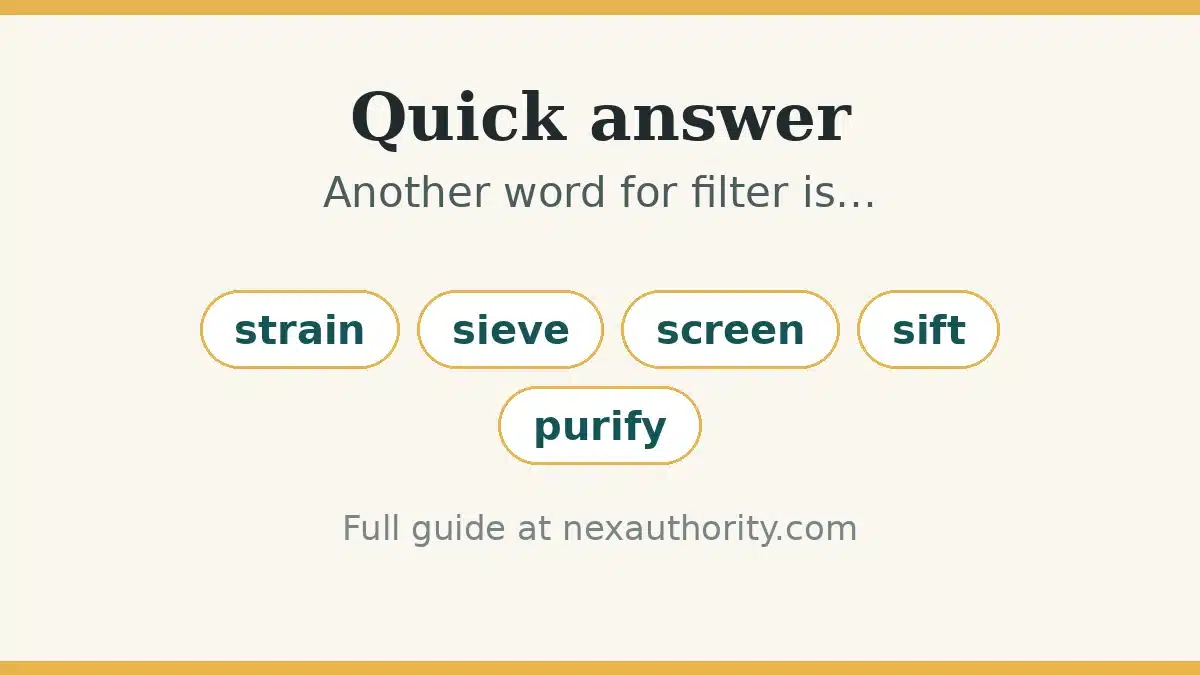
Filter means to pass a liquid, gas, light, or sound through a device or medium that removes what is unwanted, or the device that does the removing. The closest synonyms for the word itself are strain, sieve, sift, screen, and percolate.
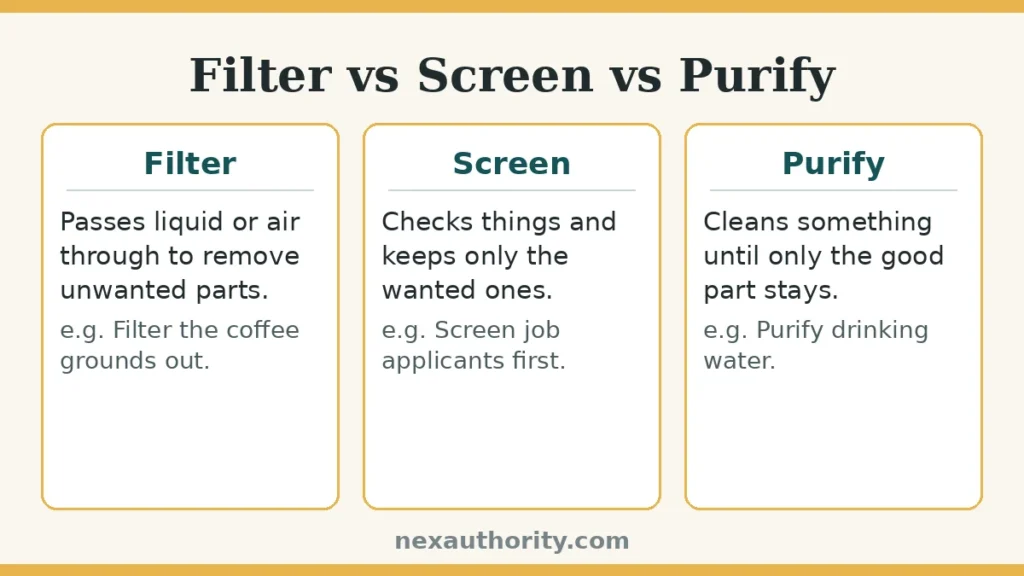
Choose strain when liquid passes through a mesh and leaves solids behind. Choose sieve when the shaking motion is the point, as with flour or gravel. Choose screen when something is checked first, as with calls.
- Strain — pass liquid through to remove solids
- Sieve — shake through a mesh to separate
- Sift — shake fine matter through a mesh
- Screen — check and sort what passes
- Percolate — seep slowly through a medium
- Clarify — remove impurities from a liquid
Synonyms for Filter: Full Tiered Table
| Synonym | Tier | Meaning (3-6 words) | Best for |
|---|---|---|---|
| Strain | Exact | Pass liquid through, remove solids | Cooking, lab work |
| Sieve | Exact | Shake through a mesh, separate | Cooking, building work |
| Sift | Exact | Shake fine matter through mesh | Baking, sorting powder |
| Screen | Exact | Check and sort what passes | Hiring, email, calls |
| Percolate | Exact | Seep slowly through a medium | Coffee, water, geology |
| Clarify | Near | Remove impurities from liquid | Cooking, lab writing |
| Purify | Near | Clean of dirt or germs | Water, air, formal writing |
| Refine | Near | Make pure by processing | Oil, sugar, formal writing |
| Cleanse | Near | Wash clean, remove dirt | Skincare, formal writing |
| Distill | Near | Purify by heating and cooling | Spirits, chemistry |
| Leach | Near | Draw out by soaking liquid | Soil, mining, chemistry |
| Separate | Near | Divide into parts | General writing |
| Seep | Near | Pass slowly through gaps | Water, news, crowds |
| Winnow | Near | Blow away the unwanted part | Grain, figurative use |
| Extract | Near | Pull out what is wanted | Chemistry, data, quotes |
| Strainer | Related | Kitchen tool for draining | Cooking contexts |
| Colander | Related | Bowl with holes for draining | Cooking contexts |
| Mesh | Related | Netting that strains matter | Technical, product writing |
| Membrane | Related | Thin layer that blocks matter | Science, medical writing |
| Censor | Related | Block content by judgment | Media, speech contexts |
| Block | Related | Stop from passing or showing | Computing, social media |
| Moderate | Related | Check posts before publishing | Online communities |
| Curate | Related | Select with care and taste | Art, content, shopping |
| Riddle | Related | Coarse sieve for soil | Building, garden work |
| Vet | Related | Check carefully before approval | Hiring, security writing |
Filter Word Card
- Part of speech: noun and verb
- Pronunciation: US /ˈfɪl.tɚ/, UK /ˈfɪl.tər/
- Word forms: filters, filtered, filtering, filtration, filtrate
- Register: neutral; technical in computing and photography
Top 10 Synonyms for Filter in Detail
Strain
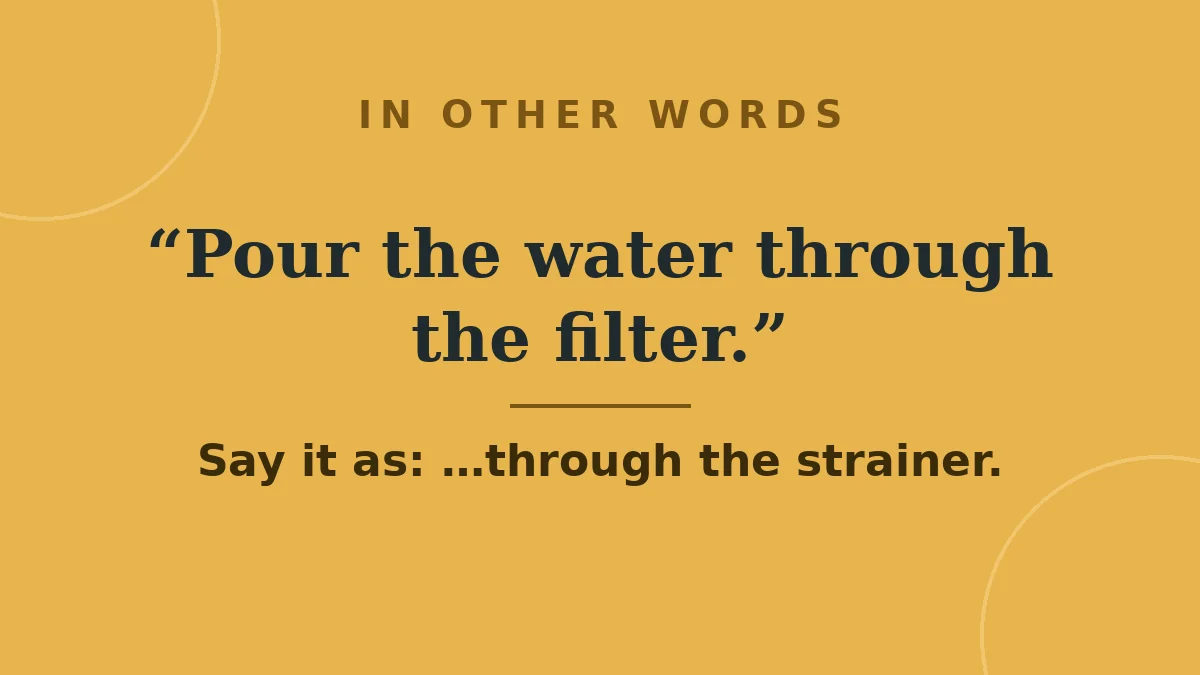
Strain means to pour liquid through a mesh or cloth so solids stay behind. It is the everyday kitchen and lab word, plain and direct. “Strain the stock through a fine cloth before serving.” Use it when liquid and trapped solids are the point. Avoid it where no liquid is involved.
Sieve
Sieve names the mesh tool and the act of shaking matter through it to sort sizes. It suits flour, soil, and gravel graded by size. “Sieve the flour twice for a lighter cake.” Use it when size sorting is the point. Avoid it for liquids passing through paper or cloth.
Sift
Sift means to shake fine, dry matter through a mesh so coarse bits stay behind. It is the baking word for flour, sugar, and cocoa. “Sift the cocoa into the bowl to remove lumps.” Use it for dry powders and fine grains. Avoid it for liquids, and for sorting large objects.
Screen
Screen means to check people, messages, or material and let only some pass. It is the hiring, security, and content-moderation word, and it always implies a decision. “The clinic screens every call before booking an appointment.” Use it when checking and sorting are the point. Avoid it for the physical act of straining.
Percolate
Percolate means to seep slowly through a porous material, drop by drop. It suits coffee, groundwater, and news that spreads slowly over time. Seep, trickle, and leak are plainer cousins for slow passage. “Rainwater percolates through the limestone for years before it reaches the spring.” Use it for slow passage through a medium. Avoid it for quick straining in the kitchen.
Clarify
Clarify means to remove visible impurities from a liquid so it turns clear. It is the cooking and lab word for butter and stock made clean by settling or straining. “Clarify the butter by skimming off the foam and solids.” Use it when clearness is the result you want. Avoid it for the device.
Purify
Purify means to clean something of dirt or germs so it is safe or clean. It is wider than filtering: boiling and chemicals purify too, and the device is a purifier. “The plant purifies river water for the whole town.” Use it for full cleanness. Avoid it where only straining is meant.
Refine
Refine means to process a raw substance until impurities are gone and only the wanted part stays. It suits oil, sugar, metal, and raw material improved in stages. “The mill refines raw cane into white sugar.” Use it for staged, industrial cleaning. Avoid it for a single pass through a paper filter.
Cleanse
Cleanse means to wash something clean and free it of dirt or unwanted matter. It is common in skincare and formal writing, and sounds softer than filter. “Cleanse the wound with warm water before you cover it.” Use it for washing and gentle cleaning. Avoid it for machine parts, where filter fits better.
Distill
Distill means to purify a liquid by heating it to vapor and cooling it back to liquid, leaving impurities behind. It is the chemistry and spirits word. “The lab distills the sample twice to reach full purity.” Use it for vapor-based purification. Avoid it for simple straining, which uses no heat.
Best Word by Situation
| Situation | Best pick | Why |
|---|---|---|
| Formal writing | Purify | Broad, formal register; covers full cleaning |
| Academic writing | Percolate | Precise term for slow passage through a medium |
| Business email | Screen | Standard term for checking calls, mail, and applicants |
| Everyday conversation | Strain | Widely understood, one word, plain and direct |
| Creative writing | Percolate | Slow, sensory image suits scenes and moods |
| Water treatment | Purify | Full cleaning of germs and dirt, not just straining |
| Garden and building work | Riddle | Coarse mesh that grades soil and rubble |
All Meanings of Filter
Filter as a device
As a noun, a filter is a device that lets a liquid, gas, light, or sound pass while holding back the unwanted. A paper coffee filter holds back grounds, a lens filter cuts glare, a HEPA filter traps dust, and a spam filter holds back junk mail.
Filter as the act of straining
As a verb, filter means to pass something through a device or medium to clean it. Water is filtered to remove grit, air to remove dust, and light to soften glare. Filter out names the removal: kidneys filter out salts, editors filter out errors.
Filter as gradual arrival
Filter also means to arrive or spread slowly, in small amounts, like light through leaves. Reports filter in during the day, sunlight filters through branches, and guests filter in one by one.
Filter as selection or control
In computing and daily talk, filter means a rule that picks what may pass. Photo filters change color and tone — an Instagram filter warms a whole picture in one tap — and content filters block unsafe pages. Having “no filter” means saying each thought aloud with no restraint.
Common Collocations for Filter
Five natural combinations:
- coffee filter — “She folds a fresh filter into the basket each morning.”
- air filter — “A clogged air filter makes the furnace work harder.”
- filter out — “The new system filters out duplicate orders before they reach the warehouse.”
- photo filter — “She tried three photo filters before posting the picture.”
- spam filter — “The spam filter caught the fake invoice first.”
Words People Confuse With Filter
Colander
A colander is a bowl with holes for draining pasta, while a filter holds back fine particles. Colander: “He drains pasta in a colander.” Filter: “She pours juice through a filter to remove pulp.”
Censor
A censor blocks speech by judgment, while a filter removes matter by rule. Censor: “The board acted as censor and cut the scene.” Filter: “The app filters known scam links.”
Strainer
A strainer is the kitchen tool, often mesh, while filter names the medium or the act. Strainer: “Pour the sauce through a strainer.” Filter: “The jug filter needs a new cartridge.”
When NOT to Use Filter
Four common mistakes, each with a wrong example and a corrected one.
- Calling a colander a filter. It only drains. Wrong: “Pour the soup through the filter to drain noodles.” Corrected: “Pour the soup through the colander to drain noodles.”
- Saying filter out when you mean add. It always removes. Wrong: “Filter out the new names before it goes live.” Corrected: “Add the new names before it goes live.”
- Using filter for a human judgment call. A person cutting content is a censor. Wrong: “The editor filtered the chapter she disliked.” Corrected: “The editor cut the chapter she disliked.”
- Calling direct sunlight filtered light. It is dimmed by a medium. Wrong: “The noon sun filtered down on bare sand.” Corrected: “The noon sun beat down on bare sand.”
Antonyms of Filter by Context
These antonyms name adding, mixing, or letting everything through.
| Antonym | Type | Context |
|---|---|---|
| Contaminate | Direct | Adding dirt or germs |
| Pollute | Direct | Fouling air or water |
| Clog | Contextual | Blocking the filter itself |
| Mix | Contextual | Combining what was separated |
| Combine | Contextual | Joining parts into one |
| Admit | Contextual | Letting everything pass |
| Unfiltered | Contextual | Left in its raw state |
| Blend | Contextual | Merging into one mass |
Origin of the Word Filter
Filter comes from a word for felt. In the early 1400s it named felt for straining liquid, from Old French feutre and Latin filtrum, meaning felt. The verb followed in the 1570s, and the figurative sense dates to about 1600. The cigarette pad sense is from 1908.
Frequently Asked Questions
What is another word for filter?
Strain is the closest everyday word for filter when liquid is poured through a mesh to remove solids. Sieve fits dry sorting, and screen fits checking people. Pick the word that matches the material and the motion, not just the tool.
What is the filter definition?
A filter is a device or medium that lets a liquid, gas, light, or sound pass while holding back what is unwanted. As a verb, it means to pass something through such a device, or to arrive slowly in small amounts. The sense depends on the device or the act.
What are the antonyms of filter?
The main filter antonyms are contaminate and pollute, which add dirt instead of removing it. Mix and combine fit when separated parts are joined again, and admit fits when everything is let through. Unfiltered names the state before any filter acts.
How do you use filter in a sentence?
Use filter for the device, the act, or slow arrival, with a clear subject. Two models: “Replace the air filter every three months.” And: “News of the result filtered in during the evening.” Name what passes and what is held back.
What is the difference between a filter and a strainer?
A strainer is a kitchen tool, usually mesh on a handle, used to drain by hand. A filter is wider: it names the medium, the device, or the act, and covers paper, sand, light, sound, and software. Every strainer works like a filter.
What does filter mean on social media?
On social media, a filter is a digital effect that changes how a photo or video looks — warmer colors, smoother skin, or a vintage feel. It removes nothing. Use one for mood, and skip it when true colors matter.
Conclusion
Strain is the best overall synonym for filter for liquid and trapped solids. For checking, screen fits better; for dry powders, sift is the pick. For the full dictionary definition, see filter at the Cambridge Dictionary.