
Synonyms for magnet (noun) /ˈmæɡ.nət/ — A magnet is an object that attracts iron and certain other materials. It can also mean a person, place, or thing that strongly attracts people, attention, or interest.
The best synonym depends on which meaning you want. Lodestone is the closest traditional synonym for the physical sense. For the figurative sense, attraction, draw, lure, appeal, and allure are strong choices.
What is another word for magnet
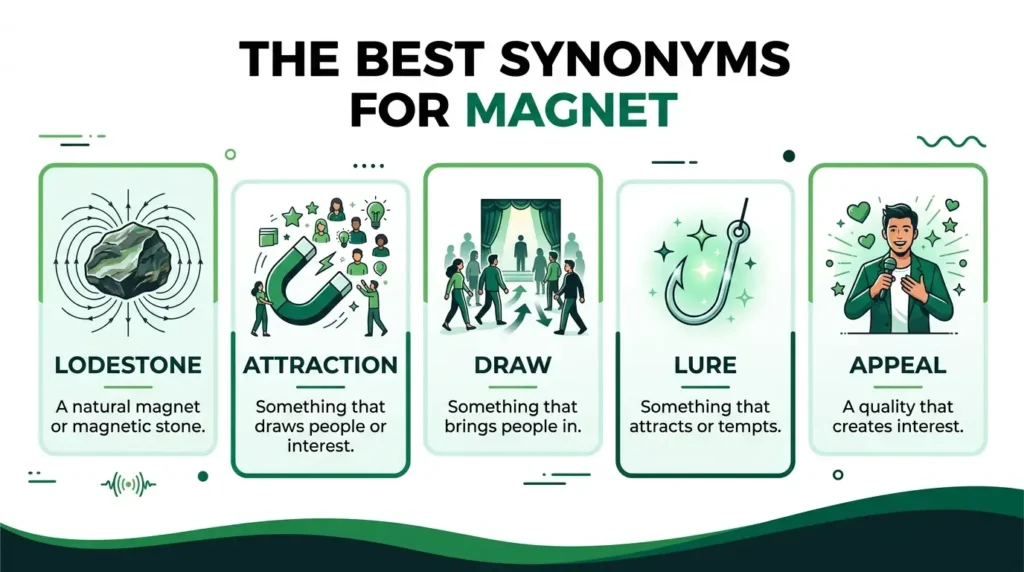
The best synonyms for magnet are:
- Lodestone — a natural magnet or magnetic stone.
- Attraction — something that draws people or interest.
- Draw — something that brings people in.
- Lure — something that attracts or tempts.
- Appeal — a quality that creates interest.
- Allure — a strong attractive quality.
- Enticement — something that attracts or tempts.
- Fascination — intense interest or attraction.
- Charm — a pleasing quality that attracts.
- Pull — informal attractive power.
For a physical magnet, choose lodestone when you need a true lexical alternative. For a person, place, event, or thing that attracts people, attraction, draw, appeal, lure, and allure are more useful.
Direct and Close Synonyms for Magnet
The table focuses on words that can replace magnet in at least one established sense. Some are close synonyms rather than exact substitutes in every sentence.
| Synonym | Specific Meaning | Synonym | Specific Meaning |
| Lodestone | Natural magnet or magnetic stone | Attraction | Something that strongly draws interest |
| Draw | Person or thing that brings people | Lure | Something that attracts or tempts |
| Appeal | Quality that creates interest | Allure | Strong and appealing attraction |
| Enticement | Something used to attract | Fascination | Strong interest or attraction |
| Charm | Pleasing quality that attracts | Pull | Informal power of attraction |
| Attractiveness | Quality of being appealing | Attractor | Something that attracts or draws |
| Bait | Something used to attract or tempt | Temptation | Something that creates strong desire |
| Incentive | Something that encourages action | Inducement | Something that persuades or encourages |
| Come-on | Informal offer used to attract | Invitation | Offer that encourages participation |
Important lexical note: lodestone, attraction, draw, lure, and enticement have especially strong dictionary support for magnet. Words such as bait, incentive, invitation, and temptation are context-dependent alternatives. They should not be treated as interchangeable in every sentence.
Where Magnet Comes From
Parts of Speech: Noun
Syllables: mag-net
Pronunciation: /ˈmæɡ.nət/
Origin: Magnet entered English in the Middle English period through Anglo-French and Latin from Greek magnēs, referring to the “stone of Magnesia.” Dictionaries date the English noun to the 15th century.
- Prefix/Suffix Breakdown: Magnet does not have a productive English prefix-and-suffix structure. Its core comes from the Greek root magnēs, linked to Magnesia and magnetic stone.
Synonyms for Magnet Meanings and Examples
1. Lodestone
Pronunciation: /ˈləʊd.stəʊn/
Meaning: A naturally magnetic stone, especially magnetite, that can act as a magnet. It can also mean a person or thing that strongly attracts.
Examples:
- The ancient sailors used a lodestone as a early compass.
- The old city became a lodestone for artists.
Usage: This is the strongest traditional alternative for the physical sense of magnet.
2. Attraction
Pronunciation: /əˈtræk.ʃən/
Meaning: Something that draws people, attention, interest, or desire.
Examples:
- The museum is a major tourist attraction.
- The city’s history is part of its attraction.
Usage: One of the safest general alternatives for figurative magnet.
3. Draw
Pronunciation: /drɔː/
Meaning: A person, place, event, or feature that brings people in.
Examples:
- The singer is the main draw at the festival.
- The beach is a major draw for tourists.
Usage: Especially natural for events, visitors, audiences, customers, and tourism.
4. Lure
Pronunciation: /lʊə(r)/
Meaning: Something that attracts or tempts someone.
Examples:
- Low prices were the main lure for shoppers.
- The island’s beaches are a powerful lure for visitors.
Usage: Often suggests temptation or deliberate attraction.
5. Appeal
Pronunciation: /əˈpiːl/
Meaning: A quality that makes something attractive or interesting.
Examples:
- The product has wide appeal.
- The town’s quiet setting adds to its appeal.
Usage: A strong choice for essays, reviews, business writing, and general prose.
6. Allure
Pronunciation: /əˈlʊə(r)/
Meaning: A powerful and often attractive quality.
Examples:
- The city has a special allure.
- The allure of island life attracted new residents.
Usage: More expressive than the neutral word attraction.
7. Enticement
Pronunciation: /ɪnˈtaɪs.mənt/
Meaning: Something that attracts or encourages someone to act.
Examples:
- The free trial was an enticement for new customers.
- The discount offered an extra enticement.
Usage: Good for sales, marketing, and persuasive contexts.
8. Fascination
Pronunciation: /ˌfæs.ɪˈneɪ.ʃən/
Meaning: Very strong interest or attraction.
Examples:
- Space has long been a source of fascination.
- The old castle holds a strange fascination for visitors.
Usage: Focuses more on the interest created than on the object that attracts.
9. Charm
Pronunciation: /tʃɑːm/
Meaning: A pleasing quality that attracts or delights.
Examples:
- The village has a quiet charm.
- Her friendly manner adds to the shop’s charm.
Usage: Especially useful for people, places, designs, and experiences.
10. Pull
Pronunciation: /pʊl/
Meaning: Informal power or force of attraction.
Examples:
- The festival has strong pull with younger visitors.
- The brand’s history gives it extra pull.
Usage: Natural in informal and journalistic writing. Collins marks pull as informal in its broader synonym set.
11. Attractor
Pronunciation: /əˈtræk.tə(r)/
Meaning: A person, thing, or feature that attracts people or attention.
Examples:
- The new stadium is a major visitor attractor.
- The shopping district is an important economic attractor.
Usage: More specialized than attraction. It works well in planning, tourism, economics, and technical writing.
12. Attractiveness
Pronunciation: /əˈtræk.tɪv.nəs/
Meaning: The quality of being attractive or appealing.
Examples:
- The area’s natural beauty increases its attractiveness.
- The simple design improves the product’s attractiveness.
Usage: Use it when you mean the quality that attracts, not the thing that attracts.
13. Bait
Pronunciation: /beɪt/
Meaning: Something used to attract or tempt someone, often as a tactic.
Examples:
- The free gift was used as bait.
- The sensational headline was bait for clicks.
Usage: Often carries a negative or manipulative tone. It is not a neutral synonym for magnet. Cambridge includes bait among related words for magnet, while Collins places it in its broader attraction/enticement group.
14. Temptation
Pronunciation: /tempˈteɪ.ʃən/
Meaning: Something that creates a strong desire to act.
Examples:
- The sale was a strong temptation.
- The promise of easy money was a powerful temptation.
Usage: Focuses on desire rather than simple attraction.
15. Incentive
Pronunciation: /ɪnˈsen.tɪv/
Meaning: Something that encourages a person to take action.
Examples:
- The bonus gave employees an incentive to improve.
- Free delivery is an incentive for new customers.
Usage: An incentive motivates action. It does not always mean strong attraction. Collins and Merriam-Webster include it among broader related terms, not as a universal replacement.
16. Inducement
Pronunciation: /ɪnˈdjuːs.mənt/
Meaning: Something that encourages or persuades someone to act.
Examples:
- The company offered an inducement to new customers.
- The tax break was an inducement to invest.
Usage: More formal than lure, bait, or come-on.
17. Come-On
Pronunciation: /ˈkʌm ɒn/
Meaning: An informal offer or feature intended to attract someone.
Examples:
- The free drink was a marketing come-on.
- The low introductory price was a come-on for new customers.
Usage: Informal and often associated with sales or persuasion.
18. Invitation
Pronunciation: /ˌɪn.vɪˈteɪ.ʃən/
Meaning: Something that encourages someone to take part or respond.
Examples:
- The open layout was an invitation to explore.
- The free sample acted as an invitation to try the product.
Usage: A contextual alternative, not a direct synonym.
19. Magnetism
Pronunciation: /ˈmæɡ.nə.tɪ.zəm/
Meaning: A powerful attractive quality, especially in a person or personality; literally, the force or properties associated with magnets.
Examples:
- Her natural magnetism drew people toward her.
- The speaker’s magnetism kept the audience engaged.
Usage: Use magnetism when you mean the power or quality of attraction, not the attracting person or object itself. Merriam-Webster also uses magnetic for extraordinary attractive power.
20. Enchantment
Pronunciation: /ɪnˈtʃɑːnt.mənt/
Meaning: A strong feeling of delight, charm, or fascination.
Examples:
- The old village has a quiet enchantment.
- The garden’s enchantment attracts visitors.
Usage: A literary or expressive alternative. It is better for style than for strict one-to-one substitution.
Best Synonyms for Magnet by Context
Another Word for Magnet in an Essay
Choose:
- attraction
- appeal
- allure
- draw
- fascination
Example:
Original: The city is a magnet for young professionals.
Better:
- The city has strong appeal for young professionals.
- The city is a major draw for young professionals.
- The city’s attraction lies in its career opportunities.
Formal Synonym for Magnet
For formal writing, the safest choices are:
- Attraction
- Appeal
- Enticement
- Inducement
- Attractor
Attraction is usually the best general formal choice because it is clear and neutral.
Synonym for Magnet in Creative Writing
Use:
- lodestone
- allure
- charm
- fascination
- magnetism
- enchantment
Example:
The forgotten harbor became a lodestone for travelers seeking a quieter life.
Synonym for a Person Who Attracts People
Depending on the meaning, use:
- attractor
- draw
- magnet
- magnetic personality
- charismatic person
- captivating person
For a person’s personality, magnetic, charismatic, captivating, and charming may be better than replacing magnet with a noun. Merriam-Webster lists charismatic, attractive, appealing, charming, and seductive as synonyms of magnetic in the figurative sense.
Synonym for a Place That Attracts Tourists
The strongest choices are:
- attraction
- draw
- lure
- magnet
- tourist hotspot
- destination
Example:
The ancient market is a major tourist attraction.
Synonym for Something That Attracts Attention
Use:
- draw
- attraction
- attention-grabber
- focal point
- center of attention
- magnet
Focal point is best when attention is visual or central. Draw is better when people are actively attracted to something.
Direct Synonyms vs. Contextual Alternatives
This distinction is essential for accurate lexical writing.
Closest Synonyms
These have the strongest relationship to the core senses of magnet:
- lodestone
- attraction
- draw
- lure
- enticement
Strong Contextual Alternatives
These can replace magnet in selected sentences:
- appeal
- allure
- fascination
- charm
- pull
- attractiveness
- inducement
- incentive
- temptation
- bait
Related but Not Universal Synonyms for magnet
These may describe attraction but should not replace magnet in every sentence:
- beacon
- focal point
- center
- pole
- stimulus
- invitation
- mecca
- polestar
- cynosure
Common Traps & Nuance Distinctions ofSynonyms for Magnet
Magnet vs. Attraction
A magnet can be the thing that attracts. Attraction can mean the quality or force of attraction, or an attractive place or feature.
- The beach is a magnet for tourists.
- The beach is a popular tourist attraction.
Magnet vs. Draw
A draw is something that brings people to a place, event, person, or product.
- The singer is the main draw.
- The singer is a magnet for fans.
Draw often sounds more natural in everyday journalism and tourism writing.
Magnet vs. Lure
A lure often contains an idea of temptation.
- The city is a magnet for artists. — neutral.
- The low prices are a lure for shoppers. — tempting.
Magnet vs. Allure
Allure describes the attractive quality.
- The island is a magnet for visitors.
- The island has a special allure.
Magnet vs. Appeal
Appeal means the quality or power that makes something attractive.
- The town is a magnet for retirees.
- The town has strong appeal for retirees.
Magnet vs. Incentive
An incentive encourages action. It does not necessarily attract people in the broader sense.
- The festival is a magnet for visitors.
- Free parking is an incentive for visitors.
Magnet vs. Bait
Bait usually suggests a tactic used to attract someone.
- The store is a magnet for shoppers. — neutral.
- The free gift was bait. — potentially manipulative.
Magnet vs. Lodestone
Lodestone is narrower than magnet. It refers to naturally magnetic rock and, figuratively, to something that strongly attracts.
Magnet vs. Magnetism
Magnet is the person, thing, or object that attracts. Magnetism is the attractive force or quality.
- She is a magnet for attention.
- Her magnetism is impossible to ignore.
Magnet vs. Magnetic
Magnetic is normally an adjective.
- He has a magnetic personality.
- He is a magnet for attention.
Merriam-Webster defines magnetic both in the physical sense and as having exceptional power to attract.
Magnet vs. Magnate
These words are easy to confuse.
A magnet attracts iron or, figuratively, people and attention.
A magnate is a powerful or influential person, often in business.
They are not synonyms.
When Not to Use synonyms for Magnet
Do not replace magnet with a related word just because a thesaurus lists it.
- Do not use lure when there is no idea of temptation.
- Do not use bait when the attraction is neutral or positive.
- Do not use incentive when you mean popularity.
- Do not use focal point when you mean a place that attracts visitors.
- Do not use beacon when you simply mean a popular destination.
- Do not use allure when you need plain, neutral English.
- Do not use lodestone in ordinary business prose unless you want a literary effect.
- Do not use magnetism when you need the name of the person or thing doing the attracting.
- Do not use magnetic as a noun when the sentence requires a noun.
- Do not use magnate as a synonym for magnet.
Opposite Words: Antonyms for Magnet
The best antonym depends on the sense.
Direct or Physical Opposites
- Repulsion — a force that pushes things apart.
Like magnetic poles produce repulsion. - Repellent — something that drives away.
The spray acts as an insect repellent. - Repulsor — something that produces a repelling effect.
The device uses a magnetic repulsor. - Non-magnetic — not possessing magnetic attraction.
The material is non-magnetic.
Operational and Contextual Opposites
- Deterrent — something that discourages action.
The high price became a deterrent. - Disincentive — something that reduces motivation.
The extra charge was a disincentive. - Barrier — something that blocks access or progress.
The cost became a barrier to entry. - Turn-off — an informal quality that reduces attraction.
Poor service was a major turn-off.
synonyms for Magnet Word Family
The core word family includes:
- magnet — noun
- magnetic — adjective
- magnetically — adverb
- magnetism — noun
- magnetize / magnetise — verb
- magnetized / magnetised — adjective or past participle
- magnetization / magnetisation — noun
- magneto- — combining form used in scientific and technical terms
Frequently Asked Questions
What is the best synonym for magnet?
Lodestone is the closest traditional synonym for the physical sense. For the figurative sense, attraction, draw, lure, appeal, and allure are strong choices.
What is another word for magnet?
Common alternatives include lodestone, attraction, draw, lure, appeal, allure, enticement, fascination, charm, and pull. The correct choice depends on the sentence.
What is a formal synonym for magnet?
Attraction is the safest general formal synonym. Appeal, enticement, and inducement can work when their specific meanings fit.
What is a synonym for magnet in an essay?
Use attraction, appeal, allure, draw, or fascination. For most academic or formal essays, attraction and appeal are the clearest choices.
What is another word for a person who attracts people?
Depending on the sentence, use attractor, draw, magnetic personality, charismatic person, or captivating person. If you mean the quality that attracts people, use magnetism.
Is lodestone another word for magnet?
Yes, with a narrower meaning. A lodestone is naturally magnetic rock and can also mean a person or thing that strongly attracts.
What is the difference between magnet and magnetic?
Magnet is a noun for an object or, figuratively, something that attracts. Magnetic is usually an adjective meaning related to magnetism or strongly attractive.
What is the difference between magnet and magnate?
A magnet attracts. A magnate is a powerful or influential person, often in business. They are different words with different meanings.
Conclusion
The best synonym for magnet depends on the meaning you need. Use lodestone for the physical or literary sense, and choose attraction, draw, appeal, lure, or allure for figurative attraction. For essays and formal writing, attraction and appeal are usually the safest choices, while allure, charm, magnetism, and lodestone add more style. The key is precision: bait, incentive, focal point, beacon, and similar words can fit specific contexts, but they are not universal replacements for magnet.