
Utter means complete and total when it describes a noun, and it means to say something aloud when it is used as a verb. The closest synonyms are absolute, complete, total, sheer, and say, each covering a different corner of the word, from utter silence to a single word spoken aloud.
Choose absolute when you want the strongest form of the adjective, as in utter trust or utter chaos. Choose complete when something has every part and nothing missing. Choose say when the verb sense is what you need, as in saying a word out loud.
- Absolute — complete, with no limits at all
- Complete — having every part, nothing missing
- Total — covering everything, whole
- Sheer — pure and complete, often with force
- Say — speak words aloud
- Speak — use the voice to talk
- Voice — put thoughts into words
- Express — show what you think or feel

Synonyms for Utter: Full Tiered Table
| Synonym | Tier | Meaning (3-6 words) | Best for |
|---|---|---|---|
| Absolute | Exact | Complete, with no limits | Trust, chaos, silence |
| Complete | Exact | Having every part, whole | Failure, surprise, silence |
| Total | Exact | Covering everything, whole | Chaos, darkness, silence |
| Sheer | Exact | Pure and complete, forceful | Nonsense, madness, joy |
| Say | Exact | Speak words aloud | Everyday speech, quotes |
| Speak | Near | Use the voice to talk | Conversation, speeches, formal use |
| Voice | Near | Put thoughts into words | Opinions, concerns, feelings |
| Express | Near | Show what you think or feel | Feelings, ideas, art |
| Articulate | Near | Say clearly, word by word | Speeches, arguments, teaching |
| Pronounce | Near | Say a word in a set way | Names, verdicts, formal speech |
| Entire | Near | Whole, with nothing left out | Silence, truth, effort |
| Perfect | Near | Complete, with no flaws | Idiot, storm, timing |
| Stark | Near | Complete, bare and harsh | Reality, contrast, madness |
| Outright | Near | Complete and open, direct | Lie, refusal, win |
| Unqualified | Near | Complete, with no exceptions | Support, praise, success |
| Thorough | Related | Complete in every detail | Checks, cleaning, research |
| Consummate | Related | Complete, highly skilled | Actor, liar, professional |
| Arrant | Related | Complete, often bad | Nonsense, fool, knave |
| Downright | Related | Complete, plain and direct | Rude, honest, silly |
| Unmitigated | Related | Complete, not softened at all | Disaster, cheek, gall |
| Verbalize | Related | Put into words | Therapy, meetings, writing |
| Enunciate | Related | Say each sound clearly | Teaching, acting, announcements |
| Declare | Related | Say firmly, in public | News, verdicts, intentions |
| State | Related | Say clearly, in facts | Reports, rules, positions |
| Emit | Related | Give out a sound | Sighs, groans, signals |
Utter Word Card
- Part of speech: adjective (complete, absolute) and verb (to say aloud)
- Pronunciation: US /ˈʌtər/, UK /ˈʌtə/
- Word forms: utter, utters, uttered, uttering, utterly (adverb), utterance (noun), unuttered (adjective)
- Register: adjective is emphatic and often informal; verb is neutral to formal
Top 10 Synonyms for Utter in Detail
Absolute
Absolute means complete, with no limits and no exceptions. It is the strongest word here, suiting trust, power, and chaos. “She has absolute trust in her doctor.” Use it when you want full force and no room for doubt. Avoid it for things only partly true.
Complete
Complete means having every part, with nothing missing and nothing left out. It is the plainest of the big three, and works almost anywhere. “The plan was a complete failure from the start.” Use it when wholeness is the point. Avoid it when you mean perfect in quality, not in parts. Positive is the informal cousin: a positive fury means a complete fury.
Total
Total means covering everything, the whole amount or the whole scene. It is cool and flat, often used for sums and states. “The room fell into total silence after the long announcement ended.” Use it for utter silence, utter darkness, and sums that add up. Avoid it for feelings, where sheer sounds warmer.
Sheer
Sheer means pure and complete, often with a sense of force or surprise. It loves drama: sheer joy, sheer madness, sheer luck. “It was sheer luck that we caught the last train home that night.” Use it when the feeling is strong, sudden, and hard to explain. Avoid it in flat, formal reports.
Say
Say means to speak words aloud, and it is the simplest verb for the job. It carries no fuss. “He did not say a word all evening.” Use it when plain speech is enough. Avoid it when the sound matters more than the words, like a sigh. Breathe is its quiet cousin: he never breathed a word about the plan.
Speak
Speak means to use the voice to talk, often for longer than a single word. It suits speeches and talks with friends. “She will speak at the school fair on Friday morning.” Use it for talks, speeches, and long conversations with friends. Avoid it for a single sound, where say fits better.
Voice
Voice means to put thoughts or feelings into words, often ones held back until now. It suggests courage and openness. “At last, after weeks of silence, she voiced her doubts about the plan.” Use it for opinions, concerns, and worries held back too long. Avoid it for casual everyday chat, where say is quite enough. Voice needs no sound: an editorial can voice concerns in print.
Express
Express means to show what you think or feel, in words or in other ways. It is broader than say, covering art and gesture too. “He expressed his thanks with a short note.” Use it for feelings and ideas. Avoid it when you only mean the act of speaking. Air fits views aired in public for sympathy, and broach fits a subject raised for the first time.
Articulate
Articulate means to say something clearly, word by word, so each part can be heard. It is the careful speaker’s word. “The teacher articulated each sound slowly for the class of beginners.” Use it for teaching, speeches, and arguments where every word must land clearly. Avoid it for rough, everyday talk.
Pronounce
Pronounce means to say a word in a set way, with the right sounds. It also means to declare something in a formal setting. “The judge pronounced the man guilty in a packed courtroom.” Use it for names, verdicts, and formal speech in public settings. Avoid it for plain chat.
Best Word by Situation
| Situation | Best pick | Why |
|---|---|---|
| Formal writing | Absolute | Strong, precise, standard in reports |
| Academic writing | Complete | Plain, exact, covers every part |
| Business email | Say | Short, clear, no fuss |
| Everyday conversation | Total | Common, flat, widely understood |
| Creative writing | Sheer | Vivid, forceful, full of feeling |
| Feelings bursting out | Vent | Strong inner pressure, in words |
All Meanings of Utter
Utter as complete or absolute
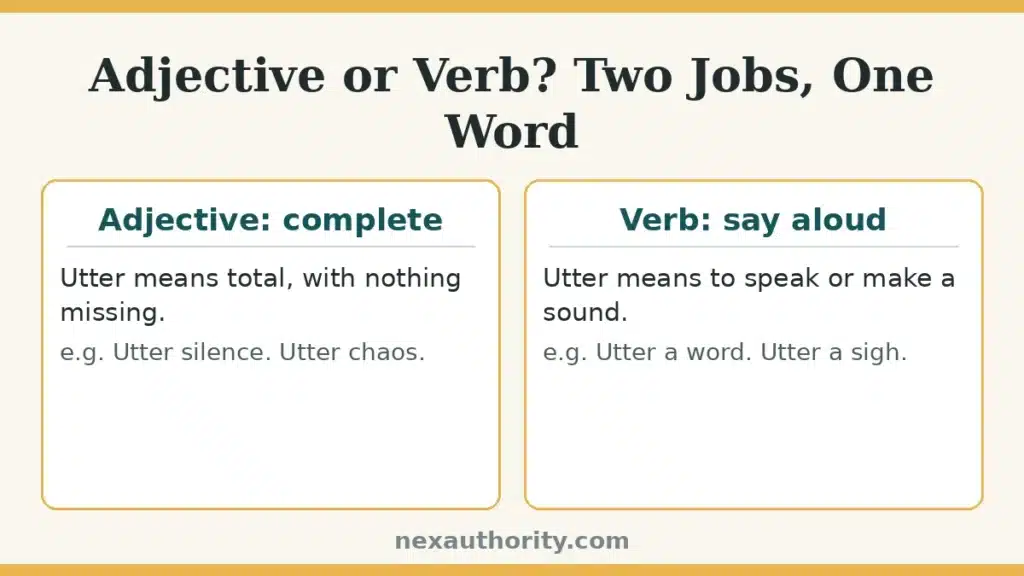
As an adjective, utter means complete, with nothing held back. Utter silence is silence with no sound at all; utter chaos is chaos with no order left. The word sits before the noun and turns the volume up.
Utter as saying words aloud
As a verb, utter means to say words with the voice. “She did not utter a word” means she stayed silent through the whole meeting. Here the word is about the act of speaking, and it often appears when speech is rare or hard.
Utter as making a sound, not words
Utter can also mean making a sound that is not a word at all. A person utters a sigh, a groan, or a cry. The sound carries the feeling, and no words are needed. This sense is why the word fits both speech and raw noise. Vent is the forceful cousin here: feelings vented in words burst out under pressure, and even an engine can utter a shriek.
Utter as putting something into circulation
In formal and legal use, utter means to put something into circulation as if it were genuine, such as a forged note. This sense is rare in everyday talk, but it still appears in court reports and old law books, where uttering false coins was a crime. The same verb also means to make something known in public: to utter a libel is to publish it.
Common Collocations for Utter
Five natural combinations:
- utter silence — “The hall fell into utter silence.”
- utter nonsense — “That claim is utter nonsense, and the facts prove it.”
- utter chaos — “The station was in utter chaos after the trains stopped.”
- utter a word — “He sat through the whole meeting without uttering a word.”
- utter a sigh — “She uttered a sigh of relief.”
Words People Confuse With Utter
Udder
Udder is a farm word, not a language word: it is the milk organ of a cow or goat. It sounds like utter but means something else. “Utter nonsense” is a phrase; “udder nonsense” is a spelling mistake.
Outer
Outer means outside, as in outer space or an outer wall. Utter grew from the same old root, “out,” but now means complete, not outside. “Outer darkness” is a place; “utter darkness” is darkness with no light at all.
Say
Say is the plain, neutral verb for speaking, while utter stresses the act of getting words or sounds out. You say a sentence in a chat; you utter a word when speech is hard or charged. Say is the everyday choice; utter adds weight.
When NOT to Use Utter
Four common mistakes, each with a wrong example and a corrected one.
- Writing “udder” for “utter.” The two sound alike but mean different things. Wrong: “That is udder nonsense.” Corrected: “That is utter nonsense.”
- Using utter for something only partly true. Utter means complete, so it clashes with halves. Wrong: “It was an utter success, except for the last part.” Corrected: “It was a partial success, except for the last part.”
- Using utter for silent thought. Utter needs the voice, so it cannot happen in the mind alone. Wrong: “She uttered the plan in her mind.” Corrected: “She thought through the plan in her mind.”
- Using utter before another verb. Utter needs a noun, not a verb. Wrong: “He uttered to speak at last.” Corrected: “He spoke at last.”
Antonyms of Utter by Context
These utter antonyms name part, not all, or silence instead of speech.
| Antonym | Type | Context |
|---|---|---|
| Partial | Direct | Only part, not all |
| Incomplete | Direct | Not finished or whole |
| Limited | Direct | Kept within bounds |
| Silence | Direct | No sound or speech at all |
| Withhold | Contextual | Holding words back on purpose |
| Suppress | Contextual | Pushing speech or feeling down |
| Mute | Contextual | Silent, without a voice |
| Hush | Contextual | Silencing a sound or voice |
Origin of the Word Utter
Utter comes from Old English utera, “outer,” the comparative of ut, “out.” The adjective sense grew from “outermost, extreme” around 1400, and the verb, “to put forth,” dates to the same time. Both halves still carry the old idea of bringing something out.

Frequently Asked Questions
What does utter mean?
Utter has two main senses. As an adjective, it means complete or total, as in utter silence or utter chaos. As a verb, it means to say something aloud or to make a sound with the voice, as in uttering a word or a sigh. Context tells you which sense.
Is utter an adjective or a verb?
Utter is both. As an adjective, it sits before a noun and means complete: utter nonsense, utter darkness. As a verb, it means to speak or to make a sound: she uttered a cry. The spelling stays the same; the job in the sentence changes.
What is another word for utter?
Absolute is the closest adjective, with complete and total close behind. For the verb, say is the simplest choice, while speak fits longer talk and voice fits opinions held back until now. Pick absolute for force, complete for wholeness, say for plain speech.
What is the opposite of utter?
Partial is the most direct opposite for the adjective, since it means only part, not all. Incomplete and limited work the same way. For the verb, silence is the natural opposite, and withhold fits holding words back on purpose. The right antonym depends on the sense.
How do you use utter in a sentence?
Use utter before a noun for the adjective sense, or before a noun naming a sound for the verb sense. Two models: “The room fell into utter silence.” And: “He did not utter a word all evening.” Keep the sense clear.
Can utter mean to publish something?
Yes, in formal use. To utter a libel means to make it known in public, and to utter a forged note means to pass it off as genuine. This publish sense is old and mostly legal now, so say or publish fits everyday writing better. Keep utter for speech and sounds.
Conclusion
Absolute is the best overall synonym for utter when you need full force as an adjective. For plain speech as a verb, say is the pick, and for wholeness without fuss, complete fits best. For the full dictionary definition, see utter at the Cambridge Dictionary.