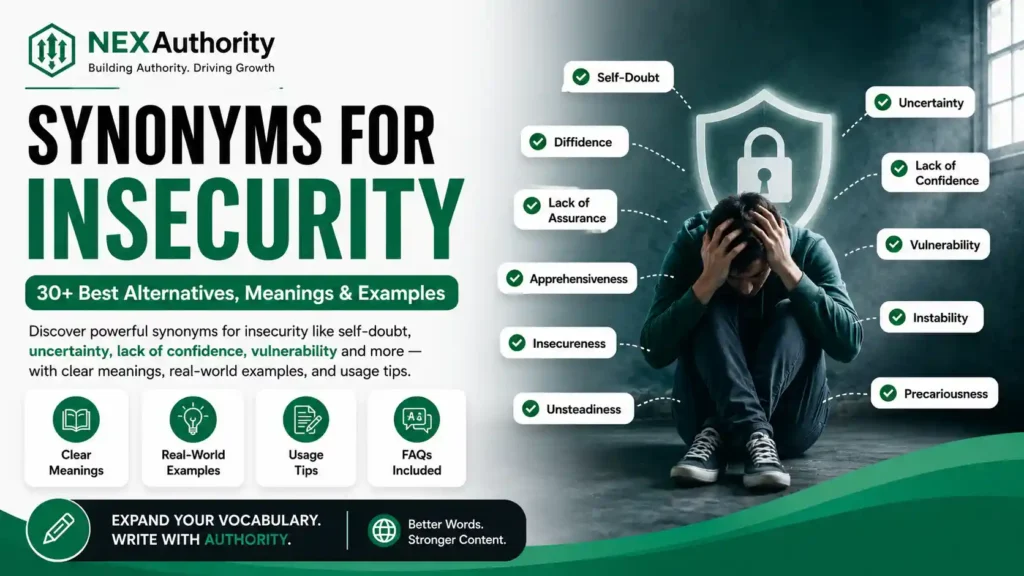

Synonyms for Insecurity (noun) (/ˌɪn.səˈkjʊr.ə.t̬i/) mean a lack of confidence or certainty, or a condition of being unsafe, unstable, or insufficiently protected. Depending on the context, insecurity can take several forms:
- Self-Doubt & Emotion: Doubting your abilities or feeling uncertain in relationships.
- Instability: Experiencing financial strain, job loss, or unpredictable living conditions.
- Risk & Danger: Facing physical threats or unsafe environments.
The best synonym depends on the sense you mean. Different terms capture specific dimensions of insecurity:
- Personal Insecurity: Characterized by self-doubt, lack of confidence, diffidence, and lack of assurance.
- General Uncertainty: Defined by uncertainty, doubt, and incertitude regarding outcomes or facts.
- Safety and stability risks occur when unstable physical, financial, or environmental conditions leave you vulnerable to harm or sudden loss.
Quick Answer: What Are the Best Synonyms for Insecurity?
The Best Synonyms for Insecurity by Context:
- For Personal Insecurity: Use self-doubt or lack of confidence for clear, direct meaning. (Also: diffidence, lack of assurance)
- For Safety & Stability Risks: Use vulnerability or instability for maximum precision. (Also: precariousness, unsteadiness, shakiness)
- For General Unpredictability: Use uncertainty.
Best Synonym for Insecurity by Context
There is no single best synonym for insecurity because the word can describe a lack of confidence, uncertainty, lack of safety, instability, or exposure to harm. The best replacement depends on the exact context.
| Context | Best Synonym | Why It Fits |
| Personal confidence | Self-doubt | Doubting your abilities, worth, or decisions |
| Self-confidence | Lack of confidence | Clear, direct description of low self-belief |
| Social situations | Self-consciousness | Feeling overly aware or uncertain about yourself |
| Shyness/formal writing | Diffidence | Lack of confidence expressed through reserve |
| Emotional uncertainty | Uncertainty | Lack of confidence about what will happen |
| Doubt about a decision | Doubt | Lack of certainty or conviction |
| Anxious uncertainty | Apprehensiveness | Worried expectation that something may go wrong |
| Future or outcome | Uncertainty | The result or situation is not known |
| Financial insecurity | Financial instability | Lack of dependable financial stability |
| Job insecurity | Employment uncertainty | Uncertainty about continued employment |
| Economic conditions | Instability | Lack of economic steadiness or reliability |
| Unstable circumstances | Precariousness | A situation is uncertain and potentially unsafe |
| Physical safety | Unsafeness | Lack of safety or protection |
| Exposure to harm | Vulnerability | Being open or susceptible to harm |
| Lack of protection | Defenselessness | Absence of adequate protection |
| Security systems | Vulnerability | A weakness that exposes something to harm |
| Dangerous situation | Risk | Possibility of harm, loss, or failure |
| Serious danger | Peril | Exposure to significant or immediate danger |
| Threat of harm | Danger | Possibility that harm may occur |
| Unstable structure/system | Instability | Lack of firmness, reliability, or steadiness |
| Unreliable condition | Unsteadiness | Lack of consistent stability |
| Academic writing | Lack of confidence | Clearer and more accessible than obscure alternatives |
| Formal writing | Diffidence | Formal term for lack of self-confidence |
| Creative writing | Self-doubt | Naturally conveys internal emotional conflict |
| Relationship context | Self-doubt | Captures uncertainty about one’s worth or acceptance |
| Public speaking | Lack of confidence | Directly describes difficulty trusting one’s ability |
| Appearance/body image | Self-consciousness | Focuses on concern about how one appears to others |
| Political environment | Instability | Lack of political steadiness or security |
| Housing/living conditions | Precariousness | Emphasizes uncertain or insecure circumstances |
| Cybersecurity | Vulnerability | A weakness that can expose a system to attack |
Best Synonyms for Insecurity by Meaning and Context
| Synonym | Specific Meaning | Synonym | Specific Meaning |
| 1. Self-doubt | Doubt about your abilities or worth | 16. Uncertainty | Lack of certainty or confidence |
| 2. Lack of confidence | Absence of belief in yourself | 17. Doubt | Lack of certainty or assurance |
| 3. Lack of assurance | Absence of confidence or certainty | 18. Dubiousness | State of being doubtful or uncertain |
| 4. Diffidence | Lack of self-confidence or assurance | 19. Doubtfulness | Condition of being uncertain |
| 5. Lack of sureness | Absence of confidence or certainty | 20. Incertitude | Lack of certainty or assurance |
| 6. Lack of self-reliance | Insufficient confidence in oneself | 21. Apprehensiveness | Anxious expectation of trouble |
| 7. Insecureness | State of being insecure or unsafe | 22. Instability | Lack of steadiness or security |
| 8. Vulnerability | Exposure to harm or attack | 23. Precariousness | Exposure to uncertain conditions |
| 9. Defenselessness | Lack of protection from harm | 24. Unsteadiness | Lack of stability or firmness |
| 10. Unsafeness | Condition of being unsafe | 25. Shakiness | Lack of firmness or stability |
| 11. Endangerment | Exposure to danger or harm | 26. Peril | Serious or immediate danger |
| 12. Peril | Exposure to serious danger | 27. Hazard | Source of possible harm |
| 13. Risk | Possibility of harm or loss | 28. Danger | Possibility of harm or injury |
| 14. Jeopardy | Exposure to danger/loss | 29. Pitfall | Hidden source of difficulty |
| 15. Precariousness | Uncertain/unsafe condition | 30. Contingency | Possible future uncertain event |
Quick rule of Synonyms for Insecurity
- Personal insecurity → self-doubt or lack of confidence
- Social insecurity → self-consciousness
- Emotional insecurity → uncertainty or self-doubt
- Financial insecurity → financial instability
- Job insecurity → employment uncertainty
- Physical insecurity → vulnerability or unsafeness
- Security weakness → vulnerability
- Unstable conditions → instability or precariousness
- Danger-related insecurity → risk, danger, or peril
The Synonyms for Insecurity most important distinction
Self-doubt is usually the strongest choice when insecurity means doubting yourself.
Uncertainty is better when you mean not knowing what will happen.
Vulnerability is better when you mean being exposed to harm.
Instability is better when you mean lack of steadiness or security.
So, instead of asking “What is a synonym for insecurity?”, the better question for precise writing is:
“What kind of insecurity do I mean?”
Where Insecurity Comes From
Parts of Speech: Noun
Syllable: in-se-cu-ri-ty
Origin: Insecurity dates to the 1640s and comes from Medieval Latin insecuritas, from insecurus, meaning “unsafe” or “not free from fear or doubt.” Its specific psychological sense dates to the early 20th century.
Prefix/Suffix Breakdown: in- means “not,” secur- comes from Latin securus, meaning “safe” or “free from care,” and -ity forms a noun expressing a state or quality.
1. Self-Doubt (/ˌselfˈdaʊt/)
Meaning: Doubt about your abilities, decisions, appearance, or worth.
Examples:
- Self-doubt made her hesitate before applying for the position.
- He overcame his self-doubt and finally presented his idea.
2. Lack of Confidence (/læk əv ˈkɒnfɪdəns/)
Meaning: Absence of confidence in yourself or your abilities.
Examples:
- His lack of confidence affected his performance during interviews.
- She developed a lack of confidence after repeated criticism.
3. Lack of Assurance (/læk əv əˈʃʊərəns/)
Meaning: Absence of confidence, certainty, or reassurance.
Examples:
- Her lack of assurance was noticeable during the presentation.
- The team’s lack of assurance delayed the final decision.
4. Diffidence (/ˈdɪfɪdəns/)
Meaning: Shyness or lack of confidence in yourself.
Examples:
- His diffidence made him reluctant to speak during meetings.
- She gradually overcame her diffidence as she gained experience.
5. Lack of Sureness (/læk əv ˈʃʊərnəs/)
Meaning: Absence of certainty or confidence.
Examples:
- His lack of sureness was apparent when answering questions.
- The candidate’s lack of sureness weakened the presentation.
6. Lack of Self-Reliance (/læk əv ˌselfrɪˈlaɪəns/)
Meaning: Insufficient confidence in your own abilities.
Examples:
- Her lack of self-reliance made independent work difficult.
- The training program helped reduce his lack of self-reliance.
7. Insecureness (/ˌɪnsɪˈkjʊərnəs/)
Meaning: The condition or quality of being insecure.
Examples:
- The insecureness of the structure concerned the engineers.
- His emotional insecureness affected his relationships.
8. Vulnerability (/ˌvʌlnərəˈbɪləti/)
Meaning: Exposure to harm, attack, or loss.
Examples:
- The audit revealed the network’s vulnerability.
- Financial vulnerability can make unexpected expenses difficult to manage.
9. Defenselessness (/dɪˈfensləsnəs/)
Meaning: Lack of protection against harm or attack.
Examples:
- The community’s defenselessness became obvious during the crisis.
- The lack of security left residents feeling defenseless.
10. Unsafeness (/ʌnˈseɪfnəs/)
Meaning: The condition of being unsafe.
Examples:
- Workers reported the unsafeness of the site.
- The inspection identified several signs of unsafeness.
11. Endangerment (/ɪnˈdeɪndʒərmənt/)
Meaning: Exposure to danger, harm, or loss.
Examples:
- Poor maintenance resulted in the endangerment of passengers.
- The report documented the endangerment of local wildlife.
12. Peril (/ˈperəl/)
Meaning: Serious or immediate danger.
Examples:
- The unstable structure placed workers in peril.
- The company’s financial position was in peril.
13. Risk (/rɪsk/)
Meaning: Possibility of harm, loss, or an undesirable outcome.
Examples:
- Job insecurity can increase the risk of financial hardship.
- The company accepted the risk of expanding too quickly.
14. Jeopardy (/ˈdʒepərdi/)
Meaning: Exposure to danger, loss, or failure.
Examples:
- The dispute put the agreement in jeopardy.
- His position was placed in jeopardy after the investigation.
15. Precariousness (/prɪˈkeəriəsnəs/)
Meaning: The condition of being uncertain, unstable, or unsafe.
Examples:
- The precariousness of temporary employment worried the workers.
- The precariousness of the situation became clear overnight.
16. Uncertainty (/ʌnˈsɜːrtənti/)
Meaning: Lack of certainty about something.
Examples:
- Economic uncertainty affected consumer spending.
- She experienced uncertainty about her future.
17. Doubt (/daʊt/)
Meaning: Lack of certainty or confidence in something.
Examples:
- Self-doubt prevented him from applying for the promotion.
- There was growing doubt about the project’s success.
18. Dubiousness (/ˈduːbiəsnəs/)
Meaning: The state of being doubtful or uncertain.
Examples:
- The dubiousness of the claim concerned the reviewers.
- Her dubiousness about the proposal was understandable.
19. Doubtfulness (/ˈdaʊtfəlnəs/)
Meaning: The condition of being doubtful or uncertain.
Examples:
- The doubtfulness surrounding the decision caused delays.
- His doubtfulness was obvious from his repeated questions.
20. Incertitude (/ɪnˈsɜːrtɪtuːd/)
Meaning: Lack of certainty or assurance.
Examples:
- The incertitude surrounding the election affected investors.
- She faced considerable incertitude about her career.
21. Apprehensiveness (/ˌæprɪˈhensɪvnəs/)
Meaning: Anxious expectation that something may go wrong.
Examples:
- His apprehensiveness was obvious before the interview.
- She approached the unfamiliar situation with apprehensiveness.
22. Instability (/ˌɪnstəˈbɪləti/)
Meaning: Lack of steadiness, permanence, or security.
Examples:
- Political instability affected investor confidence.
- Financial instability made long-term planning difficult.
23. Unsteadiness (/ʌnˈstedinəs/)
Meaning: Lack of stability, firmness, or steadiness.
Examples:
- The unsteadiness of the platform raised safety concerns.
- Financial unsteadiness made the family reconsider its plans.
24. Shakiness (/ˈʃeɪkinəs/)
Meaning: Lack of firmness, stability, or reliability.
Examples:
- The shakiness of the agreement worried both parties.
- The bridge’s shakiness prompted an immediate inspection.
25. Danger (/ˈdeɪndʒər/)
Meaning: Possibility of harm, injury, or loss.
Examples:
- The damaged bridge presented a danger to drivers.
- They were warned about the danger ahead.
26. Hazard (/ˈhæzərd/)
Meaning: Something capable of causing harm or loss.
Examples:
- Poor wiring created a serious hazard.
- The inspection identified several workplace hazards.
27. Pitfall (/ˈpɪtfɔːl/)
Meaning: A hidden danger or likely source of trouble.
Examples:
- Poor planning is a common pitfall for new businesses.
- The guide explains the main pitfalls of the process.
28. Contingency (/kənˈtɪndʒənsi/)
Meaning: A possible future event requiring preparation.
Examples:
- The company prepared for financial contingencies.
- Managers created a contingency plan for unexpected losses.
29. Vulnerability (/ˌvʌlnərəˈbɪləti/)
Meaning: A state of being exposed to harm or loss.
Examples:
- The review identified a vulnerability in the security system.
- Economic vulnerability can increase during periods of unemployment.
30. Insecurity (/ˌɪnsɪˈkjʊərəti/)
Meaning: A lack of confidence, certainty, safety, or stability.
Examples:
- Her insecurity about public speaking made presentations stressful.
- Job insecurity affected his decision to relocate.
How to Choose the Right Synonym for Insecurity
The right replacement depends on what kind of insecurity you are describing. Treating every synonym as interchangeable can subtly change your meaning.
For Personal Insecurity
Use:
self-doubt, lack of confidence, diffidence, lack of assurance, lack of sureness
Example:
Her self-doubt made her reluctant to apply for the position.
For Emotional Uncertainty
Use:
uncertainty, doubt, dubiousness, doubtfulness, incertitude, apprehensiveness
These emphasize uncertainty, hesitation, or anxious expectation rather than self-image.
Example:
Growing uncertainty about the future affected his decision.
For Physical or Structural Insecurity
Use:
instability, unsteadiness, shakiness, unsafeness, vulnerability
These fit places, systems, structures, or conditions that lack stability or protection.
Example:
The instability of the structure created a serious safety concern.
For Financial or Job Insecurity
Use:
uncertainty, instability, precariousness, vulnerability, risk
These are especially useful when discussing employment, income, housing, or economic conditions.
For Danger or Exposure
Use:
peril, danger, hazard, jeopardy, risk, vulnerability
These work when the central idea is exposure to possible harm or loss.
Formal Synonyms for Insecurity
For formal writing, the best alternative depends on the intended sense.
Personal confidence: lack of confidence, diffidence, lack of assurance, self-doubt
Uncertainty: uncertainty, incertitude, dubiousness
Stability: instability, precariousness, unsteadiness
Safety: vulnerability, defenselessness, unsafeness
Danger: peril, jeopardy, hazard
Synonyms for Insecurity in an Essay
When replacing insecurity in an essay, choose the word that preserves the exact meaning.
- Self-doubt — when discussing personal confidence
- Lack of confidence — when you want clear academic wording
- Uncertainty — when discussing an unclear future or outcome
- Instability — when discussing changing or unreliable conditions
- Vulnerability — when discussing exposure to harm
- Precariousness — when emphasizing an uncertain or risky condition
- Apprehensiveness — when emphasizing anxious expectation
- Incertitude — when a formal word for uncertainty is appropriate
Example:
Weak: Economic insecurity affected workers.
More precise: Economic uncertainty affected workers.
Or, when stability is the focus: Economic instability affected workers.
Synonyms for Insecurity in Creative Writing
When writing creatively:
- You have more flexibility with word choice.
- Your chosen word must still match the exact emotion or scene.
For emotional insecurity, self-doubt, diffidence, and apprehensiveness can create different shades of meaning.
For example:
His self-doubt followed him into every crowded room.
This is more specific than simply saying:
His insecurity followed him everywhere.
Use diffidence to convey shyness or restrained confidence. Use apprehensiveness when a character feels anxious about the future.
Common Traps & Nuance Distinctions
Related words do not always mean the exact same thing. Assuming they are identical to insecurity is a common mistake.
Insecurity vs. Self-Doubt
Insecurity is broader and can describe safety, stability, or confidence. Self-doubt specifically concerns doubt about yourself.
She felt insecure about her appearance.
She experienced self-doubt before accepting the leadership role.
Insecurity vs. Uncertainty
Uncertainty means a lack of certainty or knowledge. Insecurity can involve uncertainty but often adds vulnerability or lack of confidence.
Uncertainty: We don’t know what will happen.
Insecurity: We don’t feel confident or safe about what will happen.
Insecurity vs. Vulnerability
Vulnerability emphasizes exposure to harm, attack, or loss. Insecurity can describe vulnerability but also includes personal self-doubt.
The system has a security vulnerability.
He has an insecurity about his abilities.
Insecurity vs. Instability
Instability focuses on a lack of steadiness or reliability. It is especially suitable for markets, governments, structures, relationships, or situations.
Political instability affected the region.
Personal insecurity affected her confidence.
Insecurity vs. Anxiety
Anxiety refers to worry, nervousness, or apprehension. It can accompany insecurity but is not a universal synonym.
Insecurity vs. Risk
Risk means the possibility of an undesirable outcome. Insecurity describes a broader condition of lacking confidence, certainty, safety, or stability.
When NOT to Use a Synonym for Insecurity
Don’t replace insecurity simply to avoid repeating the same word. The replacement must preserve the intended meaning.
- Don’t use self-doubt when you mean physical or financial instability.
- Don’t use uncertainty when you specifically mean lack of self-confidence.
- Don’t use vulnerability unless exposure to harm or loss is involved.
- Don’t use danger for emotional insecurity.
- Don’t use risk when discussing someone’s negative self-image.
- Don’t use diffidence for an unsafe building or computer system.
- Don’t use instability when you specifically mean doubts about your abilities.
- Don’t use anxiety as a universal replacement for insecurity.
- Don’t use peril unless the situation involves serious danger.
- Don’t use pitfall simply to mean insecurity; a pitfall is a specific hidden problem or danger.
Direct Synonyms vs. Near and Related Terms
Not every useful alternative has the same degree of synonymy.
Strong Direct or Sense-Specific Synonyms
These are the safest replacements when their particular meaning matches your sentence:
Strong synonyms include self-doubt, uncertainty, vulnerability, instability, and precariousness, depending on your context.
Near Synonyms
These are close in meaning but may introduce an additional nuance:
apprehensiveness, dubiousness, doubtfulness, incertitude, shakiness, defenselessness.
Related or Contextual Terms
These words describe situations connected to insecurity. However, do not use them as automatic replacements:
risk, danger, hazard, peril, jeopardy, pitfall, contingency.
This distinction matters because a synonym is not simply “a word that feels related.” A true substitute must preserve the meaning of the original sentence.
Opposite Words: Antonyms for “Insecurity”
The right antonym depends on the specific meaning:
- Confidence: Confidence or assurance
- Safety: Security or safeness
- Stability: Stability
Cambridge groups its antonyms around security, assurance, confidence, certainty, stability, safeness, and invulnerability.
Direct Antonyms
- Security — freedom from danger or uncertainty.
The new policy provided greater financial security. - Confidence — belief in your abilities or judgment.
She approached the interview with confidence. - Assurance — confidence or certainty.
His assurance helped calm the team. - Certitude — complete certainty.
She spoke with certitude about her decision.
Operational & Contextual Opposites
- Stability — a condition of steadiness and reliability.
The company finally achieved financial stability. - Safeness — the condition of being safe.
The inspection confirmed the safeness of the structure. - Sureness — confidence or certainty.
He answered with sureness. - Invulnerability — resistance to harm or attack.
The system was designed to reduce its vulnerability and increase protection.
Frequently Asked Questions (FAQs)
What is another word for insecurity?
Common synonyms for insecurity depend on the context:
- Personal: Self-doubt, lack of confidence, diffidence, or lack of assurance.
- General: Uncertainty, vulnerability, instability, or precariousness.
What is the best synonym for insecurity?
The best synonym depends on your meaning:
- Personal: Self-doubt
- Uncertainty: Uncertainty or doubt
- Harm: Vulnerability
- Stability: Instability
What is a formal synonym for insecurity?
Good formal alternatives include:
- Personal: Diffidence, lack of assurance, or lack of confidence
- Uncertainty: Incertitude
- Safety & Stability: Precariousness, vulnerability, or instability
What is a synonym for insecurity in an essay?
In an essay, select synonyms for insecurity that match your exact context. Good options include self-doubt, uncertainty, vulnerability, instability, and precariousness.
What is a synonym for personal insecurity?
The top synonyms focus on doubts about personal abilities, worth, or acceptance:
- Self-doubt
- Lack of confidence
- Diffidence
- Lack of assurance
- Lack of self-reliance
What is a synonym for financial insecurity?
Depending on your context, you can use:
- Financial uncertainty
- Financial instability
- Precariousness, vulnerability, or risk
However, financial insecurity itself is usually the most natural choice.
What is the difference between insecurity and self-doubt?
The key differences:
- Self-doubt: Targets your own abilities, decisions, or self-worth.
- Insecurity: Covers broader issues like uncertainty, vulnerability, instability, or physical danger.
Conclusion
Choose synonyms for insecurity based on your context. Use self-doubt, diffidence, or lack of confidence for personal feelings. Use uncertainty or doubt for uncertain outcomes. For safety or stability, choose vulnerability, instability, or precariousness. Words like risk or danger only apply when exposure to harm is central. The best choice always preserves your exact meaning.