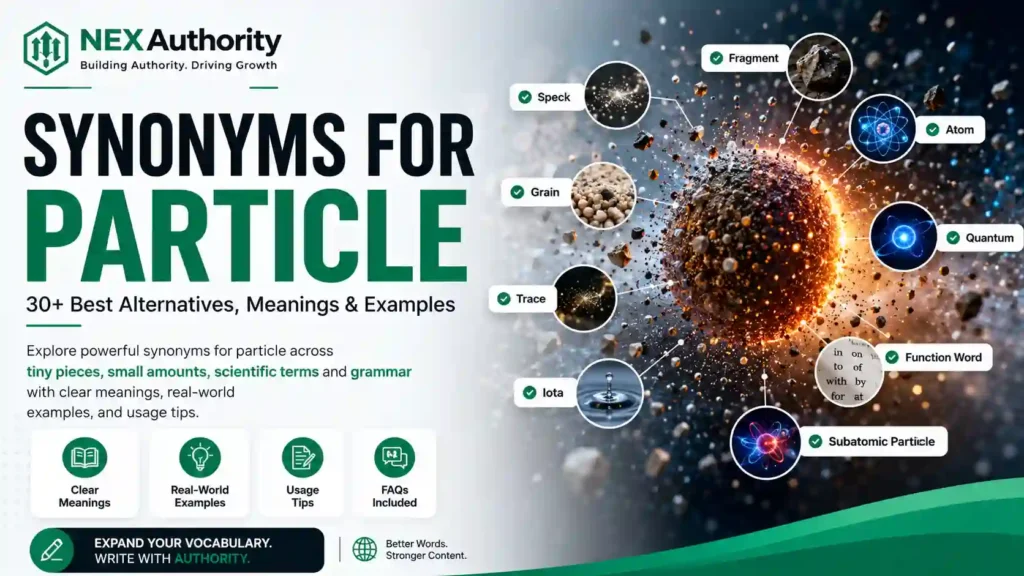

Synonyms for Particle (noun) (/ˈpɑːrtɪkəl/), mean a very small piece, amount, or constituent of something. In grammar, a particle is a small function word. In physics, it describes a basic unit of matter or radiation.
The best synonym depends on the intended meaning. Use speck or fragment for physical pieces, and iota or trace for tiny amounts. Scientific terms like atom or quantum apply only in technical contexts.
Quick Answer: What Is Another Word for Particle?
Top synonyms for particle vary by context:
- Physical Pieces: Speck, bit, fragment, grain, mote, fleck, or crumb.
- Tiny Amounts: Iota, trace, jot, whit, scintilla, or modicum.
- Scientific Terms: Atom, quantum, or subatomic particle (use only when precise).
Best Synonym for Particle by Context
| If you mean… | Best synonym | Tone or context |
| A tiny visible spot | Speck | Everyday |
| A tiny piece of matter | Bit | Informal/general |
| A broken piece | Fragment | General/formal |
| A tiny solid unit | Grain | Physical/scientific |
| A tiny floating speck | Mote | Literary |
| A tiny spot or mark | Fleck | General/descriptive |
| A small grain-like unit | Granule | Technical |
| A tiny amount | Iota | Formal |
| A tiny trace | Scintilla | Formal/literary |
| A small remaining amount | Trace | Scientific/formal |
| A small quantity | Modicum | Formal |
| A tiny matter constituent | Atom | Scientific |
| A discrete physical quantity | Quantum | Physics |
| A particle smaller than an atom | Subatomic particle | Physics |
| A grammatical unit | Grammatical marker | Linguistics |
30 Powerful Synonyms for Particle and Contextual Alternatives
Not every word below can replace particle in every sentence. This list groups direct synonyms, contextual choices, and specialized terms. It helps you choose the exact word for your intended meaning.
| Word | Type | Meaning |
| 1. Speck | Direct/contextual | A tiny visible spot or piece |
| 2. Fragment | Direct/contextual | A small broken or separated piece |
| 3. Bit | Direct/contextual | A small piece or quantity |
| 4. Grain | Contextual | A tiny solid unit |
| 5. Mote | Contextual | A tiny floating speck |
| 6. Fleck | Contextual | A tiny spot or piece |
| 7. Crumb | Contextual | A tiny piece, especially food |
| 8. Granule | Technical | A small grain-like unit |
| 9. Scrap | Contextual | A small leftover piece |
| 10. Shred | Contextual | A small torn piece |
| 11. Snippet | Contextual | A small extracted piece |
| 12. Piece | General | An individual portion of something |
| 13. Morsel | Contextual | A small piece of food or information |
| 14. Modicum | Abstract | A small measurable amount |
| 15. Mite | Literary | A very small amount or thing |
| 16. Iota | Abstract | An extremely small amount |
| 17. Jot | Abstract | A very small amount or detail |
| 18. Whit | Literary | A tiny amount |
| 19. Tittle | Literary | A very small mark or detail |
| 20. Scintilla | Formal | A tiny trace or suggestion |
| 21. Trace | Scientific/formal | A very small remaining amount |
| 22. Smidgen | Informal | A very small quantity |
| 23. Atom | Scientific | A basic unit of ordinary matter |
| 24. Corpuscle | Specialized | A tiny body or microscopic particle |
| 25. Quantum | Physics | A discrete quantity of a physical property |
| 26. Subatomic particle | Physics | A particle smaller than an atom |
| 27. Elementary particle | Physics | A particle treated as fundamental |
| 28. Constituent | Technical | A component forming part of something |
| 29. Function word | Linguistics | A word serving a grammatical function |
| 30. Grammatical marker | Linguistics | An element signaling grammatical information |
Where Particle Comes From
Parts of Speech: Noun; also used as a grammatical term.
Syllable: par-ti-cle
Origin: Particle traces back through two key language steps:
- Middle French: Entered English as an adaptation of the French form.
- Latin Origin: Derives from particula (“little part”), a diminutive of pars (“part”).
Prefix/Suffix Breakdown:
- Root (part-): Means “part.”
- Suffix (-icula): A diminutive suffix meaning “little” or “small.”
1. Speck (/spɛk/)
A speck is a very small visible spot or piece and is one of the most natural everyday alternatives to particle.
Meaning: A tiny visible piece, spot, or mark.
Examples:
- A speck of dust landed on the camera lens.
- The scientist noticed tiny specks in the sample.
2. Fragment (/ˈfræɡmənt/)
A fragment is a small part that has broken or separated from something larger.
Meaning: A broken or separated piece of something.
Examples:
- The researchers examined a fragment of the rock.
- A fragment of glass was found near the window.
3. Bit (/bɪt/)
Bit is an informal and highly flexible word for a small piece or amount.
Meaning: A small piece, portion, or quantity.
Examples:
- There was a bit of dust on the screen.
- Add a bit of salt to the mixture.
4. Grain (/ɡreɪn/)
A grain represents a small solid unit of matter:
- Common Examples: Sand, salt, powder, and minerals.
- Context: Describes individual, solid particles of granular materials.
Meaning: A tiny individual piece of solid material.
Examples:
- Every grain of sand looked different.
- A grain of salt fell onto the table.
5. Mote (/moʊt/)
Mote is a literary word commonly used for a tiny speck floating in air or visible in light.
Meaning: A tiny floating particle or speck.
Examples:
- Motes of dust floated through the sunlight.
- A mote appeared in the beam of light.
6. Fleck (/flɛk/)
Fleck refers to a tiny spot, mark, or piece, often contrasting with a larger surface.
Meaning: A very small spot or piece of material.
Examples:
- A fleck of paint landed on the floor.
- The stone contained tiny flecks of gold.
7. Crumb (/krʌm/)
Crumb is most commonly used for a tiny piece of food but can also have figurative uses.
Meaning: A small broken piece, especially of food.
Examples:
- A crumb fell from the bread.
- There wasn’t a crumb of evidence left behind.
8. Granule (/ˈɡrænjuːl/)
Granule is a more technical alternative for a small grain-like unit of a substance.
Meaning: A small grain or compact piece of material.
Examples:
- Each granule was measured separately.
- The powder contains uniform granules.
9. Scrap (/skræp/)
Scrap describes a small leftover or discarded piece of material.
Meaning: A small leftover piece of something.
Examples:
- He kept a scrap of metal for testing.
- She wrote the number on a scrap of paper.
10. Shred (/ʃrɛd/)
Shred emphasizes a thin, torn, or narrow piece.
Meaning: A small torn or narrow piece.
Examples:
- A shred of fabric was caught on the fence.
- There wasn’t a shred of evidence against him.
11. Snippet (/ˈsnɪpɪt/)
A snippet refers to a short extracted piece, especially across digital media:
- Common Uses: Brief excerpts of text, speech, audio, or code.
- Context: Ideal when describing small portions of information or digital content.
Meaning: A short or small extracted piece.
Examples:
- The article included a snippet from the interview.
- I only heard a snippet of their conversation.
12. Piece (/piːs/)
Piece is a general, everyday substitute for particle:
- Tone: Informal and flexible.
- Usage Tip: Best for general writing; use a specialized term when precision matters.
Meaning: An individual portion of something.
Examples:
- A small piece of debris was found nearby.
- He removed a piece of material from the sample.
13. Morsel (/ˈmɔːrsəl/)
Morsel usually means a small piece of food but can also describe a small piece of information.
Meaning: A small piece, especially food or information.
Examples:
- He ate a small morsel of bread.
- The report offered an interesting morsel of information.
14. Modicum (/ˈmɒdɪkəm/)
Modicum represents a specific type of small amount:
- Tone: Formal and precise.
- Usage Tip: Best used for abstract concepts like truth, patience, or respect.
Meaning: A small quantity or amount.
Examples:
- The proposal contains a modicum of truth.
- She showed a modicum of patience.
15. Mite (/maɪt/)
Mite describes a small quantity with a distinct style:
- Tone: Literary, vintage, or old-fashioned.
- Usage Tip: Best used for abstract amounts rather than physical objects.
Meaning: A very small amount or thing.
Examples:
- There wasn’t a mite of doubt.
- The change made only a mite of difference.
16. Iota (/aɪˈoʊtə/)
Iota describes a specific type of small amount:
- Tone: Formal and emphatic.
- Usage Tip: Best applied to abstract qualities like evidence, truth, or doubt.
Meaning: An extremely small amount.
Examples:
- There wasn’t an iota of evidence.
- His position hasn’t changed one iota.
17. Jot (/dʒɒt/)
Jot can refer to a tiny amount, detail, or piece of information.
Meaning: A very small amount or detail.
Examples:
- There wasn’t a jot of difference between them.
- He didn’t give a jot of attention to the warning.
18. Whit (/wɪt/)
Whit is formal or literary and means a very small amount.
Meaning: A tiny amount or degree.
Examples:
- The explanation wasn’t a whit clearer.
- He showed not a whit of remorse.
19. Tittle (/ˈtɪtəl/)
Tittle refers to a very small mark, detail, or amount.
Meaning: A tiny mark or insignificant detail.
Examples:
- The editor checked every tittle of the document.
- Not a tittle of evidence was overlooked.
20. Scintilla (/sɪnˈtɪlə/)
Scintilla describes a specific type of small amount:
- Tone: Formal and literary.
- Usage Tip: Best applied to subtle traces of abstract concepts like evidence, hope, or doubt.
Meaning: A tiny trace or suggestion.
Examples:
- There wasn’t a scintilla of evidence.
- She retained a scintilla of hope.
21. Trace (/treɪs/)
Trace is appropriate when the particle means a tiny detectable or remaining quantity.
Meaning: A very small amount that remains or can be detected.
Examples:
- The test detected traces of metal.
- Only a trace of the substance remained.
22. Smidgen (/ˈsmɪdʒən/)
Smidgen is informal and conversational.
Meaning: A very small quantity.
Examples:
- Add a smidgen of sugar.
- The recipe needs a smidgen more salt.
23. Atom (/ˈætəm/)
Atom is a precise scientific term. Use it instead of particle only when referring to an actual atom.
Meaning: A basic unit of ordinary matter.
Examples:
- Each atom contains a nucleus and electrons.
- The material consists of individual atoms.
24. Corpuscle (/ˈkɔːrpəsəl/)
Corpuscle is a specialized or historical term for a tiny body or particle.
Meaning: A tiny body or microscopic particle.
Examples:
- Older theories described matter as corpuscles.
- Historical texts sometimes treated light as corpuscles.
25. Quantum (/ˈkwɒntəm/)
Quantum is a technical physics term and is not a general synonym for any tiny object.
Meaning: A discrete quantity of a physical property.
Examples:
- The system absorbed a quantum of energy.
- Researchers studied quantum behavior at microscopic scales.
26. Subatomic Particle (/ˌsʌbəˈtɒmɪk ˈpɑːrtɪkəl/)
Subatomic particle is the precise choice when referring to particles smaller than atoms.
Meaning: A particle smaller than an atom.
Examples:
- Electrons are subatomic particles.
- The experiment measured the behavior of a subatomic particle.
27. Elementary Particle (/ˌelɪˈmentəri ˈpɑːrtɪkəl/)
Elementary particle describes a fundamental unit in particle physics. It refers to particles that cannot be broken down further.
Meaning: A fundamental particle in particle physics.
Examples:
- The electron is an elementary particle.
- Researchers investigated interactions between elementary particles.
28. Constituent (/kənˈstɪtʃuənt/)
Constituent is a formal, structural alternative:
- Definition: A component that forms part of a larger whole.
- Usage Rule: Best used in technical, scientific, or academic writing.
Meaning: A component forming part of something.
Examples:
- The researchers analyzed each constituent of the mixture.
- Each constituent contributes to the final structure.
29. Function Word (/ˈfʌŋkʃən wɜːrd/)
A function word is a linguistic term. It describes a word that serves a grammatical role instead of a descriptive one.
Meaning: A word primarily serving a grammatical function.
Examples:
- The researcher counted function words in the text.
- Function words can reveal patterns in language use.
30. Grammatical Marker (/ɡrəˈmætɪkəl ˈmɑːrkər/)
Grammatical marker is useful when discussing an element that signals grammatical information.
Meaning: An element indicating a grammatical relationship or function.
Examples:
- The suffix acts as a grammatical marker.
- The language uses particles as grammatical markers.
How to Choose the Right Synonym for Particle
Choosing the Right Synonym:
- Priority: Context and precise definition.
- Avoid: Relying strictly on basic thesaurus similarity.
For Everyday English
Choose speck, bit, piece, fleck, crumb, or grain when describing a small physical object.
Example:
Instead of “a particle of dust,” you can often say “a speck of dust.”
Synonyms for Particle For Formal or Academic Writing
Use terms like fragment, constituent, or granule when context fits. For example, “only a trace remained” is more precise than “only a small particle remained.”
For Creative Writing
Enhance creative tone with vivid alternatives:
- Visual Imagery: Mote, fleck, speck, or shred.
- Subtle Traces: Fragment or scintilla.
- Choose words like mote, fleck, or shred to build richer imagery.
Example:
“Golden motes drifted through the afternoon light” creates a more vivid image than the neutral “particles.”
Synonyms for Particle For Scientific Writing
Apply technical terms strictly when accurate:
- Technical Terms: Atom, granule, corpuscle, quantum, elementary particle, or subatomic particle.
Example:
Use subatomic particle when discussing electrons, protons, or other entities below the atomic scale—not simply because something is small.
Synonyms for Particle For Grammar and Linguistics
Use particle itself when discussing the recognized grammatical category. Terms like grammatical marker, function word, or grammatical element describe related ideas. However, they are not always interchangeable.
Particle vs. Similar Words: Key Nuance Differences
Particle vs. Speck
A particle can be physical, grammatical, or scientific. A speck refers to a tiny visible spot or piece.
Particle vs. Fragment
A fragment implies that the object is a separated or broken part of something larger. Particle does not necessarily imply breakage.
Particle vs. Grain
A grain usually suggests a small solid unit such as sand, salt, or powder. Particle is broader.
Particle vs. Atom
An atom is a specific scientific entity. A particle is a broader category and can refer to many different physical entities.
Particle vs. Quantum
A quantum is a discrete amount of a physical property in quantum physics. It should not be used simply to mean “a very small particle.”
Particle vs. Mote
A mote is usually a tiny visible or floating speck and has a more literary tone than particle.
Particle Synonyms for Essays and Academic Writing
Avoid replacing particle with a complex word when writing an essay. Choose simpler, more exact terms instead.
Use:
- fragment for a broken or separated part;
- constituent for a component of a larger system;
- granule for a small grain-like unit;
- trace for a tiny detectable quantity;
- modicum for a small abstract amount;
- element when referring broadly to a component;
- particle when the scientific or technical meaning is important.
For academic writing, precision is more important than vocabulary variety.
Particle Synonyms for Creative Writing
Creative writing gives you more freedom to select words for imagery and tone.
- Mote creates an image of something tiny floating in light or air.
- Fleck emphasizes a tiny spot or contrasting mark.
- Speck gives a simple visual impression.
- Shred suggests something torn or damaged.
- Fragment suggests something broken or incomplete.
- Scintilla can convey a tiny trace of emotion, hope, or possibility.
For example:
Motes of dust danced in the golden sunlight.
This creates a more vivid image than:
Particles of dust moved through the sunlight.
Particle Synonyms for Formal Writing
For professional and formal writing, the strongest choices depend on meaning.
Physical piece: fragment, granule, constituent
Tiny amount: modicum, trace, scintilla
Scientific entity: particle, atom, subatomic particle
Tiny visible mark: speck, fleck
Avoid overly casual alternatives such as smidgen when writing research papers, reports, or technical documentation.
Direct Synonyms vs. Related Terms for Synonyms for Particle
First, distinguish between true synonyms for particle and words that are simply related.
Strong Contextual Synonyms
Speck, bit, fragment, grain, mote, fleck, granule, piece
These can replace particle in particular physical contexts.
Small-Amount Alternatives
Iota, jot, whit, modicum, scintilla, trace, smidgen
These work when particle refers figuratively or contextually to a very small amount.
Specialized Scientific Terms
Atom, corpuscle, quantum, subatomic particle, elementary particle
These are more precise scientific concepts, not universal substitutes.
Linguistic Terms
Function word, grammatical marker
Linguistic Usage Rule:
- Scope: Applies strictly to the grammatical sense of particle.
- Requirement: Substitute these terms only when your context matches their exact definitions.
Opposite Words: Antonyms for Particle
Because particle can mean a small part or constituent, its opposite varies by context.
Direct Antonyms
- Whole — an entire thing rather than one small part.
The particle was only one part of the whole. - Entirety — the complete amount or structure.
The study considered the entirety of the sample. - Totality — the complete set or amount.
The totality of the evidence was examined. - Whole unit — a complete entity rather than one constituent.
The researcher analyzed the whole unit.
Operational and Contextual Opposites
- Bulk — the main or larger quantity.
The bulk of the material remained intact. - Aggregate — a collection formed from smaller units.
The aggregate consists of many individual particles. - Mass — a large quantity or body of matter.
The mass behaved differently from individual particles. - Complete structure — an integrated whole rather than a constituent.
The complete structure was analyzed rather than individual components.
FAQs about Synonyms for Particle
What is another word for particle?
Common alternatives for particle depend on meaning:
- Physical Pieces: Speck, fragment, bit, grain, mote, fleck, granule, piece, crumb, shred.
- Tiny Amounts: Iota, trace, scintilla, modicum, jot, whit.
What is the best synonym for particle?
The best synonym depends on your exact context:
- Visible Piece: Speck
- Broken Piece: Fragment
- Tiny Amount: Iota
- Scientific Entity: Subatomic particle
What is a formal synonym for particle?
Choose formal alternatives based on category:
- Physical Piece: Fragment, constituent, or granule.
- Small Amount: Trace, modicum, or scintilla.
- Scientific Entity: Corpuscle.
What is a scientific synonym for particle?
Scientific Terms Usage Rule:
- Key Terms: Atom, corpuscle, quantum, elementary particle, subatomic particle.
- Warning: Each term carries a distinct technical definition, never treat them as direct synonyms.
What is a synonym for particle in an essay?
Essay & Academic Usage Strategy:
- Subject Options: Fragment, constituent, component, element, trace, or granule.
- Golden Rule: Prioritize exact context—never swap particle for a synonym simply to vary your vocabulary.
What is another word for particle in grammar?
Grammar & Linguistics Terminology:
- Related Terms: Grammatical marker, function word, or grammatical element.
- Usage Warning: Do not treat these as direct synonyms; exact classification depends on your specific linguistic framework.
What is a synonym for a small particle?
Small Physical Particle Alternatives:
- Everyday Objects: Speck, bit, grain, crumb, or fragment.
- Visual or Literary: Mote, fleck, or granule.
- Selection Rule: Choose based on the specific material and context.
Conclusion for Synonyms for Particle
Choose the right synonym for particle based on context. Use speck, bit, or fragment for physical pieces, and iota or trace for tiny amounts. Use scientific terms like atom or quantum only when precise.
In essays, focus on precision over variety. Creative writers can use mote or fleck for vivid imagery. In grammar, use terms like function word only when they match the linguistic context.