
Synonyms for Scowl (verb, noun) /skaʊl/mean to look angry, annoyed, or hostile, often with lowered or drawn-together eyebrows. As a noun, a scowl is an angry, gloomy, or threatening facial expression.
The closest synonyms for scowl are glower, frown, glare, lower, and lour. Other expressions, such as “look daggers” and “give someone a dirty look,” can work in the right context but place a stronger emphasis on hostile eye contact or informal speech.
What Are the Best Synonyms for Scowl?
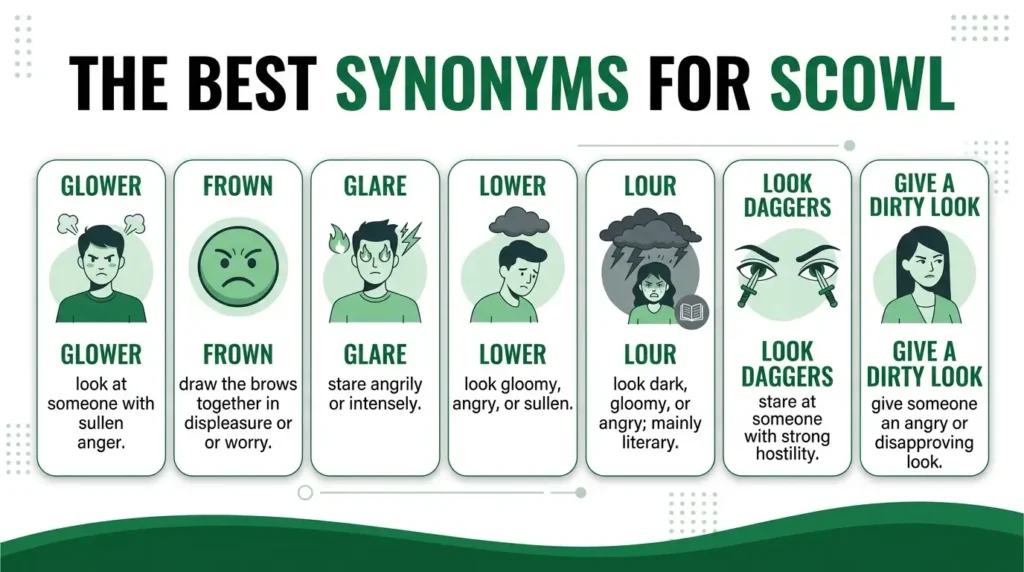
The best synonyms for scowl are:
- Glower — look at someone with sullen anger.
- Frown — draw the brows together in displeasure or worry.
- Glare — stare angrily or intensely.
- Lower — look gloomy, angry, or sullen.
- Lour — look dark, gloomy, or angry; mainly literary.
- Look daggers — stare at someone with strong hostility.
- Give a dirty look — give someone an angry or disapproving look.
Glower is usually the closest replacement when you mean a dark, angry look. Frown is broader, while glare emphasizes an intense stare. Major dictionaries confirm these overlaps but also show that the words are not interchangeable in every context.
Direct Synonyms for Scowl by Meaning
| Synonym | Specific Meaning | Synonym | Specific Meaning |
| Glower | Look with sullen, angry intensity | Frown | Show displeasure with the brows |
| Glare | Stare with anger or hostility | Lower | Look gloomy, angry, or sullen |
| Lour | Look dark, gloomy, or threatening | Look daggers | Stare at someone with hostility |
| Gloom | Have a dark or sullen appearance | Make a face | Alter the face to show displeasure |
Accuracy note: Glower, frown, glare, and lower have strong dictionary support as synonyms or close equivalents of scowl. Lour is valid but uncommon. Look daggers and make a face are contextual alternatives rather than perfect replacements.
Where Does Scowl Come From?
Parts of Speech: Verb and noun
Syllable: 1
Pronunciation: /skaʊl/
Origin: Scowl entered English in Middle English, around the 14th century. Its origin is probably Scandinavian; Collins compares it with Danish skule, meaning to scowl or look furtively.
Prefix/Suffix Breakdown: Scowl does not have a productive English prefix or suffix. It functions as a single lexical root.
Word Family: scowl, scowled, scowling, scowls, scowler, scowlingly.
1. Glower /ˈɡlaʊər/
Meaning: To look or stare with sullen anger or strong displeasure.
- Example: He glowered at the driver who cut in front of him.
- Example: She glowered across the table but said nothing.
Best fit: Use glower when the expression is dark, angry, and often sustained. Collins defines it as looking angrily and also gives scowl, glare, and frown as synonyms.
2. Frown /fraʊn/
Meaning: To draw the eyebrows together to show displeasure, worry, puzzlement, or concentration.
- Example: She frowned when she read the final paragraph.
- Example: He frowned at the unexpected charge.
Best fit: Use frown for a broader range of negative or serious expressions. Unlike scowl, it does not always imply anger. Cambridge and Collins both connect frown with scowl and glower.
3. Glare /ɡler/
Meaning: To stare at someone with an angry, hard, or unfriendly look.
- Example: She glared at him after the rude remark.
- Example: The coach glared at the player from the sidelines.
Best fit: Use glare when the eyes and direct stare matter most. A person can glare without having the specific furrowed-brow expression associated with a scowl. Collins explicitly lists scowl, frown, and glower as synonyms of the angry-look sense of glare.
4. Lower /ˈlaʊər/
Meaning: To look angry, gloomy, or sullen.
- Example: The manager lowered when the team missed the deadline.
- Example: He lowered at the visitors from beneath his brows.
Best fit: Lower is a valid but less common synonym for scowl. Cambridge specifically lists scowl, glare, frown, and glower under this less common sense of lower.
5. Lour /laʊər/
Meaning: To look gloomy, dark, or threatening.
- Example: The old captain loured at the crew.
- Example: His face loured when he heard the news.
Best fit: Use lour mainly in literary or formal descriptive writing. It is not the best everyday replacement for scowl.
6. Look Daggers /lʊk ˈdæɡərz/
Meaning: To give someone a very hostile or angry look.
- Example: She looked daggers at him across the room.
- Example: He looked daggers at anyone who questioned his decision.
Best fit: This phrase is vivid and expressive. It emphasizes hostility and eye contact rather than simply describing the facial expression. Collins lists look daggers among the related synonyms of scowl.
7. Make a Face /meɪk ə feɪs/
Meaning: Change your facial expression to show dislike, displeasure, or another emotion.
- Example: The child made a face when offered the vegetables.
- Example: She made a face at the bitter taste.
Best fit: This is broader than scowl. Use it only when the context makes the negative expression clear. Thesaurus sources associate it with scowl, but it is not an exact synonym.
8. Gloom /ɡluːm/
Meaning: To look or appear dark, gloomy, or dispirited.
- Example: He gloomed at the disappointing result.
- Example: The character gloomed silently in the corner.
Best fit: This is an uncommon literary choice. In most modern writing, scowl, glower, frown, or glare will sound more natural.
Closely Related Alternatives That Are Not Exact Synonyms
Some words appear in thesaurus results because they overlap with scowl, but they should not be treated as interchangeable in every sentence.
Grimace
A grimace is a distorted facial expression that can show pain, disgust, discomfort, or dislike. It can overlap with scowl, but it does not necessarily show anger. Collins lists grimace among synonyms for scowl, while Cambridge places it in the broader group of expressions involving grimacing and frowning.
Use: He grimaced when he tasted the medicine.
Dirty Look
A dirty look is an angry or disapproving look, usually in informal English.
Use: She gave him a dirty look when he interrupted.
It works well as a noun phrase but is not a direct one-word synonym.
Black Look
A black look means a dark, angry, or unfriendly expression.
Use: He gave me a black look after I mentioned the mistake.
It is a contextual alternative, not a universal replacement for scowl. Thesaurus sources group it with scowl, glare, and glower.
Scowl vs. Frown: What Is the Difference?
Scowl usually signals stronger anger, hostility, or displeasure. Frown has a wider meaning and can show worry, confusion, concentration, or mild displeasure.
- Frown: She frowned at the difficult question.
- Scowl: She scowled at the person who insulted her.
Both words can describe lowered or drawn-together brows, but scowl normally carries a more hostile tone.
Scowl vs. Glower: What Is the Difference?
Scowl focuses on an angry or threatening facial expression. Glower often suggests looking or staring with sustained, sullen anger.
- Scowl: He scowled when he heard the news.
- Glower: He glowered at his rival across the room.
Glower is therefore one of the strongest choices when you want to emphasize a prolonged angry look.
Scowl vs. Glare: What Is the Difference?
Scowl describes the facial expression. Glare emphasizes an intense, angry stare.
- Scowl: He scowled at the bad report.
- Glare: He glared at the person who wrote it.
A character may glare without visibly scowling, so the two words should not always be swapped.
Scowl vs. Grimace: What Is the Difference?
A scowl normally communicates anger or displeasure. A grimace can communicate pain, disgust, discomfort, or dislike.
- She scowled at the rude waiter. → anger
- She grimaced after tasting the sour drink. → discomfort or dislike
Choose grimace only when the facial distortion is more important than anger.
When Not to Use a Synonym for Scowl
Do not replace scowl simply because another word appears in a thesaurus.
- Use frown when the person may be worried, puzzled, or concentrating.
- Use glower for a dark, sustained angry look.
- Use glare when intense eye contact is central.
- Use lower when you want a less common or literary alternative.
- Use lour for literary descriptions of dark or threatening looks.
- Use look daggers when the hostility comes through a direct stare.
- Use grimace when pain, disgust, or discomfort causes the facial expression.
- Use dirty look for informal speech.
- Avoid gloom unless the literary style clearly supports it.
This distinction is important because thesaurus lists combine exact synonyms with related expressions. Current dictionary evidence supports the core group of frown, glower, glare, and lower, while other terms require more context.
Best Synonym for Scowl by Context
| If you mean… | Best choice |
| A general angry expression | Scowl |
| A very angry or sullen look | Glower |
| Mild displeasure or worry | Frown |
| An angry stare | Glare |
| A gloomy or sullen look | Lower |
| A literary dark expression | Lour |
| A hostile stare | Look daggers |
| An informal angry expression | Dirty look |
| Pain or disgust on the face | Grimace |
Formal Synonyms for Scowl
For formal or polished writing, the strongest choices are:
- Glower — precise and natural.
- Frown — neutral and widely understood.
- Glare — precise when an angry stare is meant.
- Lower — formal but uncommon.
- Lour — literary and uncommon.
For most professional or academic writing, frown, glower, or glare will be clearer than an obscure synonym.
Synonyms for Scowl in Creative Writing
Creative writers often need a word that shows the type and intensity of anger.
- Frown creates mild or uncertain displeasure.
- Scowl creates visible anger.
- Glower creates a darker, more sustained mood.
- Glare creates direct confrontation.
- Look daggers creates vivid, dramatic hostility.
- Grimace creates discomfort or disgust rather than pure anger.
Example:
He glowered across the room, saying nothing.
This gives the reader a stronger sense of sustained anger than simply saying:
He looked angry.
Opposite Words: Antonyms for “Scowl”
The best antonyms describe friendly, happy, or approving facial expressions.
Direct Antonyms
- Smile — show happiness or friendliness.
She smiled when she saw her friend. - Grin — smile broadly with pleasure or amusement.
He grinned after hearing the joke. - Beam — smile with obvious warmth or happiness.
She beamed with pride. - Laugh — express amusement or joy through laughter.
They laughed at the funny story.
Operational and Contextual Opposites
- Welcome — show friendliness toward someone.
The host welcomed the guests. - Approve — show acceptance or support.
The manager approved the proposal. - Praise — express approval or admiration.
The teacher praised her work. - Encourage — give someone support or confidence.
His words encouraged the nervous speaker.
Thesaurus sources identify smile and grin as direct opposites of scowl.
Frequently Asked Questions
What is another word for scowl?
Glower is one of the closest alternatives to scowl. Other useful choices include frown, glare, lower, and lour, depending on the exact meaning.
What is the strongest synonym for scowl?
Glower is usually the strongest natural one-word choice when you mean a dark, angry, or sullen look. Glare can be stronger when the main idea is an intense stare.
Is frown a synonym for scowl?
Yes. Frown is a genuine synonym in some contexts, but it is broader. A frown can show worry, confusion, concentration, or displeasure, while a scowl more strongly suggests anger or hostility.
Is glare another word for scowl?
Glare is a close synonym when scowl means an angry look. However, glare emphasizes an intense or hostile stare, while scowl emphasizes the facial expression.
What is a good synonym for scowl in creative writing?
Glower is often the best choice for creative writing because it suggests a sustained, dark, angry look. Glare works well when the character makes direct eye contact, while look daggers creates a more vivid and informal effect.
Conclusion
The best synonyms for scowl are glower, frown, glare, lower, and lour, with glower usually providing the closest natural alternative for a dark, angry look. Use frown for broader displeasure, glare for an angry stare, and look daggers for vivid hostile eye contact. For accurate writing, avoid treating grimace or dirty look as exact synonyms because they add different meanings or levels of formality.