
Synonyms for Charisma (noun) (kə-RIZ-mə) means a powerful personal quality that attracts, interests, or inspires other people. It often describes someone who has a natural ability to gain attention, admiration, or support.
The closest synonyms for charisma are charm, magnetism, personal magnetism, personal appeal, appeal, and allure. Other words, such as presence, influence, and force of personality, overlap with charisma but express a more specific idea.
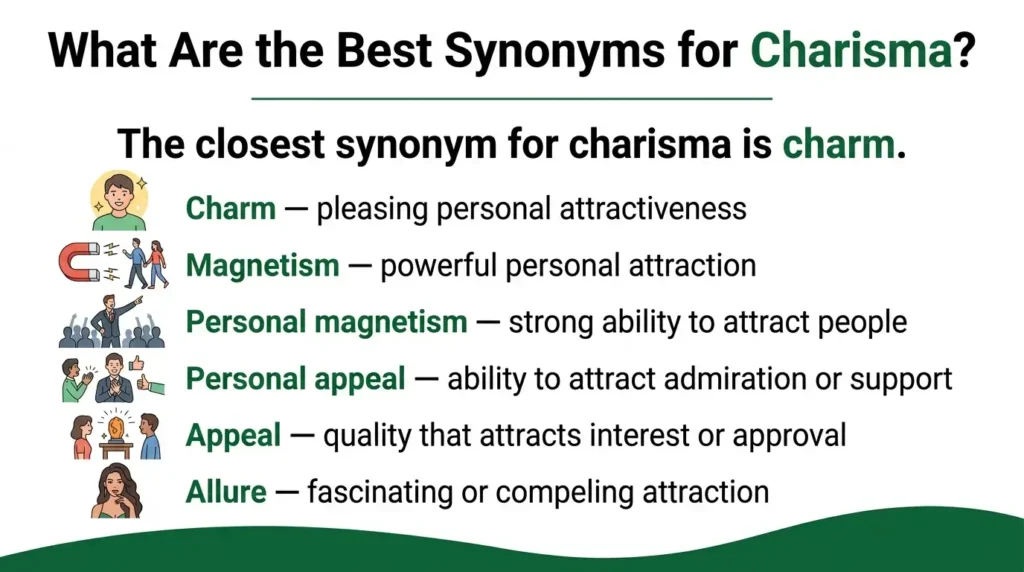
What Are the Best Synonyms for Charisma?
The closest synonym for charisma is charm.
Use magnetism when you mean strong personal attraction, personal appeal when you mean the ability to attract admiration or support, and allure when you mean a fascinating or compelling quality.
For more specific contexts:
- Charm — pleasing personal attractiveness
- Magnetism — powerful personal attraction
- Personal magnetism — strong ability to attract people
- Personal appeal — ability to attract admiration or support
- Appeal — quality that attracts interest or approval
- Allure — fascinating or compelling attraction
Important: Presence, influence, confidence, leadership, persuasiveness, personality, and dynamism are related to charisma but are not exact synonyms.
Direct Synonyms for Charisma
| Synonym | Specific Meaning | Synonym | Specific Meaning |
| Charm | Pleasing quality that attracts others | Magnetism | Powerful personal ability to attract |
| Personal magnetism | Strong ability to attract people | Personal appeal | Ability to attract admiration or support |
| Appeal | Quality that attracts interest or approval | Allure | Fascinating quality that attracts others |
These six are the strongest lexical alternatives, but they are not identical in every context. Charm is the broadest everyday substitute, while magnetism suggests a stronger and more compelling attraction.
Where Does Charisma Come From?
Parts of Speech: Noun
Syllable: Three syllables — cha-ris-ma
Origin: Charisma comes from Greek kharisma, meaning “favor” or “gift,” from kharis, meaning “grace” or “favor.” English first used the word in a religious sense for a special gift or grace before it developed its modern sense of exceptional personal appeal and influence.
Prefix/Suffix Breakdown: The word contains the Greek noun-forming element -isma, related to a quality, result, or process. Its deeper root is kharis, meaning “grace” or “favor.”
Charm
Pronunciation: /tʃɑːrm/
Meaning: A pleasing personal quality that attracts or delights other people.
Examples:
- Her natural charm made everyone feel welcome.
- The actor won the audience with his quiet charm.
Nuance: Charm is usually the best simple replacement for charisma, but it can sound warmer and less powerful.
Magnetism
Pronunciation: /ˈmæɡnəˌtɪzəm/
Meaning: A powerful personal quality that attracts other people.
Examples:
- His magnetism held the audience’s attention.
- Her natural magnetism made people want to follow her.
Nuance: Magnetism is especially strong when charisma means powerful attraction.
Personal Magnetism
Pronunciation: /ˈpɜːrsənəl ˈmæɡnəˌtɪzəm/
Meaning: A strong personal ability to attract and influence others.
Examples:
- His personal magnetism made him a memorable speaker.
- Her personal magnetism helped her build a loyal following.
Nuance: This phrase is very close to charisma and makes the personal nature of the attraction explicit.
Personal Appeal
Pronunciation: /ˈpɜːrsənəl əˈpiːl/
Meaning: A personal quality that attracts admiration, interest, or support.
Examples:
- His personal appeal helped him connect with voters.
- Her personal appeal made the campaign more engaging.
Nuance: Personal appeal works especially well when charisma helps someone gain public support.
Appeal
Pronunciation: /əˈpiːl/
Meaning: A quality that attracts interest, approval, or admiration.
Examples:
- The speaker has broad public appeal.
- Her calm manner adds to her appeal.
Nuance: Appeal is broader than charisma. It can describe people, products, ideas, places, and experiences.
Allure
Pronunciation: /əˈlʊr/
Meaning: A fascinating or attractive quality that draws people in.
Examples:
- The actress had an unusual allure.
- His quiet allure drew attention without effort.
Nuance: Allure can suggest mystery, fascination, or seductive attraction. It is therefore not suitable for every use of charisma.
Contextual Alternatives to Charisma
The following words are useful in specific contexts, but they should not be presented as exact synonyms.
Presence
Meaning: A noticeable and often compelling effect created by someone’s manner or appearance.
The speaker has a powerful stage presence.
Difference: Presence describes the effect someone has in a space or before an audience. It does not always imply personal charm or influence.
Force of Personality
Meaning: A strong personality that can influence other people.
She won support through sheer force of personality.
Difference: This is very close to charisma when influence is central, but it is a phrase rather than a direct one-word synonym.
Influence
Meaning: The ability to affect people’s opinions, actions, or decisions.
His influence grew after years of public service.
Difference: Influence can come from knowledge, authority, wealth, position, or expertise. It does not require charisma.
Persuasiveness
Meaning: The ability to convince people to accept an idea or take action.
Her persuasiveness helped win support for the proposal.
Difference: Persuasiveness focuses on convincing people. Charisma can influence people without persuasion.
Confidence
Meaning: A strong belief in one’s own abilities or qualities.
His confidence made him an effective speaker.
Difference: Confidence can contribute to charisma, but confident people are not always charismatic.
Dynamism
Meaning: Energetic and forceful personal qualities.
Her dynamism energized the entire team.
Difference: Dynamism stresses energy and drive. Charisma stresses attraction and influence.
Personality
Meaning: The distinctive qualities and character of a person.
She has a warm personality.
Difference: Personality is much broader than charisma. A person can have a strong personality without being charismatic.
Star Quality
Meaning: A distinctive quality that makes someone especially suited to public attention or fame.
The young actor has real star quality.
Difference: Star quality is strongly linked to entertainment, performance, and public appeal.
Synonyms for Charisma in Different Contexts
The best alternative depends on what charisma means in your sentence.
Charisma in a Person
Use:
- Charm
- Magnetism
- Personal magnetism
- Personal appeal
- Allure
- Force of personality
She has natural charisma.
Possible alternatives:
- She has natural charm.
- She has strong personal magnetism.
- She has remarkable personal appeal.
Charisma in Leadership
Use:
- Magnetism
- Personal appeal
- Personal magnetism
- Force of personality
- Influence
His magnetism helped attract supporters.
Her force of personality made her an influential leader.
Use influence only when the focus is the person’s ability to affect others, not their personal attraction.
Charisma in Public Speaking
Use:
- Presence
- Magnetism
- Personal appeal
- Charm
- Force of personality
The speaker has remarkable stage presence.
Her magnetism kept the audience engaged.
Charisma on a Resume
Charisma is usually too vague for a resume. Describe the actual professional skill instead.
Useful alternatives include:
- Leadership presence
- Persuasive communication
- Relationship-building ability
- Stakeholder engagement
- Public-speaking ability
- Personal influence
Instead of:
I have excellent charisma and leadership skills.
Write:
Built strong stakeholder relationships through persuasive communication and confident leadership.
This gives the reader evidence of the quality instead of simply naming it.
Charisma in an Essay
For formal writing, choose a word that expresses the exact idea.
| If you mean… | Use… |
| Personal attractiveness | Charm |
| Powerful attraction | Magnetism |
| Public support | Personal appeal |
| Strong personal influence | Force of personality |
| Ability to affect others | Influence |
| Compelling effect before an audience | Presence |
| Ability to convince | Persuasiveness |
Example:
The leader’s charisma helped attract public support.
More precise:
The leader’s personal appeal helped attract public support.
Charisma in Creative Writing
Creative writing may need a more vivid description than charisma.
Use magnetic, captivating, mesmerizing, enchanting, or compelling when they fit the sentence.
She had a magnetic presence that silenced the room.
His captivating voice held the audience.
These are contextual alternatives, not direct noun synonyms for charisma.
Charisma vs. Charm
Charisma suggests a strong ability to attract, influence, or inspire people.
Charm usually suggests a pleasing and likable quality.
The leader’s charisma inspired thousands.
Her charm made everyone feel comfortable.
Charm is the closest everyday substitute, but charisma can suggest greater influence.
Charisma vs. Magnetism
Magnetism is one of the closest alternatives to charisma.
Both can describe a powerful ability to attract people.
The main difference is emphasis:
- Charisma → attraction, influence, and inspiration
- Magnetism → powerful personal attraction
His magnetism drew people toward him.
His charisma inspired people to follow him.
Charisma vs. Appeal
Appeal means the quality of being attractive or interesting to others.
Charisma is more strongly linked with a person’s distinctive ability to attract or influence.
The product has broad appeal.
The speaker has strong charisma.
Because appeal applies to many things, it is broader than charisma.
Charisma vs. Allure
Allure describes an attractive or fascinating quality.
It can overlap with charisma, but it often suggests mystery, beauty, or seductive attraction.
The actress had a mysterious allure.
The leader had strong charisma.
Use allure when fascination is central.
Charisma vs. Presence
Presence describes the noticeable effect someone has in a room, on stage, or before an audience.
She has a commanding presence.
This does not necessarily mean she has charisma.
A person can have strong presence because of authority, confidence, physical stature, or speaking skill.
Charisma vs. Influence
Influence means the ability to affect people or decisions.
Charisma can create influence, but influence does not require charisma.
The scientist has great influence in her field.
That influence may come from expertise rather than personal charm.
Common Traps & Nuance Distinctions
The biggest mistake is treating every positive personal quality as a synonym for charisma.
- Charm is the closest everyday alternative.
- Magnetism suggests unusually strong attraction.
- Personal appeal emphasizes attraction and public support.
- Allure can suggest mystery or seductive attraction.
- Presence focuses on someone’s effect in a space.
- Force of personality stresses strong personal influence.
- Influence focuses on the ability to affect others.
- Confidence focuses on self-belief.
- Persuasiveness focuses on convincing people.
- Personality is broader than charisma.
- Leadership describes the ability to guide others.
- Dynamism emphasizes energy and drive.
- Star quality focuses on public or entertainment appeal.
When NOT to Use Charisma
Do not use charisma when you only mean physical beauty.
She is beautiful.
Beauty does not automatically mean charisma.
Do not use charisma when you only mean confidence.
He speaks with confidence.
Confidence and charisma can occur together, but they are different qualities.
Do not use charisma when you mean professional influence based on expertise.
Her research gives her influence in the field.
That influence may come from knowledge rather than charisma.
Do not use charisma when you mean persuasion alone.
His argument was persuasive.
A persuasive argument does not require a charismatic speaker.
Do not use personality as a direct replacement. Personality covers a much wider range of human traits.
Word Forms Related to Charisma
Understanding the word family helps you use the term correctly.
- Charisma — noun
- Charismatic — adjective
- Charismatically — adverb
Examples
Her charisma attracted the audience.
She is highly charismatic.
He spoke charismatically to the crowd.
Charismatic is the natural adjective when describing a person who has charisma.
Opposite Words: Antonyms for Charisma
Charisma has no single exact antonym. The best opposite depends on whether you mean a lack of attraction, warmth, energy, or influence.
Direct Contextual Opposites
- Dullness — lack of interest or engaging quality
The speaker’s dullness lost the audience. - Blandness — lack of distinctive or appealing qualities
His blandness made the presentation forgettable. - Unappealingness — lack of attractive qualities
Her unappealing manner made connection difficult. - Uninspiringness — failure to motivate or excite others
The speech was criticized for its uninspiringness.
Operational & Contextual Opposites
- Aloofness — emotional distance from other people
His aloofness made him difficult to approach. - Inexpressiveness — limited outward emotional expression
Her inexpressiveness made the interview feel flat. - Passivity — lack of active energy or initiative
His passivity did not inspire the team. - Inaccessibility — difficulty forming a personal connection
His professional inaccessibility limited engagement.
These are contextual opposites, not universal dictionary antonyms.
FAQs about Synonyms for Charisma
What is the closest synonym for charisma?
Charm is usually the closest simple synonym for charisma. Magnetism is stronger when you mean powerful personal attraction, while personal appeal emphasizes the ability to attract admiration or support.
What is another word for charisma in a person?
The strongest alternatives are charm, magnetism, personal magnetism, personal appeal, and allure. Force of personality is also useful when strong personal influence is the main idea.
What is a formal synonym for charisma?
There is no single formal synonym that works in every context. Personal appeal, personal magnetism, presence, and force of personality can work when they match the intended meaning.
What is a synonym for charisma on a resume?
For a resume, use a specific professional quality instead of simply claiming charisma. Good choices include leadership presence, persuasive communication, stakeholder engagement, personal influence, and relationship-building ability.
What is a synonym for charisma in an essay?
Use charm, magnetism, personal appeal, force of personality, presence, or influence, depending on the intended meaning. Formal writing is stronger when the exact quality is named.
Is charm the same as charisma?
No. Charm usually means a pleasing and likable personal quality. Charisma often suggests a stronger ability to attract, influence, or inspire other people.
Is magnetism a synonym for charisma?
Yes, magnetism is one of the closest alternatives to charisma. It emphasizes the powerful attraction a person creates in others.
What is the opposite of charisma?
There is no perfect one-word opposite. Depending on context, useful opposites include dullness, blandness, unappealingness, aloofness, inexpressiveness, and uninspiringness.
Conclusion
The strongest synonyms for charisma are charm, magnetism, personal magnetism, personal appeal, appeal, and allure. Use magnetism for powerful attraction, personal appeal for public admiration or support, and force of personality or presence when a more specific leadership or performance meaning is intended. For resumes and formal writing, describe the exact quality behind charisma—such as persuasive communication, leadership presence, or personal influence rather than using a vague personality label.