
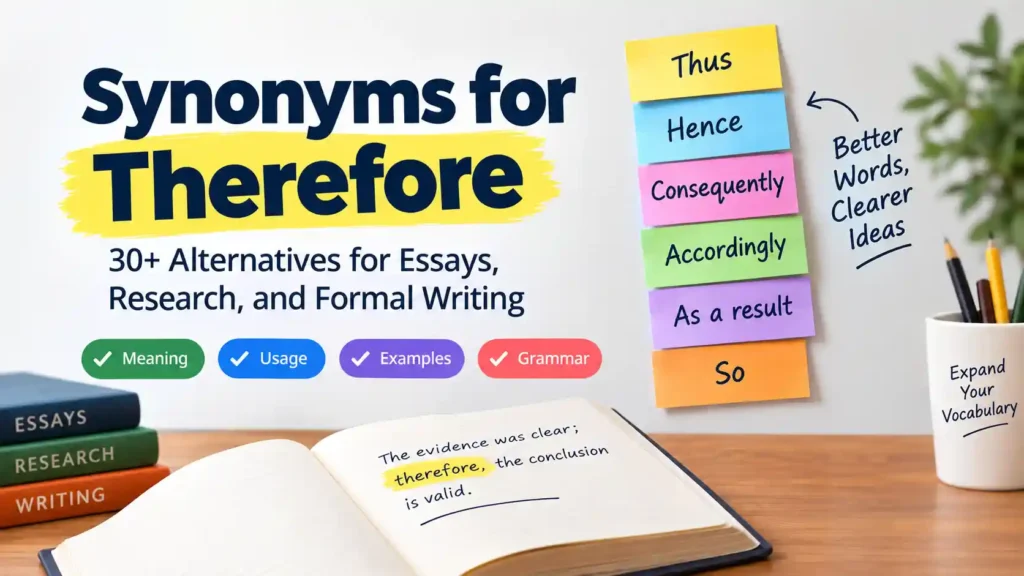

Synonyms for Therefore (adverb) (/ˈðer.fɔːr/; UK /ˈðeə.fɔːr/) mean “for that reason,” “as a result,” or “consequently.” It introduces a result, conclusion, or logical consequence that follows from an earlier statement.
If you need another word for therefore, the closest choices are thus, hence, consequently, accordingly, so, and as a result. The best choice depends on your tone and the type of connection you want to show.
What Are Synonyms for Therefore?
The most useful synonyms for therefore are:
- Thus — shows a logical result or conclusion.
- Hence — shows a result, often in formal writing.
- Consequently — stresses a direct consequence.
- Accordingly — shows an action or result that follows.
- As a result — clearly states cause and effect.
- For this reason — directly explains why something follows.
- So — a common, less formal alternative.
- For that reason — clearly links a result to a previous point.
- As a consequence — emphasizes the outcome of an event.
- Ergo — a formal or philosophical way to say “therefore.”
For an essay or research paper, thus, hence, consequently, as a result, and for this reason are usually the most useful choices. Collins lists consequently, so, thus, and as a result as synonyms of therefore, while Dictionary.com distinguishes the more formal reasoning use of therefore from the conversational tone of so.
Direct Synonyms for Therefore by Intent
| Synonym | Specific Meaning | Synonym | Specific Meaning |
|---|---|---|---|
| Thus | Shows a logical result or conclusion | Hence | Shows a result from stated facts |
| Consequently | Shows a direct resulting effect | Accordingly | Shows a response to preceding facts |
| So | Shows a result in plain language | As a result | Clearly states an outcome |
| For this reason | Gives the reason for a conclusion | For that reason | Links result to prior information |
| As a consequence | Emphasizes the resulting outcome | Ergo | Marks a formal logical conclusion |
| Then | Shows a result in some contexts | It follows that | Introduces a logical conclusion |
Important: Not every word above works as a perfect one-for-one replacement in every sentence. Accordingly, then, and ergo have narrower uses, while as a result and for this reason are phrases rather than single-word synonyms. Dictionary sources confirm that therefore can signal either consequence or logical inference, so context matters.
Where Therefore Comes From
Parts of Speech: Adverb
Syllables: there-fore
Origin: Middle English ther-fore, from Old English þærfore, formed from there + fore/for. The word developed with the sense “for that reason” or “in consequence of that.”
Prefix/Suffix Breakdown: there + fore; it is a compound formation rather than a modern prefix-and-suffix construction.
The word is therefore Germanic in origin, not a Latin or Greek formation. Its parts developed from Old English words related to there and for/before. The modern spelling and meaning developed through Middle English.
Therefore Meaning and Usage
Therefore means “for that reason,” “because of that,” or “as a result.” Cambridge classifies it as an adverb and gives the core meaning “for that reason.”
Use therefore when the second idea follows logically from the first.
Example:
The roads were flooded; therefore, the school closed.
The flooding is the reason. The school closure is the result.
Therefore in a Sentence
- The evidence was incomplete; therefore, the researchers repeated the test.
- She had already completed the work; therefore, she left early.
You can also place therefore inside a sentence:
The results were therefore difficult to interpret.
Cambridge examples show that therefore can appear in different positions within a clause, including after the subject or auxiliary verb.
Synonyms for Therefore in English
English has several ways to show a result. Choose the connector that matches the strength and tone of your relationship between the two ideas.
Thus (/ðʌs/)
Meaning: In this way or as a result.
Examples:
- The data were consistent; thus, the hypothesis gained support.
- The store closed early; thus, customers had to return the next day.
Best context: Academic, formal, analytical, and professional writing.
Hence (/hens/)
Meaning: For this reason or as a result.
Examples:
- The sample was too small; hence, the findings require caution.
- The machine was damaged; hence, production stopped.
Best context: Formal, academic, technical, and concise writing.
Consequently (/ˈkɒnsɪkwəntli/)
Meaning: As a direct result of something.
Examples:
- Costs increased sharply; consequently, the project was delayed.
- The storm damaged the bridge; consequently, traffic was diverted.
Best context: Formal reports, research, essays, and professional writing.
Accordingly (/əˈkɔːrdɪŋli/)
Meaning: In a way that follows from the stated facts.
Examples:
- The requirements changed; accordingly, we revised the plan.
- The weather worsened; accordingly, the event schedule was changed.
Best context: Formal and professional writing.
Nuance: Accordingly often suggests that someone acts or adjusts in response to earlier information. It is not always interchangeable with therefore.
So (/soʊ/)
Meaning: Because of that or as a result.
Examples:
- The store was closed, so we went home.
- The test was difficult, so many students needed more time.
Best context: Everyday English, conversation, informal writing.
Collins identifies so as a synonym of therefore, while Dictionary.com notes that so is generally more informal or conversational than therefore.
As a Result (/æz ə rɪˈzʌlt/)
Meaning: Because of the preceding event or fact.
Examples:
- The river rose quickly. As a result, nearby roads closed.
- Sales fell during winter. As a result, the company reduced production.
Best context: Essays, reports, explanations, and general writing.
For This Reason (/fɔːr ðɪs ˈriːzən/)
Meaning: Because of the reason just explained.
Examples:
- The evidence was weak. For this reason, the claim needs further testing.
- The road was unsafe. For this reason, officials closed it.
Best context: Essays, research, formal explanations, and clear cause-and-effect writing.
For That Reason (/fɔːr ðæt ˈriːzən/)
Meaning: Because of the fact just mentioned.
Examples:
- The deadline had passed. For that reason, the application was rejected.
- The data were incomplete. For that reason, the analysis was postponed.
Best context: Formal and neutral writing.
As a Consequence (/æz ə ˈkɒnsɪkwəns/)
Meaning: Because something produced a particular result.
Examples:
- The company lost funding. As a consequence, the project stopped.
- The temperature dropped suddenly. As a consequence, the pipes froze.
Best context: Formal writing and cause-and-effect explanations.
Ergo (/ˈɜːrɡoʊ/)
Meaning: Therefore or consequently.
Examples:
- The premises are false; ergo, the conclusion cannot stand.
- The contract was invalid; ergo, the agreement had no legal effect.
Best context: Logic, philosophy, rhetoric, or deliberately formal writing.
Note: Ergo is much less common in ordinary modern English. Do not use it just to sound academic.
It Follows That (/ɪt ˈfɒloʊz ðæt/)
Meaning: The next conclusion logically follows.
Examples:
- The two conditions cannot coexist. It follows that one must be rejected.
- The results support the first assumption. It follows that the model remains useful.
Best context: Formal reasoning, mathematics, philosophy, and research.
Synonyms for Therefore in an Essay
When writing an essay, avoid repeating therefore in every paragraph. Choose a connector based on the exact relationship between your ideas.
For a Formal Conclusion
Use:
- Thus
- Hence
- Consequently
- Accordingly
- It follows that
Example:
The evidence supports the proposed explanation. Thus, the original claim remains plausible.
For Clear Cause and Effect
Use:
- As a result
- As a consequence
- For this reason
- For that reason
Example:
The sample contained several errors. As a result, the researchers repeated the experiment.
For a Simple Transition
Use:
- So
- Then
Example:
The first method produced inconsistent results, so the researchers tested another method.
For academic writing, so may sound less formal than thus, hence, consequently, or as a result.
Formal Synonyms for Therefore
If you need a professional way to say therefore, consider:
- Thus
- Hence
- Consequently
- Accordingly
- As a result
- For this reason
- As a consequence
- It follows that
What Is a Professional Way to Say “Therefore”?
The most natural professional alternatives are thus, consequently, accordingly, as a result, and for this reason.
Choose thus when you want a short logical link. Choose consequently when you want to stress the result. Choose accordingly when the next action responds to the previous information.
Another Word for Therefore in Research
Research writing needs precise logical links. Good alternatives include:
- Thus — for a logical conclusion.
- Hence — for a concise formal result.
- Consequently — for a direct consequence.
- As a result — for clear cause and effect.
- Accordingly — when a decision follows from findings.
- It follows that — when the conclusion follows logically.
- For this reason — when you want to make the reason explicit.
Research example:
The control group showed no significant change. Therefore, the intervention cannot be linked to the observed difference.
Alternative:
The control group showed no significant change. Thus, the intervention cannot be linked to the observed difference.
Another:
The control group showed no significant change. Consequently, the observed difference cannot be attributed to the intervention.
Synonyms for Therefore in the Bible
The best biblical alternative depends on the Bible translation and the original-language connector. There is no single English synonym that replaces therefore in every verse.
Common translation equivalents include:
- Thus
- So
- Then
- For this reason
- For that reason
- Wherefore
- Accordingly
Biblical translation resources show that Greek connectors such as διό (dio) can carry the sense “therefore” or “for this reason,” while οὖν (oun) can be translated as “therefore,” “then,” “so,” or “accordingly,” depending on context.
Some Bible translation notes also show “so,” “then,” “therefore,” and “for this reason” being used for closely related inferential connectors.
Why Bible Translations Differ
Biblical Hebrew and Greek do not always map one-to-one onto modern English connectors. A translator may choose therefore, so, thus, then, or for this reason to make the logical relationship natural in English.
For that reason, check the specific Bible translation when you need an exact wording.
Is Therefore a Formal Word?
Yes. Therefore is a standard formal and neutral English word. It is common in academic, professional, legal, scientific, and logical writing.
It is not restricted to formal writing, but alternatives such as so usually sound more conversational.
Dictionary.com specifically notes that therefore and wherefore can imply exact reasoning and are especially associated with logic, law, mathematics, and formal styles, while so and then are more informal.
Is Therefore Grammatically Correct?
Yes. Therefore is grammatically correct when it correctly connects a reason, premise, or fact with its result or conclusion.
Correct:
The evidence was incomplete; therefore, the study continued.
Also correct:
The evidence was incomplete. Therefore, the study continued.
And:
The evidence was therefore considered insufficient.
A common error is to treat therefore as if it were always a coordinating conjunction like and or but. Its punctuation and position depend on how it functions in the sentence.
Is Therefore a Synonym of So?
Yes, in some contexts. Both can introduce a result or consequence.
The weather was poor, so the game was canceled.
The weather was poor; therefore, the game was canceled.
The difference is mainly register and nuance. So is more natural in conversation. Therefore sounds more formal and often highlights logical reasoning. Collins lists both as synonyms, while Dictionary.com describes so as more informal or conversational.
Is “As Such” Similar to Therefore?
Not exactly.
Therefore means “as a result” or “for that reason.”
As such usually means “in that capacity,” “being what was just described,” or “as a consequence of that status.”
Compare:
The data were unreliable; therefore, we repeated the test.
Here, therefore clearly introduces a result.
He is the team leader and, as such, he must make the final decision.
Here, as such refers back to his role as team leader.
In some sentences, as such can express a consequence, but it is not a general replacement for therefore.
Therefore Symbol: ∴
The standard therefore symbol is:
∴
It consists of three dots arranged as an upright triangle and is used to mark a logical conclusion in mathematics, logic, and proofs. Its Unicode code point is U+2234.
Example:
All humans are mortal. Socrates is human. ∴ Socrates is mortal.
The related because symbol is ∵, which reverses the triangle and introduces a reason rather than a conclusion.
How to Type the Therefore Symbol
Therefore: ∴
Unicode: U+2234
HTML entity: ∴
LaTeX: \therefore
In Microsoft Word, you can type 2234 and press Alt + X to convert the code into ∴.
Another Word for Therefore in a Sentence
The best replacement depends on the sentence.
| Original | Alternative |
|---|---|
| The test failed; therefore, we repeated it. | The test failed; thus, we repeated it. |
| The road was closed; therefore, we turned back. | The road was closed; so, we turned back. |
| The evidence was weak; therefore, the claim was rejected. | The evidence was weak; consequently, the claim was rejected. |
| The deadline changed; therefore, we revised the schedule. | The deadline changed; accordingly, we revised the schedule. |
| The sample was too small; therefore, more data were needed. | The sample was too small; as a result, more data were needed. |
| The evidence was incomplete; therefore, further testing was needed. | The evidence was incomplete; for this reason, further testing was needed. |
Another Word for Therefore in a Conclusion
For the conclusion of an essay, report, or argument, useful alternatives include:
- Thus
- Hence
- Consequently
- As a result
- For this reason
- It follows that
- In light of this
Use thus when you are drawing a logical conclusion.
Thus, the evidence supports the proposed explanation.
Use in light of this when the conclusion responds to the evidence or facts already discussed.
In light of this, further research is needed.
Note: In conclusion is not a direct synonym for therefore. It signals the final section or summary of a piece of writing, while therefore signals a result or inference.
Common Traps & Nuance Distinctions
Small differences matter when replacing therefore.
Therefore vs. Thus
Both can introduce a logical result.
Therefore is broader and very common in formal writing.
Thus is concise and often works well in academic or analytical prose.
The results were consistent; therefore, the method was accepted.
The results were consistent; thus, the method was accepted.
Therefore vs. Hence
Both express a result or conclusion.
Hence can sound more formal or concise and is common in technical writing.
The system failed; hence, the delay.
The system failed; therefore, the project was delayed.
Therefore vs. Consequently
Consequently puts stronger emphasis on the result as an outcome.
Costs increased; consequently, the project was delayed.
Therefore can focus more directly on the logical inference:
Costs increased; therefore, the budget must be revised.
Therefore vs. Accordingly
Accordingly often means that an action or decision follows in response to earlier information.
The requirements changed; accordingly, we updated the design.
This is not always the same as:
The requirements changed; therefore, the old design was unsuitable.
Therefore vs. So
So is usually simpler and more conversational.
It was raining, so we stayed inside.
Therefore is more formal:
It was raining; therefore, we stayed inside.
Therefore vs. Therefor
These are different words.
Therefore = as a result; for that reason.
Therefor = for that thing or in exchange for that thing. It is uncommon in modern English and often appears in legal language.
Correct:
The evidence was weak; therefore, the claim was rejected.
Different meaning:
The payment was made therefor.
Do not use therefor as a shorter spelling of therefore.
When NOT to Use Therefore
Do not use therefore when there is no clear logical or causal connection.
1. Do Not Use It for Simple Contrast
Incorrect:
The study was small; therefore, the results were interesting.
If “interesting” does not logically result from “small,” therefore is not the right connector.
2. Do Not Use It Just to Sound Formal
Avoid replacing every so with therefore.
Natural:
I was tired, so I went home.
More formal:
I was tired; therefore, I went home.
Both can be correct, but the second may sound unnecessarily formal in casual conversation.
3. Do Not Use It When You Mean “In This Way”
Thus can mean “in this way,” but therefore normally means “for that reason.”
Hold the handle thus.
You cannot normally replace thus here with therefore.
4. Do Not Use “Therefor” Instead
Therefor and therefore have different meanings.
5. Do Not Use “As Such” Automatically
As such has a different grammatical and semantic role. Use it when referring back to a status, identity, or previously described thing—not simply whenever you mean “therefore.”
Direct Synonym Guide by Writing Context
| Writing Context | Strong Choices | Less Suitable Choice |
|---|---|---|
| Academic essay | Thus, hence, consequently | So |
| Research paper | Thus, consequently, as a result | So |
| Scientific writing | Thus, hence, consequently | That’s why |
| Business report | Accordingly, consequently, as a result | Ergo |
| Formal email | Therefore, accordingly, as a result | Ergo |
| Legal writing | Therefore, accordingly, consequently | So |
| Conversation | So, that’s why | Ergo |
| Creative writing | Thus, so, as a result | Accordingly |
| Mathematical proof | Therefore, hence, thus, ∴ | That’s why |
| Bible translation context | Therefore, thus, so, for this reason | One fixed substitute |
What Can I Say Instead of “Therefore”?
If you want a simple replacement, choose based on your purpose:
For a formal essay:
Thus
For academic research:
Consequently or hence
For clear cause and effect:
As a result
For an explicit reason:
For this reason
For a professional decision:
Accordingly
For casual English:
So
For formal logic:
Ergo or it follows that
Key Takeaway: The Best Synonym Depends on Context
There is no single replacement that works perfectly in every sentence. Thus is one of the closest compact alternatives, hence is concise and formal, consequently stresses the outcome, accordingly often introduces a response or action, as a result clearly states cause and effect, and so is the natural conversational choice.
Opposite Words: Antonyms for “Therefore”
Therefore expresses a result or inference, so its antonyms are not exact one-word opposites. The useful contrasts are words that do not establish a consequence, introduce a cause, or signal a different logical relationship.
Direct Contextual Antonyms
- However — introduces contrast rather than result.
The sample was small; however, the results were useful. - But — introduces an opposing or contrasting idea.
The method was simple, but it was effective. - Nevertheless — introduces a contrasting point despite the previous statement.
The evidence was limited; nevertheless, the study continued. - Although — introduces a condition or contrast.
Although the sample was small, the results were consistent.
Operational & Contextual Opposites
- Because — introduces a reason rather than a conclusion.
The test failed because the equipment was damaged. - Since — can introduce a reason or cause.
Since the road was closed, we took another route. - Before — establishes sequence rather than consequence.
Finish the test before you submit the report. - Meanwhile — signals simultaneous timing rather than logical result.
The team analyzed the data; meanwhile, the technicians checked the equipment.
These are contextual opposites, not dictionary antonyms in the strict sense.
Frequently Asked Questions
What are the best synonyms for therefore?
The closest and most useful alternatives are thus, hence, consequently, accordingly, so, as a result, for this reason, and for that reason. The best option depends on whether you want to stress logic, consequence, response, or simple cause and effect.
What is a formal synonym for therefore?
Use thus, hence, consequently, accordingly, or as a consequence. For academic writing, thus, hence, and consequently are especially useful.
What can I say instead of therefore in an essay?
Use thus, hence, consequently, as a result, for this reason, or accordingly. Choose thus for a concise conclusion and as a result when you want the cause-and-effect relationship to be very clear.
Is therefore a formal word?
Yes. Therefore is a standard formal and neutral English adverb. It is widely used in academic, professional, scientific, legal, and logical writing. So is generally more conversational.
Is “as such” similar to therefore?
Only in some contexts. As such can refer to a consequence of someone’s status or identity, but it is not a general synonym for therefore. Use therefore when you mean “as a result” or “for that reason.”
Is therefore a synonym of so?
Yes, when so means “as a result” or “because of that.” However, so is usually more conversational, while therefore is more formal and often emphasizes logical reasoning.
Is there a symbol for therefore?
Yes. The standard mathematical and logical symbol is ∴. It is Unicode U+2234 and marks a conclusion that follows from preceding statements.
What is another word for therefore in research?
Good research alternatives include thus, hence, consequently, as a result, accordingly, and it follows that. Use the word that best matches the relationship between the evidence and your conclusion.
Conclusion
Therefore means “for that reason” or “as a result,” and its closest alternatives include thus, hence, consequently, accordingly, as a result, and so. For essays and research, thus, hence, consequently, and as a result offer clear formal choices, while so works better in everyday English. If you need a logical symbol, use ∴, and remember that therefor is a different word with a different meaning.