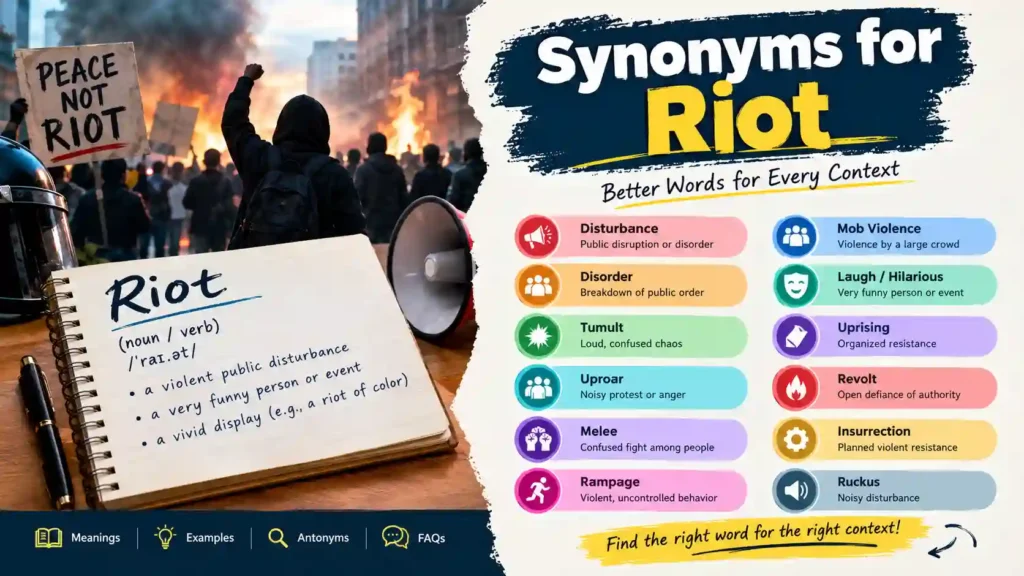

Synonyms for Riot (noun, verb) (/ˈraɪ.ət/) means a violent or uncontrolled public disturbance involving a crowd. It can also mean something very funny in informal English, or a vivid and abundant display, as in “a riot of color.”
The best synonym depends on the sense. For public violence, use disturbance, disorder, tumult, melee, or mob violence. And for uncontrolled action, use rampage or run amok. For the informal sense, use laugh, joke, hilarious person, or comic.
Best other word for Riot
The best synonyms for riot are disturbance, disorder, tumult, uproar, melee, brawl, mob violence, and rampage, depending on context.
Riot is also used informally to describe a very funny person or event, as in “She is a riot.” In this sense, laugh, joke, comic, or hilarious person may fit better.
Riot Synonym Master Table
| Synonym | Specific Meaning | Synonym | Specific Meaning |
| Disturbance | Public disruption or disorder | Disorder | Lack of public order |
| Tumult | Loud, confused public disorder | Uproar | Noisy confusion or protest |
| Melee | Confused fight among people | Brawl | Rough physical fight |
| Mob violence | Violence by a crowd | Rampage | Violent uncontrolled action |
| Commotion | Noisy confusion or disturbance | Fray | A physical fight or clash |
| Outbreak | Sudden eruption of disorder | Ruckus | Informal noisy disturbance |
| Run amok | Act wildly without control | Run riot | Become wildly uncontrolled |
| Uprising | Organized resistance against authority | Revolt | Open resistance to rule |
| Insurrection | Organized violent resistance | Row | British informal noisy dispute |
| Laugh | Something very funny | Joke | Person or thing that amuses |
Note: These words are not interchangeable in every sentence. Disturbance, disorder, tumult, and uproar are broad alternatives. Melee and brawl imply fighting. Uprising, revolt, and insurrection suggest organized resistance and therefore should not replace riot automatically.
Where Riot Comes From
Parts of Speech: Noun, verb
Syllables: 2 — ri-ot
Origin: Riot entered Middle English from Old French riote, related to rioter, meaning “to quarrel.” Its early English sense involved disorderly or dissolute behavior before developing the modern sense of public disturbance.
Prefix/Suffix Breakdown: Riot does not have a productive modern English prefix and suffix. It comes into English as a historical borrowing from French.
Direct and Contextual Synonyms for Riot
The following words are useful when you need another word for riot, but their meanings must match the context.
1. Disturbance (/dɪˈstɜːr.bəns/)
Meaning: A disruption of public peace or order.
Examples:
- Police moved in after the disturbance spread across the square.
- The match ended after a serious disturbance in the stands.
Synonym status: Close synonym.
2. Disorder (/dɪˈsɔːr.dər/)
Meaning: A state in which normal public order breaks down.
Examples:
- The crowd created widespread disorder outside the stadium.
- Officers arrived to restore order after the disorder began.
Synonym status: Close synonym.
3. Tumult (/ˈtuː.mʌlt/)
Meaning: Loud, confused, and disorderly activity.
Examples:
- The announcement was followed by tumult in the crowd.
- Workers gathered amid growing tumult.
Synonym status: Close synonym.
4. Uproar (/ˈʌp.rɔːr/)
Meaning: A loud and angry public reaction.
Examples:
- The decision caused an uproar among local residents.
- An uproar broke out outside the building.
Synonym status: Contextual synonym.
5. Melee (/ˈmeɪ.leɪ/)
Meaning: A confused fight involving several people.
Examples:
- A melee broke out after the final whistle.
- Police struggled to separate people in the melee.
Synonym status: Contextual synonym; it focuses on fighting.
6. Brawl (/brɔːl/)
Meaning: A rough and uncontrolled physical fight.
Examples:
- A brawl broke out near the entrance.
- Security guards stopped the brawl before it spread.
Synonym status: Contextual synonym; a brawl is not necessarily a public riot.
7. Mob Violence (/mɑːb ˈvaɪələns/)
Meaning: Violence committed by a large crowd.
Examples:
- The report described the event as mob violence.
- Authorities worked to prevent further mob violence.
Synonym status: Strong contextual alternative.
8. Rampage (/ræmˈpeɪdʒ/)
Meaning: Violent or destructive uncontrolled behavior.
Examples:
- The crowd went on a rampage through the area.
- The group caused damage during its rampage.
Synonym status: Contextual synonym.
Collins specifically gives rampage, take to the streets, run riot, and run amok as alternatives for the verb riot.
9. Ruckus (/ˈrʌk.əs/)
Meaning: A noisy disturbance or commotion.
Examples:
- The protest turned into a ruckus outside the hall.
- Police arrived after a ruckus started in the street.
Synonym status: Informal near-synonym.
10. Fray (/freɪ/)
Meaning: A fight or physical confrontation.
Examples:
- Several people became involved in the fray.
- Officers moved toward the center of the fray.
Synonym status: Contextual alternative.
11. Outbreak (/ˈaʊt.breɪk/)
Meaning: A sudden beginning of violent disorder.
Examples:
- An outbreak of violence followed the announcement.
- Police contained the outbreak before it spread.
Synonym status: Contextual alternative.
12. Uprising (/ˈʌp.raɪ.zɪŋ/)
Meaning: Organized resistance against authority.
Examples:
- The event became an uprising against the ruling government.
- The uprising spread to nearby towns.
Synonym status: Related term, not an exact synonym.
13. Revolt (/rɪˈvəʊlt/)
Meaning: Open resistance against an authority or government.
Examples:
- The soldiers joined the revolt.
- The revolt challenged the ruling regime.
Synonym status: Related term, not an exact synonym.
14. Insurrection (/ˌɪn.səˈrek.ʃən/)
Meaning: An organized attempt to resist or overthrow authority.
Examples:
- The government called the event an insurrection.
- The insurrection was suppressed by security forces.
Synonym status: Related political term, not a general replacement for riot.
Riot Synonyms in English by Context
Different contexts call for different words.
Public Riot
Use:
- disturbance
- disorder
- tumult
- uproar
- mob violence
- melee
- rampage
Political or Social Riot
Use carefully:
- uprising
- revolt
- insurrection
- civil disorder
- street violence
These terms carry different implications. A protest is not automatically a riot. A riot normally involves violent or uncontrolled public behavior, while a protest can be peaceful. Cambridge defines a riot as noisy, violent, and uncontrolled public behavior, often linked to protest.
Informal “Riot” Meaning Funny
In older informal usage, a riot can mean a very funny or entertaining person or event.
Useful alternatives include:
- laugh
- joke
- comic
- hilarious person
- very funny person
- side-splitter
Example:
“She is a riot” means “She is very funny.”
Cambridge and Oxford both record this informal sense.
Riot Slang Synonyms
Riot itself has an informal sense meaning something or someone very funny. The phrase “a riot” can therefore mean “very funny” in casual English.
Possible informal alternatives include:
- a laugh — a funny person or thing.
- a joke — someone or something amusing.
- a hoot — a very amusing person or thing.
- a scream — an extremely funny person or thing.
- a riot — a very funny person or event.
Example:
“Your brother is a riot” means “Your brother is very funny.”
Do not use these informal words to describe actual public violence.
Laugh Riot Synonyms
Laugh riot means something extremely funny or highly entertaining.
Useful alternatives are:
- hilarious
- side-splitting
- uproarious
- hysterical
- comic
- a real laugh
- a hoot
- a scream
Examples:
- The movie was a laugh riot.
- The comedian’s new show was hilarious.
- Her stories were side-splitting.
Riot in a Sentence
Here are clear examples for different meanings.
- Public disorder: “Police arrived after a riot broke out downtown.”
- Verb: “Several groups rioted after the match.”
- Funny: “His stories were a riot.”
- Vivid display: “The garden was a riot of color.”
- Uncontrolled action: “The children were allowed to run riot.”
- Political context: “The authorities declared a state of emergency after the riots.”
The word has several distinct senses, so the surrounding words matter.
Run Riot Meaning and Synonyms
Run riot means to behave in an uncontrolled way. It can describe people, emotions, imagination, plants, or other things that grow or spread without control.
Run Riot Synonyms
Depending on context:
- run amok
- rampage
- go wild
- get out of control
- run loose
- spread unchecked
Examples:
- “The children ran riot in the garden.”
- “Her imagination ran riot.”
- “The weeds ran riot after the rain.”
Do not use run riot as a direct replacement for every occurrence of riot.
Synonyms for “Spark a Riot”
If spark a riot means “cause a riot to begin,” useful alternatives include:
- trigger a riot
- cause a riot
- provoke a riot
- set off a riot
- ignite a riot
- fuel a riot
- lead to a riot
Example:
“The controversial decision sparked a riot.”
Here, spark describes the cause. It is not itself a synonym for riot.
Synonyms for “Start a Riot”
Use:
- trigger a riot
- cause a riot
- provoke a riot
- incite a riot
- set off a riot
- ignite a riot
Incite is stronger than cause. It suggests deliberately encouraging people to engage in violent or unlawful action.
Synonyms for “Raise a Riot”
Raise a riot is an older or less common expression meaning to create a disturbance.
Modern alternatives include:
- cause a disturbance
- create an uproar
- start a riot
- cause a commotion
- stir up trouble
For modern writing, cause a disturbance or create an uproar will usually sound more natural.
Race Riot: What Does It Mean?
Race riot is a specific historical and social term for violent conflict involving racial groups or violence directed at people because of race.
It should not be replaced casually with protest, uprising, or rebellion, because those words can change the historical meaning.
Cambridge uses race riot as an example of the noun riot, while historical sources use the term for specific events such as the Chicago race riot of 1919.
Haymarket Riot: Synonym or Related Term?
Haymarket Riot is the established historical name for the 1886 Haymarket event in Chicago. It is a proper historical name, not a synonym for riot.
Depending on the historical source and context, writers may discuss the event as the Haymarket affair or Haymarket incident, but these are historical labels, not general synonyms for riot.
Riot Part of Speech
Riot can function as both a noun and a verb.
As a Noun
It names a violent public disturbance.
Example:
“A riot broke out after the match.”
As a Verb
It means to take part in a riot.
Example:
“Protesters rioted in the streets.”
Cambridge and Collins both list riot as a noun and verb.
Riot Word Family
- riot — noun/verb
- rioter — person who riots
- rioting — the act or process of rioting
- riotous — disorderly, wild, or exuberant
- riotously — in a riotous manner
Riot Pronunciation
The Word Riot is pronounced as:
/ˈraɪ.ət/
It sounds roughly like “RY-uht.”
The pronunciation is essentially the same in British and American English, although dictionary phonetic systems may vary slightly.
What Is Riot Short For?
Riot is not normally short for another English word.
It is a complete English word with its own historical origin. It came through Middle English from Old French riote.
If someone writes RIOT in capital letters, they may be using it as an acronym or name in a specific context. That is separate from the ordinary English word riot.
What Words Contain “Riot”?
Common words and expressions containing riot include:
- rioter
- rioting
- riotous
- riotously
- riot act
- riot police
- riot gear
- riot squad
- race riot
- riot control
- run riot
- riot of color
- laugh riot
Cambridge lists compounds and expressions such as riot gear, riot police, riot squad, race riot, run riot, and Riot Act.
Riot Symbols
There is no universal linguistic symbol for “riot.”
In visual communication, symbols such as ⚠️ or 🚨 may represent danger, emergency, or public disorder, but they are not official symbols meaning riot.
The exact symbols used around a riot depend on the event, group, culture, or historical setting. Research on riot events shows that flags, banners, clothing, and other symbols can carry specific political or group meanings.
Common Traps & Nuance Distinctions
Riot vs. Protest
A protest is an expression of opposition or a demand for change. A riot involves violent or uncontrolled public behavior.
Example:
“The group held a peaceful protest.”
“The protest later turned into a riot.”
Do not call every protest a riot.
Riot vs. Uprising
A riot is usually a period of public disorder. An uprising suggests organized resistance against authority.
Example:
“A riot broke out after the decision.”
“The uprising challenged the government.”
Riot vs. Revolt
A revolt involves resistance against authority or control. It often has a political or military meaning.
Example:
“The crowd rioted after the announcement.”
“The soldiers joined the revolt.”
Riot vs. Insurrection
An insurrection is a more formal term for organized resistance against established authority.
It is not a general synonym for every riot.
Riot vs. Rampage
A riot usually involves a crowd or group. A rampage focuses on violent or destructive uncontrolled behavior.
Example:
“A riot broke out downtown.”
“The group went on a rampage.”
Riot vs. Melee
A melee means a confused physical fight. It does not necessarily involve a large public disturbance.
Riot vs. Uproar
An uproar can be loud and angry without being violent.
This makes uproar broader and less severe than riot.
Riot vs. Commotion
A commotion means noisy confusion or disturbance. It does not require violence.
Riot vs. Anarchy
Anarchy means a lack of effective government or control. A riot is a specific event or episode of public disorder.
They are not interchangeable.
When NOT to Use Riot
Avoid using riot when the facts do not support the word.
- Do not use riot as a synonym for every protest.
- Do not use riot when the event was clearly peaceful.
- Do not use uprising if you only mean a brief disturbance.
- Do not use insurrection for a minor public argument.
- Do not use brawl when there was no physical fight.
- Do not use uproar if you specifically need to describe violence.
- Do not use rampage when there was no destructive or uncontrolled action.
- Do not use laugh riot for a violent event.
- Do not use riotous as a casual synonym for riot; it is an adjective with broader meanings.
The word riot can also be politically and socially loaded. Dictionary.com notes that calling a protest a “riot” can portray protesters as violent or lawless, so writers should choose the term that accurately describes the documented events.
Riot Synonym and Antonym
The best synonym depends on the sense.
- For public disorder: disturbance, disorder, tumult, uproar, melee, mob violence
- For violent uncontrolled action: rampage, run amok, run riot
- For the funny informal sense: laugh, joke, hoot, scream
- For a vivid display: display, show, splash
Collins explicitly lists disturbance, row, disorder, display, show, splash, laugh, joke, and scream across the different senses of riot.
Opposite Words: Antonyms for “Riot”
Because riot has several meanings, its antonyms also depend on context.
Direct Antonyms
- Peace — a state without violence or conflict.
The city returned to peace after the unrest. - Order — a state of organized and controlled behavior.
Police restored order in the area. - Calm — a quiet state without disturbance.
The streets remained calm overnight. - Tranquility — a peaceful and quiet condition.
The town regained its tranquility.
Operational & Contextual Opposites
- Composure — controlled and calm behavior.
She kept her composure during the crisis. - Harmony — peaceful agreement between people.
The groups worked together in harmony. - Stability — a steady state without sudden disruption.
The region needs political stability. - Cooperation — people working together peacefully.
The leaders chose cooperation over conflict.
These are conceptual opposites rather than perfect dictionary antonyms. No single word is an exact opposite of every sense of riot.
What Does “I Will Riot” Mean?
“I will riot” usually means “I will become extremely angry or protest strongly if this happens.”
Online, people may also use it humorously or dramatically. The exact meaning depends on context.
Example:
“If they cancel the final season, I will riot.”
Here, the speaker usually expresses strong frustration rather than making a literal statement about joining a violent public disturbance.
What Is “Riot” in Slang?
In informal English, a riot can mean a very funny or entertaining person or event.
Example:
“Your uncle is a riot.”
This means the uncle is very funny.
Cambridge labels this use old-fashioned informal, while Dictionary.com and Oxford also record the humorous sense.
What Is a Fancy Word for Riot?
There is no single “fancy” synonym that works in every context.
For formal writing:
- disturbance
- civil disorder
- tumult
- public disorder
- insurrection — only when accurate
- uprising — only when accurate
For literary writing:
- tumult
- uproar
- frenzy
- commotion
Use the most precise word rather than the most complicated word.
What Is Another Word for Riot?
The strongest general alternatives are:
- Disturbance
- Disorder
- Tumult
- Uproar
- Melee
- Brawl
- Mob violence
- Rampage
- Commotion
- Ruckus
For formal writing, disturbance or public disorder is often safer. If for a violent crowd, mob violence may be more precise. For uncontrolled destructive action, rampage may fit better.
French, Spanish, German, and Latin Words for Riot
If you need a translation rather than an English synonym:
- French: émeute
- Spanish: disturbio or motín, depending on context
- German: Aufruhr or Krawall, depending on context
- Latin: tumultus is a classical Latin word for tumult or disturbance
These are translations or historical equivalents, not English synonyms.
Cambridge’s translation data gives French émeute and Spanish disturbio, while Collins gives French émeute and Spanish disturbio/motín depending on sense.
Competitor Content Gap: What This Guide Adds
Many synonym pages simply list dozens of words without explaining when each one works. That creates a major accuracy problem.
This guide fills the main gaps by separating:
- Direct synonyms from loose related words.
- Public-disorder meanings from the informal “funny” meaning.
- Riot vs. protest.
- Riot vs. uprising.
- Riot vs. revolt.
- Riot vs. insurrection.
- Riot vs. rampage.
- Riot vs. brawl.
- Riot vs. melee.
- Laugh riot from violent riot.
- Run riot from the basic noun.
- Spark a riot from the noun riot itself.
- Race riot and Haymarket Riot as established historical terms.
- Riot word family and compounds.
- Antonyms by meaning.
- French, Spanish, German, and Latin equivalents.
This distinction follows the sense-based treatment used by major dictionaries rather than treating every thesaurus result as an exact synonym.
Frequently Asked Questions
What is another word for riot?
The best alternatives are disturbance, disorder, tumult, uproar, melee, mob violence, and rampage. Choose the word that matches the type and severity of the event.
What is a synonym for riot in English?
Common English alternatives include disturbance, disorder, tumult, uproar, melee, brawl, and mob violence. They differ in meaning, so they are not interchangeable in every sentence.
What is a synonym for riot slang?
For the informal meaning “very funny,” use laugh, joke, hoot, scream, or comic. “She is a riot” means “She is very funny.”
What are the antonyms of riot?
Useful opposites include peace, order, calm, tranquility, composure, harmony, stability, and cooperation. These are conceptual opposites rather than exact antonyms for every sense.
What does the word “riot” mean?
Most often, riot means a violent or uncontrolled public disturbance involving a crowd. It can also mean something very funny or a vivid display, such as “a riot of color.”
What type of word is “riot”?
Riot is both a noun and a verb. As a noun, it names a public disturbance. As a verb, it means to take part in a riot.
What does “run riot” mean?
Run riot means to behave or develop without control. It can describe people, emotions, imagination, plants, or other things that spread freely.
Is protest a synonym for riot?
No. A protest and a riot are not the same. A protest can be peaceful. A riot involves violent or uncontrolled public behavior. Calling a peaceful protest a riot can therefore change the meaning of a report.
What is “laugh riot” a synonym for?
Laugh riot means something extremely funny or entertaining. Suitable alternatives include hilarious, side-splitting, uproarious, hysterical, and very funny.
What is riot short for?
The ordinary word riot is not short for another English word. It is a complete word with a Middle English and Old French history.
What words contain the word riot?
Common examples include rioter, rioting, riotous, riotously, riot gear, riot police, riot squad, race riot, Riot Act, run riot, and riot of color.
Conclusion
The strongest synonyms for riot are disturbance, disorder, tumult, uproar, melee, brawl, mob violence, and rampage, but each carries a different level or type of disorder. For political or historical writing, use uprising, revolt, or insurrection only when the facts support those meanings. For informal English, a riot can mean something very funny, while run riot means to become uncontrolled. The safest SEO and real-world writing practice is to choose the synonym that describes the exact event rather than using a broader or more dramatic word simply for variation.