
Intervention means the act of stepping in to change what is happening, to stop a conflict, help someone, or improve a result, and academic and formal writing needs a precise match for the kind of stepping in you describe. The closest synonyms are mediation, interference, intercession, interposition, and involvement, each fitting a different kind of stepping in.
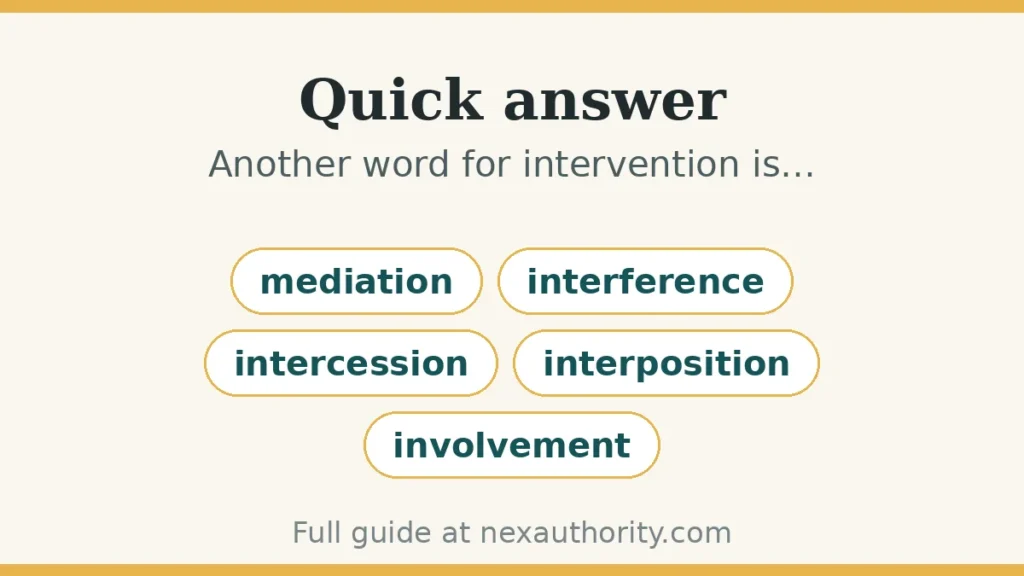
Choose mediation when a neutral third party helps two sides agree. Choose interference when the stepping in is unwanted. Choose intercession when someone pleads for another person.
- Mediation — neutral help settling a dispute
- Interference — stepping in that gets in the way
- Intercession — pleading for someone else
- Interposition — placing yourself between two sides
- Involvement — taking part to affect an outcome
- Arbitration — binding ruling by a neutral party
Synonyms for Intervention: Full Tiered Table
| Synonym | Tier | Meaning (3-6 words) | Best for |
|---|---|---|---|
| Mediation | Exact | Neutral help settling dispute | Disputes, talks, workplaces |
| Interference | Exact | Stepping in, unwanted | Conflicts, politics, sport |
| Intercession | Exact | Pleading for someone else | Formal, religious, legal |
| Interposition | Exact | Placing between two sides | Formal, legal, disputes |
| Involvement | Exact | Taking part to affect outcome | General, news, reports |
| Arbitration | Near | Binding ruling by outsider | Legal, business, labour |
| Intermediation | Near | Acting as go-between | Finance, trade, diplomacy |
| Intrusion | Near | Unwelcome entry into affairs | Politics, privacy, news |
| Stepping in | Near | Acting to stop trouble | Everyday, news, family |
| Engagement | Near | Taking part in events | Military, politics, business |
| Action | Near | Something done to help | General, reports, medicine |
| Treatment | Near | Care given to improve health | Medicine, therapy, trials |
| Interruption | Near | Breaking into an event | Conversations, events, sport |
| Conciliation | Near | Bringing sides back together | Diplomacy, labour, family |
| Negotiation | Near | Talks to reach agreement | Business, diplomacy, unions |
| Meddling | Related | Unwanted poking into affairs | Everyday, gossip, family |
| Remediation | Related | Corrective help for learners | Education, essays, policy |
| Interjection | Related | Remark thrown into talk | Speech, writing, grammar |
| Obtrusion | Related | Forcing oneself into situation | Formal, literary writing |
| Hindrance | Related | Something that holds back | General, reports, sport |
| Prevention | Related | Stopping something before it happens | Health, safety, policy |
| Rescue | Related | Saving someone from danger | Emergencies, news, stories |
| Support | Related | Help given to someone | Everyday, care, education |
| Assistance | Related | Aid given when needed | Formal, services, care |
| Diplomacy | Related | Managing relations between states | Politics, international news |
Intervention Word Card
- Part of speech: noun (countable)
- Pronunciation: UK /ˌɪn.təˈven.ʃən/, US /ˌɪn.t̬ɚˈven.ʃən/
- Word forms: intervention (noun), interventions (plural); verb: intervene, intervened
- Register: neutral; formal in law, medicine, politics
Top 10 Synonyms for Intervention in Detail
Mediation
Mediation means a neutral third party steps in to help two sides settle a dispute. It is the softest exact synonym, since nobody is forced. “The mediation between the workers and the firm took three days.” Use it when both sides want a deal. Avoid it when one side overrules the other, since that is not a shared agreement.
Interference
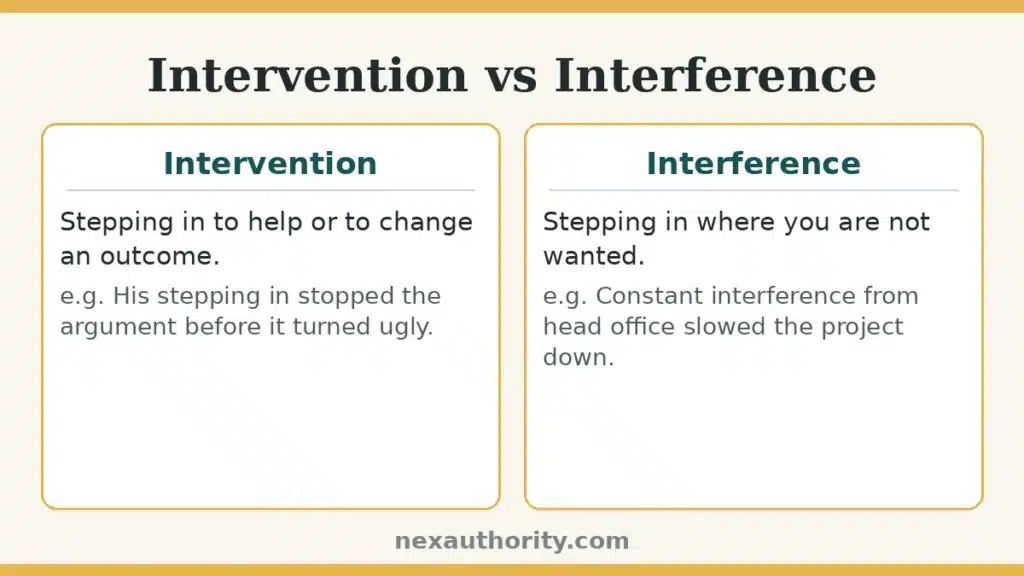
Interference means stepping in where you are not wanted, or getting in the way. It carries a negative tone that intervention does not always have. “Constant interference from head office slowed the project down.” Use it when the stepping in causes harm. Avoid it when the help is welcome, since then mediation or involvement fits better.
Intercession
Intercession means pleading or speaking up on behalf of someone else, often to a person in power. It is formal and a little old-fashioned, and also names prayer for another person. “The priest’s intercession saved the man from prison.” Use it when someone asks for mercy for another. Avoid it for a hands-on rescue, where intervention is plainer.
Interposition
Interposition means placing yourself, or one thing, between two sides or two events. It is the most formal exact synonym and turns up mostly in law and formal writing. “The court’s interposition ended the strike.” Use it when the act is about standing between people or facts. Avoid it in everyday speech, where stepping in sounds more natural.
Involvement
Involvement means taking part in a situation in order to affect what happens. It is the broadest exact synonym and works in any setting. “Her involvement in the talks brought both sides back to the table.” Use it when you want a neutral word for taking part. Avoid it when the stepping in is forceful, since interference says more.
Arbitration
Arbitration means a neutral third party hears both sides and makes a binding decision. It is stronger than mediation, since the ruling must be obeyed. “The dispute went to arbitration after talks broke down.” Use it for legal, business, and labour disputes. Avoid it for casual talks, where mediation is the right word.
Intermediation
Intermediation means acting as a go-between so that two parties can deal with each other. It is common in finance, trade, and diplomacy, where a middleman smooths the way. “The bank’s intermediation made the loan possible.” Use it when the role is linking two sides, not settling a fight. Avoid it for a rescue or conflict, where intervention fits better.
Intrusion
Intrusion means an unwelcome entry into someone else’s affairs, often sudden and forceful. It stresses the stepping in was not invited. “The intrusion of foreign troops angered the whole region.” Use it when the action crosses a line. Avoid it when the help was asked for, since then the word sounds unfair.
Stepping in
Stepping in is the plain phrase for stopping trouble or helping out. It is friendly and direct, and it works in speech and news reports alike. “His stepping in stopped the argument before it turned ugly.” Use it when you want a simple, human phrase. Avoid it in formal legal or academic writing, where intervention reads better.
Engagement
Engagement means taking part in an event or a conflict, often as an official act. In military and political writing it names an armed clash or formal commitment. “The army’s engagement in the region lasted six months.” Use it when the involvement is planned. Avoid it for a casual helping hand, where involvement is simpler.
Best Word by Situation
| Situation | Best pick | Why |
|---|---|---|
| Academic essay | Mediation | Neutral term for settling disputes |
| Formal report | Interposition | Precise, formal register; common in law |
| Research paper | Treatment | Standard term for the treatment tested in a study |
| Business email | Negotiation | Clear, standard in deals and talks |
| Everyday conversation | Stepping in | Plain, warm, instantly understood |
All Meanings of Intervention
Intervention as stepping in to stop a conflict
An intervention is stepping in to stop a fight or crisis before it gets worse. “The teacher’s intervention ended the playground fight.” It carries a sense of urgency, since waiting would cost more.
Intervention as mediation between two sides
Intervention can also mean a neutral party helping two sides reach a deal. “The intervention of mediators brought the talks back to life.” Here the tone is calmer, and the focus is guiding people toward agreement.
Intervention as medical treatment
In medicine, an intervention is a treatment, procedure, or action to prevent or treat a disease or improve health. “The drug trial tested a new intervention for high blood pressure.” Doctors use the word for anything from a pill to a surgery.
Intervention as government action abroad
In politics, intervention means one country acting in another’s affairs, often with peacekeepers or sanctions. “The two countries will not accept outside intervention.”
Intervention as a family meeting to help someone
Since the 1980s, an intervention has also meant a meeting where family and friends confront someone about a harmful habit, such as drinking. “His family staged an intervention after his drinking got worse.”
Common Collocations for Intervention
Five natural combinations:
- state intervention — “State intervention saved the banks.”
- military intervention — “The military intervention ended after six months.”
- medical intervention — “Early medical intervention gave her the best chance.”
- early intervention — “Early intervention stops small problems growing.”
- humanitarian intervention — “The humanitarian intervention delivered food and medicine.”
Words People Confuse With Intervention
Interference
Interference is stepping in that gets in the way, while intervention can help. Interference: “His interference ruined the deal.” Intervention: “Her intervention saved the deal.”
Prevention
Prevention means stopping something before it happens, while intervention happens once the problem is under way. Prevention: “Vaccines are the best prevention.” Intervention: “Doctors acted fast once the fever started.”
Treatment
Treatment is the care given to a sick person, while intervention is any action that changes an outcome, medical or not. Treatment: “She finished treatment in June.” Intervention: “The charity’s intervention fed a thousand families.”
When NOT to Use Intervention
Four common mistakes, each with a wrong and corrected example.
- Calling ordinary help an intervention. Wrong: “Thanks for your intervention with my shopping.” Corrected: “Thanks for your help with my shopping.”
- Using intervention for a routine check-up. Wrong: “He went to the clinic for an intervention.” Corrected: “He went to the clinic for a check-up.”
- Using intervention for a planned event. Wrong: “The intervention of the wedding went smoothly.” Corrected: “The wedding went smoothly.”
- Using intervention when you mean prevention. Wrong: “Brushing your teeth is the best intervention against decay.” Corrected: “Brushing your teeth is the best prevention against decay.”
Antonyms of Intervention by Context
These name staying out or doing nothing.
| Antonym | Type | Context |
|---|---|---|
| Nonintervention | Direct | Refusing to get involved |
| Noninterference | Direct | Staying out of others’ affairs |
| Inaction | Direct | Doing nothing at all |
| Neglect | Contextual | Failing to act when help is needed |
| Withdrawal | Contextual | Pulling out of a situation |
| Passivity | Contextual | Accepting events without acting |
| Detachment | Contextual | Keeping a cool distance |
Origin of the Word Intervention
Intervention entered English in the early 1400s as intervencioun, meaning “intercession, intercessory prayer”. It comes from Late Latin interventionem, “an interposing”, from Latin intervenire, “to come between”, from inter, “between”, and venire, “to come”. The family-meeting sense dates to 1983.
Frequently Asked Questions
What is another word for intervention in academic writing?
Mediation is the closest friendly word for intervention in academic writing when a neutral party helps settle a dispute; intercession fits when someone pleads for another person. Arbitration suits a binding ruling by an outsider, while involvement is the broadest neutral swap. Facilitation fits when someone guides a discussion.
What does intervention mean?
Intervention means the act of stepping in to change what is happening, to stop a conflict, help someone, or improve a result. In medicine it names a treatment or procedure, and in politics it means one country acting in another’s affairs.
What is the difference between intervention and interference?
Intervention is the neutral word for stepping in and can help, while interference always means stepping in where you are not wanted or getting in the way. A teacher’s intervention stops a fight, but constant interference slows a team down.
What are the antonyms of intervention?
The main antonyms are nonintervention and noninterference: intervention means getting involved, and these words mean staying out. Inaction fits when nothing is done, while neglect fits when help was needed but never came. Withdrawal works when someone pulls out entirely.
How do you use intervention in a sentence?
Use intervention when someone steps in to change an outcome, with the setting clear from the words around it. Two examples: “The government’s intervention saved thousands of jobs.” And: “Early intervention gave the child the support she needed at school.”
What does intervention mean in a research paper?
In a research paper, an intervention is the treatment or program the researchers test, such as a new drug, teaching method, or policy. The intervention group receives it, while the control group does not, so the study can measure the effect. In education, a remediation program is a common kind of intervention.
Conclusion
Mediation is the best synonym for intervention in academic writing when a neutral party helps settle a dispute. Involvement is the broadest neutral swap, and interference fits when the stepping in is unwanted. For the full dictionary definition, see intervention at the Cambridge Dictionary.