
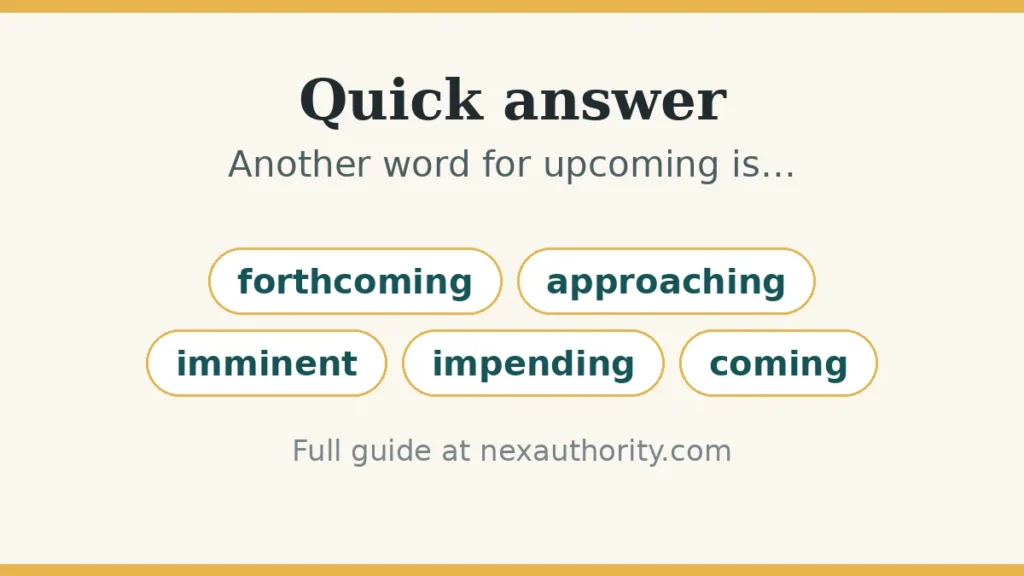
Upcoming means happening or appearing soon, in the near future, and in formal writing and announcements the word you choose sets the tone: forthcoming sounds official, scheduled sounds certain, and imminent sounds urgent. The closest synonyms are forthcoming, approaching, imminent, impending, and coming, each with a slightly different shade of nearness.
Choose forthcoming for an event set to appear or be released. Choose approaching for something drawing nearer in time. Choose imminent for something about to happen any moment now.
- Forthcoming — set to appear or be released soon
- Approaching — drawing nearer in time
- Imminent — about to happen any moment now
- Impending — hanging over the near future
- Coming — on its way, due to arrive
- Nearing — getting close, almost here
- Next — the one that follows right now
Synonyms for Upcoming: Full Tiered Table
| Synonym | Tier | Meaning (3-6 words) | Best for |
|---|---|---|---|
| Forthcoming | Exact | Set to appear soon | Events, books, releases |
| Approaching | Exact | Drawing nearer in time | Dates, seasons, deadlines |
| Imminent | Exact | About to happen now | Danger, change, arrival |
| Impending | Exact | Hanging over near future | Trouble, decisions, doom |
| Coming | Exact | On its way, due | Events, people, seasons |
| Nearing | Near | Getting close, almost here | Deadlines, holidays, ends |
| Next | Near | Follows right after now | Meetings, issues, steps |
| Oncoming | Near | Moving toward you | Traffic, storms, crowds |
| Pending | Near | Awaiting decision or outcome | Cases, results, approval |
| Scheduled | Near | Fixed for a set time | Meetings, launches, exams |
| Anticipated | Near | Looked forward to eagerly | Releases, visits, results |
| Expected | Near | Thought likely to happen | Arrivals, reports, babies |
| Future | Near | Belonging to time ahead | Plans, generations, tense |
| Looming | Near | Large, threatening, near | Deadlines, storms, elections |
| At hand | Near | Very close in time | Exams, deadlines, change |
| Prospective | Related | Likely to happen, possible | Buyers, students, brides |
| Eventual | Related | Happening in the end | Outcomes, winners, results |
| Subsequent | Related | Coming after, following on | Events, chapters, stages |
| Later | Related | At a time after now | Dates, meetings, calls |
| En route | Related | On the way here | Deliveries, guests, trains |
| In store | Related | Waiting in the future | Surprises, treats, change |
| On the horizon | Related | Coming into view soon | Trends, elections, storms |
| Around the corner | Related | Very soon, almost here | Holidays, birthdays, deadlines |
| Coming up | Related | Due to happen shortly | Events, topics, birthdays |
| To come | Related | Yet to happen or arrive | Weeks, attractions, news |
Upcoming Word Card
- Part of speech: adjective
- Pronunciation: UK /ˈʌpˌkʌm.ɪŋ/, US /ˈʌpˌkʌm.ɪŋ/
- Word forms: upcoming (adjective); no verb form
- Register: neutral; mainly US English — British English usually says forthcoming
Top 10 Synonyms for Upcoming in Detail
Forthcoming
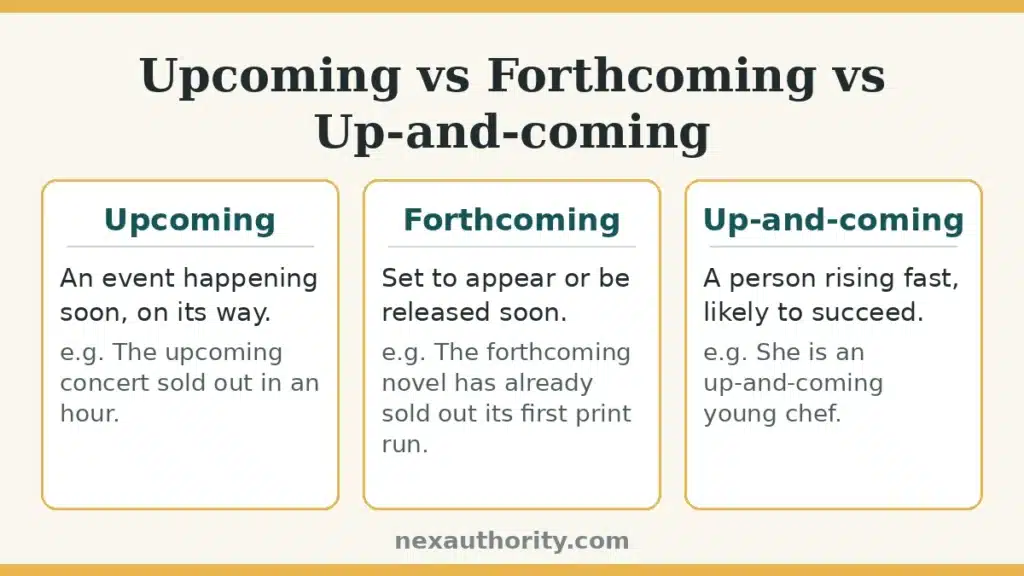
Forthcoming means set to appear or be released soon, such as a book, a report, or a film. “The forthcoming novel has already sold out its first print run.” It is the standard British swap for upcoming, and it sounds a touch more formal. Use it for things due to be made public.
Approaching
Approaching means drawing nearer in time, step by slow step, like a date on the calendar. “With the approaching holiday, the town filled with visitors.” Use it when the nearness is steady and easy to see coming, week by week. Avoid it for a sudden event, where imminent fits better.
Imminent
Imminent means about to happen any moment now, with no real wait left. “The imminent storm sent everyone running for cover.” It carries urgency, and it often warns of trouble. Use it when the wait is nearly over. Avoid it for a date weeks away, where forthcoming or scheduled is more honest.
Impending
Impending means hanging over the near future, often a threat. “The impending cut to funding worried every department head.” In the offing is Collins’s phrase for a change close at hand. It sounds grave, and suits bad news. Use it when something looms and cannot be dodged. Avoid it for happy events, where anticipated or forthcoming sounds warmer.
Coming
Coming means on its way, due to arrive or happen, and it is the plainest swap on this list. “The coming winter will be cold, the farmers say.” Use it when you want the simplest word that does the job. Avoid it when you need to say how soon, where imminent or next is sharper.
Nearing
Nearing means getting close, almost here, with the end at last in sight. “The project is nearing completion after two years of work.” Use it for a long job or journey that is nearly done. Avoid it for a fixed date on the calendar, where scheduled or next fits better.
Next
Next means the one that follows right after now, the nearest in a line. “We will discuss it at the next meeting.” It is short, plain, and exact about order. Use it when the sequence matters more than the wait. Avoid it when nothing has been lined up yet, where future is truer.
Oncoming
Oncoming means moving toward you, coming at you from ahead. “The oncoming traffic on the road slowed to a crawl in the rain.” Use it for things that approach in space as well as time. Avoid it for a date or a meeting, where upcoming or scheduled is the natural word.
Pending
Pending means awaiting a decision or an outcome, not yet settled. “The court case is still pending after eleven months.” Business writing calls work still being prepared in the pipeline. Use it when the wait is about a verdict or an answer. Avoid it for a fixed event, where scheduled or forthcoming fits better.
Scheduled
Scheduled means fixed for a set time, set in a diary or plan. “The scheduled launch is set for Tuesday at noon.” Formal notices often call it slated, as in “slated for release next month.” Use it when the date and hour are known and set. Avoid it for something hoped for, where expected or anticipated is more honest.
Best Word by Situation
| Situation | Best pick | Why |
|---|---|---|
| Formal announcement | Forthcoming | Precise, formal register; standard in reports |
| Press release | Scheduled | Clear when the date and hour are set |
| Official notice | Imminent | Neutral term for change close at hand |
| Business email | Anticipated | Warm and clear for releases people await |
| Product launch | Anticipated | Warm and clear for a launch people await; “anticipated debut” fits too |
| Book or film release | Forthcoming | Formal and precise; “slated for release” also fits |
| Formal email or invite | Forthcoming | Polished and precise; “forthcoming webinar” is the classic example |
| Everyday conversation | Next | Widely understood, warm, one word |
All Meanings of Upcoming
Upcoming as an event happening soon
Upcoming means an event that will happen in the near future. “The upcoming wedding has kept the whole family busy for weeks.” The word points at the calendar: the thing is set, the date is near, and people are getting ready.
Upcoming as something about to appear or be released
Upcoming also means something that is about to appear or go public, such as a book, an album, or a film. “Fans are already queuing for the upcoming album.” Here the word points at a release, not a meeting. It is the music and publishing sense.
Upcoming as a date fixed on the calendar
Upcoming can mean a date that is already set, such as an election, a holiday, or an exam. “The upcoming election will decide the town’s next mayor.” Here it labels the diary: the event exists, the day is known, the countdown has begun.
Upcoming as a season or a stretch of time ahead
Upcoming also works for a season or a stretch ahead, such as the upcoming months or year. “More rain is expected in the upcoming weeks.” It covers a period, not a single day.
Common Collocations for Upcoming
Seven natural combinations:
- upcoming election — “The upcoming election will be held in November.”
- upcoming holiday — “We booked a cottage for the upcoming holiday.”
- upcoming event — “The upcoming event starts at noon.”
- upcoming conference — “The upcoming conference opens on Monday.”
- upcoming deadline — “The upcoming deadline falls on Friday.”
- upcoming release — “The upcoming release has fans counting the days.”
- in the upcoming weeks — “More details will follow in the upcoming weeks.”
Words People Confuse With Upcoming
Forthcoming
Forthcoming is the usual British word for upcoming, but it also means open and frank about feelings, which upcoming never does. Forthcoming: “She was not very forthcoming about her plans.” Upcoming: “The upcoming fair opens on Saturday.”
Up-and-coming
Up-and-coming means a young person or business rising fast and likely to succeed, while upcoming means an event happening soon. Up-and-coming: “She is an up-and-coming young chef.” Upcoming: “The upcoming food festival starts on Friday.”
Incoming
Incoming means arriving toward you, or taking up a new job or office, while upcoming means happening soon. Incoming: “The incoming mayor takes office in January.” Upcoming: “The upcoming ceremony marks the handover.”
When NOT to Use Upcoming
Four common mistakes, each with a wrong example and a corrected one.
- Calling a person upcoming — say up-and-coming, or soon-to-be for a new role. Wrong: “He is an upcoming young singer.” Corrected: “He is an up-and-coming young singer.”
- Using upcoming for something years away. Wrong: “The upcoming Olympics in ten years will be huge.” Corrected: “The Olympics in ten years will be huge.”
- Using upcoming for the past. Wrong: “The upcoming meeting yesterday went well.” Corrected: “Yesterday’s meeting went well.”
- Using upcoming when you mean incoming. Wrong: “Please welcome our upcoming manager.” Corrected: “Please welcome our incoming manager.”
Antonyms of Upcoming by Context
These name what has passed, or what is finished.
| Antonym | Type | Context |
|---|---|---|
| Past | Direct | Already happened, gone by |
| Previous | Direct | The one before this |
| Concluded | Direct | Finished, brought to an end |
| Over | Contextual | Done, no longer happening |
| Finished | Contextual | Completed, at an end |
| Former | Contextual | Earlier, no longer current |
| Gone | Contextual | Passed, no longer here |
| Departed | Contextual | Left, moved on |
Origin of the Word Upcoming
Upcoming joined up and coming, from the phrase coming up. Merriam-Webster dates its first known use to 1943. It is mainly American English; British English usually says forthcoming. The word is still young, so it sounds fresh.
Frequently Asked Questions
What is another word for upcoming in a formal announcement?
Forthcoming is the closest word for upcoming in a formal announcement, and the usual British choice. Scheduled fits a fixed date, anticipated fits an awaited release, and slated suits a formal notice. Coming is the plainest swap, and next fits when order matters most.
What does upcoming mean?
Upcoming means happening or appearing soon, in the near future. It describes events, dates, and releases that are set and close at hand, such as an election or a holiday. It is an adjective, mainly American English, and it never describes a person.
What is the difference between upcoming and forthcoming?
The two words are near-synonyms for something happening soon, but forthcoming is the usual British choice and upcoming the usual American one. Forthcoming also means open and frank about feelings, which upcoming never does. For a promised report or release, either word works; for an honest person, only forthcoming fits.
What is the difference between upcoming and up-and-coming?
Upcoming means an event happening soon, such as a festival or an exam, while up-and-coming means a young person or business rising fast and likely to succeed. The two look alike but point at different things: events for upcoming, people for up-and-coming. Never call a rising singer upcoming.
What are the antonyms of upcoming?
The main upcoming antonyms are past and previous, since upcoming points at the near future. Concluded fits when an event is finished, and over and finished fit when something is done. Former fits an earlier version, and gone and departed fit what has already passed.
How do you use upcoming in a sentence?
Use upcoming before a noun for an event, a date, or a release that is set and close at hand. Examples: “The upcoming concert sold out in an hour.” And: “We are saving for the upcoming holiday.” Keep it for the near future, and never use it for a person.
Conclusion
Forthcoming is the best overall synonym for upcoming in formal announcements, and it is the usual British choice. Approaching fits a date drawing nearer, and imminent fits something about to happen any moment now. For the full dictionary definition, see upcoming at the Cambridge Dictionary.