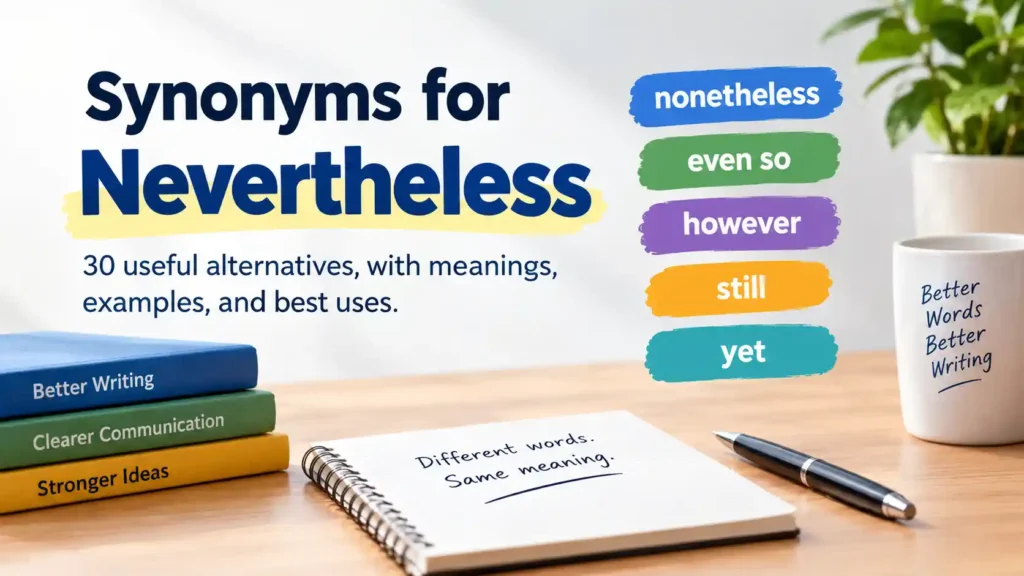

Synonyms for nevertheless mean despite something already mentioned or understood. The five best synonyms are nonetheless, even so, however, still, and yet. These words connect contrasting ideas while showing that the second statement remains true despite the first statement.
Choose nonetheless for a close, formal alternative, even so for a conversational contrast, and however for a clear transition between contrasting points.
- Nonetheless: Despite what was mentioned.
- Even so: Despite that particular fact.
- However: Introduces a contrasting statement.
- Still: Shows that something remains true.
- Yet: Connects ideas that contrast.
- In spite of that: Despite the situation.
- All the same: Despite the circumstances.
Synonyms for Nevertheless: Complete Comparison Table
The following table distinguishes close synonyms from alternatives that work only in certain contexts.
| Synonym | Meaning | Best for |
| Nonetheless | Despite what was mentioned | Formal and academic writing |
| Even so | Despite that fact | Everyday conversation |
| However | Introduces a contrasting point | Essays and reports |
| Still | Despite the circumstances | General writing |
| Yet | Despite an opposing fact | Short, direct sentences |
| In spite of that | Despite the preceding situation | Clear explanations |
| All the same | Despite everything mentioned | Conversational writing |
| Notwithstanding | Despite a stated condition | Formal and legal writing |
| Regardless | Without being affected by something | Decisions and outcomes |
| Despite this | In spite of this fact | Reports and explanations |
| For all that | Despite what has been said | Emphatic statements |
| Even then | Despite that point or time | Conditional contexts |
| Anyway | In any case, despite objections | Informal conversation |
| Anyhow | In any case | Casual communication |
| Though | Despite a contrasting fact | Conversational writing |
| Although | Despite the fact that | Subordinate clauses |
| Albeit | Although or even though | Formal writing |
| But | Introduces an opposing idea | Simple sentences |
| Even though | Despite a stated fact | Emphasizing contrast |
| Despite that | In spite of that fact | Direct explanations |
| In any event | Whatever happens or is considered | Decisions and conclusions |
| At any rate | Whatever the circumstances | Informal conclusions |
| On the other hand | Presents an alternative perspective | Comparing viewpoints |
| In contrast | Highlights a difference | Comparisons |
| Conversely | Introduces an opposing relationship | Analytical writing |
| Whereas | Connects contrasting facts | Comparisons |
| While | Connects contrasting ideas | Complex sentences |
| Instead | Indicates an alternative choice | Choices and actions |
| Otherwise | Indicates a different outcome | Conditions and warnings |
| All things considered | Considers the overall situation | Conclusions |
What Does Nevertheless Mean?
Nevertheless is an adverb that introduces a statement that remains true despite a previous fact, difficulty, or objection.
Example: The road was flooded. Nevertheless, the rescue team reached the village.
The flooding created an obstacle, but the second sentence shows that the team reached its destination despite that obstacle.
Word Card
| Feature | Details |
| Word | Nevertheless |
| Part of speech | Adverb |
| US pronunciation | /ˌnev.ɚ.ðəˈles/ |
| UK pronunciation | /ˌnev.ə.ðəˈles/ |
| Primary meaning | Despite that; in spite of that |
| Common synonyms | Nonetheless, even so, however |
| Writing style | Neutral to formal |
| Spelling | Nevertheless |
| Related expression | None the less, a less common variant |
What Are the 30 Best Alternatives to Nevertheless?
The following alternatives help you express contrast without repeating the same word. Choose each expression according to its meaning, tone, and grammatical structure.
1. Nonetheless
Meaning: Despite what has already been said.
Tone: Formal and neutral.
Example: The task was difficult. Nonetheless, she completed it on time.
Use nonetheless when you want a close substitute that preserves the meaning of nevertheless.
2. Even So
Meaning: Despite that fact or situation.
Tone: Natural and conversational.
Example: The hotel was expensive. Even so, we enjoyed our stay.
Use even so when you want to connect two contrasting ideas in everyday writing.
3. However
Meaning: Introduces a contrasting statement.
Tone: Neutral and professional.
Example: The proposal was creative. However, it exceeded our budget.
Use however to introduce a contrast in essays, reports, and professional documents.
4. Still
Meaning: Despite the circumstances, something remains true.
Tone: Natural and direct.
Example: The weather was unpleasant. Still, we went hiking.
Use still when the second statement remains true despite an obstacle.
5. Yet
Meaning: Despite an opposing fact.
Tone: Concise and versatile.
Example: The book was short, yet it contained valuable lessons.
Use yet when you want to express contrast within a concise sentence.
6. In Spite of That
Meaning: Despite the previously mentioned situation.
Tone: Clear and explanatory.
Example: The equipment was old. In spite of that, it worked well.
Use this phrase when you want to make the relationship between two statements explicit.
7. All the Same
Meaning: Despite what has been mentioned.
Tone: Conversational.
Example: The restaurant was crowded. All the same, we found a table.
Use all the same when a conversational tone suits your message.
8. Notwithstanding
Meaning: Despite a particular fact or condition.
Tone: Formal.
Example: Notwithstanding the delays, the project finished successfully.
Use notwithstanding in formal contexts, but check its grammatical position before replacing nevertheless.
9. Regardless
Meaning: Without allowing a particular factor to change the outcome.
Tone: Direct and firm.
Example: The team continued regardless of the criticism.
Use regardless when emphasizing that a factor does not affect an action or decision.
10. Despite This
Meaning: In spite of the fact just mentioned.
Tone: Neutral and professional.
Example: Sales declined in July. Despite this, the company remained profitable.
Use despite this when referring directly to a previously mentioned fact.
11. For All That
Meaning: Despite everything mentioned.
Tone: Emphatic and sometimes literary.
Example: He had little experience. For all that, he handled the assignment well.
Use this expression when you want to emphasize an unexpected result.
12. Even Then
Meaning: Despite the circumstances at a particular point.
Tone: Context-dependent.
Example: The evidence was limited. Even then, the researchers avoided making unsupported claims.
Use even then when referring to a particular time or situation. It is not interchangeable with nevertheless in every sentence.
13. Anyway
Meaning: In any case, despite a concern or objection.
Tone: Informal.
Example: We were running late, but we decided to attend anyway.
Use anyway in casual conversation when the outcome remains unchanged.
14. Anyhow
Meaning: In any case or regardless of a preceding point.
Tone: Informal.
Example: The weather forecast looked poor. Anyhow, we prepared for the trip.
Use anyhow in casual writing, not when a formal academic tone is necessary.
15. Though
Meaning: Despite a contrasting fact.
Tone: Conversational and flexible.
Example: The assignment was challenging. I enjoyed it, though.
Use though when its placement fits the sentence. It can appear at the end of a sentence in conversational English.
16. Although
Meaning: Despite the fact that something is true.
Tone: Neutral.
Example: Although the room was small, it felt comfortable.
Use although to introduce a dependent clause rather than as a direct replacement in every position.
17. Albeit
Meaning: Although or even though.
Tone: Formal.
Example: The company made progress, albeit slowly.
Use albeit when a concise, formal expression of qualification suits your sentence.
18. But
Meaning: Introduces an opposing or contrasting idea.
Tone: Simple and direct.
Example: The instructions were confusing, but we completed the task.
Use but for straightforward contrast. Remember that it may change sentence structure and emphasis.
19. Even Though
Meaning: Despite the fact that something is true.
Tone: Emphatic and natural.
Example: Even though the train was delayed, we arrived before noon.
Use even though to emphasize a condition that might have suggested a different result.
20. Despite That
Meaning: In spite of the fact already mentioned.
Tone: Neutral.
Example: The proposal faced strong opposition. Despite that, the committee approved it.
Use despite that when you want a clear reference to the preceding statement.
21. In Any Event
Meaning: Whatever happens or whatever the circumstances.
Tone: Formal to neutral.
Example: The meeting may be postponed. In any event, we will share the results tomorrow.
Use this phrase when emphasizing that the next point applies regardless of the circumstances.
22. At Any Rate
Meaning: In any case or whatever the situation.
Tone: Conversational to neutral.
Example: The original plan changed. At any rate, everyone reached the destination safely.
Use at any rate to move toward a conclusion or return to the main point.
23. On the Other Hand
Meaning: Introduces a different perspective.
Tone: Neutral and analytical.
Example: The apartment is affordable. On the other hand, it is far from work.
Use this expression to compare perspectives rather than simply indicate that something happened despite an obstacle.
24. In Contrast
Meaning: Shows how two things differ.
Tone: Formal and analytical.
Example: The first design is expensive. In contrast, the second is affordable.
Use in contrast when highlighting differences between people, things, or situations.
25. Conversely
Meaning: Introduces an opposing or reversed relationship.
Tone: Formal.
Example: Higher demand can increase prices. Conversely, lower demand can reduce them.
Use conversely when the relationship between two points involves opposition or reversal.
26. Whereas
Meaning: Connects two contrasting facts.
Tone: Neutral to formal.
Example: Maya prefers working alone, whereas her colleague enjoys teamwork.
Use whereas to compare two facts within a sentence.
27. While
Meaning: Introduces a contrasting fact in an appropriate context.
Tone: Neutral.
Example: While the first option is cheaper, the second offers better support.
Use while for contrast when the intended meaning is clear. It can also express time, so context matters.
28. Instead
Meaning: In place of something else.
Tone: Direct.
Example: The original venue was unavailable, so we met online instead.
Use instead to indicate an alternative action or choice, not simply to introduce every contrasting statement.
29. Otherwise
Meaning: In a different situation or under different conditions.
Tone: Neutral.
Example: Save a copy of the file. Otherwise, you might lose your changes.
Use otherwise when explaining a possible alternative outcome or consequence.
30. All Things Considered
Meaning: After taking the relevant factors into account.
Tone: Reflective and conclusive.
Example: All things considered, the new system performed well despite its initial problems.
Use this expression when summarizing an overall judgment rather than making a direct substitution for nevertheless.
How Do You Choose the Best Synonym for Nevertheless?
The best alternative depends on the relationship between your ideas, the sentence structure, and the tone you want.
| Situation | Best alternative | Example |
| Academic writing | Nonetheless | The evidence was limited. Nonetheless, the findings were useful. |
| Professional reports | However | The costs increased. However, demand remained strong. |
| Everyday conversation | Even so | It was late. Even so, we stayed. |
| Short, direct sentences | Still | The task was difficult. Still, we finished. |
| Concise sentence contrast | Yet | The plan was simple, yet effective. |
| Formal qualifications | Albeit | The process was successful, albeit slowly. |
| Contrasting two options | On the other hand | One option is faster. On the other hand, it costs more. |
| Describing an alternative | Instead | We chose the train instead. |
| Drawing a conclusion | All things considered | All things considered, the decision was sensible. |
What Are the Different Meanings of Nevertheless?
Nevertheless has one central meaning: something remains true despite a previously mentioned fact or obstacle.
It can express several kinds of contrast.
1. Contrast Despite a Difficulty
Example: The climb was exhausting. Nevertheless, they reached the summit.
The second statement describes a result achieved despite a difficulty.
2. Contrast Between Expectations and Reality
Example: The product received mixed reviews. Nevertheless, sales continued to grow.
The second statement describes an outcome that might seem surprising given the first statement.
3. Acknowledging a Problem Without Dismissing a Point
Example: The proposal has weaknesses. Nevertheless, it deserves further consideration.
Here, nevertheless acknowledges a problem while emphasizing that the main point remains valid.
Does Nevertheless Have a Common Spelling Variant?
The standard spelling is nevertheless, written as one word.
The expression none the less appears as a variant in some dictionaries, while never the less is also recorded in American dictionary material. For standard contemporary US English, use nevertheless unless a specific quotation or editorial style requires otherwise.
What Words Are Commonly Confused With Nevertheless?
Some alternatives express contrast but do not share precisely the same meaning.
Nevertheless vs. Nonetheless
Both words usually mean despite what has just been mentioned.
Example: The schedule was demanding. Nonetheless, the team finished early.
Difference: These are the closest substitutes for each other and usually work in the same sentence positions.
Nevertheless vs. However
Both words can introduce contrasting information.
Example: The service was expensive. However, customers praised its quality.
Difference: However has broader uses and can introduce a contrast between ideas without emphasizing an obstacle in quite the same way.
Nevertheless vs. Although
Both can express contrast, but they follow different grammatical patterns.
Example: Although it was raining, the event continued.
Difference: Although introduces a dependent clause. Nevertheless usually functions as an adverb connecting contrasting statements.
Nevertheless vs. Regardless
Both can suggest that something continues despite a particular circumstance.
Example: She continued regardless of the criticism.
Difference: Regardless often emphasizes that a factor does not change an action or outcome. Nevertheless more directly connects contrasting ideas.
Nevertheless vs. Instead
These words express different relationships.
Example: The original plan failed, so we tried another approach instead.
Difference: Instead identifies a replacement or alternative. Nevertheless indicates that something remains true despite an opposing fact.
When Should You Avoid Using Nevertheless?
Avoid these common mistakes when writing with nevertheless.
- Do not use it when no meaningful contrast exists. If the second sentence simply adds information, also or additionally may fit better.
- Do not replace every instance with however. Although the words overlap, the best choice depends on context and sentence structure.
- Do not use it as a substitute for instead. The first expresses contrast; the second indicates an alternative.
- Do not overuse it in short paragraphs. Repeating the same transition can make writing sound mechanical. Alternate between suitable expressions.
- Do not confuse contrast with cause and effect. Words such as therefore indicate a result, while nevertheless signals that a point remains valid despite a contrasting fact.
What Are the Antonyms of Nevertheless?
Nevertheless does not have a single, exact antonym in every context. However, several words can express a different relationship between ideas.
| Word or phrase | Meaning | Example |
| Therefore | For that reason | The road was closed; therefore, we turned back. |
| Consequently | As a result | Demand fell; consequently, sales declined. |
| Accordingly | In a way that follows from facts | The budget was reduced, and spending changed accordingly. |
| Thus | As a result or conclusion | The evidence was incomplete; thus, no final decision followed. |
| Hence | For this reason | The data were missing; hence, the delay. |
| Because | Gives a reason | We stayed home because it was raining. |
| As a result | Shows an outcome | The team practiced daily. As a result, its performance improved. |
| For this reason | Identifies a cause | The road was unsafe. For this reason, we canceled the trip. |
These are contextual opposites, not direct dictionary antonyms. They emphasize reasons, results, or conclusions rather than contrast despite an obstacle.
What Is the Origin of Nevertheless?
Nevertheless developed from the expression never the less and earlier Middle English forms. Historical dictionary records trace the word to the period around 1250–1300.
The modern spelling combines the elements into one word. Its meaning retains the idea that a fact or circumstance does not prevent the following statement from remaining true.
Frequently Asked Questions About Synonyms for Nevertheless
The following questions address common related search intents. They have not been verified against live People Also Ask results.
What Is the Closest Synonym for Nevertheless?
Nonetheless is one of the closest synonyms for nevertheless. Both words introduce a statement that remains true despite a previously mentioned fact. For example, “The project was difficult. Nonetheless, we completed it” conveys nearly the same meaning as “The project was difficult. Nevertheless, we completed it.”
What Is Another Word for Nevertheless in Formal Writing?
Nonetheless, however, and notwithstanding can work in formal writing, depending on the sentence. Nonetheless is especially close in meaning. However provides a flexible transition, while notwithstanding can sound more formal or legal. Always check the grammar before replacing one expression with another.
Can I Use However Instead of Nevertheless?
Yes, in many contexts. Both words can introduce contrasting information. For example, “The proposal was expensive. However, the committee approved it” is a natural sentence. However, the words are not identical in every context, so consider the precise relationship between your statements.
Are Nevertheless and Nonetheless the Same?
Yes, nevertheless and nonetheless usually have the same core meaning: despite what has already been mentioned. Both work in formal and general writing. For example, “The task was difficult. Nevertheless, she succeeded” can become “The task was difficult. Nonetheless, she succeeded” without a major change in meaning.
Is Nevertheless Formal or Informal?
Nevertheless is generally neutral to formal. Writers commonly use it in essays, reports, professional documents, and careful everyday writing. In casual conversation, expressions such as even so or still may sound more natural. Choose the word that suits your audience and the tone of your sentence.
What Is the Difference Between Nevertheless and Although?
Nevertheless usually connects contrasting statements, while although introduces a dependent clause. For example, “It was raining. Nevertheless, we left” uses an adverb. “Although it was raining, we left” uses a subordinating conjunction. Both express contrast, but their grammatical roles differ.
What Is a Simple Alternative to Nevertheless?
Still and even so are simple alternatives to nevertheless. For example, “The weather was bad. Still, we went outside” expresses contrast in clear language. These alternatives work well in everyday communication, but the best choice depends on sentence structure and intended emphasis.
Conclusion
The best synonyms for nevertheless include nonetheless, even so, however, still, and yet. Each can express contrast, but the right choice depends on grammar, tone, and context. Choose the alternative that communicates your meaning clearly without changing the relationship between your ideas.