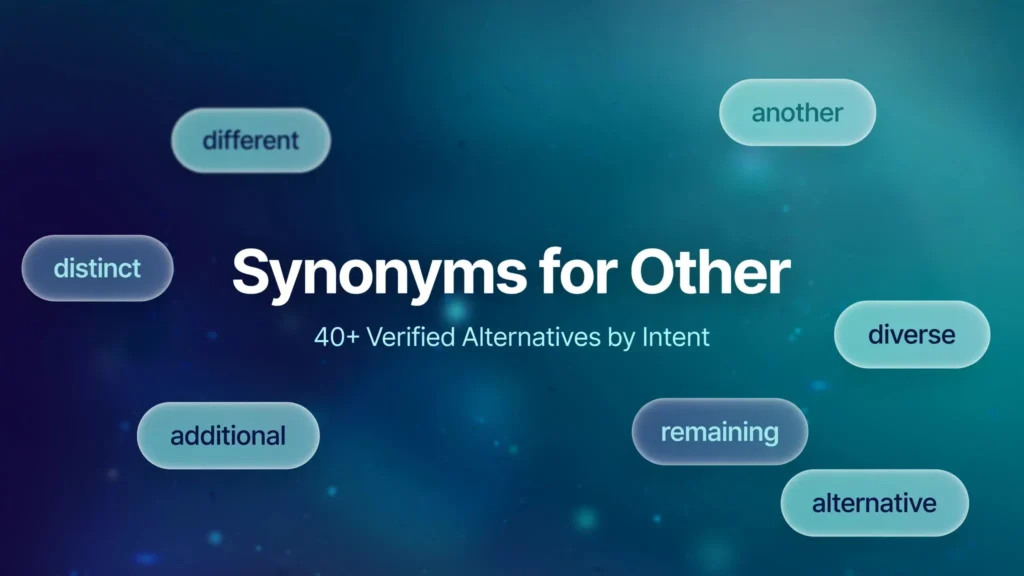

Synonyms for Other (adjective, determiner, pronoun) (/ˈʌðər/) — “other” points to something different from the one already named, or to something added, left over, or from another time. It acts as adjective, pronoun, noun, determiner, adverb, and even verb.
Quick answer: The best synonym for “other” depends on your intent. Use different or distinct for “not the same,” another or additional for “one more,” remaining for “left over,” and former for “from the past.”
| Word Master | Part of Speech | Pronunciation | Core Meaning | Quick Example |
| other | adjective / determiner | /ˈʌðər/ | not this one; an added one | I want the other pen. |
| another | determiner / pronoun | /əˈnʌðər/ | one more; an extra one | Bring another chair. |
| different | adjective | /ˈdɪfrənt/ | not the same | Try a different route. |
| additional | adjective | /əˈdɪʃənəl/ | extra; added | We need additional help. |
| remaining | adjective | /rɪˈmeɪnɪŋ/ | left over | The remaining cake is yours. |
| former | adjective | /ˈfɔːrmər/ | from an earlier time | In former days, we walked. |
Merriam-Webster lists 109 similar words for “other,” split into three senses: different, more, and former. This guide keeps only verified, direct synonyms and labels every near-synonym honestly.
Synonyms for “Other” Grouped by Intent
Pick the column that matches your meaning. Never swap across columns without checking the nuance.
| Synonym | Specific Meaning | Synonym | Specific Meaning |
| 1. different | not the same kind | 2. another | one more; an extra one |
| 3. distinct | clearly separate | 4. additional | added; extra |
| 5. diverse | varied in kind | 6. further | more; to a greater extent |
| 7. separate | apart; unconnected | 8. extra | beyond what is needed |
| 9. unlike | not similar to | 10. else | other; in addition (after pronouns) |
| 11. distinct | unmistakably different | 12. new | recently added |
| 13. alternative | a choice between options | 14. remaining | left over |
| 15. variant | a different form | 16. former | from an earlier time |
| 17. dissimilar | not alike | 18. past | belonging to earlier days |
| 19. miscellaneous | assorted; mixed | 20. spare | kept for extra use |
Where “Other” Comes From
- Parts of Speech: adjective, determiner, pronoun, noun, adverb, verb
- Syllables: oth-er (2)
Origin: Old English oþer meant “second; additional; further.” It comes from Proto-Germanic *anthera- and PIE *an-tero-, likely from the root al- (“beyond”) plus the comparative suffix -tero-. It is cousin to Latin alter (“the other of two”). The “second” sense later moved to the Latin-based word “second,” to avoid confusion.
Prefix/Suffix Breakdown: an- (one/that one) + -tero- (comparative suffix, “the more X of two”). The same -tero- builds alter, either, and whether. As an adverb it meant “otherwise” by c. 1200 and “in addition” by the mid-1300s.
Different, Not the Same
Use these when “other” means “not this kind.”
Different (/ˈdɪfrənt/)
Meaning: not of the same kind.
- We took a different road to avoid traffic.
- She chose a different dress for the party.
Distinct (/dɪˈstɪŋkt/)
Meaning: clearly separate; unmistakable.
- The two wines have distinct flavors.
- He heard a distinct knock at the door.
Diverse (/daɪˈvɜːrs/)
Meaning: varied; made of different kinds.
- Our team has diverse skills.
- The city offers diverse food options.
Separate (/ˈsɛprət/)
Meaning: apart; not joined to.
- Keep the bills in a separate folder.
- They booked separate rooms.
Unlike (/ʌnˈlaɪk/)
Meaning: not similar to something.
- Unlike the others, he stayed calm.
- This model is unlike any phone I owned.
Alternative (/ɔːlˈtɜːrnətɪv/)
Meaning: a choice you can pick instead. Near-synonym: implies a decision between options.
- We found an alternative route.
- She suggested an alternative plan.
Variant (/ˈvɛəriənt/)
Meaning: a different form of the same thing. Near-synonym: works for versions, not people.
- This is a regional variant of the dish.
- The store sells a cheaper variant.
Dissimilar (/dɪˈsɪmɪlər/)
Meaning: not alike. Near-synonym: formal tone.
- Their views are dissimilar on this issue.
- The twins have dissimilar tastes.
Additional, One More
Use these when “other” means “an extra one.”
Another (/əˈnʌðər/)
Meaning: one more of the same kind.
- I need another minute.
- She ordered another coffee.
Additional (/əˈdɪʃənəl/)
Meaning: added; extra. Broader term: formal register.
- The company hired additional staff.
- We paid an additional fee.
Further (/ˈfɜːrðər/)
Meaning: more; to a greater degree. Near-synonym: formal, often abstract.
- I have no further questions.
- They ran further tests.
Extra (/ˈɛkstrə/)
Meaning: beyond what is needed.
- Bring an extra jacket.
- We ordered extra chairs.
Else (/ɛls/)
Meaning: other; in addition. Contextual alternative: only follows pronouns and question words.
- Someone else can help you.
- What else do you need?
New (/nuː/)
Meaning: recently added or different from before. Contextual alternative: implies freshness.
- We hired three new writers.
- Try the new menu.
The Remaining Ones
Remaining (/rɪˈmeɪnɪŋ/)
Meaning: left over after others are gone.
- The remaining tickets sold out fast.
- Eat the remaining pizza.
From Another Time
Former (/ˈfɔːrmər/)
Meaning: belonging to an earlier time.
- In former years, the fair drew crowds.
- A former student visited us.
Past (/pæst/)
Meaning: belonging to earlier days. Near-synonym: broader than “other.”
- In times past, people wrote letters.
- She spoke of past summers.
“Other” in Phrases, People & Quick Queries
“Other” in Common Phrases
- Other half → partner, spouse, better half, significant other. Example: He introduced his other half at dinner.
- Other side → flip side, reverse, opposite side, converse. Example: Let’s hear the other side of the story.
- Other than → except, besides, apart from, but. Example: No one came other than Sarah.
- Otherworldly → unearthly, supernatural, ethereal, alien. Example: The cave had an otherworldly glow.
- Other ways → alternative methods, different approaches. Example: We found other ways to save money.
- Significant other → partner, spouse, loved one, better half. Example: Bring your significant other to the event.
“Each Other” Phrase Synonyms
- Each other → one another, mutually. Example: They respect each other.
- Help each other → assist one another, cooperate, mutual aid. Example: Neighbors help each other after storms.
- Get to know each other → become acquainted, break the ice. Example: The retreat helped us get to know each other.
- Learn from each other → share knowledge, exchange ideas. Example: The teams learn from each other weekly.
- Next to each other → adjacent, side by side, beside one another. Example: They sat next to each other.
- One after the other → consecutively, in succession, back-to-back. Example: The buses arrived one after the other.
- Like no other → unparalleled, unmatched, one of a kind. Example: Her voice is like no other.
- One or the other → either. Example: Pick one or the other.
- Affect each other → interact, influence one another. Example: Weather and mood affect each other.
- Pit against each other → oppose, set against one another. Example: The coach pitted them against each other.
- Six of one, half a dozen of the other → much the same, no real difference. Example: Both plans cost the same; it’s six of one, half a dozen of the other.
Quick Answers to Popular Queries: Synonyms for Other
- 4-letter word for “other” → else.
- 9-letter word for “other” → different.
- Spanish word for “other” → otro.
- Latin word for “other” → alter (of two), alius (of many).
- Rhyming word for “other” → brother, mother, another.
- Another word for “other people” → others, fellow people, other individuals.
- Another word for “other things” → additional items, further matters.
Common Traps & Nuance Distinctions of Synonyms for Other
Small swaps change meaning. Watch these traps.
- “Other” vs. “Another”: “Another” means one more (“bring another pen”). “Other” means the different one or the rest (“bring the other pen,” “the other students”). Never write “an another.”
- “Other” vs. “Different”: “Different” stresses unlikeness (“a different color”). “Other” stresses which one (“the other color, not this one”). Use “different” for contrast, “other” for selection.
- “Others” vs. “The others”: “Others” means people in general (“others may disagree”). “The others” means a specific group already named (“the others stayed home”).
- “Alternative” vs. “Other”: “Alternative” always implies a choice between options. Do not write “two alternative apples” when you mean “two other apples.”
- “Else” vs. “Other”: “Else” only follows pronouns and question words: “someone else,” “what else,” “anything else.” It never stands alone as an adjective.
When NOT to use these synonyms:
- Do not use “alternative” for a simple addition.
- Do not use “else” before a noun (“else people” is wrong).
- Do not use “former” for living variety (“former options” is wrong; use “other options”).
- Do not use the verb “othering” in casual writing; it belongs to academic and sociological contexts.
Opposite Words: Antonyms for “Other”
- Direct Antonyms: same (identical; not different — “the same pen”); similar (nearly alike — “a similar plan”); identical (exactly the same — “identical twins”); alike (like each other — “they think alike”).
- Operational & Contextual Opposites: none (not any — “we have none left”); neither (not one nor the other — “neither option works”); this (the one here, not the other one — “take this seat”); current (happening now, not in other times — “the current policy”).
FAQs about Synonyms for Other
What words can I use instead of “other”?
Use different, another, additional, extra, or alternative. Pick by intent: “different” for contrast, “another” for one more, “additional” for formal additions.
What is another word for “other” in a formal essay?
Use additional, further, alternative, or distinct. For “other people,” write “other individuals” or “fellow participants.” For “other things,” write “additional items” or “further matters.”
What is the difference between “other” and “another”?
“Another” means one more of the same kind (“another slice”). “Other” points to the different one or the rest of a group (“the other slice,” “the other guests”).
What is a 4-letter word for “other”?
“Else.” It follows pronouns and question words: “someone else,” “what else,” “nothing else.”
What can I use instead of “others”?
For people in general, use “other people,” “fellow people,” or “the rest.” In formal writing, use “other individuals” or “other parties.”
Conclusion
Match the synonym to your intent: different and distinct for contrast, another and additional for extra items, remaining for leftovers, and former for past times.