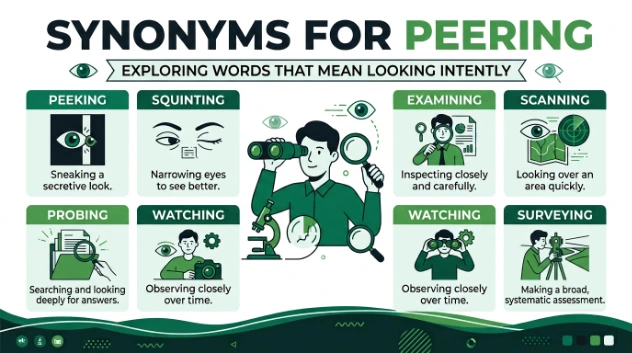

Synonyms for Peering (verb, present participle) (/ˈpɪərɪŋ/) mean looking closely or with difficulty, often because something is far away, dark, small, or partly hidden.
The best synonym depends on the situation. Gazing suggests a calm, steady look. Staring suggests a fixed look. Scrutinizing suggests close examination. Peeking suggests a quick or secret look.
What are the Peering Synonyms
The closest common synonyms for peering are gazing, staring, examining, inspecting, scrutinizing, studying, looking closely, looking intently, and squinting.
Other alternatives fit specific situations. Peeking and peeping suggest a brief or secret look. Gawking and gaping suggest surprise. Prying and snooping suggest unwanted curiosity.
30 Synonyms and Related Alternatives for Peering
These words are not all exact synonyms. The table separates close synonyms from contextual alternatives so you can choose the most accurate word.
Direct and Common Synonyms
| Synonym | Meaning |
| Gazing | Looking steadily for some time |
| Staring | Looking fixedly for a while |
| Examining | Looking carefully to understand something |
| Inspecting | Checking something closely |
| Scrutinizing | Examining details very closely |
| Studying | Looking closely to understand details |
| Looking closely | Looking with careful attention |
| Looking intently | Looking with strong concentration |
| Squinting | Looking with partly closed eyes |
| Eyeing | Looking at something with interest |
| Observing | Watching carefully and noticing details |
| Watching | Keeping your eyes on something |
| Viewing | Looking at something deliberately |
| Regarding | Looking at or considering something |
| Focusing | Directing attention toward something |
| Fixating | Keeping attention fixed on something |
| Perusing | Looking through something carefully |
| Looking over | Giving something a quick examination |
| Scanning | Looking over an area to find something |
| Searching | Looking carefully for something |
Contextual, Curious, or Investigative Alternatives
| Synonym | Meaning |
| Peeking | Taking a quick or secret look |
| Peeping | Looking briefly through an opening |
| Gawking | Looking openly with surprise or foolishness |
| Gaping | Looking with open-mouthed surprise |
| Goggling | Looking with wide-eyed surprise |
| Prying | Looking into private matters |
| Snooping | Secretly looking for information |
| Spying | Watching secretly |
| Probing | Investigating deeply for information |
| Investigating | Trying to discover facts or causes |
Detailed Synonyms for Peering
1. Gazing
Pronunciation: /ˈɡeɪzɪŋ/
Meaning: Looking steadily at something for some time, often with interest, pleasure, or thought.
Usage: A softer and calmer alternative to peering. It works well in everyday and creative writing.
Real-life examples:
- She was gazing at the sunset.
- He sat quietly, gazing through the window.
2. Staring
Pronunciation: /ˈsterɪŋ/
Meaning: Looking at something for a long time with a fixed gaze.
Usage: Stronger than peering. It can sound rude when directed at another person.
Real-life examples:
- He was staring at the screen.
- She stood there, staring at the locked door.
3. Examining
Pronunciation: /ɪɡˈzæmɪnɪŋ/
Meaning: Looking at something carefully to understand or assess it.
Usage: Good for formal, academic, medical, and professional writing.
Real-life examples:
- The doctor was examining the scan.
- She was examining the damaged phone.
4. Inspecting
Pronunciation: /ɪnˈspektɪŋ/
Meaning: Looking closely to check the condition, quality, or safety of something.
Usage: Best when the person has a checking or testing purpose.
Real-life examples:
- The mechanic was inspecting the engine.
- We were inspecting the house before buying it.
5. Scrutinizing
Pronunciation: /ˈskruːtənaɪzɪŋ/
Meaning: Examining something very closely to find details, errors, or problems.
Usage: Strong and formal. Excellent for reports, evidence, contracts, and data.
Real-life examples:
- She was scrutinizing the contract.
- The manager was scrutinizing the sales figures.
6. Studying
Pronunciation: /ˈstʌdiɪŋ/
Meaning: Looking closely at something to understand or learn about it.
Usage: Natural when the person wants to understand details.
Real-life examples:
- He was studying the map.
- She was studying the old photograph.
7. Looking Closely
Pronunciation: /ˈlʊkɪŋ ˈkloʊsli/
Meaning: Looking carefully and paying attention to details.
Usage: The clearest simple-English replacement for peering.
Real-life examples:
- She was looking closely at the label.
- He was looking closely through the window.
8. Looking Intently
Pronunciation: /ˈlʊkɪŋ ɪnˈtentli/
Meaning: Looking with strong focus and concentration.
Usage: Good when you want to stress attention rather than difficulty seeing.
Real-life examples:
- He was looking intently at the screen.
- She was looking intently into the distance.
9. Squinting
Pronunciation: /ˈskwɪntɪŋ/
Meaning: Looking with partly closed eyes, often because something is hard to see.
Usage: Very useful when bright light, distance, or small print makes seeing difficult.
Real-life examples:
- She was squinting at the road sign.
- He was squinting through the bright sunlight.
10. Eyeing
Pronunciation: /ˈaɪɪŋ/
Meaning: Looking at someone or something with interest, attention, or desire.
Usage: Often suggests that the person is judging, considering, or wanting something.
Real-life examples:
- He was eyeing the last slice of pizza.
- She was eyeing a new phone in the shop.
11. Observing
Pronunciation: /əbˈzɜːrvɪŋ/
Meaning: Watching carefully and noticing what happens.
Usage: Neutral and useful in academic, scientific, and professional writing.
Real-life examples:
- The scientist was observing the birds.
- She was observing the crowd from a distance.
12. Watching
Pronunciation: /ˈwɒtʃɪŋ/ or /ˈwɑːtʃɪŋ/
Meaning: Keeping your eyes on someone or something.
Usage: Very common, but broader than peering. It does not necessarily suggest difficulty seeing.
Real-life examples:
- He was watching the road.
- We were watching the children play.
13. Viewing
Pronunciation: /ˈvjuːɪŋ/
Meaning: Looking at something deliberately.
Usage: Common in formal, technical, artistic, and professional contexts.
Real-life examples:
- Visitors were viewing the exhibition.
- She was viewing the image on her laptop.
14. Regarding
Pronunciation: /rɪˈɡɑːrdɪŋ/
Meaning: Looking at or directing attention toward something.
Usage: Formal or literary. It is less common in everyday speech as a replacement for peering.
Real-life examples:
- He sat quietly, regarding the painting.
- She was regarding the strange object carefully.
15. Focusing
Pronunciation: /ˈfoʊkəsɪŋ/
Meaning: Directing attention toward something.
Usage: Focuses on concentration rather than the physical act of looking.
Real-life examples:
- She was focusing on the small print.
- He was focusing on the road ahead.
16. Fixating
Pronunciation: /fɪkˈseɪtɪŋ/
Meaning: Keeping your attention fixed on something.
Usage: Often suggests excessive or unusually strong attention.
Real-life examples:
- He was fixating on one small mistake.
- She kept fixating on the same detail.
17. Perusing
Pronunciation: /pəˈruːzɪŋ/
Meaning: Reading or examining something carefully.
Usage: Best for books, reports, documents, menus, and written material.
Real-life examples:
- He was perusing the morning newspaper.
- She was perusing the restaurant menu.
18. Looking Over
Pronunciation: /ˈlʊkɪŋ ˈoʊvər/
Meaning: Examining something, often fairly quickly.
Usage: More casual than scrutinizing or inspecting.
Real-life examples:
- She was looking over the report.
- He was looking over the car before the test drive.
19. Scanning
Pronunciation: /ˈskænɪŋ/
Meaning: Looking over an area or text to find something.
Usage: Good when the person is searching visually rather than studying one object.
Real-life examples:
- She was scanning the crowd for her friend.
- He was scanning the menu for vegetarian dishes.
20. Searching
Pronunciation: /ˈsɜːrtʃɪŋ/
Meaning: Looking carefully because you want to find something.
Usage: Focuses on the purpose of looking rather than the way the person looks.
Real-life examples:
- He was searching the room for his keys.
- She was searching the horizon for the boat.
21. Peeking
Pronunciation: /ˈpiːkɪŋ/
Meaning: Taking a quick or secret look.
Usage: A useful alternative when the look is brief or hidden.
Real-life examples:
- The child was peeking through the curtains.
- She was peeking inside the gift box.
Important: Peeking is not an exact replacement when peering means looking for a long time or struggling to see.
22. Peeping
Pronunciation: /ˈpiːpɪŋ/
Meaning: Looking briefly through a small opening or from a hidden place.
Usage: Often suggests concealment or a small opening.
Real-life examples:
- He was peeping through the keyhole.
- The child was peeping around the door.
23. Gawking
Pronunciation: /ˈɡɔːkɪŋ/
Meaning: Looking openly and often foolishly, rudely, or with surprise.
Usage: Informal and usually negative.
Real-life examples:
- Tourists were gawking at the huge statue.
- He stood there gawking at the expensive car.
24. Gaping
Pronunciation: /ˈɡeɪpɪŋ/
Meaning: Looking with your mouth open because of surprise.
Usage: Stronger than peering because it adds shock or amazement.
Real-life examples:
- The children were gaping at the dinosaur model.
- We stood gaping at the sudden view.
25. Goggling
Pronunciation: /ˈɡɒɡəlɪŋ/
Meaning: Looking with wide eyes because of surprise or amazement.
Usage: Informal and expressive.
Real-life examples:
- He was goggling at the huge screen.
- The tourists stood goggling at the unusual building.
26. Prying
Pronunciation: /ˈpraɪɪŋ/
Meaning: Trying to discover information that is private or not your business.
Usage: Negative. It adds unwanted curiosity.
Real-life examples:
- She did not want to seem like she was prying.
- He was prying into his neighbor’s private life.
27. Snooping
Pronunciation: /ˈsnuːpɪŋ/
Meaning: Secretly looking around to find private information.
Usage: Informal and usually negative.
Real-life examples:
- The child was snooping through the drawers.
- She caught him snooping around her desk.
28. Spying
Pronunciation: /ˈspaɪɪŋ/
Meaning: Watching someone or something secretly.
Usage: Adds secrecy or surveillance.
Real-life examples:
- The detective was spying on the suspect.
- He was spying through the gap in the curtains.
29. Probing
Pronunciation: /ˈproʊbɪŋ/
Meaning: Investigating deeply to discover information.
Usage: More investigative than visual. Use it when the main idea is finding answers.
Real-life examples:
- The reporter was probing the company for answers.
- Investigators were probing the cause of the accident.
30. Investigating
Pronunciation: /ɪnˈvestɪɡeɪtɪŋ/
Meaning: Trying to discover facts, causes, or information.
Usage: A contextual alternative, not a direct visual synonym.
Real-life examples:
- Police were investigating the fire.
- The engineer was investigating the machine failure.
What Does Peering Mean?
Peering means looking carefully or with difficulty. It often happens when something is far away, dark, small, unclear, or partly hidden.
Examples:
- I was peering at the tiny print.
- She was peering through the rain.
What Does Peering Into Mean?
Peering into means looking carefully inside something or toward a place that is difficult to see.
Examples:
- He was peering into the dark room.
- She was peering into the box.
Synonyms for Peering Into
- looking into
- looking closely into
- examining
- inspecting
- staring into
- gazing into
- peeking into
- peeping into
What Does Peering Through Mean?
Peering through means looking carefully through an opening, window, gap, curtain, or other barrier.
Examples:
- She was peering through the window.
- He was peering through the fog.
Synonyms for Peering Through a Window
- looking through the window
- looking closely through the window
- gazing through the window
- staring through the window
- peeking through the window
- peeping through the window
What Is a Synonym for Peering Down?
Peering down means looking carefully toward something below you.
Good alternatives include:
- looking down
- looking downward
- gazing down
- staring down
- looking over
Example:
They were peering down into the canyon.
Natural alternative:
They were looking down into the canyon.
What Does Peering Up Mean?
Peering up means looking carefully toward something above you.
Examples:
- She was peering up at the tall building.
- The child was peering up through the trees.
Possible alternatives:
- looking up
- looking upward
- gazing upward
- staring upward
- looking intently upward
Peering in a Sentence
Here are natural real-life examples:
- She was peering through the window for movement.
- He was peering into the dark room.
- They were peering down into the valley.
- The child was peering up at the aircraft.
- She was peering at the tiny map.
- He was peering around the corner.
Common Grammar Patterns
peer at + object
She peered at the photograph.
peer into + place or container
He peered into the box.
peer through + opening or barrier
She peered through the window.
peer out of + place
He peered out of the doorway.
What Type of Word Is Peering?
Peering is usually the present participle of the verb peer.
It can also work as:
- Verb: She is peering through the glass.
- Gerund: Peering into the darkness was difficult.
- Adjective: They noticed a pair of peering eyes.
Peering vs. Peeking
Peering means looking carefully or with difficulty.
Peeking usually means taking a quick or secret look.
She was peering through the fog.
The problem is seeing clearly.
She was peeking through the curtains.
The look is brief or secret.
Peering vs. Peeping
Peering focuses on careful or difficult seeing.
Peeping often suggests looking briefly through a small opening.
He was peering through the fog.
The child was peeping through the keyhole.
Peering vs. Staring
Peering suggests an effort to see.
Staring suggests a fixed or prolonged gaze.
She was peering at the tiny print.
She was staring at the painting.
Peering vs. Gazing
Gazing often sounds calm, thoughtful, or admiring.
Peering suggests careful visual effort.
He was gazing at the stars.
He was peering through the telescope.
Peering vs. Scrutinizing
Scrutinizing means examining something very closely, often to find errors or important details.
Peering simply describes careful or difficult looking.
She was peering at the faded sign.
She was scrutinizing the contract for errors.
When NOT to Use Synonyms for Peering
Do not use peering when you only mean a quick look.
Use glancing:
He glanced at his watch.
Do not use it when the look is secret and brief.
Use peeking:
She peeked inside the room.
Do not use it when the person is angry.
Use glaring:
He was glaring at the driver.
Do not use it when the main idea is unwanted curiosity.
Use prying:
They were prying into her private life.
Do not use it when the person is simply watching an event.
Use watching:
She was watching the children play.
Synonyms for Peering in an Essay
For essays and formal writing, choose the word that matches your exact meaning.
- Examining — careful analysis
- Scrutinizing — close critical examination
- Inspecting — careful checking
- Observing — neutral watching
- Studying — detailed examination
- Investigating — finding facts
- Analyzing — examining information or ideas
Example
Instead of:
The researcher was peering at the data.
Use:
The researcher was examining the data.
For a more critical tone:
The researcher was scrutinizing the data for errors.
Synonyms for Peering in Creative Writing
Choose the word based on the mood.
Calm:
She was gazing at the lake.
Tense:
He was staring at the locked door.
Dark or unclear:
She was peering into the darkness.
Poor visibility:
He was squinting through the rain.
Surprise:
They stood gaping at the enormous waterfall.
Secret:
The child was peeking through the curtains.
What Is Another Word for Peer?
There are two main meanings of peer.
Peer as a verb
When peer means “look carefully or with difficulty,” use:
- gaze
- stare
- examine
- inspect
- scrutinize
- study
- look closely
Peer as a noun
When peer means a person of similar age, rank, ability, or position, possible alternatives include:
- equal
- counterpart
- colleague
- fellow
- associate
The correct synonym depends on the sentence.
What Can I Say Instead of Peers?
When peers means people at a similar level:
| Alternative | Best context |
| Colleagues | People you work with |
| Classmates | People in the same class |
| Equals | People with similar status |
| Counterparts | People with similar roles |
| Fellow professionals | People in the same profession |
| Fellow students | People studying together |
| Associates | Professional or social contacts |
Example:
She asked her peers for advice.
Professional:
She asked her colleagues for advice.
Academic:
She asked her fellow students for advice.
What Is Public Peering?
Public peering is a networking term. It is not related to looking.
In networking, peering means a direct connection between networks that allows them to exchange traffic.
So:
- peering through a window = looking carefully
- network peering = direct exchange between networks
- public peering = network interconnection through a shared exchange
What Is a Synonym for Peer-to-Peer?
Peer-to-peer (P2P) is a technical term.
Depending on context, related terms include:
- decentralized
- distributed
- direct
- user-to-user
- node-to-node
- person-to-person
These are contextual alternatives, not universal synonyms.
Antonyms for Peering
There is no single perfect antonym for every meaning of peering.
Direct or Strong Opposites
Glancing — looking briefly.
He glanced at the sign.
Ignoring — deliberately giving no attention.
She ignored the warning.
Overlooking — failing to notice something.
He overlooked the small error.
Missing — failing to see something.
She missed the sign in the fog.
Contextual Opposites
Disregarding — choosing not to pay attention.
They disregarded the warning.
Neglecting — failing to give attention.
He neglected the details.
Unseeing — not noticing what is around you.
She walked past, unseeing.
Unconcerned — showing little interest.
He remained unconcerned by the strange sight.
FAQs Synonyms for Peering
What is the closest synonym for peering?
The closest common alternatives are looking closely, gazing, staring, examining, inspecting, scrutinizing, studying, and looking intently.
What is another word for peering through a window?
Use looking through the window, looking closely through the window, peeking through the window, peeping through the window, or staring through the window.
What is a synonym for peering down?
Use looking down, gazing down, staring down, or looking downward.
What is the difference between peering and peeking?
Peering means looking carefully or with difficulty. Peeking usually means taking a quick or secret look.
What is the antonym of peering?
Depending on context, use glancing, ignoring, overlooking, missing, disregarding, or neglecting.
What does peering into mean?
Peering into means looking carefully inside something or toward a place that is difficult to see.
What does peering through mean?
Peering through means looking carefully through an opening, window, gap, or barrier.
What does peering up mean?
Peering up means looking carefully toward something above you.
What does peering down mean?
Peering down means looking carefully toward something below you.
Conclusion
Peering means looking closely or with difficulty. Its strongest everyday alternatives are gazing, staring, examining, inspecting, scrutinizing, studying, looking closely, and looking intently. Use peeking and peeping for brief or secret looks, squinting for difficult visibility, and gaping or gawking for surprise. For formal writing, choose examining, inspecting, scrutinizing, or investigating only when the exact meaning fits.