
Synonyms for Terminated (verb form / adjective, /ˈtɜːrmɪneɪtɪd/) mean brought to an end, stopped, or ended. It can describe a contract, job, service, project, journey, pregnancy, or other process.
The best synonym depends on what ended and how it ended. For a general ending, use ended, finished, concluded, stopped, or ceased. For employment, words such as dismissed, fired, and laid off have narrower meanings and should not be treated as universal synonyms.
What is another word for terminated?
The closest general synonyms for terminated are:
ended, finished, concluded, stopped, ceased, closed, completed, and discontinued.
However, they are not identical. Ended is the broadest everyday choice. Concluded suggests a formal closing. Finished can stress completion. Stopped focuses on cessation. Discontinued often means something will no longer continue. Closed often applies to something that was open. Completed usually suggests that the intended work was successfully finished.
For employment, use dismissed, fired, sacked, discharged, or laid off only when that specific employment situation is meant. If for a train or bus, ended its journey or stopped may be more natural. For a pregnancy, ended or the medically established term aborted belongs to that specific sense and should not be mixed into the general synonym list.
Direct Synonyms for Terminated
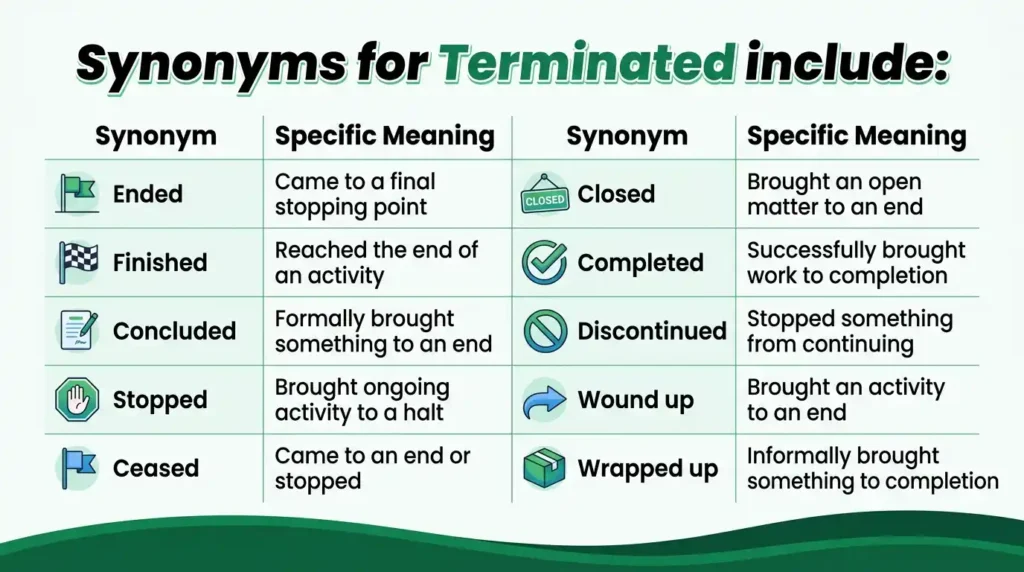
These are the strongest general alternatives supported by major dictionary and thesaurus sources. They describe the core idea of something being brought or coming to an end.
| Synonym | Specific Meaning | Synonym | Specific Meaning |
| Ended | Came to a final stopping point | Finished | Reached the end of an activity |
| Concluded | Formally brought something to an end | Stopped | Brought ongoing activity to a halt |
| Ceased | Came to an end or stopped | Closed | Brought an open matter to an end |
| Completed | Successfully brought work to completion | Discontinued | Stopped something from continuing |
| Wound up | Brought an activity to an end | Wrapped up | Informally brought something to completion |
Important: wound up and wrapped up are useful near-equivalents in suitable contexts, but they are less formal than terminated. Merriam-Webster lists wind up and wrap up among related alternatives, while Collins lists wind up and discontinue.
Where Terminated Comes From
Parts of Speech: Past tense and past participle of the verb terminate; also used as an adjective.
Syllable: ter-mi-na-ted
Origin: Terminate comes from Latin terminātus, the past participle of termināre, meaning to set boundaries or bring to an end. It comes from Latin terminus, meaning an end, boundary, or limit. Collins dates the English verb to the 16th century.
Prefix/Suffix Breakdown: termin- relates to an end, boundary, or limit; -ate forms the verb terminate; -ed marks the past tense and past participle.
Common Synonyms for Terminated
The following words are useful replacements when the sentence has the same basic meaning as terminated.
Ended (/ˈendɪd/)
Meaning: Came to a final stopping point.
- The meeting ended at noon.
- The agreement ended after five years.
Finished (/ˈfɪnɪʃt/)
Meaning: Reached the end of an activity or process.
- The team finished the project on time.
- The work was finished before the deadline.
Nuance: Finished can stress completion of the final stage, while terminated can simply stress that something reached an end.
Concluded (/kənˈkluːdɪd/)
Meaning: Was formally brought to an end.
- The investigation concluded after six months.
- The conference concluded with a final speech.
Nuance: Concluded often sounds more formal than ended. It works especially well for meetings, investigations, negotiations, and proceedings.
Stopped (/stɑːpt/)
Meaning: Came to a halt or was made inactive.
- The machine stopped suddenly.
- The company stopped the service.
Nuance: Stopped can describe a temporary halt. Terminated often suggests a definite end.
Ceased (/siːst/)
Meaning: Came to an end or stopped happening.
- Production ceased in July.
- The payments ceased after the account closed.
Nuance: Ceased is more formal than stopped and works well in legal, business, and academic writing. Collins and Cambridge both list cease as a synonym of terminate.
Closed (/kloʊzd/)
Meaning: Brought an open matter or activity to an end.
- The investigation was closed.
- The account was closed after the review.
Nuance: Closed often suggests that something was previously open. Merriam-Webster makes this distinction between close and terminate.
Completed (/kəmˈpliːtɪd/)
Meaning: Successfully brought something to completion.
- The project was completed ahead of schedule.
- The final stage was completed yesterday.
Nuance: Do not use completed when something simply stopped. Complete usually suggests that the intended work was successfully finished.
Discontinued (/ˌdɪskənˈtɪnjuːd/)
Meaning: Was deliberately stopped and no longer continued.
- The company discontinued the product.
- The service was discontinued last year.
Nuance: This is especially useful for products, services, programs, and treatments. Collins specifically lists discontinue as a synonym for the general ending sense.
Wound Up (/waʊnd ʌp/)
Meaning: Was brought to a final end.
- The company wound up its operations.
- The committee wound up its work.
Nuance: More informal than terminated. It works well for organizations, activities, and processes.
Wrapped Up (/ræpt ʌp/)
Meaning: Was completed or brought to an end.
- The team wrapped up the project.
- We wrapped up the discussion before lunch.
Nuance: This is conversational and should usually be avoided in highly formal legal or academic prose.
Employment Synonyms for Terminated
Terminated has a specific employment sense: an employer ends an employee’s job. Collins and Merriam-Webster both document this sense.
Dismissed (/dɪsˈmɪst/)
Meaning: Removed from employment or a position.
- The employee was dismissed after an investigation.
- She was dismissed for serious misconduct.
Nuance: Formal and often more neutral than fired.
Fired (/faɪərd/)
Meaning: Removed from a job by an employer.
- He was fired for repeated policy violations.
- She was fired after several warnings.
Nuance: Common and direct, especially in American English. It is not a general synonym for terminated outside employment.
Sacked (/sækt/)
Meaning: Dismissed from a job.
- The manager was sacked after the incident.
- He was sacked for repeated misconduct.
Nuance: Common in British English and more informal than dismissed.
Discharged (/dɪsˈtʃɑːrdʒd/)
Meaning: Formally released from employment or duty.
- The employee was discharged after the hearing.
- He was discharged from service.
Nuance: Formal and context-dependent.
Laid Off (/leɪd ɔːf/)
Meaning: Lost a job because the employer reduced staffing.
- Hundreds of workers were laid off.
- She was laid off when the factory reduced its workforce.
Nuance: Laid off is not a universal synonym for terminated. A layoff usually relates to staffing needs, reduced work, restructuring, or business conditions.
Contract and Agreement Alternatives
A terminated contract has ended, but the reason and legal mechanism matter.
Ended
Meaning: The contract is no longer in force.
- The contract ended in June.
- Their agreement ended after the final payment.
Concluded
Meaning: The agreement or contractual period came to an end.
- The agreement concluded after the final review.
- The negotiations concluded successfully.
Expired
Meaning: Ended because its stated period ran out.
- The contract expired on June 30.
- Her license expired last month.
Important: Expired does not necessarily mean someone actively terminated the agreement.
Cancelled
Meaning: An arrangement was called off or withdrawn.
- The booking was cancelled.
- The company cancelled the agreement.
Important: Cancelled can describe an agreement being called off, but it is not interchangeable with terminated in every legal setting.
Rescinded
Meaning: A contract was legally set aside or undone.
- The court rescinded the agreement.
- The buyer sought to rescind the contract.
Important: Rescinded is a legal term with a narrower meaning. Do not use it as a casual replacement for terminated.
Terminated for Products and Services
When a product or service will no longer be offered, discontinued is often the clearest choice.
- Terminated service: The service was terminated.
- Discontinued service: The service was discontinued.
- Discontinued product: The company no longer makes the product.
Other possible alternatives include ended, stopped, withdrawn, or phased out, depending on the facts.
Phased out is not an exact synonym. It means something was gradually removed rather than ended immediately.
Terminated for Projects and Activities
For a project, task, meeting, or activity, choose the word that shows what actually happened.
- Ended — neutral and broad.
- Concluded — formal closing.
- Finished — stresses reaching the end.
- Completed — stresses successful fulfillment.
- Stopped — stresses cessation.
- Closed — useful for cases, investigations, or matters.
- Discontinued — useful when something will not continue.
- Suspended — means temporarily stopped, so it is not normally a synonym for terminated.
Example:
The project was terminated before completion.
Do not rewrite this as:
The project was completed before completion.
The second sentence changes the meaning.
Terminated for a Train, Bus, or Journey
Terminate has a specific transport sense. When a train or bus terminates at a place, its scheduled journey ends there. Collins gives end its journey, stop, and finish up for this sense.
Useful alternatives include:
- ended its journey
- stopped
- finished its run
- reached its terminus
Examples:
- The train terminated at Oxford.
- The train ended its journey at Oxford.
- The bus stopped at the final station.
Here, reached its terminus can be more precise than simply saying ended.
Medical Sense of Terminated
Terminate also has a distinct medical sense meaning to end a pregnancy. Collins lists abort and end for this sense.
This meaning should remain separate from the ordinary synonym list because the context changes the meaning.
Examples:
- The pregnancy was terminated.
- The pregnancy was ended.
Important: Abort is a medical/contextual alternative here. It should not be presented as a general synonym for terminated.
Technical and Mathematical Senses
The word terminate has specialized meanings that do not map neatly onto ordinary synonyms.
In electrical engineering, terminate can mean connecting the end of a transmission line to absorb energy and reduce reflections. Collins documents this technical sense.
In mathematics, a decimal can terminate when it has a finite number of digits. For example:
0.75 is a terminating decimal.
In this context, ordinary alternatives such as fired, dismissed, or discontinued would be incorrect.
Common Traps & Nuance Distinctions
Choosing a synonym for terminated requires attention to the exact meaning.
Terminated vs. Ended
Ended is broader and more natural in everyday English.
Terminated sounds more formal and can suggest that a definite boundary or limit has been reached. Merriam-Webster specifically says terminate implies setting a limit in time or space.
Terminated vs. Finished
Finished often stresses the completion of a final step.
Terminated stresses the fact that something was brought to an end.
Terminated vs. Concluded
Concluded often suggests a formal closing.
Use it for meetings, investigations, negotiations, reports, and proceedings.
Terminated vs. Completed
Completed normally suggests successful fulfillment.
If a project stopped halfway, it was terminated, not necessarily completed.
Terminated vs. Stopped
Stopped can describe a temporary halt.
Terminated usually suggests a definite ending.
Terminated vs. Discontinued
Discontinued means something was stopped and will generally not continue.
It is especially useful for products, services, programs, and treatments.
Terminated vs. Suspended
Suspended means temporarily stopped.
Terminated generally means ended.
These words should not be treated as interchangeable.
Terminated vs. Expired
Expired means a period of validity ended.
A contract may expire when its fixed term runs out. That is different from actively terminating it.
Terminated vs. Dismissed
Dismissed normally refers to removing someone from employment or another position.
It is not the correct replacement when the subject is a product, service, contract, or project.
Terminated vs. Laid Off
Laid off describes a particular type of employment separation.
It often results from reduced staffing needs rather than individual misconduct or performance.
When NOT to Use Terminated
Use a more precise word when it tells the reader more.
Do not use terminated when you specifically mean:
- completed — the intended work was successfully finished
- concluded — a formal event or process came to an end
- expired — a fixed period ran out
- suspended — something stopped temporarily
- discontinued — a product or service will no longer continue
- laid off — employment ended because of staffing or business conditions
- resigned — an employee voluntarily left
- retired — someone left work because of retirement
- cancelled — an arrangement was called off
- rescinded — a legal agreement was formally set aside
Precision is better than simply choosing a more formal-sounding word.
Best Synonyms for Terminated on a Resume
The best wording depends on what actually happened.
If the job simply ended
Use:
- employment ended
- position ended
- contract concluded
If you were dismissed
Use:
- dismissed
- discharged
- employment was ended
If you were laid off
Use:
- laid off
- position eliminated
- role made redundant
Do not use fired when a more neutral and accurate description is available.
Most importantly, never use a synonym that changes the facts of your employment history.
Best Formal Synonyms for Terminated
For formal writing, the strongest choices are:
- Concluded — formal ending of a process or event
- Ceased — formal stopping of activity
- Discontinued — formal ending of a service or product
- Ended — neutral and broadly applicable
- Completed — successful completion
- Closed — ending an open matter
- Wound up — ending an organization or activity, but less formal
Merriam-Webster’s synonym guidance supports close, complete, conclude, end, and finish as the main alternatives, while Cambridge and Collins add stop, cease, discontinue, and related choices.
Best Synonym for Terminated by Context
| Context | Best Choice | Why |
| General | Ended | Broad and natural |
| Formal process | Concluded | Signals formal closure |
| Completed task | Finished | Stresses completion |
| Successful project | Completed | Shows fulfillment |
| Activity that stopped | Ceased | Formal cessation |
| Product | Discontinued | No longer produced |
| Service | Discontinued | No longer offered |
| Account | Closed | Ends an open account |
| Employment | Dismissed | Formal job separation |
| Employment, informal | Fired | Direct job-related term |
| Staff reduction | Laid off | Specific business reason |
| Fixed-term contract | Expired | Term period ran out |
| Legal agreement | Rescinded | Specific legal action |
| Train or bus | Ended its journey | Ends scheduled route |
| Temporary halt | Suspended | Not actually terminated |
Antonyms for “Terminated”
The opposite of terminated is usually a word that means something began, continued, or was extended.
Direct Antonyms
- Started — began to happen.
The project started in June. - Began — came into action or existence.
The meeting began at nine. - Commenced — formally began.
The proceedings commenced on Monday. - Initiated — caused something to begin.
The company initiated a new program.
Operational & Contextual Opposites
- Continued — carried on without ending.
The service continued after the review. - Resumed — started again after a pause.
Operations resumed the next morning. - Extended — made something last longer.
The contract was extended for another year. - Renewed — continued through a new period or agreement.
The subscription was renewed.
Cambridge lists begin, start, commence, initiate, open, continue, pursue, and extend among the opposites or related antonyms of terminate.
FAQs Synonyms for Terminated
What is the best synonym for terminated?
Ended is the best broad synonym for terminated. Finished, concluded, stopped, ceased, closed, and discontinued can be better in specific contexts.
What is a formal synonym for terminated?
The strongest formal alternatives are concluded, ceased, discontinued, and ended. Choose based on the subject. Concluded works well for formal events, while discontinued works well for products and services.
What is another word for terminated employment?
Use dismissed, fired, sacked, or discharged when an employer ends someone’s employment. Use laid off only when the separation reflects staffing or business conditions.
What is another word for a terminated contract?
Depending on what happened, you may use ended, concluded, expired, cancelled, or rescinded. These terms do not have identical legal meanings, so the exact circumstances matter.
Is terminated the same as discontinued?
Not always. Discontinued usually means something has been stopped and will no longer continue, especially a product, service, or program. Terminated has a wider range of uses.
Is terminated the same as fired?
Only in the employment sense. In American English, terminate can mean to dismiss an employee, while fired is a more direct and informal employment term. Terminated can also describe contracts, services, journeys, projects, and other things.
What is the opposite of terminated?
The most direct opposites are started, began, commenced, and initiated. In an ongoing context, continued, resumed, extended, and renewed can be more precise.
Conclusion
The strongest general synonyms for terminated are ended, finished, concluded, stopped, ceased, closed, completed, and discontinued, but each carries a different nuance. For employment, choose dismissed, fired, sacked, discharged, or laid off only when the specific situation supports it. For contracts, products, services, journeys, and medical contexts, use the more precise contextual term rather than forcing every related word into one synonym list. This context-first approach produces clearer, more accurate English for resumes, essays, business writing, legal communication, and everyday use.