
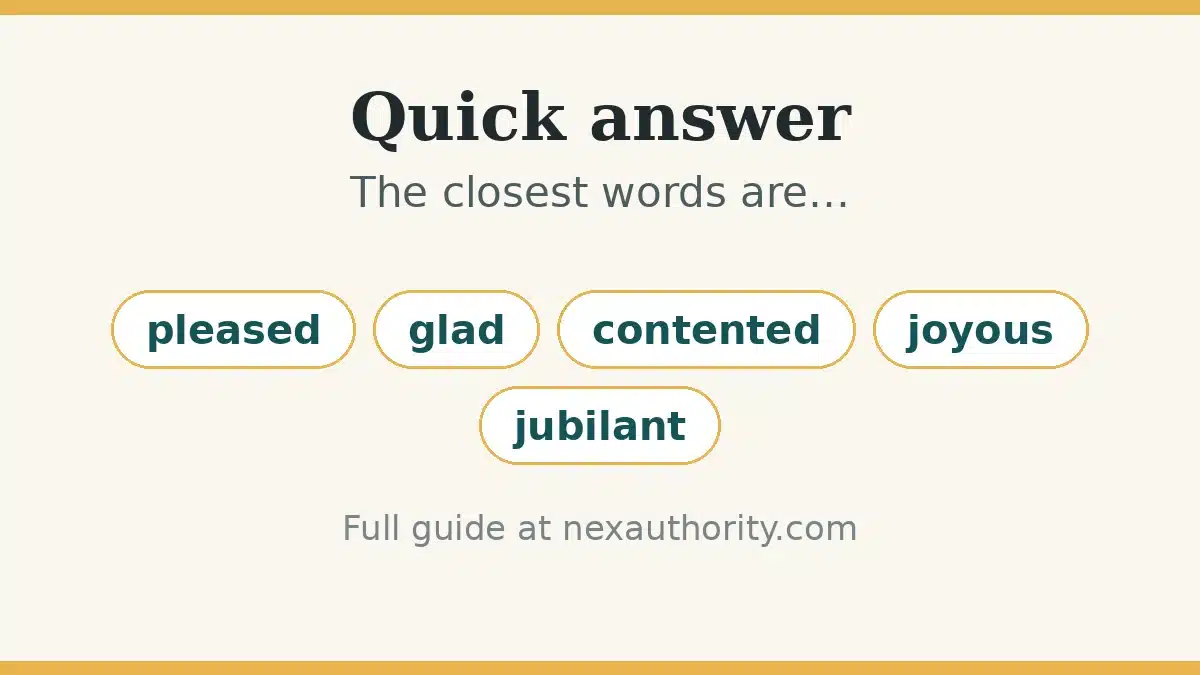
Happy means feeling pleased and satisfied, while joyful means feeling or showing great happiness that runs deeper and shows more. The closest words for the pair are pleased, glad, contented, joyous, and jubilant, each fitting a different moment. Happy covers everyday pleasure, and joyful covers the bigger, brighter feeling that often comes with a celebration.
Choose pleased for a calm, polite reaction to good news. Choose joyous for a bright, open feeling that shows in a smile or a song. Choose jubilant for a loud, triumphant feeling after a win.
- Happy — feeling pleased and satisfied, the broad everyday word
- Joyful — feeling or showing great happiness, stronger and brighter
- Pleased — calm and polite, a gentle reaction to good news
- Glad — pleased and relieved, often about a person or an outcome
- Contented — quiet and settled, wanting nothing more
- Joyous — full of joy, bright and open
- Jubilant — triumphant and loud after a success
Happy vs Joyful: The Verdict Table
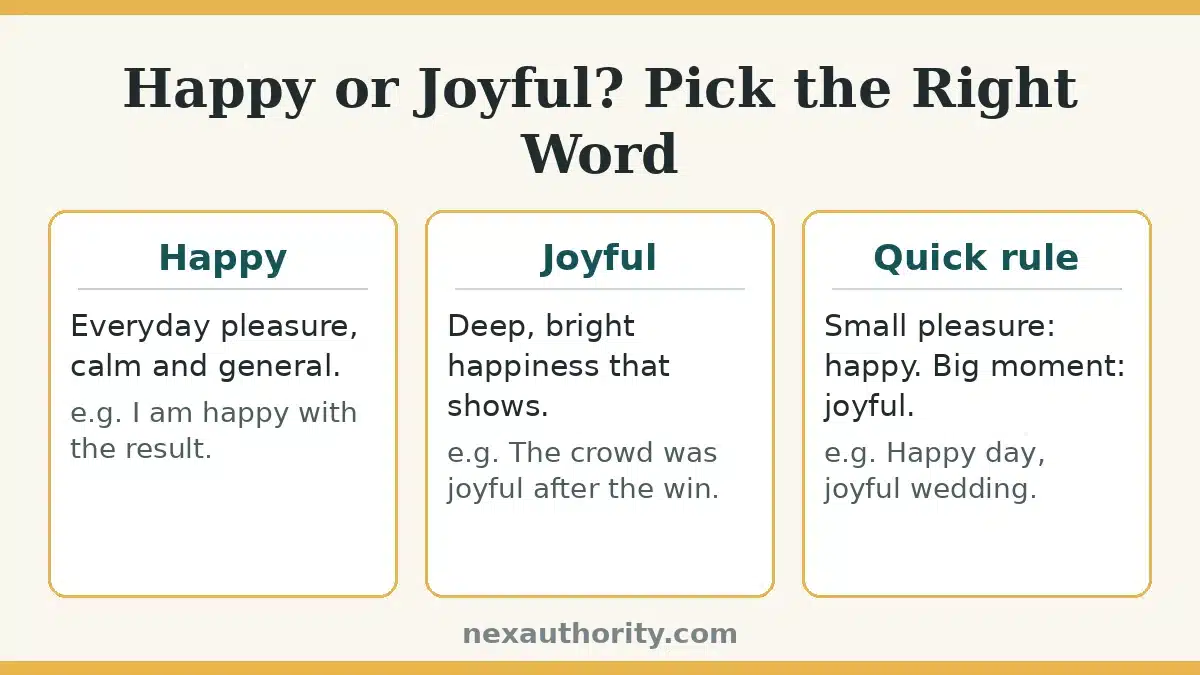
| Happy | Joyful | |
|---|---|---|
| Meaning | Feeling pleased and satisfied | Feeling or showing great happiness |
| Strength | Mild to strong, the general word | Strong, deeper than happy |
| Register | Neutral, fits every setting | Slightly formal and literary |
| Duration | Often short, tied to one event | Can last longer, tied to a big moment |
| Source | Often an outside event, like good news | Often meaning, connection, or purpose |
| Shows in | A smile, a calm mood | Face, voice, movement, celebration |
| Example | “I am happy with the result.” | “The crowd was joyful after the win.” |
| Use happy when… | The pleasure is ordinary or calm | — |
| Use joyful when… | — | The feeling is big, bright, and shared |
Happy and Joyful Word Cards
- Happy — part of speech: adjective (happier, happiest)
- Happy — pronunciation: US /ˈhæp.i/, UK /ˈhæp.i/
- Happy — register: neutral, the most common word for the feeling
- Joyful — part of speech: adjective (more joyful, most joyful)
- Joyful — pronunciation: US /ˈdʒɔɪ.fəl/, UK /ˈdʒɔɪ.fəl/
- Joyful — register: slightly formal, common in writing, songs, and speeches
Ten Words That Show the Difference in Detail
Pleased
Pleased means calmly happy about something that happened, and it is the politest word on the happy side. It fits emails, thanks, and formal replies, where a big emotional word would feel too much. “She was pleased with the exam results and thanked her teacher.” Use it when the feeling is mild and controlled. Avoid it when the joy is loud or wild, since pleased sounds far too quiet.
Glad
Glad means pleased and often relieved, and it usually points at a person or an outcome. It is warm and everyday, and it fits thanks, greetings, and good news about someone else. “I am glad you could come to the party.” Use it when relief mixes with pleasure. Avoid it for deep, lasting joy, where joyful or contented says more.
Contented
Contented means quietly happy with what you have, with no urge for more. It describes a settled state rather than a reaction, and it suits calm people, simple lives, and peaceful scenes. “The contented cat slept by the fire all afternoon.” Use it when peace is the point. Avoid it for sudden good news, since contented moves slowly and never jumps.
Cheerful
Cheerful means happy in a way other people can see, bright in face, voice, and manner. It describes how someone comes across, not only how they feel inside. “The cheerful shopkeeper greeted every customer by name.” Use it for people and greetings that lift a room. Avoid it for private, quiet feelings, where contented fits better.
Delighted
Delighted means very happy about something that happened, and it stays polite even at full strength. It is the workhorse of formal announcements, invitations, and thank-you notes. “We are delighted to welcome you to the show.” Use it when you want warmth with good manners. Avoid it for wild celebration, since delighted stays composed and never shouts.
Joyous
Joyous means full of joy, bright and open, and it is the closest synonym for joyful itself. It suits weddings, music, spring mornings, and any scene where happiness fills the air. “The joyous crowd sang as the sun came up.” Use it when the feeling is visible and shared. Avoid it for small, private pleasures, where happy is the honest word.
Jubilant
Jubilant means extremely happy because of a success, and it is loud, public, and triumphant. Teams, crowds, and winners are jubilant, and the word carries movement and noise. “The jubilant fans poured into the streets after the final whistle.” Use it after a win or a hard-earned result. Avoid it for quiet good news, since jubilant needs a crowd and a cause.
Elated
Elated means very happy and lifted up, often after tension breaks or a result lands. The feeling is high and short-lived, like a rush that fades back to calm. “She felt elated when the acceptance letter arrived.” Use it when the high follows a risk or a wait. Avoid it for steady, settled happiness, where contented is the better pick.
Ecstatic
Ecstatic means excited and extremely happy, often beyond words, and it suits crowds, fans, and life-changing news. It is one of the strongest words in this group, so it needs a moment to match it. “The ecstatic crowd cheered as the band took the stage.” Use it only for the biggest highs. Avoid it for everyday pleasure, since it will sound like overstatement.
Overjoyed
Overjoyed means so happy that the feeling overflows, and it usually follows news about a person you love. It is warm and personal, and it fits reunions, births, and long-awaited good news. “They were overjoyed to hear their son was safe.” Use it when the news moves you deeply. Avoid it for work wins and small favours, where pleased or glad is enough.
Best Word by Situation
| Situation | Best pick | Why |
|---|---|---|
| Everyday conversation | Happy | Broad, warm, and instantly clear |
| Formal email | Pleased | Polite and controlled, never too much |
| A wedding or celebration | Joyful | Bright, deep, and made for big moments |
| After a sports win | Jubilant | Loud, public, and triumphant |
| Quiet, settled life | Contented | Calm and lasting, wanting nothing more |
| Creative writing | Joyous | Visual and open, full of light |
Happy and Joyful on One Scale
Think of the two words as points on one scale, not as opposites. Happiness is the broad category, and joy sits at the top of it: you can be happy without being joyful, but you cannot be joyful without being happy. Joy also lasts through hard times, since it grows from meaning and connection, while happiness fades when things stop going well.
Common Collocations for Happy and Joyful
Five natural combinations:
- happy ending — “The film had a happy ending, and the whole cinema cheered.”
- happy birthday — “We sang happy birthday before she cut the cake.”
- joyful noise — “The children made a joyful noise as they ran into the garden.”
- joyful celebration — “The joyful celebration lasted long into the night.”
- happy accident — “Meeting her in that small cafe was a happy accident.”
Words People Confuse With Happy and Joyful
Happy
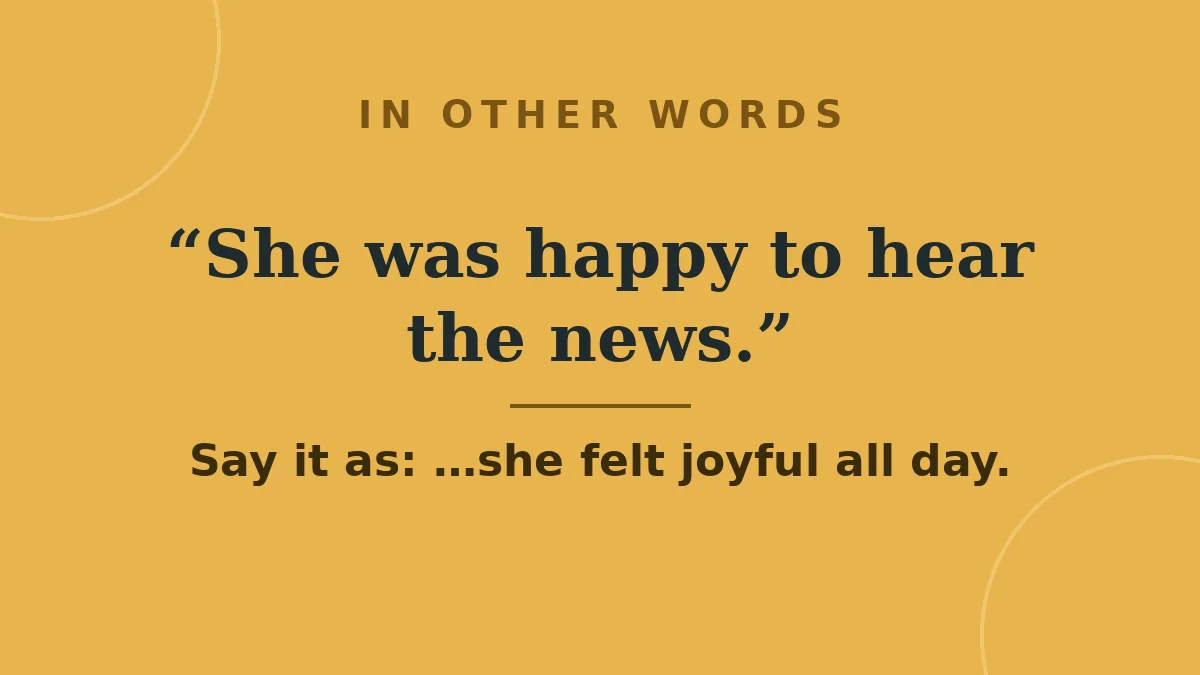
Happy is the broad word for feeling pleased, while joyful is the stronger word for feeling great happiness. Happy: “I am happy with my new flat.” Joyful: “The joyful choir sang at the wedding.” Happy fits almost any good feeling, while joyful needs a bigger, brighter moment to sound right.
Joyful
Joyful describes a deep, visible happiness, while cheerful describes a bright manner other people can see. Joyful: “The joyful crowd sang all night.” Cheerful: “The cheerful nurse greeted every patient with a smile.” Joyful runs deep, while cheerful stays on the surface in face and voice.
Jubilant
Jubilant means triumphant after a success, while elated means lifted up after tension breaks. Jubilant: “The jubilant team lifted the trophy.” Elated: “She felt elated when the results came in.” Jubilant needs a win and a crowd, while elated needs only a release of pressure.
When NOT to Use Happy or Joyful
Four common mistakes, each with a wrong example and a corrected one.
- Calling a loud win merely happy. A triumph needs a stronger word. Wrong: “The team was happy after winning the final.” Corrected: “The team was jubilant after winning the final.”
- Calling a small favour joyful. Joyful is too big for everyday thanks. Wrong: “She was joyful that he held the door.” Corrected: “She was pleased that he held the door.”
- Calling a quiet mood joyful. Joyful shows, so a calm state needs a calmer word. Wrong: “He sat in joyful silence all evening.” Corrected: “He sat in contented silence all evening.”
- Calling relief joyful. Relief is glad, not joyful. Wrong: “I am joyful the train was only ten minutes late.” Corrected: “I am glad the train was only ten minutes late.”
Antonyms of Happy and Joyful by Context
The antonyms of happy and joyful name feelings that are sad, flat, or without pleasure.
| Antonym | Type | Context |
|---|---|---|
| Sad | Direct | Unhappy, full of sorrow |
| Unhappy | Direct | Not pleased, not satisfied |
| Miserable | Direct | Deeply unhappy, suffering |
| Gloomy | Contextual | Dark in mood, without hope |
| Sorrowful | Contextual | Full of grief, formal use |
| Joyless | Contextual | Without joy, flat and dull |
| Downcast | Contextual | Sad in look and manner |
| Dejected | Contextual | Low after a failure or loss |
Origin of the Words Happy and Joyful
Happy came into English in the late 1300s from hap, meaning chance or fortune, so a happy person was first someone favoured by luck. Joyful comes from joy, which reached English through Old French joie and Latin gaudium, meaning delight. The two words grew from different roots: one from fortune, one from delight, and that split still shows in how they feel today.
Frequently Asked Questions
What is the difference between happy and joyful?
Happy is the broad, everyday word for feeling pleased and satisfied, and it fits small wins, good news, and calm days. Joyful is stronger and brighter, and it describes a deep feeling of joy that often shows in the face, voice, or body. Use happy for ordinary pleasure and joyful for moments that feel bigger.
Is joyful stronger than happy?
Yes, joyful is stronger than happy in most uses. Happy covers the whole range from mild pleasure to real delight, while joyful sits near the top of that range and adds brightness and depth. A happy day can be quiet, but a joyful day is one you can see and hear.
Can you use happy and joyful in the same sentence?
Yes, you can use both words in one sentence when you compare them or build from one to the other. For example: “She was happy with the gift, and joyful when her whole family arrived.” The pair works best when happy comes first and joyful marks the bigger feeling.
When should I use joyful instead of happy?
Use joyful when the feeling is big, bright, and shared, as at a wedding, a reunion, or a win that moves a crowd. It also fits songs, poems, and speeches, where its slightly formal tone sounds natural. For small, everyday pleasures, happy is the honest and safer choice.
Is joyful formal?
Joyful is slightly formal and literary, but it is not stiff or old-fashioned. It appears in speeches, hymns, poems, and formal writing more often than in casual chat. In everyday talk, happy does the same job without sounding dressed up, so save joyful for moments that deserve it.
Can you be joyful and sad at the same time?
Yes, and this is the clearest split between the two words. Happiness depends on things going well, so sadness pushes it away. Joy grows from meaning and connection, so it can sit beside grief and still hold, even on a hard day.
Conclusion
Happy is the safe, everyday word for feeling pleased, and it fits almost any good moment without sounding wrong. Joyful is the stronger, brighter word for deep happiness that shows, and it suits celebrations, songs, and big shared moments. For the full dictionary definition, see joyful at the Cambridge Dictionary.