
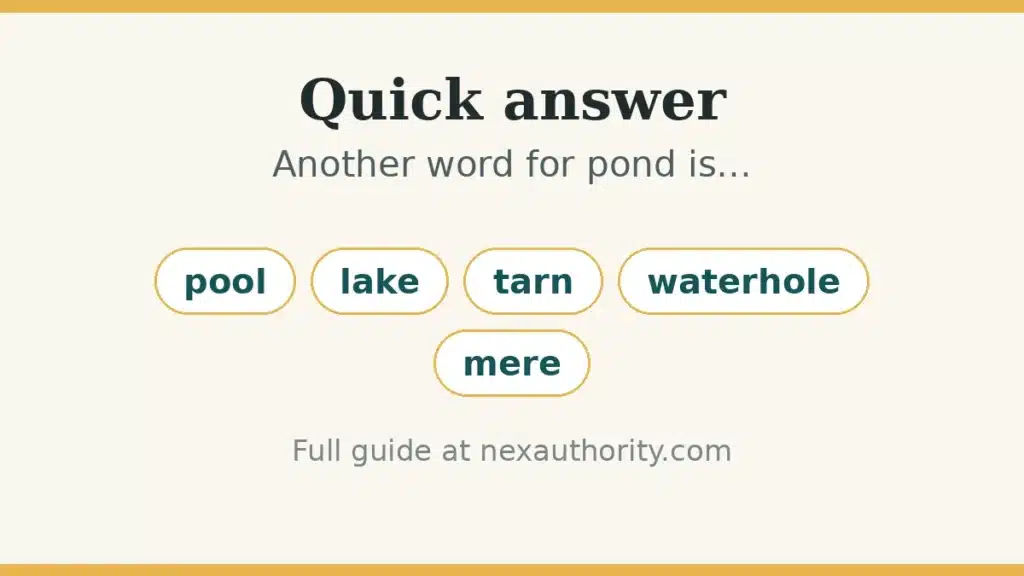
Pond means a small body of still water, smaller than a lake, that forms naturally or is made by people for fish, wildlife, or decoration. The closest synonyms for the word itself are pool, small lake, lakelet, mere, and tarn.
Choose pool for everyday use. Choose small lake when size is the point. Choose mere for a literary tone about still water.
- Pool — small still-water body
- Small lake — lake smaller than usual
- Lakelet — very small lake
- Mere — literary small lake
- Tarn — small mountain lake
- Waterhole — animals drink here
Synonyms for Pond: Full Tiered Table
| Synonym | Tier | Meaning (3-6 words) | Best for |
|---|---|---|---|
| Pool | Exact | Small still water | Everyday |
| Small lake | Exact | Lake smaller than usual | Size |
| Lakelet | Exact | Very small lake | Description |
| Mere | Exact | Small literary lake | Literary |
| Tarn | Exact | Small mountain lake | Mountains |
| Waterhole | Near | Pool where animals drink | Nature |
| Millpond | Near | Pond holding mill water | History |
| Reservoir | Near | Stored water supply | Technical |
| Lagoon | Near | Shallow coastal water | Coasts |
| Loch | Near | Scottish lake or inlet | Scotland |
| Fishpond | Near | Fish kept here | Gardens |
| Duck pond | Near | Ducks live here | Parks |
| Garden pond | Near | Small ornamental pond | Gardens |
| Lily pond | Near | Water lilies here | Description |
| Basin | Near | Hollow holding water | Description |
| Lake | Related | Large inland water | Comparisons |
| Ocean | Related | Vast sea, “the pond” | Idiom |
| Puddle | Related | Small rainwater pool | Temporary |
| Marsh | Related | Wet, grassy lowland | Wetlands |
| Wetland | Related | Water-saturated land area | Ecology |
| Swamp | Related | Flooded wooded wetland | Nature |
| Bog | Related | Soft, peaty wetland | Nature |
| Estuary | Related | Tidal river mouth | Coasts |
| Inlet | Related | Narrow coastal passage | Coasts |
| Cove | Related | Small sheltered bay | Coasts |
Pond Word Card
- Part of speech: noun, countable
- Pronunciation: US /pɑːnd/, UK /pɒnd/
- Word forms: ponds (plural); pond (verb), ponding
- Register: neutral
Top 10 Synonyms for Pond in Detail
Pool
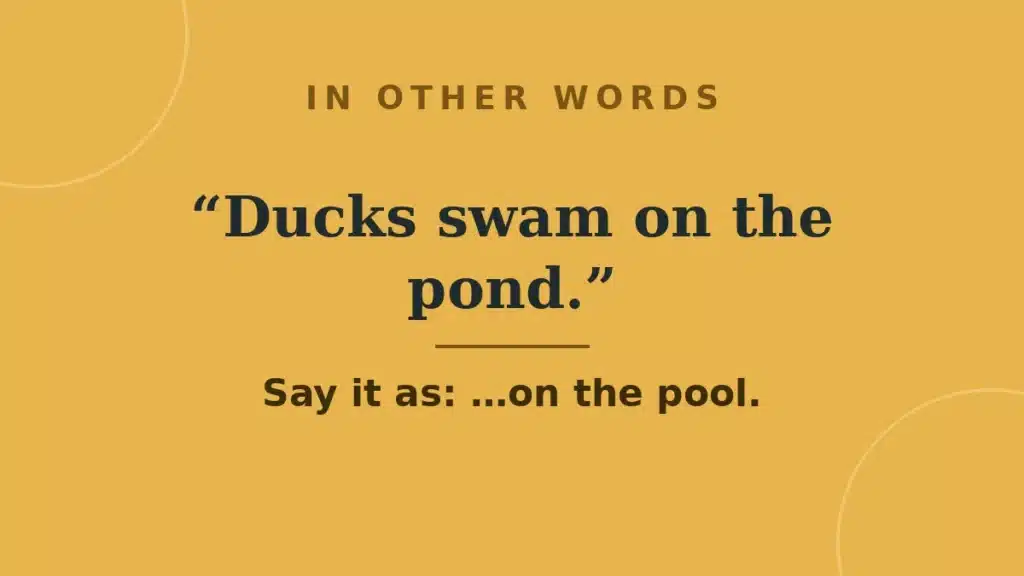
Pool names a small body of still water, the stand-in for pond. It suits gardens and parks. “The frogs returned to the pool each spring.” Use it for a plain, familiar word. A swimming hole is a pond deep enough to swim in. Avoid it for a built swimming pool.
Small lake
Small lake is the plainest descriptive option: it says the water is lake-like but smaller. It works in reports and guides where precision matters most. “The trail ends at a small lake ringed with pines.” Use it when size is the point. Avoid it in poetry, where it sounds flat.
Lakelet
Lakelet is a rare diminutive word for a small lake, from lake plus -let. It carries a quaint tone for descriptive passages. “A lakelet no wider than a garden hid behind the hill.” Use it for tiny water bodies. Avoid it in plain writing, where readers may not know it.
Mere
Mere is an old literary word for a small lake or pond, heard in place names. It sounds quiet and still, with an old-fashioned color. “Mist lay over the mere at dawn.” Use it for a literary tone about calm water. Avoid it in everyday writing, where it can confuse.
Tarn
Tarn names a small lake in the mountains, often one left by a glacier in rock. It is precise for hill country, known to walkers and climbers. “We ate lunch beside a tarn high above the valley.” Use it for mountain lakes. Avoid it for lowland ponds, where it misleads.
Waterhole
Waterhole names a pool where wild animals drink, in dry country. It stresses drinking animals, not size or beauty. “Elephants gathered at the waterhole as the sun went down.” Use it when animals drink. Avoid it for a garden or wildlife pond, where people, not wild animals, are the point.
Millpond
Millpond names the pond that holds water to drive a mill wheel, behind a dam. It is a historical word, tied to mills and old water power. “The millpond lay still above the ruined wheelhouse.” Use it for historical settings with mills. Avoid it for any pond without a mill.
Reservoir
Reservoir names a stored body of water, usually made by damming a stream for water, irrigation, or power. It is a technical word for human control and purpose. “The town draws its water from a reservoir in the hills.” Use it for managed water supplies. Avoid it for a natural pond.
Lagoon
Lagoon names a shallow body of water cut off from the sea by sand or coral, common on coasts and islands. It sounds warm and tropical, suiting coastal writing. “We swam in the lagoon before breakfast.” Use it for shallow coastal water. Avoid it for inland ponds, where it misleads.
Loch
Loch is the Scottish word for a lake or narrow sea inlet, the natural choice for Scottish settings. It carries place and culture; readers hear Scotland at once. “The road ran beside the loch all morning.” Use it for Scottish lakes and inlets. Avoid it outside Scotland, where it sounds affected.
Best Word by Situation
| Situation | Best pick | Why |
|---|---|---|
| Formal | Reservoir | Technical |
| Academic | Small lake | Clear |
| Business | Pond | Plain |
| Everyday | Pool | Familiar |
| Creative | Mere | Literary |
All Meanings of Pond
Pond as a small body of still water
In its main sense, a pond is a body of still water smaller than a lake, natural or man-made. Garden, farm, wildlife, and millponds all fit. Sunlight often reaches the bottom, so rooted plants grow across the bed. It is open water, not a marsh, wet land with plants through it. “Children fed ducks at the pond every morning.”
“The pond” as the Atlantic Ocean
With “the” in front, pond is a joking name for the Atlantic ocean, as in “across the pond.” The joke shrinks a vast ocean to a farm pond. “Her sister moved across the pond to Boston.”
Common Collocations for Pond
Five natural combinations:
- garden pond — “They built a garden pond with a waterfall.”
- duck pond — “The village green has a duck pond.”
- koi pond — “They keep koi in the pond behind the house.”
- lily pond — “A lily pond covered half the garden.”
- across the pond — “Our cousins live across the pond in Toronto.”
Words People Confuse With Pond
Lake
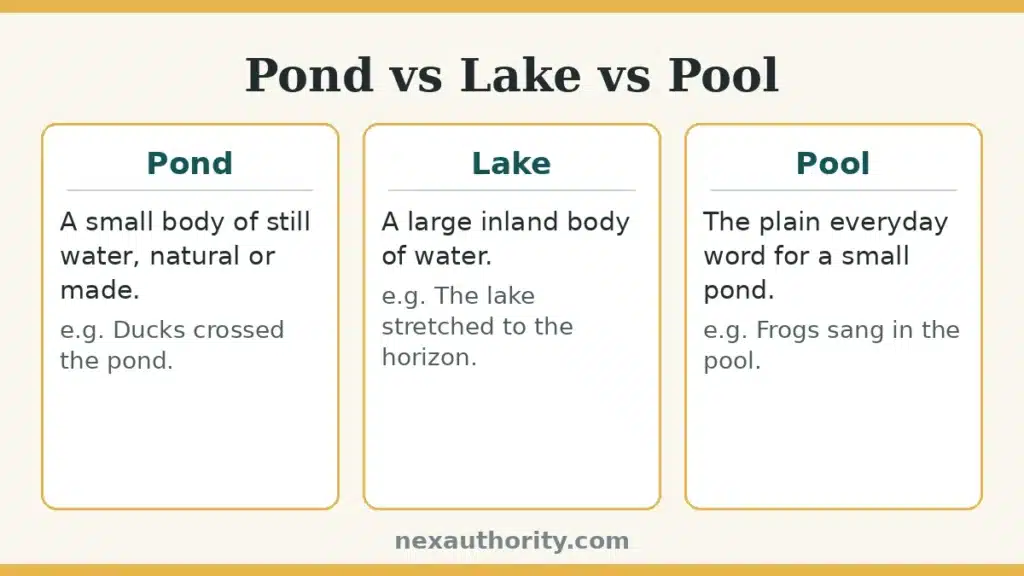
A lake is large water, while a pond is small. Size is the usual difference, but names follow local use. Lake: “The lake stretched to the horizon.” Pond: “The pond sat behind the house.”
Pool
Pool is the closest everyday synonym, but also names a swimming pool or a game. Pool: “The hotel pool opens at seven.” Pond: “Frogs sang in the pond all night.”
Puddle
A puddle is rainwater that dries fast, while a pond lasts and holds life. Puddle: “She stepped over a puddle.” Pond: “The pond held fish all year.”
When NOT to Use Pond
Four common mistakes.
- Calling a puddle a pond. Puddles dry in hours. Wrong: “A pond formed on the sidewalk after the storm.” Corrected: “A puddle formed on the sidewalk after the storm.”
- Calling a large lake a pond. Size differs. Wrong: “We sailed across the pond to the far shore.” Corrected: “We sailed across the lake to the far shore.”
- Using “the pond” in formal writing. It sounds flippant. Wrong: “The trade deal links firms on both sides of the pond.” Corrected: “The trade deal links firms on both sides of the Atlantic.”
- Calling a swimming pool a pond. Readers picture mud and frogs. Wrong: “The kids swam in the pond behind the hotel.” Corrected: “The kids swam in the pool behind the hotel.”
Antonyms of Pond by Context
These antonyms name larger water, flowing water, or dry land.
| Antonym | Type | Context |
|---|---|---|
| Ocean | Direct | Vast opposite |
| Sea | Direct | Large saltwater |
| Lake | Contextual | Larger water |
| River | Contextual | Flowing, not still |
| Stream | Contextual | Flowing water |
| Desert | Contextual | Almost no water |
| Dry land | Contextual | Solid ground |
| Drought | Contextual | Long dry period |
Origin of the Word Pond
Pond dates to about 1300 as a banked body of water, a variant of pound, an enclosed place. It spread to natural pools in the late 1400s, and the joking Atlantic use dates to the 1640s.
Frequently Asked Questions
What is another word for pond?
Pool is the closest everyday word for pond, fitting gardens and parks alike. Small lake works when size matters, and mere suits literary writing. For a mountain lake, tarn is the precise word; for Scotland, loch is the natural choice.
What is the definition of pond?
The pond definition covers a small body of still water, smaller than a lake, natural or man-made. Garden, farm, wildlife, and millponds all count. With “the” in front, it is also an informal Atlantic name, as in “across the pond.”
What are the antonyms of pond?
The main pond antonyms are ocean and sea, vastly larger water. Lake is the antonym when size is the point, while river and stream oppose the stillness of a pond. Desert, dry land, and drought name the absence of water.
How do you use pond in a sentence?
To use pond in a sentence, name the water and give it a setting or a creature. Two models: “Ducks crossed the pond at first light.” And: “The old millpond holds trout.” Say where the pond is or what lives in it.
What is the difference between a pond and a lake?
Size is the main difference: a pond is small and shallow, a lake large and deep. Ponds warm fast and support plants across most of their bed. Names follow local use: Island Pond in New Hampshire covers about 500 acres, while Echo Lake nearby covers under 16.
Conclusion
Pool is the best overall synonym for pond: short, familiar, and fit for gardens, parks, and wild places. For a literary tone, mere adds quiet color; for mountains, tarn is the precise pick. For the full dictionary definition, see pond at the Cambridge Dictionary.