
Who means which person or people, used to ask about someone’s identity or to point to a person already mentioned in a sentence. The closest synonyms for the word itself are whom, whose, whoever, which person, and the person that.
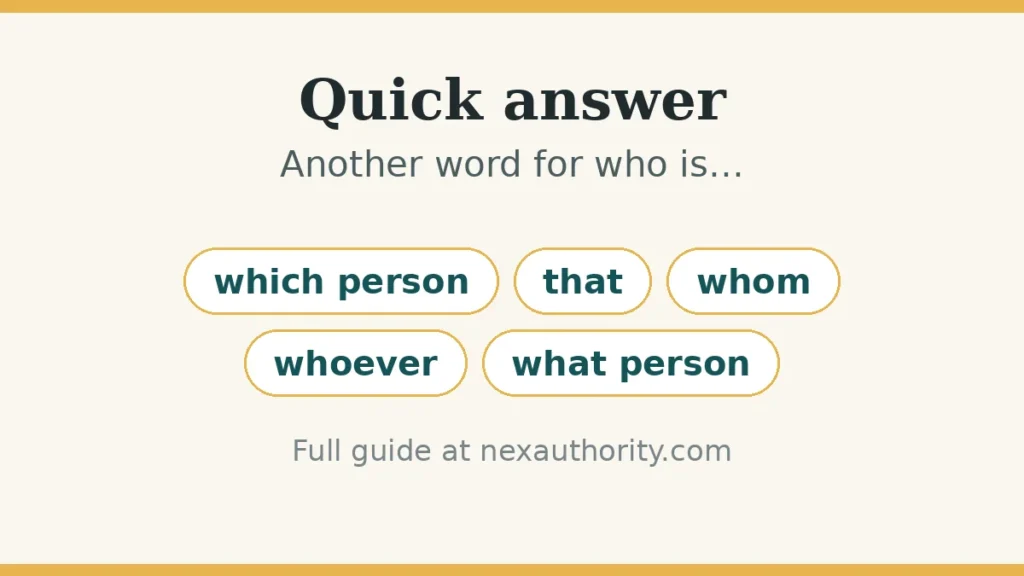
Choose whom for objects and after prepositions in formal writing. Choose whose when the person owns something. Choose whoever when any person at all will do.
- Whom — object form of who
- Whose — possessive form of who
- Whoever — any person at all
- Which person — asking for identity
- The person that — person described
- That — relative pronoun, informal use
Synonyms for Who: Full Tiered Table
| Synonym | Tier | Meaning (3-6 words) | Best for |
|---|---|---|---|
| Whom | Exact | Object form of who | Formal |
| Whose | Exact | Possessive form of who | Ownership |
| Whoever | Exact | Any person at all | Indefinite |
| Which person | Exact | Asking for identity | Questions |
| The person that | Exact | Person being described | Clauses |
| That | Near | Relative pronoun, informal | Defining |
| Which | Near | For things or people | Non-defining |
| Whosoever | Near | Any person, formal | Older |
| Whomever | Near | Object form of whoever | Formal |
| Who on earth | Near | Emphatic, surprised question | Emphasis |
| What person | Near | Asking which person | Questions |
| Any person | Near | No named person | General |
| Someone | Near | An unnamed person | General |
| The one who | Near | The person described | Clauses |
| A person who | Near | Described by clause | Clauses |
| What | Related | Asks about things | Contrast |
| When | Related | Asks about time | Contrast |
| Where | Related | Asks about place | Contrast |
| Why | Related | Asks about reasons | Contrast |
| How | Related | Asks about manner | Contrast |
| Anyone | Related | Any person | General |
| Anybody | Related | Any person | Speech |
| Nobody | Related | No person at all | Negative |
| He or she | Related | A known person | Contrast |
| They | Related | Known people | Contrast |
Who Word Card
- Part of speech: pronoun (interrogative and relative)
- Pronunciation: US /huː/, UK /huː/
- Word forms: whom, whose, whoever, whomever, whosoever, who’s (who is/has)
- Register: neutral; whom is formal
Top 10 Synonyms for Who in Detail
Whom
Whom is the object form of who, used when the person receives the action or follows a preposition. It belongs in formal writing. “She is the manager whom I asked for help.” Use it in formal prose and after prepositions. Avoid it in casual speech, where who is the norm.
Whose
Whose is the possessive form of who, used to ask or show who owns or holds something. It covers people and things in relative clauses. “Whose coat is this?” Use it whenever ownership or belonging is the question. Avoid it for the contraction who’s, which means who is or who has.
Whoever
Whoever means any person at all, without naming anyone. It is indefinite and open, and it also adds force to questions. “Whoever finds the key should return it.” Judge it by its own clause: “Whoever called first wins.” Use it for unnamed subjects. Avoid it for one named person, where who points directly.
Which person
Which person is the plain paraphrase of who in a question, asking for identity out of a group. It helps when who feels too short. “Which person left the door open?” Use it for a choice among people present. Avoid it in relative clauses, where who or that fits better.
The person that
The person that is the plain paraphrase of who in a defining relative clause, naming the person a clause describes. Clear and common in speech. “The person that called left no name.” Use it for defining clauses in informal writing. Avoid it in non-defining clauses after commas, where that is barred.
That
That works as a relative pronoun for people in defining clauses, the everyday choice. It replaces who when the clause defines the person. “The woman that helped us was kind.” Use it in defining clauses and casual prose. Avoid it in non-defining clauses, where who is required after a comma.
Which
Which is a relative pronoun used for things, sometimes standing in for who about people in loose speech. Safest for things and choices among a set. “The team, which won last year, celebrated.” Use it for things and non-defining clauses. Avoid it as a first choice for people, where who is standard.
Whosoever
Whosoever is the older, formal form of whoever, meaning any person at all, without exception. It appears in scripture, law, and older poetry, and sounds grand today. “Whosoever seeks help shall find it.” Use it for a solemn, formal, or scriptural tone. Avoid it in modern writing, where whoever is natural.
Whomever
Whomever is the object form of whoever, used in formal writing when the unnamed person receives the action. Rare and formal. “Give the prize to whomever you choose.” Judge it by its own clause, not the whole sentence. Use it after verbs and prepositions. Avoid it in speech, where whoever does the job.
Who on earth
Who on earth is an emphatic question phrase showing shock or surprise about a person’s identity. It stresses the question and expects no calm answer. “Who on earth left the gate open?” Use it for surprise and strong feeling. Avoid it in formal or polite writing, where it sounds rude.
Best Word by Situation
| Situation | Best pick | Why |
|---|---|---|
| Formal | Whom | Object form |
| Academic | Who | Standard |
| Business | Who | Plain |
| Everyday | Who | Natural |
| Creative | Whoever | Open |
All Meanings of Who
Who as an interrogative pronoun
Asks which person or people.
Who as a relative pronoun
Names the person meant. “The teacher who helped me retired.”
Who as the person that
Means the person that. “Who laughs last laughs best.”
Who in indirect questions
Reports what is not known. “I don’t know who took the keys.”
Who in emphatic questions
Adds shock or force. “Whoever would do such a thing?”
Who as initials
WHO is the World Health Organization.
Common Phrases With Who
Who has no true collocations; five fixed phrases follow:
- who knows — “Who knows what tomorrow brings?”
- who cares — “Who cares about old rules?”
- who’s who — “A who’s who of local lawyers.”
- who on earth — “Who on earth did this?”
- guess who — “Guess who came to dinner?”
Words People Confuse With Who
Whom
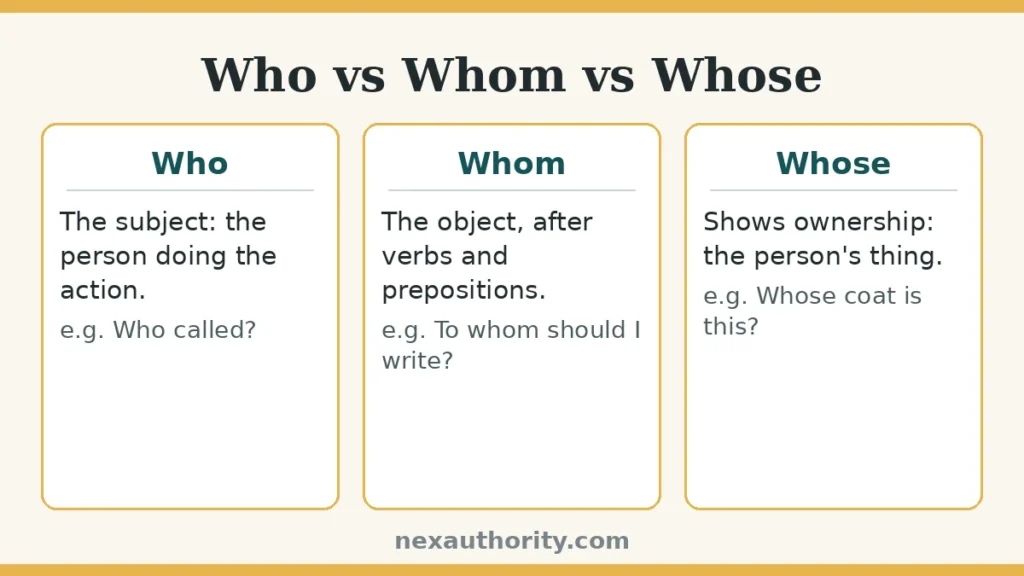
Whom is the object form of who, used after verbs and prepositions. He/him test: if him fits, use whom. Whom: “To whom should I address the letter?” Who: “Who wrote the letter?”
Whose
Whose is the possessive form, showing ownership. Whose comes before a noun: “Whose umbrella is this?” Who’s: “Who’s coming to the meeting?”
Who’s
Who’s contracts who is or who has; it is not a pronoun. Test it: if “who is” fits, use who’s. Who’s: “Who’s at the door?” Whose: “Whose voice was that?”
When NOT to Use Who
Five mistakes.
- Using who for things. Who is for people; things take that. Wrong: “The book who I read was long.” Corrected: “The book that I read was long.”
- Using who after a preposition in formal writing. Formal prose wants whom. Wrong: “To who should I write?” Corrected: “To whom should I write?”
- Using who’s for whose. Who’s means who is or who has; whose shows ownership. Wrong: “Who’s coat is this?” Corrected: “Whose coat is this?”
- Using that in a non-defining clause. After a comma, that cannot replace who. Wrong: “My father, that was a lawyer, retired.” Corrected: “My father, who was a lawyer, retired.”
- Using whom as a subject. Whom never does the verb’s action. Wrong: “The spy whom loved me was brave.” Corrected: “The spy who loved me was brave.”
Antonyms of Who by Context
The nearest contrasts follow.
| Antonym | Type | Context |
|---|---|---|
| Which | Contextual | Points at things |
| What | Contextual | Asks about things |
| Nobody | Contextual | No person at all |
| No one | Contextual | No person at all |
| None | Contextual | Not any person |
| Someone | Contextual | A known unnamed person |
Origin of the Word Who
Who comes from Old English hwā, from Proto-Germanic *hwas. First known use: before the 12th century.
Frequently Asked Questions
What is the who definition?
The who definition is a pronoun with two jobs: asking which person or people, and pointing to a person mentioned. As a question word it asks for identity; as a relative word it adds information about a person, never a thing.
What is another word for who?
Another word for who depends on the job: whom for objects in formal writing, whose for possession, whoever for any person at all. In defining relative clauses, that does the same work informally. In questions, which person is the plain paraphrase.
How do you use who in a sentence?
Use who for people, as a question word or a relative word. Examples: “Who is at the door?” and “The nurse who helped me was kind.” Use whom after prepositions in formal writing, and never use who for a thing.
What are the who antonyms?
Who has no true antonyms, because pronouns do not take opposites the way adjectives do. The nearest contrasts are which and what, which point at things rather than people, and nobody and no one, which say no person is meant.
What is the difference between who and whom?
Who is the subject form and whom is the object form. Use who when the person does the action: “Who called?” Use whom as an object or after a preposition: “Whom did you call?” He means who; him means whom.
What is the difference between whoever and whomever?
Whoever is the subject form and whomever is the object form. Check the role inside its own clause, not the whole sentence: “Whoever called first wins” but “Give it to whomever you choose.” In casual speech, whoever does both jobs.
Conclusion
Who is the standard pronoun for asking about people and adding information about a person mentioned. For formal object uses, whom is correct; for possession, whose; for any person, whoever. For the full dictionary definition, see who at the Cambridge Dictionary.