
Synonyms for colors are words that describe colors, color variations, or specific qualities of color. The closest alternatives include hues, shades, tones, tints, and tinges, but each word has a slightly different meaning.
If you need another word for colors in an essay, creative writing, art, design, fashion, or everyday speech, the right choice depends on context. Hue is the closest general alternative, while shade, tint, tone, and tinge describe more specific types or qualities of color.
What is the best other word for Colors
The closest synonyms for colors are hues, shades, tones, tints, and tinges. These words overlap with colors, but they are not always interchangeable.
Hue usually means a color or color type. Shade means a particular form of a color. Tint often means a small amount or lighter variation of color. Tinge means a slight amount of color. Tone can describe a color variation or quality.
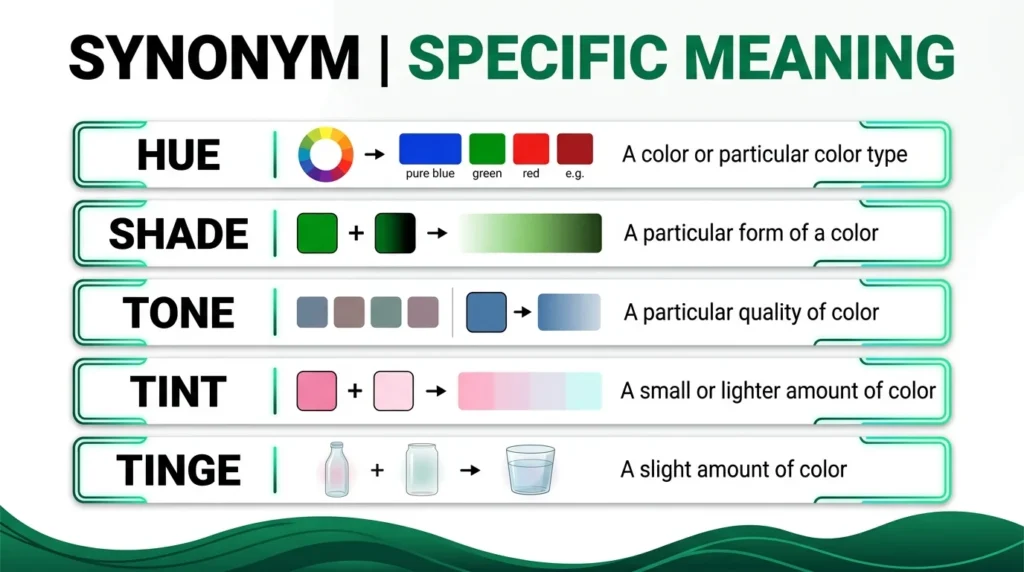
Synonyms for Colors at a Glance
| Synonym | Specific Meaning | Synonym | Specific Meaning |
| Hue | A color or particular color type | Shade | A particular form of a color |
| Tone | A particular quality of color | Tint | A small or lighter amount of color |
| Tinge | A slight amount of color |
These five are the strongest lexical alternatives for the visual-color meaning of color/colors. Dictionary sources also list other related terms, but those words often carry narrower meanings.
Direct Synonyms for Colors
Hue
Pronunciation: /hjuː/
Meaning: A color or a particular type or variation of color.
Examples:
- The room has a soft blue hue.
- The artist used warm hues of red and orange.
Use it when: You want a polished or slightly more technical alternative to color. Cambridge and Collins both define hue in terms of color.
Shade
Pronunciation: /ʃeɪd/
Meaning: A particular form or variation of a color.
Examples:
- She chose a dark shade of green.
- The paint comes in several shades of blue.
Use it when: You mean one specific variation of a color. Collins defines shade as one of the different forms of a particular color.
Tone
Pronunciation: /toʊn/
Meaning: A particular quality or variation of color.
Examples:
- The painting uses warm earth tones.
- The designer chose soft gray tones.
Use it when: You are describing the quality or character of a color, especially in art, design, and photography.
Note: Tone has many other meanings, including sound, mood, and attitude. Context must make the color meaning clear.
Tint
Pronunciation: /tɪnt/
Meaning: A small amount or lighter variation of a color.
Examples:
- The walls have a pale blue tint.
- The glass has a slight green tint.
Use it when: You mean a light, pale, or slight color variation. Cambridge and Collins both describe tint as a small amount or variation of color.
Tinge
Pronunciation: /tɪndʒ/
Meaning: A small or slight amount of color.
Examples:
- The clouds had a pink tinge.
- The white fabric showed a blue tinge.
Use it when: The color is faint or only slightly noticeable.
Important distinction: Tinge usually emphasizes a small amount of color. It is weaker than the general word color. Collins and other dictionary sources distinguish this nuance clearly.
Related and Contextual Alternatives for Colors
Not every thesaurus result is an exact synonym. The following words are useful only in specific contexts.
| Word | Classification | Meaning |
| Coloration | Contextual alternative | The overall appearance produced by color |
| Coloring | Contextual alternative | The combined or applied color appearance |
| Cast | Contextual alternative | A noticeable influence from another color |
| Pigmentation | Technical term | Color produced by pigment |
| Chroma | Technical term | The strength or purity of a color |
| Saturation | Technical term | The strength or intensity of a color |
| Lightness | Technical term | How light or dark a color appears |
| Brightness | Technical term | The apparent brightness of a color |
| Value | Art/design term | The lightness or darkness of a color |
| Undertone | Color-analysis term | A subtle color beneath the main color |
| Colourway | Design/fashion term | A particular color combination |
| Tincture | Formal/specialized term | A coloring substance or color |
| Pigment | Material term | A substance that produces color |
| Dye | Material term | A substance used to color materials |
| Stain | Material/process term | A substance that colors or marks a surface |
| Colorant | Technical term | A substance used to impart color |
| Palette | Design term | A selected group of colors |
| Color scheme | Design term | A planned combination of colors |
| Chromaticity | Technical term | A measure describing chromatic color |
| Chromatic color | Technical term | Color with a discernible hue |
These terms should not be presented as interchangeable replacements for colors. They describe properties, materials, combinations, or specific aspects of color. Dictionary and thesaurus sources support many of them as related vocabulary, but their meanings are narrower.
Where the Word Color Comes From
Parts of Speech: Noun and verb
Syllables: col-or
Pronunciation: /ˈkʌl.ər/ in American English; /ˈkʌl.ə/ in British English
Origin: Color entered English through Middle English and Anglo-French from Latin color, meaning color, hue, or appearance. The British spelling colour comes from the same historical source.
Prefix/Suffix Breakdown: Color has no productive modern prefix or suffix in its basic form. Related forms include coloration, coloring, colorant, colored, colorless, colorize, and colourise.
Color or Colour?
Color is the standard spelling in American English.
Colour is the standard spelling in British English and is also used in many other varieties of English.
Both forms have the same meaning and historical origin. Cambridge and Collins both identify color as the US spelling of colour.
American English:
- color
- colors
- colored
- coloring
British English:
- colour
- colours
- coloured
- colouring
For a global audience, it is useful to recognize both spellings.
Color vs. Hue
Color is the broad everyday term.
Hue is a more specific term for a color or color type.
- The car is a bright color.
- The car has a bright red hue.
Hue is especially useful in art, design, photography, and technical writing. Cambridge defines hue as a degree or type of color.
Color vs. Shade
A shade is a particular form of a color.
- Color: Blue is a popular color.
- Shade: Navy is a dark shade of blue.
Do not use shade as a universal replacement for color. A shade normally identifies a specific variation within a color.
Color vs. Tint
A tint refers to a small, pale, or lighter variation of a color.
- The wall is blue.
- The wall has a pale blue tint.
Use tint when the color is slight or light.
Color vs. Tinge
A tinge is a small amount or trace of color.
- The sky was pink.
- The sky had a pink tinge.
Use tinge when the color is subtle rather than dominant.
Color vs. Tone
Tone can describe a particular quality or variation of color.
- The artist used earthy colors.
- The artist used earthy tones.
However, tone also means the quality of a sound, mood, attitude, or style. Use it only when the context clearly points to color.
Common Traps and Nuance Distinctions
Color vs. Hue
Color is the general term. Hue is more precise and often refers to a particular color type or chromatic quality.
Color vs. Shade
Shade means a particular form of a color. It is narrower than color.
Color vs. Tint
Tint suggests a small, pale, or lighter color variation.
Color vs. Tinge
Tinge suggests only a small amount of color.
Color vs. Tone
Tone can describe color, but it has several unrelated meanings. It needs context.
Color vs. Chroma
Chroma does not mean a specific color. It describes an aspect of color, especially its strength or purity.
Color vs. Pigmentation
Pigmentation describes coloring produced by pigment. It is more technical than color.
Color vs. Undertone
An undertone is a subtle color influence beneath the main visible color. It is not the complete color itself.
When Not to Use These Synonyms
Do not replace color with a synonym simply to avoid repetition.
- Use hue when you mean a color or color type.
- Use shade when you mean a specific variation.
- Use tint when you mean a light or slight color variation.
- Use tinge when you mean a faint trace of color.
- Use tone when you mean a particular color quality and the context is clear.
Avoid chroma, saturation, lightness, value, and brightness when you simply mean color. These describe properties of color.
Avoid pigmentation, pigment, dye, and colorant when you mean the visual color rather than the material that produces it.
Avoid colourway when you mean one individual color.
Synonyms for Colors in Different Types of Writing
For Creative Writing
Best choices include:
- hue
- shade
- tinge
- tone
- tint
Example:
A golden hue spread across the evening sky.
For Academic Writing
Prefer precise terms such as:
- hue
- coloration
- pigmentation
- chroma
- saturation
- lightness
Choose the term that matches the exact concept.
For Art and Design
Useful terms include:
- hue
- shade
- tint
- tone
- chroma
- saturation
- value
- undertone
- palette
For Fashion and Beauty
Useful terms include:
- shade
- hue
- tone
- tint
- undertone
- colourway
For Photography
Useful terms include:
- hue
- tone
- tint
- color cast
- saturation
- brightness
- color temperature
Words Related to Colors
These words are related to color but are not direct synonyms:
- Red
- Blue
- Green
- Yellow
- Orange
- Purple
- Violet
- Pink
- Brown
- Gray / Grey
- Black
- White
- Crimson
- Scarlet
- Azure
- Cyan
- Magenta
- Teal
- Turquoise
- Indigo
- Olive
- Maroon
- Navy
- Coral
- Ivory
- Beige
- Amber
- Gold
- Silver
These are color names, not synonyms for the general word colors.
Opposite Words: Antonyms for Colors
There is no single perfect antonym for color in every context. The best opposite depends on whether you mean the absence of color, a restricted palette, or a lack of chromatic variation.
Direct or Technical Opposites
- Colorless — having no visible color.
- The liquid was completely colorless.
- Achromatic — lacking a discernible hue.
- The designer used an achromatic palette.
- Nonchromatic — not having chromatic color.
- The image uses mainly nonchromatic tones.
- Uncolored — not given or marked with color.
- The diagram contains several uncolored areas.
Contextual Opposites
- Monochrome — using one color or a limited range of one color.
- The photograph has a monochrome look.
- Grayscale — using gray values between black and white.
- The image was converted to grayscale.
- Black-and-white — using black, white, and often gray rather than full color.
- The film was shot in black-and-white.
- Colorlessness — the state of lacking visible color.
- The glass’s colorlessness made it almost invisible.
Important: Black and white are not true antonyms of color. They can form a black-and-white or achromatic contrast, but they are themselves color terms in ordinary language.
FAQs about Synonyms for Colors
What is another word for colors?
The closest alternatives are hues, shades, tones, tints, and tinges. Hue is usually the strongest general alternative when you mean the color itself.
What is a fancy word for colors?
Hues is the most natural polished alternative. In technical contexts, coloration, chroma, pigmentation, or chromaticity may be appropriate, but these words have narrower meanings.
What is a synonym for colors in art?
Use hues, shades, tones, tints, or coloration. For technical art writing, chroma, saturation, and value can describe specific properties of color.
What is the difference between hue and color?
Color is the broad general term. Hue refers more specifically to a color or color type. Cambridge defines hue in relation to the degree or type of a color.
Are shade, tint, tone, and tinge exact synonyms for color?
No. They overlap with color, but each has a more specific use. Shade identifies a form of a color, tint suggests a small or pale variation, tinge suggests a slight amount, and tone can describe a color quality.
Conclusion
The strongest synonyms for colors are hues, shades, tones, tints, and tinges, but they are not interchangeable in every sentence. Use hue for a color or color type, shade for a particular variation, tint for a light or slight variation, tinge for a faint trace, and tone for a particular color quality. Terms such as coloration, pigmentation, chroma, undertone, saturation, and colourway are useful related terms, but they should not be presented as exact synonyms.