
Synonyms for Temptation (noun) — /tempˈteɪʃən/ —means a strong desire to do or have something that may be wrong, unwise, or difficult to resist. It can also mean a person or thing that creates that desire.
The best synonym depends on the meaning. Lure, enticement, and allurement describe something that attracts you. Urge, desire, and impulse describe the inner feeling that makes you want to act.
What Are the Best Synonyms for Temptation?
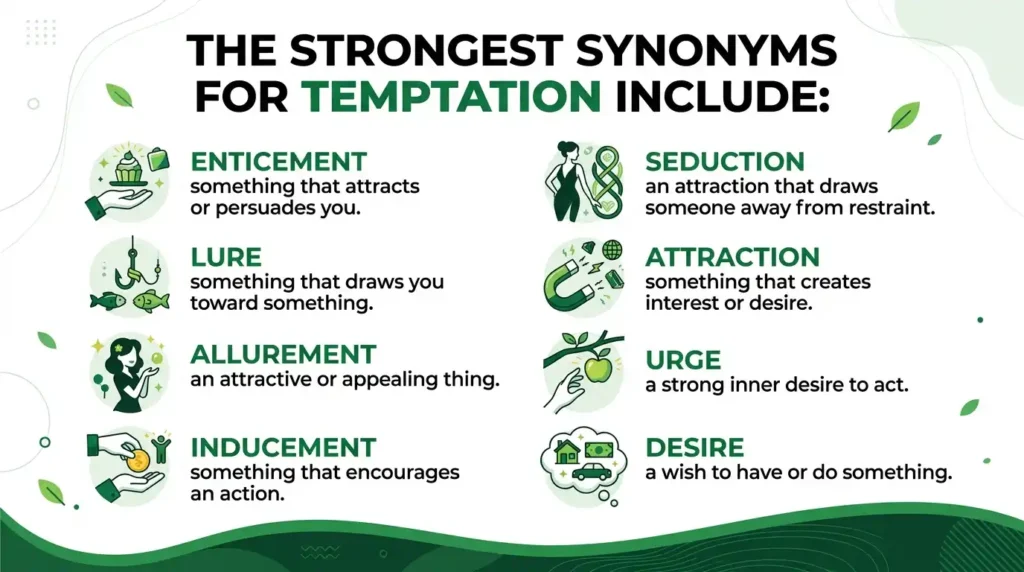
The closest and most useful synonyms for temptation include:
- Lure — something that attracts or draws someone.
- Enticement — something that attracts or persuades.
- Allurement — something strongly attractive or appealing.
- Inducement — something that encourages a person to act.
- Seduction — an attractive influence that draws someone in.
- Urge — a strong inner desire to act.
- Desire — a wish to have or do something.
- Impulse — a sudden desire to act.
- Inclination — a tendency or desire to act.
- Attraction — something that creates interest or desire.
Quick rule: Use lure, enticement, or allurement when you mean the thing that tempts someone. Use urge, desire, or impulse when you mean the feeling of wanting to do something.
Synonyms for Temptation by Meaning
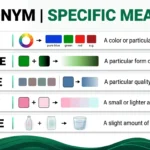
| Synonym | Specific Meaning | Synonym | Specific Meaning |
| Lure | Something that attracts or draws someone | Enticement | Something that attracts or persuades |
| Allurement | Something strongly attractive or appealing | Inducement | Something that encourages an action |
| Seduction | Attractive influence that draws someone in | Urge | A strong inner desire to act |
| Desire | A wish to have or do something | Impulse | A sudden desire to act |
| Inclination | A tendency or desire to act | Attraction | Something that creates interest or desire |
Note: These words do not have identical meanings. The first group focuses mainly on an external source of temptation, while the second group focuses more on the internal desire or attraction.
Where Temptation Comes From
Parts of Speech: Noun
Syllables: temp-ta-tion
Pronunciation: /tempˈteɪʃən/
Origin: Temptation entered English through Old French and Middle English from Latin temptatio, meaning a testing, trial, or attempt. It is related to the Latin verb temptare or tentare, meaning to test, try, or handle.
Prefix/Suffix Breakdown: The word contains the Latin root associated with testing or trying and the noun-forming suffix -ation. Its meaning developed from the idea of being tested to the modern idea of being attracted toward something that may be difficult to resist.
Close Synonyms for Temptation
These are the strongest alternatives when temptation refers to something that attracts or draws a person toward an action.
Lure (/lʊr/)
Meaning: Something that attracts or draws someone toward something.
Examples:
- The lure of easy money was hard to resist.
- The lure of city life attracted many young workers.
Enticement (/ɪnˈtaɪsmənt/)
Meaning: Something that attracts or persuades someone to act.
Examples:
- The discount was an enticement to buy more.
- Free samples provided an enticement for new customers.
Allurement (/əˈlʊərmənt/)
Meaning: Something that strongly attracts or appeals to someone.
Examples:
- The allurement of fame can be powerful.
- The resort relied on the allurement of luxury.
Inducement (/ˌɪnduːsmənt/)
Meaning: Something offered to encourage a particular action.
Examples:
- The bonus was an inducement to finish early.
- The free trial served as an inducement to sign up.
Seduction (/sɪˈdʌkʃən/)
Meaning: An attractive influence that draws someone toward something.
Examples:
- He understood the seduction of instant success.
- The seduction of wealth proved difficult to resist.
Usage note: Seduction can have a sexual or romantic meaning, so it is stronger than temptation in many contexts.
Near-Synonyms for the Feeling of Temptation
These words describe the desire or inner pull associated with temptation rather than the tempting object itself.
Urge (/ɜːrdʒ/)
Meaning: A strong desire to do something.
Examples:
- She resisted the urge to check her phone.
- He felt an urge to leave early.
Nuance: An urge does not always involve something wrong or unwise.
Desire (/dɪˈzaɪər/)
Meaning: A strong wish to have or do something.
Examples:
- He had a strong desire to travel.
- She resisted her desire to spend more money.
Nuance: Desire is broader and more neutral than temptation.
Impulse (/ˈɪmpʌls/)
Meaning: A sudden desire to act without much thought.
Examples:
- She bought the dress on impulse.
- He resisted the impulse to respond.
Nuance: Impulse emphasizes sudden action.
Inclination (/ˌɪnkləˈneɪʃən/)
Meaning: A tendency or desire to do something.
Examples:
- He had little inclination to argue.
- She felt an inclination to leave.
Nuance: Inclination is usually softer than temptation.
Attraction (/əˈtrækʃən/)
Meaning: A quality that creates interest, desire, or appeal.
Examples:
- The attraction of a higher salary was clear.
- The flexibility of the job was a major attraction.
Nuance: Attraction is broader and more neutral than temptation.
Contextual Alternatives for Temptation
These words can overlap with temptation in specific situations but should not be treated as exact synonyms.
Appeal (/əˈpiːl/)
Meaning: A quality that makes something attractive or desirable.
Example:
- The appeal of remote work continues to grow.
Why it differs: Something can have appeal without creating a temptation to do something wrong.
Incentive (/ɪnˈsentɪv/)
Meaning: Something that encourages a person to act.
Example:
- The bonus gave employees an incentive to work harder.
Why it differs: An incentive usually encourages useful or rational action.
Craving (/ˈkreɪvɪŋ/)
Meaning: A powerful desire for something.
Example:
- She had a strong craving for chocolate.
Why it differs: Craving often describes an intense physical or emotional desire and is narrower than temptation.
Fascination (/ˌfæsɪˈneɪʃən/)
Meaning: A powerful interest in something.
Example:
- His fascination with luxury cars never faded.
Why it differs: Fascination emphasizes interest rather than the need to resist.
Bait (/beɪt/)
Meaning: Something used to attract or trap someone.
Example:
- The cheap offer was bait for inexperienced buyers.
Why it differs: Bait usually suggests deliberate deception or a trap.
Temptation Synonyms by Context
| Context | Best Choice | Reason |
| Something that draws you in | Lure | Strong focus on attraction |
| Something that persuades you | Enticement | Suggests active attraction |
| Strong attractiveness | Allurement | Emphasizes appeal |
| An offered benefit | Inducement | Suggests encouragement |
| Romantic attraction | Seduction | Strong romantic meaning |
| Inner desire | Urge | Focuses on internal feeling |
| General wish | Desire | Broad and neutral |
| Sudden desire | Impulse | Emphasizes spontaneity |
| Mild tendency | Inclination | Softer than temptation |
| General attraction | Attraction | Broad and neutral |
Formal Synonyms for Temptation
For formal writing, choose the synonym based on the exact meaning.
For an external temptation
- Enticement
- Lure
- Allurement
- Inducement
An internal desire
- Desire
- Urge
- Inclination
- Impulse
For neutral academic writing
Temptation itself is often the most precise choice. Do not replace it merely to avoid repetition.
Synonyms for Temptation in an Essay
When using a synonym in an essay, match the word to the idea.
- Lure — when something draws people toward an option.
- Enticement — when something actively encourages an action.
- Inducement — when a benefit encourages action.
- Urge — when the temptation is an inner feeling.
- Impulse — when the desire is sudden.
- Desire — when you need a broad, neutral term.
- Inclination — when the desire is mild.
Example
Original:
The temptation of social media can affect students.
More precise alternatives:
The lure of social media can affect students.
This emphasizes the attraction.
The urge to check social media can affect students.
This emphasizes the student’s internal desire.
Synonyms for Temptation in Creative Writing
Creative writing often needs words with a stronger emotional tone.
For attraction
- Allurement
- Lure
- Fascination
For danger
- Lure
- Bait
- Snare
If inner desire
- Urge
- Craving
- Impulse
For romantic attraction
- Seduction
- Allurement
- Desire
Choose the word that matches the emotional effect you want.
Common Traps and Nuance Distinctions
Temptation vs. Lure
A lure is something that draws someone toward something.
Temptation can describe both the attractive thing and the desire it creates.
- Lure: The lure of wealth attracted him.
- Temptation: He struggled with the temptation to take the money.
Temptation vs. Enticement
Enticement focuses on something that attracts or persuades.
Temptation can also describe the internal struggle to resist.
- Enticement: The discount was an enticement.
- Temptation: She resisted the temptation to buy it.
Temptation vs. Desire
Desire is much broader.
A desire can be positive, neutral, or negative. Temptation usually suggests that the desire is difficult to resist or may lead to an unwise action.
Temptation vs. Urge
An urge is a strong internal desire.
It does not necessarily involve moral conflict.
- Urge: I had an urge to call her.
- Temptation: I resisted the temptation to ignore the warning.
Temptation vs. Impulse
An impulse is usually sudden.
A temptation can remain present for a long time.
- Impulse: He bought it on impulse.
- Temptation: He had resisted the offer for weeks.
Temptation vs. Attraction
Attraction means something draws your interest or desire.
Temptation often adds the idea of resistance.
Something can be attractive without being a temptation.
When NOT to Use Temptation
Do not use temptation when the situation does not involve desire, attraction, or resistance.
Use a more precise word when you mean:
- Preference — a choice or liking.
- Motivation — a reason for taking action.
- Incentive — a benefit that encourages action.
- Impulse — a sudden desire to act.
- Ambition — a strong desire to achieve something.
- Interest — attention or curiosity.
Do not automatically use temptation as a dramatic substitute for every form of desire.
Words That Should Not Be Treated as Direct Synonyms
Some related words appear in broad thesaurus results but do not have the same meaning as temptation.
Trap
A trap is something designed to catch or deceive someone.
It may be connected to temptation, but it is not a synonym.
Decoy
A decoy is something used to distract or lure someone.
It has a specific strategic meaning.
Accomplice
An accomplice is someone who helps another person commit a crime.
It is not a synonym for temptation.
Crony
A crony is a close friend or associate, often with a negative suggestion.
It has no general synonym relationship with temptation.
Confidant
A confidant is someone trusted with private information.
It describes a person, not a tempting desire or object.
Word Family of Temptation
Tempt
Tempt is the related verb meaning to attract someone toward something they may want to resist.
Example:
The discount tempted her to buy the product.
Tempted
Tempted describes someone who feels an attraction or desire to do something.
Example:
He was tempted to accept the offer.
Tempting
Tempting describes something attractive or difficult to resist.
Example:
The offer looked tempting.
Tempter
A tempter is a person or thing that tempts someone.
Example:
The tempter offered an easy solution.
Temptation
Temptation is the noun for the desire or thing that tempts someone.
Example:
She resisted the temptation to spend the money.
Opposite Words: Antonyms for Temptation
The exact opposite depends on whether you mean attraction, desire, or resistance.
Direct or Strong Contrasts
Aversion — a strong dislike of something.
- She felt an aversion to dishonest behavior.
Repulsion — a strong feeling of dislike or rejection.
- The smell caused immediate repulsion.
Indifference — a lack of interest or concern.
- He showed indifference to the offer.
Disinterest — a lack of interest in something.
- Her disinterest in luxury was obvious.
Contextual Opposites
Resistance — the act of refusing to give in.
- He showed strong resistance to the temptation.
Restraint — control over an impulse or desire.
- She exercised restraint when shopping.
Deterrent — something that discourages an action.
- The fine acted as a deterrent.
Avoidance — the act of staying away from something.
- Avoidance helped him manage the temptation.
Note: Resistance, restraint, deterrent, and avoidance are contextual opposites, not strict dictionary antonyms of temptation.
Frequently Asked Questions
What is the best synonym for temptation?
The best synonym depends on the meaning. Lure, enticement, and allurement work best for something that attracts a person. Urge, desire, and impulse work better for the internal feeling.
What is a formal synonym for temptation?
Enticement, allurement, inducement, and inclination can work in formal writing, depending on the sentence. Temptation itself is often the most precise choice.
What is another word for temptation in an essay?
Use lure for something attractive, enticement for active persuasion, inducement for an offered benefit, urge for an inner desire, or impulse for a sudden desire.
What is a synonym for temptation in a romantic context?
Depending on the intended meaning, seduction, attraction, allurement, or desire can work. Seduction is the strongest and can carry a sexual meaning.
What is the difference between temptation and desire?
Desire is a broad wish to have or do something. Temptation usually suggests a desire that may be difficult to resist or that conflicts with judgment, rules, or values.
What is the difference between temptation and lure?
A lure is something that draws or attracts someone. Temptation can describe the lure itself or the desire it creates.
What is the opposite of temptation?
Possible contrasts include aversion, repulsion, indifference, and disinterest. In practical contexts, resistance, restraint, deterrence, and avoidance can describe ways of opposing temptation.
Conclusion
The best synonyms for temptation depend on whether you mean an external attraction or an internal desire. Use lure, enticement, allurement, and inducement for something that attracts or encourages, and use urge, desire, impulse, or inclination for the feeling behind the temptation. For formal, academic, and professional writing, choose the most precise word rather than replacing temptation simply for variety.