


By Site Editor | Last updated: 2026-11-08
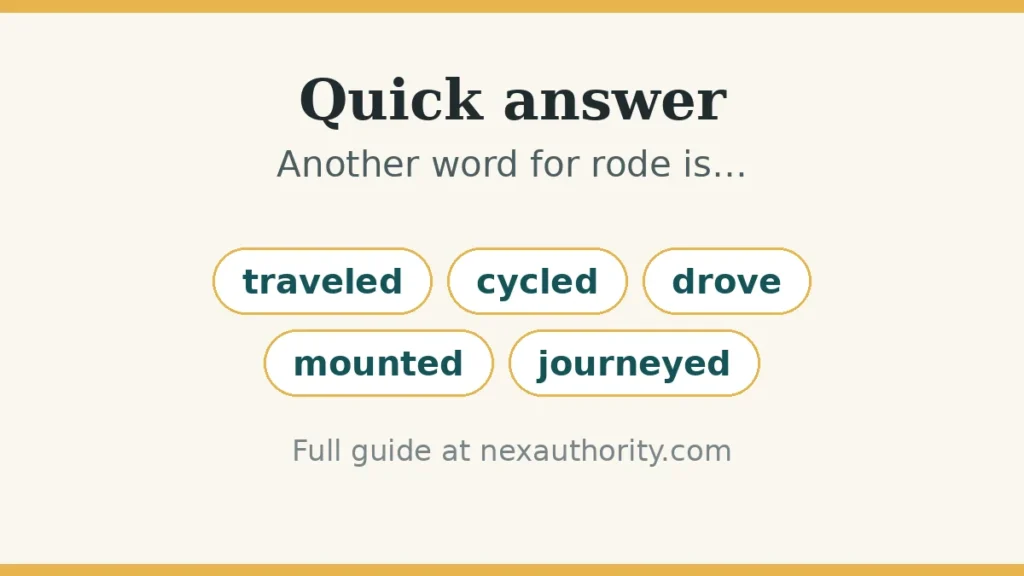
Rode means traveled in the past by sitting on and controlling a horse, bicycle, or motorcycle, or by traveling as a passenger in a car, bus, train, or roller coaster. The closest synonyms for the word itself are traveled, journeyed, went, traversed, and toured.
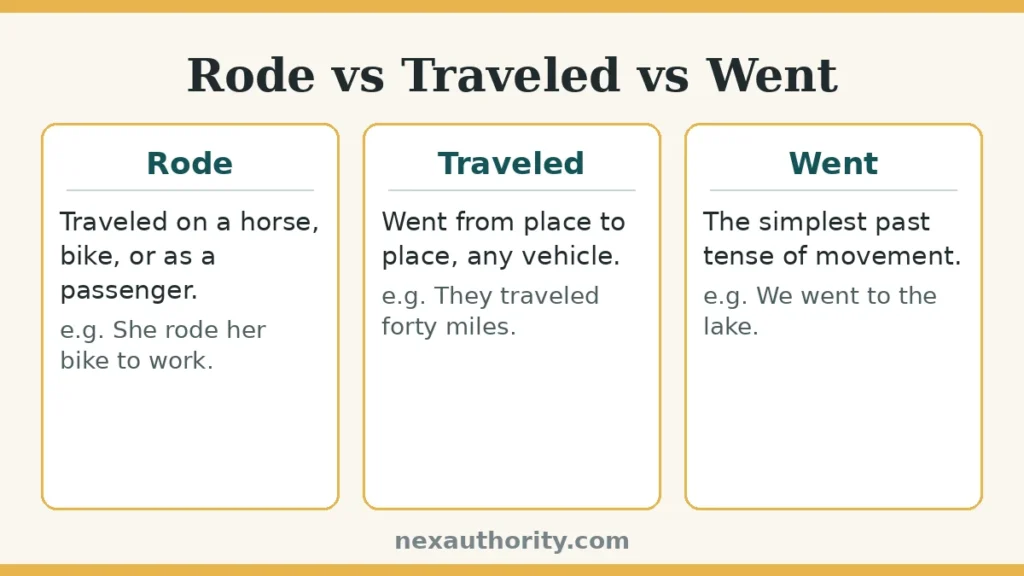
Choose traveled for going somewhere, whatever the vehicle. Choose journeyed for a long trip. Choose went for short sentences.
- Traveled — went from one place to another
- Journeyed — traveled a long distance
- Went — moved or traveled, past tense
- Traversed — traveled across an area
- Toured — traveled around a place
- Galloped — rode a horse at full speed
Synonyms for Rode: Full Tiered Table
| Synonym | Tier | Meaning (3-6 words) | Best for |
|---|---|---|---|
| Traveled | Exact | Went from place to place | General writing |
| Journeyed | Exact | Traveled a long distance | Narratives, travel writing |
| Went | Exact | Moved or traveled, past | Everyday writing |
| Traversed | Exact | Traveled across an area | Formal, descriptive writing |
| Toured | Exact | Traveled around a place | Travel, sightseeing contexts |
| Drove | Near | Traveled by controlling a vehicle | Cars, road trips |
| Cycled | Near | Traveled by bicycle | Cycling contexts |
| Galloped | Near | Rode a horse fast | Horseback, racing contexts |
| Cantered | Near | Rode a horse steadily | Horseback contexts |
| Trotted | Near | Rode a horse slowly | Horseback contexts |
| Sailed | Near | Traveled by boat or glided | Sea, figurative contexts |
| Floated | Near | Moved gently on water | Figurative, water contexts |
| Drifted | Near | Moved slowly without steering | Figurative, water contexts |
| Glided | Near | Moved smoothly and quietly | Figurative, graceful motion |
| Motored | Near | Traveled by car | Road trips, older style |
| Mounted | Related | Climbed onto a horse | Horseback contexts |
| Steered | Related | Controlled a vehicle’s direction | Driving contexts |
| Navigated | Related | Planned and directed a route | Travel, sailing contexts |
| Cruised | Related | Traveled at steady speed | Cars, boats, casual style |
| Sped | Related | Moved very fast | Action writing |
| Raced | Related | Moved at top speed | Competition, action writing |
| Wandered | Related | Traveled without a fixed route | Literary, wandering contexts |
| Roamed | Related | Traveled freely over an area | Literary, open-country contexts |
| Depended | Related | Hung on an outcome | The “rode on” sense |
| Rolled | Related | Moved steadily on wheels | Vehicles, informal writing |
Rode Word Card
- Part of speech: verb, past tense of ride; also a noun in nautical use
- Pronunciation: US /roʊd/, UK /rəʊd/
- Word forms: ride (base form), riding, ridden (past participle), rides, rider (noun), rode (noun: anchor rope or chain)
- Register: neutral; travel, sport, and story writing
Top 10 Synonyms for Rode in Detail
Traveled
Traveled is the plain word for going from one place to another. It covers horses, bikes, cars, and trains without naming the vehicle, the safest swap for rode in most sentences. “They traveled forty miles before dark.” Use it when the journey matters more than the vehicle. Avoid it when the vehicle is the point.
Journeyed
Journeyed means traveled a long way through difficult country, with purpose and story. It suits novels, memoirs, and long travel writing. “They journeyed north for three weeks before they found the pass.” Use it when the trip itself deserves attention. Avoid it for a short, ordinary trip to the store.
Went
Went is the simplest past tense of movement, replacing rode whenever the vehicle adds nothing. It is plain and natural in speech. “We went to the lake by bike that morning.” Use it for quick, everyday sentences. Avoid it when the way of traveling is the detail the reader needs.
Traversed
Traversed means traveled across land, water, or country, often with effort. It is formal, at home in history and adventure writing. “The party traversed the desert in nine days.” Use it when crossing difficult ground is the achievement. Avoid it in casual writing, where it can sound stiff and overworked.
Toured
Toured means traveled around a place visiting sights and towns, for pleasure or work. It fits holidays and sightseeing stories. “The band toured the South that summer, playing small halls.” Use it for a route with stops. Avoid it for a single straight trip with no visiting along the way.
Drove
Drove means traveling by controlling a car or vehicle, naming the driver, not a passenger. It is the right swap for a car trip taken behind the wheel. “She drove to the coast before sunrise.” Use it when the person steered. Avoid it for passengers: a bus rider never drove the bus.
Cycled
Cycled means traveled by bicycle, the word for a bike trip. It is neutral and common in sport, commuting, and travel writing. “They cycled along the river path every Sunday.” Use it when the bicycle is the vehicle. Avoid it for horses, motorcycles, or any ride that used no pedals.
Galloped
Galloped means rode a horse at its fastest pace, all four feet off the ground. It is at home in racing and historical scenes. “The messenger galloped into the yard with the news.” Use it when speed on horseback is the picture. Avoid it for slow rides, bikes, or cars.
Sailed
Sailed means traveled by boat, or moved smoothly as if wind-borne. It covers sea journeys and smooth motion on water or air. “They sailed down the coast before the wind changed.” Use it for boats and wind-driven motion. Avoid it for land travel, where it reads as a figure of speech.
Floated
Floated means moved gently on water or through air, carried rather than steered. It matches rode in its sense of drifting on waves. “The boat floated down the river all afternoon.” Use it for gentle, drifting motion. Avoid it when the rider controlled the speed or direction of the trip.
Best Word by Situation
| Situation | Best pick | Why |
|---|---|---|
| Formal writing | Traversed | Precise and formal; names crossing ground |
| Academic writing | Traveled | Neutral and general; fits any vehicle |
| Business email | Traveled | Plain and professional; no extra color |
| Everyday conversation | Went | Shortest and most natural in speech |
| Creative writing | Galloped | Vivid and physical; paints the scene |
| Informal speech | Went | Shortest and most natural; “catch a ride” fits casual talk |
| When one thing depended on another | Depended | Matches the “rode on” sense |
All Meanings of Rode
Rode on horseback or a bicycle
Here rode means sitting on an animal or bicycle and controlling it while moving. “She rode her horse along the beach at dawn.”
Rode as a passenger
Here rode means traveling in a vehicle one does not control: a bus, train, or car driven by someone else. “He rode the subway to school every morning.”
Rode on waves or in the air
Here rode means moving as if carried by water or air, smoothly and beyond control. “The small boat rode the waves into the harbor.”
Rode at anchor
A ship rides at anchor when it lies moored, held by its anchor, holding position, not traveling. “The freighter rode at anchor all night.”
Rode as an anchor cable
As a noun, a rode is the rope or chain joining anchor to ship, a word for boating and naval writing. “The crew checked the rode before the storm.”
Rode in figurative use
Rode can also mean teased someone again and again. “His friends rode him about his old car for years.” It also covers being carried by success, as in riding a wave of popularity.
Rode as depended on
Here rode means one result depended on a single event. “Everything rode on the final vote that night.” Use it when one outcome decides the rest.
Rode of the woodcock
In one rare sense, rode describes a male woodcock’s display flight at dusk in breeding season. “At dusk the woodcock rode over the meadow, calling as it flew.”
Common Collocations for Rode
Five natural combinations:
- rode off — “He rode off before anyone could ask him a question.”
- rode out — “They rode out the storm in a sheltered cove.”
- rode roughshod over — “The new rules rode roughshod over local custom.”
- rode the wave — “She rode the wave of good reviews into a second printing.”
- rode shotgun — “He rode shotgun on the long drive home, keeping the driver awake.”
Words People Confuse With Rode
Ridden
Ridden is the past participle, used after has, have, or had; rode stands alone as the past. Rided is not a standard form. Ridden: “She has ridden that trail many times.” Rode: “She rode that trail last spring.”
Road
Road is a noun meaning a paved way for vehicles. It sounds like rode but is spelled differently. Road: “The road to town was closed for repairs.” Rode: “They rode to town before it closed.”
Rowed
Rowed is the past tense of row, moving a boat with oars, while rode means traveling on something. Rowed: “They rowed across the lake at sunrise.” Rode: “They rode the ferry across the lake.”
When NOT to Use Rode
Five common mistakes, each with a wrong example and a corrected one.
- Using rode after has or have. The participle is ridden, not rode. Wrong: “She has rode that trail before.” Corrected: “She has ridden that trail before.”
- Using rode when the person drove. A passenger rides; the driver drives. Wrong: “He rode his car to work.” Corrected: “He drove his car to work.”
- Using rode for walking. Walking is not riding. Wrong: “They rode to the shop on foot.” Corrected: “They walked to the shop.”
- Using rode for a future trip. Rode is past only. Wrong: “Tomorrow we rode to the lake.” Corrected: “Tomorrow we will ride to the lake.”
- Using rode in the passive voice. Use ridden after was or been. Wrong: “The bike was rode all summer.” Corrected: “The bike had been ridden all summer.”
Antonyms of Rode by Context
These name the opposite motion or stopping. Rode has no single direct opposite, so these pairs are contextual.
| Antonym | Type | Context |
|---|---|---|
| Walked | Contextual | Traveled on foot instead of riding |
| Stayed | Contextual | Remained in place; did not travel |
| Dismounted | Contextual | Got off a horse or bicycle |
| Stopped | Contextual | Ended the journey; came to rest |
| Alighted | Contextual | Stepped down from a vehicle, formal |
| Remained | Contextual | Stayed behind while others traveled |
| Weighed anchor | Contextual | Left anchorage; opposite of riding at anchor |
Origin of the Word Rode
Rode is the past tense of ride, from Old English rīdan, before the 12th century. The noun ride dates to 1708. The noun sense of rode, an anchor rope or chain, is separate, of uncertain origin.
Frequently Asked Questions
What is the rode definition?
The rode definition is the past tense of ride: travel on a horse, bike, or motorcycle, or as a passenger. It can describe a ship lying at anchor. As a noun, it names the rope or chain holding an anchor.
What is another word for rode?
Another word for rode is traveled, the safest swap in most sentences. Journeyed fits long trips, went fits short sentences, and traversed fits formal writing. For horseback scenes, galloped or cantered may be much closer than any other general word.
How do you use rode in a sentence?
Use rode for a past trip, naming the vehicle when it matters. Two models: “She rode her bicycle to work.” And: “They rode the train to the city.” Keep the tense past: rode never describes a present or future trip.
What are the rode antonyms?
Rode has no direct opposite, so its antonyms are contextual: walked for travel on foot, stayed for not traveling, and dismounted for getting off a horse. Stopped ends a journey. For that sense, weighed anchor is the opposite of riding at anchor.
What is the difference between rode and ridden?
Rode is the past tense and stands alone: “She rode yesterday.” Ridden is the past participle and follows has, have, or had: “She has ridden before.” Mixing them is the commonest mistake with this verb: check for a helping verb.
Conclusion
Traveled is the best overall synonym for rode: it covers every vehicle and stays neutral. For horseback scenes, galloped is sharper; for short sentences, went is most natural. For the full dictionary definition, see rode at the Cambridge Dictionary.