
Synonyms for Pal (noun, /pæl/) mean a friend or close companion. It is an informal word and can sound warm, casual, old-fashioned, or even annoyed when used to address someone.
The closest synonyms for pal are friend, buddy, mate, chum, companion, and comrade. The best choice depends on tone, region, and context.
What Is Another Word for Pal?
The best general synonym for pal is friend.
Other close choices include:
- Buddy — casual friend
- Mate — informal friend, especially in British English
- Chum — old-fashioned informal friend
- Companion — person who spends time with you
- Comrade — friend or fellow member of a group
- Confidant — trusted friend
- Sidekick — close companion in activities or adventures
For slang, bud, bro, homie, and bestie can work in the right context. They are informal alternatives, not always exact synonyms.
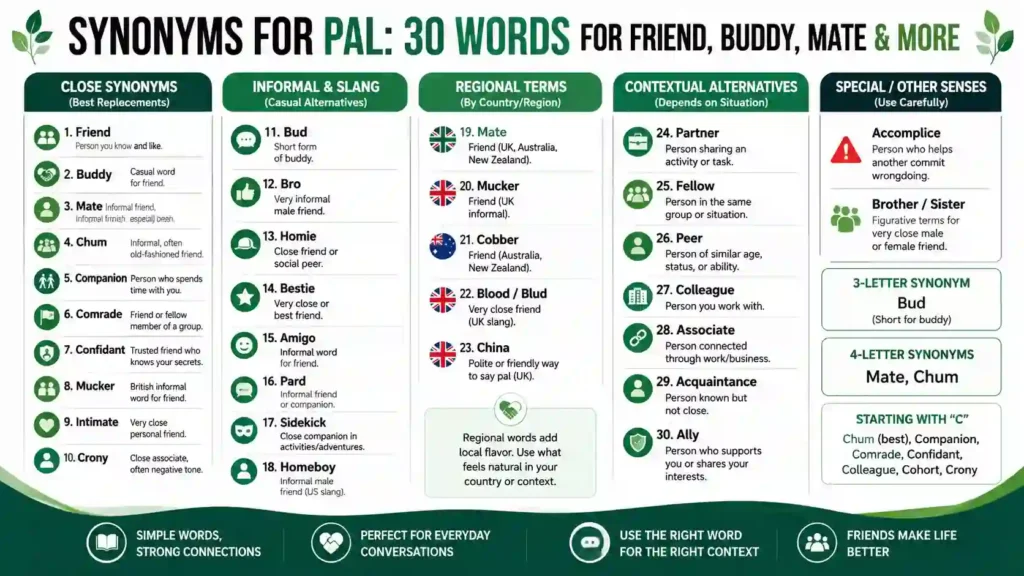
30 Synonyms for Pal and Related Alternatives for Pal
The table separates strong synonyms from contextual alternatives so you can choose the right word without forcing a meaning.
| Synonym or Alternative | Specific Meaning | Synonym or Alternative | Specific Meaning |
| 1. Friend | Person you know and like | 16. Amigo | Informal word for friend |
| 2. Buddy | Casual word for friend | 17. Bestie | Very close best friend |
| 3. Mate | Informal friend, especially British | 18. Bro | Very casual male friend |
| 4. Chum | Informal, often old-fashioned friend | 19. Bud | Short, casual form of buddy |
| 5. Companion | Person who spends time with you | 20. Homie | Close friend or social peer |
| 6. Comrade | Friend or fellow member | 21. Sidekick | Close companion in activities |
| 7. Confidant | Trusted person with private matters | 22. Pard | Informal friend or companion |
| 8. Confidante | Female trusted friend or adviser | 23. Mucker | British informal friend |
| 9. Intimate | Very close personal friend | 24. Cobber | Australian informal friend |
| 10. Crony | Close associate, often negative | 25. Colleague | Person who works with you |
| 11. Partner | Person sharing an activity | 26. Associate | Person connected through work |
| 12. Fellow | Person in the same group | 27. Acquaintance | Person known but not close |
| 13. Peer | Person of similar status | 28. Ally | Person who supports you |
| 14. Cohort | Member of the same group | 29. Accomplice | Person involved in wrongdoing |
| 15. Brother | Very close male friend | 30. Sister | Very close female friend |
Important: The first eight to nine Synonyms for Pal are the strongest semantic matches. Words such as colleague, acquaintance, ally, cohort, and accomplice are contextual alternatives, not interchangeable synonyms. Current thesaurus results support this distinction; Cambridge, for example, lists acquaintance under “compare,” rather than as a direct synonym.
Where Pal Comes From
Parts of Speech: noun; verb
Syllable: 1 — pal
Origin: Pal comes from English Romani phral/phal, meaning “brother” or “friend,” and is ultimately related to Sanskrit bhrātṛ, meaning “brother.” Merriam-Webster records the noun’s first known use around 1886.
- Prefix/Suffix Breakdown: Pal has no productive English prefix or suffix. It is a borrowed root word.
1. Friend (/frend/)
Meaning: A person you know, like, and trust.
- Example: She is my oldest friend from school.
- Example: He invited a close friend to dinner.
Why it works: Friend is the safest and most neutral replacement for pal. It works in casual, general, and many formal contexts. Merriam-Webster and Cambridge both place friend among the closest synonyms.
2. Buddy (/ˈbʌdi/)
Meaning: A close friend in casual English.
- Example: I went fishing with my buddy.
- Example: My old buddy lives nearby.
Why it works: Buddy is one of the closest everyday alternatives to pal. It has a relaxed, friendly tone.
3. Mate (/meɪt/)
Meaning: An informal word for a friend, especially in British English.
- Example: He’s an old mate from college.
- Example: Thanks, mate. I appreciate it.
Why it works: Mate is one of the strongest answers to “What is pal in British English?” Cambridge labels it UK informal.
4. Chum (/tʃʌm/)
Meaning: A friend or companion, often with an old-fashioned tone.
- Example: He met an old school chum.
- Example: She spent the summer with her childhood chum.
Why it works: Chum is a genuine synonym, but it sounds more dated than friend or buddy. Cambridge marks it old-fashioned informal.
5. Companion (/kəmˈpænjən/)
Meaning: A person who spends time or travels with you.
- Example: Her dog was her constant companion.
- Example: He traveled with a trusted companion.
Why it works: Companion is close to pal, but it focuses more on shared time or company than friendship.
6. Comrade (/ˈkɒmreɪd/)
Meaning: A friend or fellow member of a group.
- Example: His army comrades stayed in touch.
- Example: She thanked her comrades for their support.
Why it works: It can mean friend, but it often suggests shared work, service, struggle, or group identity.
7. Confidant (/ˈkɒnfɪdænt/)
Meaning: A trusted friend who knows private thoughts or secrets.
- Example: Her sister was her closest confidant.
- Example: He became a trusted confidant of the leader.
Why it works: It is more specific than pal. Use it when trust and private information matter.
8. Confidante (/ˌkɒnfɪˈdænt/)
Meaning: A trusted female friend or adviser.
- Example: She became his closest confidante.
- Example: Her longtime confidante knew the full story.
Why it works: It adds the idea of trust and advice. It is not a general replacement for every use of pal.
9. Intimate (/ˈɪntɪmət/)
Meaning: A very close personal friend.
- Example: Only a few intimates knew the truth.
- Example: She shared the news with an intimate friend.
Why it works: It suggests a very close relationship. Use it with care because intimate also has romantic and sexual meanings.
10. Crony (/ˈkroʊni/)
Meaning: A close associate, often with a negative meaning.
- Example: The politician was accused of helping his cronies.
- Example: He surrounded himself with old cronies.
Why it works: Crony can mean a close friend or associate, but it often suggests favoritism or disapproval. Cambridge marks it informal and disapproving.
11. Partner (/ˈpɑːrtnər/)
Meaning: A person who shares an activity, task, or relationship.
- Example: She was my tennis partner.
- Example: He worked with his business partner.
Why it works: It can overlap with pal when two people spend time together, but friendship is not part of its core meaning.
12. Fellow (/ˈfeloʊ/)
Meaning: A person who belongs to the same group or situation.
- Example: I met a fellow traveler on the train.
- Example: She asked a fellow student for help.
Why it works: It suggests shared status or experience, not necessarily friendship.
13. Peer (/pɪr/)
Meaning: A person with similar age, status, or position.
- Example: She asked her peers for advice.
- Example: His peers respected his work.
Why it works: Peer is related to social connection but does not mean friend.
14. Cohort (/ˈkoʊhɔːrt/)
Meaning: A member of the same group or generation.
- Example: She still meets her university cohort.
- Example: His cohort started work in the same year.
Why it works: This is a group term, not a direct synonym for pal.
15. Brother (/ˈbrʌðər/)
Meaning: A very close male friend in informal speech.
- Example: He’s like a brother to me.
- Example: My old college brother still visits.
Why it works: The friendship sense is figurative. The normal literal meaning is a male sibling.
16. Amigo (/əˈmiːɡoʊ/)
Meaning: An informal word for friend.
- Example: Thanks for helping me, amigo.
- Example: He’s an old amigo from college.
Why it works: It is borrowed from Spanish and is used informally in English.
17. Bestie (/ˈbɛsti/)
Meaning: A very close or best friend.
- Example: She’s been my bestie since school.
- Example: My bestie helped me move.
Why it works: Bestie is informal and strongly suggests a close friendship. It is better treated as a slang/informal alternative than a neutral synonym.
18. Bro (/broʊ/)
Meaning: Very informal term for a male friend or peer.
- Example: Thanks, bro.
- Example: My bro helped me fix the car.
Why it works: It is highly casual. It works in speech, texting, and social media, but not formal writing.
19. Bud (/bʌd/)
Meaning: A short, casual form of buddy.
- Example: Hey, bud, how are you?
- Example: Thanks, bud. I owe you one.
Why it works: Bud is the strongest three-letter answer for the query “pal synonym 3 letters.”
20. Homie (/ˈhoʊmi/)
Meaning: A close friend or person from the same social circle.
- Example: He met his homies after work.
- Example: My homie has known me for years.
Why it works: It is slang and highly informal. It should not replace friend in formal writing.
21. Sidekick (/ˈsaɪdkɪk/)
Meaning: A close companion who joins another person in activities.
- Example: The hero and his sidekick solved the case.
- Example: My dog is my hiking sidekick.
Why it works: It is playful and works especially well in stories and informal writing.
22. Pard (/pɑːrd/)
Meaning: An informal friend or companion.
- Example: He met his old pard at the station.
- Example: My pard helped me with the job.
Why it works: It is less common and more regional than pal or buddy.
23. Mucker (/ˈmʌkər/)
Meaning: A British informal word for a friend.
- Example: He’s an old mucker from school.
- Example: My mucker helped me move house.
Why it works: Cambridge identifies mucker as UK informal.
24. Cobber (/ˈkɒbər/)
Meaning: An informal Australian word for a friend.
- Example: He’s an old cobber from Sydney.
- Example: Thanks, cobber.
Why it works: Collins includes cobber among regional synonyms and related forms of pal.
25. Colleague (/ˈkɒliːɡ/)
Meaning: A person who works with you.
- Example: A colleague helped me finish the report.
- Example: She met an old colleague for lunch.
Why it works: It is a contextual alternative, not an exact synonym. A colleague can be a pal, but not every colleague is a friend.
26. Associate (/əˈsoʊʃiət/)
Meaning: A person connected to you through work or activity.
- Example: She met a business associate.
- Example: He is a longtime associate of the company.
Why it works: It is more formal and less personal than pal.
27. Acquaintance (/əˈkweɪntəns/)
Meaning: A person you know but do not know well.
- Example: He’s an acquaintance from work.
- Example: I know her, but she’s only an acquaintance.
Why it works: Do not treat this as an exact synonym. Cambridge explicitly separates acquaintance from its direct synonym list.
28. Ally (/ˈælaɪ/)
Meaning: A person who supports you or shares your interests.
- Example: She found an ally in her new manager.
- Example: His allies supported the plan.
Why it works: An ally may be a friend, but the core idea is support rather than friendship.
29. Accomplice (/əˈkʌmplɪs/)
Meaning: A person who helps another person commit wrongdoing.
- Example: Police arrested his alleged accomplice.
- Example: The thief escaped with an accomplice.
Why it works: This is not a safe general synonym for pal. Dictionaries list it because pal can have an accomplice sense, but the criminal meaning must be clear.
30. Sister (/ˈsɪstər/)
Meaning: A very close female friend when used figuratively.
- Example: She’s like a sister to me.
- Example: My closest friend is more like a sister.
Why it works: It describes closeness rather than simply meaning pal.
What Is the Best Synonym for Pal?
The best Synonyms for Pal depend on the context:
| Context | Best synonym |
| General English | friend |
| Casual English | buddy |
| British English | mate |
| Old-fashioned style | chum |
| Close trusted friend | confidant |
| Person who spends time with you | companion |
| Shared group or struggle | comrade |
| Adventure or story | sidekick |
| Very close friend | bestie |
| Casual male address | bro |
| Short slang form | bud |
| Australian informal English | cobber |
For a neutral audience, friend is the strongest choice. Merriam-Webster defines pal as “a close friend,” while Cambridge defines it simply as “a friend.”
What Is a 3-Letter Synonym for Pal?
The best three-letter synonym is bud.
Bud is a short, informal form of buddy.
Example: Hey, bud, how’s it going?
It is useful in casual speech but should not be used in formal writing.
What Is a 4-Letter Synonym for Pal?
The strongest four-letter options are:
- Mate — informal friend, especially British
- Chum — informal friend with an old-fashioned feel
Mate is usually the better modern choice. Cambridge marks mate as UK informal and chum as old-fashioned informal.
What Is Another Word for Pal Starting With C?
The clearest C-word is chum.
Other C-words can overlap with pal in special contexts:
- Chum — friend
- Companion — person who spends time with you
- Comrade — friend or fellow member
- Confidant — trusted friend
- Colleague — workmate
- Cohort — member of the same group
- Crony — close associate, often negative
Only chum is a straightforward everyday C-word replacement for pal.
What Are Synonyms for Pal in Slang?
Common informal and slang alternatives include:
- bud — casual friend
- buddy — casual friend
- bro — informal male friend
- homie — close friend
- bestie — very close friend
- mate — informal friend, especially British
- mucker — British informal friend
- cobber — Australian informal friend
Regional usage matters. Collins includes terms such as cobber, blood/blud, homeboy, and mucker in its broader synonym material, while Cambridge identifies mate and mucker as UK informal.
What Is Pal in British English?
Pal is a British English word for a friend, but it is informal.
A very common British alternative is mate.
Other British informal choices include mucker. Cambridge labels both mate and mucker as UK informal.
Examples:
- He’s an old pal of mine.
- He’s an old mate of mine.
- Thanks, mate.
Collins also defines pal in British English as an informal close friend or comrade.
What Is Pal in Slang?
Pal is itself an informal word, not necessarily slang. It normally means friend or close companion.
It can also be used as a form of address:
- Friendly: Thanks, pal.
- Casual: My pal is coming over.
- Annoyed: Listen, pal.
Cambridge notes that pal can sound friendly when addressing someone, but it can also be used for a man who is annoying you.
What Is Another Word for Buddy or Pal?
The closest choices are:
friend, mate, chum, companion, buddy, comrade, and confidant.
For casual speech:
buddy, mate, bud, bro, and bestie work well.
For more neutral writing:
friend is usually the best choice.
Pal vs. Buddy vs. Mate vs. Chum
| Word | Tone | Region | Key meaning |
| Pal | Informal | US & UK | Friend |
| Buddy | Informal | Especially US | Casual friend |
| Mate | Informal | Especially UK | Friend |
| Chum | Informal, old-fashioned | General | Friend or companion |
These four words overlap strongly, but they are not identical in tone or regional use. Cambridge and Collins both identify buddy, chum, and mate as related terms for pal.
Pal vs. Friend
Friend is the broader and safer word.
- Pal: informal, casual
- Friend: neutral
- Best formal choice: usually friend
Example:
- Casual: He’s an old pal.
- Neutral: He’s an old friend.
Merriam-Webster defines pal as a close friend, while Dictionary.com gives “friend or close associate.”
Pal vs. Acquaintance
These words describe different levels of connection.
Pal: someone you regard as a friend.
Acquaintance: someone you know but are not close to.
Example:
- Tom is my pal.
- Tom is an acquaintance from work.
Cambridge specifically lists acquaintance as a word to compare with, rather than treating it as an exact synonym.
Pal vs. Colleague
A colleague is someone you work with.
A pal is a friend.
One person can be both:
Sarah is my colleague and my pal.
But colleague does not automatically imply friendship.
Pal vs. Mate
Mate is one of the closest alternatives to pal, especially in British English.
- He’s my pal.
- He’s my mate.
In British English, mate is often the more natural casual choice. Cambridge labels it UK informal.
Pal vs. Chum
Both can mean friend.
The main difference is tone:
- Pal — casual and familiar
- Chum — more old-fashioned
Example:
He is an old pal from school.
He is an old school chum.
Cambridge labels chum “old-fashioned informal.”
Pal vs. Crony
A pal normally has a friendly or neutral meaning.
A crony can suggest an overly close associate, favoritism, or corruption.
Example:
He met his old pal.
The politician rewarded his cronies.
Use crony only when the negative meaning fits.
Pal vs. Accomplice
These meanings are very different.
A pal can simply mean friend.
An accomplice is someone involved in wrongdoing.
Example:
My pal helped me move.
The thief escaped with an accomplice.
Dictionary.com and Collins both recognize an accomplice sense for pal, but it is a separate contextual meaning, not a general synonym.
Pal vs. Pale
Pal and pale are completely different words.
- Pal — friend
- Pale — light in color; lacking normal color
Example:
He is my pal.
The wall is pale blue.
The word pale has a separate history linked through French and Latin to ideas of being pale or colorless.
So “synonyms for pale” is a different search from “synonyms for pal.”
When NOT to Use Synonyms for Pal
Avoid pal in formal academic writing
Use friend, companion, or another precise word.
Less formal:
The researcher asked his pal for help.
Better:
The researcher asked his colleague for help.
Avoid pal when you mean acquaintance
If you barely know someone, acquaintance is more accurate.
Avoid pal when you mean colleague
Use colleague when the work relationship matters.
Avoid pal when you mean ally
Use ally when the key idea is support or shared interests.
Avoid pal when you mean accomplice
Use accomplice when the person helped with wrongdoing.
Avoid pal in formal business writing
Use colleague, associate, business partner, or another exact term.
Be careful when addressing strangers
“Thanks, pal” can sound friendly.
“Listen, pal” can sound annoyed or threatening.
Cambridge specifically notes this difference in the address form of pal.
English Proficiency and Register Guide of Synonyms for Pal
Choosing a synonym is not only about meaning. It is also about register.
| Word | Register | Safe for formal writing? |
| Friend | Neutral | Yes |
| Companion | Neutral | Yes |
| Colleague | Neutral/formal | Yes |
| Associate | Formal | Yes |
| Buddy | Informal | Usually no |
| Pal | Informal | Usually no |
| Mate | Informal | Usually no |
| Chum | Informal/old-fashioned | Usually no |
| Confidant | Neutral/formal | Yes |
| Comrade | Context-dependent | Yes, when accurate |
| Bestie | Very informal | No |
| Bro | Slang | No |
| Homie | Slang | No |
| Bud | Informal | No |
| Mucker | British informal | No |
| Cobber | Australian informal | No |
For academic, professional, or formal English, prefer friend, companion, colleague, associate, or confidant when the meaning fits.
In everyday conversation use, pal, buddy, mate, and chum are natural.
For slang and social media, bud, bro, homie, and bestie may fit.
Synonyms for Pal Word Family and Related Terms
The core semantic field around pal includes words for friendship, companionship, trust, social connection, and shared activity.
Closest friendship terms
friend, buddy, mate, chum, companion, comrade, confidant
Informal friendship terms
pal, buddy, bud, mate, bestie, bro, homie
Group and social terms
peer, fellow, cohort, colleague, associate
Relationship-strength terms
confidant, intimate, companion, bestie
Opposition terms
enemy, foe, rival, opponent, adversary, stranger
This semantic structure helps distinguish words that share the broad idea of social connection but differ in strength, tone, region, or purpose.
Synonyms for Pal Word Forms and Grammar
Pal is mainly used as a countable noun.
Singular
pal
She is my pal.
Plural
pals
We have been pals for years.
Verb
pal can also function as a verb meaning to become or act as friends.
They palled around after meeting at school.
Merriam-Webster lists pal as both a noun and an intransitive verb and gives palship as a noun form.
Opposite Words: Antonyms for Pal
The strongest antonyms depend on whether you mean friendship, social distance, or conflict.
Direct Antonyms
- Enemy — a person who opposes you.
He became her enemy. - Foe — an enemy or opponent.
The hero defeated his old foe. - Adversary — a person who strongly opposes you.
The two leaders became adversaries. - Opponent — someone competing against you.
She defeated her opponent.
Operational and Contextual Opposites
- Stranger — someone you do not know.
He was a complete stranger. - Rival — someone competing with you.
Her rival won the award. - Competitor — someone competing for the same goal.
The two companies are competitors. - Antagonist — a person who actively opposes another.
The antagonist challenged the hero.
Cambridge’s current thesaurus results include enemy and stranger as key opposites of pal.
FAQs Synonyms for Pal
What is the best synonym for pal?
Friend is the best general synonym for pal. Buddy is a strong casual alternative, while mate is especially natural in British English.
What is another word for pal in slang?
Common informal alternatives include bud, buddy, bro, homie, bestie, and mate. Regional slang varies, so not every term works in every English-speaking country.
What is a three-letter synonym for pal?
Bud is the clearest three-letter informal synonym for pal. It is a shortened form of buddy.
What is a four-letter synonym for pal?
Mate and chum are four-letter synonyms. Mate is especially common in British informal English, while chum is more old-fashioned.
What is another word for pal starting with C?
Chum is the strongest direct C-word synonym. Companion, comrade, and confidant are related C-words with more specific meanings.
What is pal in British English?
In British English, pal means a friend and is informal. Mate is a very common British alternative, while mucker is another informal option.
Is pal a slang word?
Pal is informal rather than strongly slang. It means friend or close companion. It can also be used as an address term, sometimes in an annoyed way.
Is pal a formal word?
No. Pal is informal. In formal writing, use a more precise term such as friend, companion, colleague, associate, or confidant.
What is the difference between pal and buddy?
Both mean a friend. Buddy often sounds more casual, while pal can sound more familiar or old-fashioned.
What is the difference between pal and mate?
Both can mean friend. Mate is especially common in British informal English. Pal is used across both British and American English.
Is acquaintance a synonym for pal?
Not exactly. A pal is a friend. An acquaintance is someone you know but are not close to. Cambridge treats acquaintance as a comparison rather than a direct synonym.
What is the opposite of pal?
The clearest opposites are enemy, foe, adversary, and opponent. Stranger is a contextual opposite because it describes someone you do not know.
Is pal the same as pale?
No. Pal means friend. Pale means light in color or lacking color. They are different words with different origins.
Conclusion
The best synonyms for pal are friend, buddy, mate, chum, companion, comrade, and confidant, with the exact choice depending on tone and context. For British English, mate is a strong choice; for slang, bud, bro, homie, and bestie are common informal alternatives. In formal writing, choose a precise neutral term such as friend, companion, colleague, or associate instead of pal. Always treat words such as acquaintance, ally, crony, and accomplice as contextual alternatives rather than automatic synonyms.