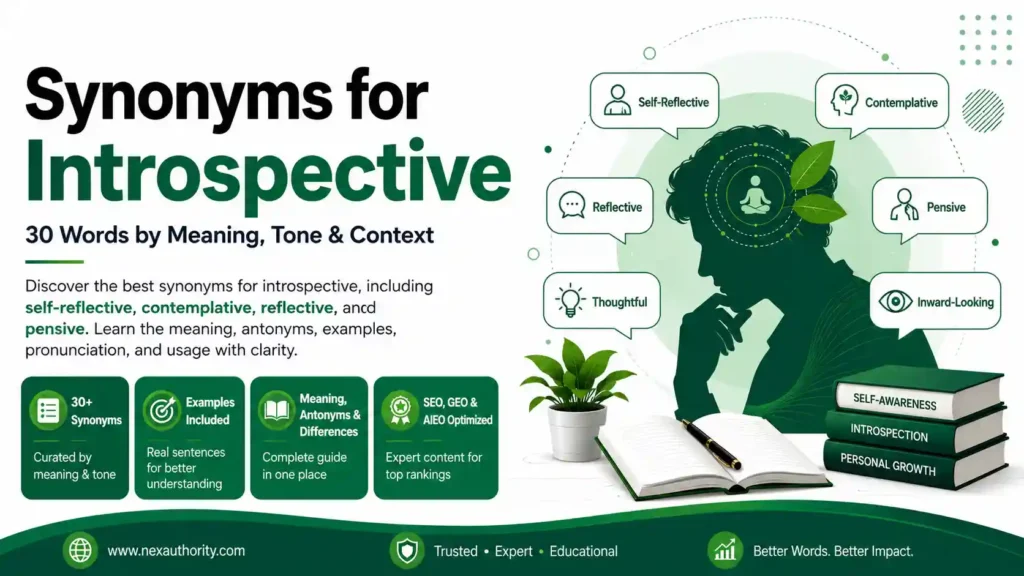

Synonyms for Introspective (adjective) (/ˌɪn.trəˈspek.tɪv/) mean examining your own thoughts, feelings, motives, and inner experiences. An introspective person looks inward and thinks carefully about why they feel, think, or behave in certain ways.
The closest introspective synonyms include self-reflective, reflective, contemplative, meditative, pensive, ruminative, thoughtful, self-examining, self-analytical, and inward-looking. The best choice depends on whether you mean deep thought, self-awareness, quiet reflection, or repeated thinking.
What Is a Synonym for Introspective?
The best general synonyms for introspective is self-reflective because it directly describes thinking about your own feelings, behavior, and reasons.
Other strong choices of Synonyms for Introspective include:
- Reflective — thinking deeply about experiences or ideas.
- Contemplative — quietly thinking about something deeply.
- Meditative — calmly focused on sustained thought.
- Pensive — quietly serious and thoughtful.
- Ruminative — repeatedly thinking about something.
- Self-examining — closely examining your own actions.
- Self-analytical — analyzing your own thoughts and behavior.
- Thoughtful — showing careful or deep thought.
- Inward-looking — focused on inner experience.
Merriam-Webster and Thesaurus also identify contemplative, pensive, meditative, reflective, self-reflective, ruminative, and thoughtful as among the strongest related words for introspective.
30 Synonyms for Introspective by Meaning
| Synonym | Specific Meaning | Synonym | Specific Meaning |
| 1. Self-reflective | Examining your own feelings and behavior | 16. Self-questioning | Questioning your own choices or motives |
| 2. Reflective | Thinking deeply about experiences | 17. Self-searching | Exploring your inner values and motives |
| 3. Contemplative | Thinking deeply in a quiet way | 18. Inward-looking | Focused on inner thoughts and experience |
| 4. Meditative | Engaged in calm, sustained thought | 19. Inward | Directed toward internal experience |
| 5. Pensive | Quietly absorbed in serious thought | 20. Self-scrutinizing | Closely examining your own behavior |
| 6. Ruminative | Thinking repeatedly about something | 21. Self-observing | Closely noticing your own behavior |
| 7. Thoughtful | Showing careful and deep consideration | 22. Self-analytical | Analyzing your own thoughts and motives |
| 8. Self-examining | Examining your own actions and motives | 23. Analytical | Examining something through careful thought |
| 9. Self-aware | Understanding your own traits and feelings | 24. Philosophical | Considering deeper questions and meaning |
| 10. Self-reflexive | Reflecting on oneself or one’s work | 25. Musing | Engaged in quiet, thoughtful reflection |
| 11. Cogitative | Involving deep or careful thinking | 26. Brooding | Thinking deeply, often about problems |
| 12. Serious-minded | Inclined toward serious thought | 27. Soul-searching | Deeply examining personal values |
| 13. Meditative-minded | Inclined toward quiet reflection | 28. Deep-thinking | Inclined to think deeply about ideas |
| 14. Deliberative | Carefully considering before deciding | 29. Inner-directed | Focused mainly on inner experience |
| 15. Pensive-minded | Inclined toward quiet serious thought | 30. Self-conscious | Highly aware of oneself |
Accuracy note: These are not equal in meaning. The strongest direct or near-direct choices are self-reflective, reflective, contemplative, meditative, pensive, ruminative, thoughtful, and self-examining. Words such as brooding, self-conscious, and philosophical add meanings that introspective does not always contain. Merriam-Webster’s current thesaurus places words such as contemplative, pensive, meditative, reflective, self-reflective, ruminative, and thoughtful among the leading related terms.
Where Introspective Comes From
Parts of Speech: Adjective
Syllable: in-tro-spec-tive
Origin: Introspective entered English in the early 19th century. It comes from Latin introspicere, meaning “to look into” or “to examine,” from intro- meaning “inward” and specere meaning “to look at.”
Prefix/Suffix Breakdown: intro- = inward/within + spect/spec = look or observe + -ive = relating to or tending toward. The related noun introspection means examining your own thoughts, feelings, and reasons for behavior. (
Introspective Meaning in English
The introspective meaning is simple: looking inward and thinking carefully about your own thoughts, feelings, and behavior.
Oxford defines introspective as tending to think a lot about your own thoughts and feelings. Cambridge similarly defines it as examining and considering your own ideas, thoughts, and feelings. (
What Does Introspective Mean in Simple Words?
In simple words, introspective means “thinking about what is happening inside your own mind.”
For example:
“After the argument, Maya became introspective.”
This means Maya spent time thinking about her feelings, reactions, and behavior.
What Is Introspective Thinking?
Introspective thinking means examining your own mental and emotional experience.
It may involve asking:
- Why did I react that way?
- What am I really feeling?
- Why do I keep making this choice?
- What caused this change in my mood?
- What do I value?
- What could I have done differently?
Introspection is specifically concerned with examining one’s own thoughts and feelings. (
Introspective Pronunciation
pronounced:
/ˌɪn.trəˈspek.tɪv/
A simple pronunciation guide is:
in-truh-SPEK-tiv
The main stress falls on SPEK. Cambridge and Oxford have the same basic pronunciation.
30 Introspective Synonyms With Meaning and Examples
1. Self-Reflective (/ˌself rɪˈflektɪv/)
Meaning: Thinking about your own feelings, behavior, and reasons.
- She is naturally self-reflective.
- His essay is honest and self-reflective.
This is one of the closest answers to what is a synonym for the word introspective? Cambridge defines self-reflective as thinking about your own feelings and behavior and the possible reasons for them.
2. Reflective (/rɪˈflektɪv/)
Meaning: Thinking deeply about experiences, ideas, or events.
- She became reflective after the conversation.
- The memoir has a reflective tone.
3. Contemplative (/kənˈtemplətɪv/)
Meaning: Quietly thinking about something in depth.
- He sat in a contemplative mood.
- The novel has a contemplative quality.
Contemplative is one of the strongest dictionary-supported synonyms of introspective.
4. Meditative (/ˈmedɪteɪtɪv/)
Meaning: Involving calm and sustained thought.
- She entered a meditative state.
- The music created a meditative mood.
5. Pensive (/ˈpensɪv/)
Meaning: Quietly serious and absorbed in thought.
- He looked pensive after the meeting.
- She became quiet and pensive.
6. Ruminative (/ˈruːmɪneɪtɪv/)
Meaning: Thinking repeatedly and deeply about something.
- His writing has a ruminative quality.
- She became ruminative after the experience.
7. Thoughtful (/ˈθɔːtfl/)
Meaning: Showing careful and serious consideration.
- He gave a thoughtful answer.
- Her writing is calm and thoughtful.
8. Self-Examining (/ˌself ɪɡˈzæmɪnɪŋ/)
Meaning: Closely examining your own actions or motives.
- His writing is deeply self-examining.
- The experience led to a self-examining period.
9. Self-Aware (/ˌself əˈwer/)
Meaning: Understanding your own feelings, traits, and behavior.
- She is highly self-aware.
- His response showed strong self-awareness.
Nuance: Self-aware means understanding yourself. Introspective emphasizes actively thinking about yourself.
10. Self-Reflexive (/ˌself rɪˈfleksɪv/)
Meaning: Reflecting on oneself, one’s work, or one’s process.
- The essay is strongly self-reflexive.
- The film takes a self-reflexive approach.
Important: In literary or media studies, self-reflexive can mean that a work draws attention to itself or its own construction. It is not always a synonyms for introspective.
11. Cogitative (/ˈkɑːdʒɪteɪtɪv/)
Meaning: Involving deep or careful thought.
- His writing has a cogitative quality.
- She entered a quiet, cogitative mood.
12. Serious-Minded (/ˌsɪriəs ˈmaɪndɪd/)
Meaning: Inclined toward serious thought.
- He is a serious-minded writer.
- Her approach is thoughtful and serious-minded.
13. Deliberative (/dɪˈlɪbərətɪv/)
Meaning: Carefully considering something before deciding.
- She has a deliberative style.
- His decision was slow but deliberative.
14. Self-Analytical (/ˌself ˌænəˈlɪtɪkl/)
Meaning: Analyzing your own thoughts, motives, or behavior.
- He is highly self-analytical.
- Her journal is very self-analytical.
Best context: essays, personal writing, psychology-related discussion, and self-development.
15. Pensive-Minded (/ˈpensɪv ˌmaɪndɪd/)
Meaning: Inclined toward quiet, serious thought.
- He has a pensive nature.
- Her expression was quiet and thoughtful.
Usage note: Pensive-minded is less natural than simply pensive. Use pensive in polished writing.
16. Self-Questioning (/ˌself ˈkwestʃənɪŋ/)
Meaning: Questioning your own choices, beliefs, or motives.
- His writing is deeply self-questioning.
- The experience triggered self-questioning.
17. Self-Searching (/ˌself ˈsɜːrtʃɪŋ/)
Meaning: Exploring personal values, motives, and feelings.
- The journey became deeply self-searching.
- Her memoir is a self-searching account.
18. Inward-Looking (/ˈɪnwərd ˌlʊkɪŋ/)
Meaning: Focused on inner thoughts and experience.
- The album has an inward-looking tone.
- His writing became more inward-looking.
19. Inward (/ˈɪnwərd/)
Meaning: Directed toward internal thoughts or feelings.
- After the loss, he turned inward.
- Her work takes an inward approach.
20. Self-Scrutinizing (/ˌself ˈskruːtənaɪzɪŋ/)
Meaning: Closely examining your own behavior.
- He is highly self-scrutinizing.
- Her writing can be very self-scrutinizing.
21. Self-Observing (/ˌself əbˈzɜːrvɪŋ/)
Meaning: Closely noticing your own thoughts or behavior.
- She became more self-observing over time.
- His journal shows careful self-observation.
22. Inner-Directed (/ˌɪnər dɪˈrektɪd/)
Meaning: Mainly focused on internal experience.
- He has an inner-directed style.
- Her work is strongly inner-directed.
23. Philosophical (/ˌfɪləˈsɑːfɪkl/)
Meaning: Thinking deeply about meaning or larger questions.
- She became more philosophical with age.
- His answer was calm and philosophical.
Nuance: Philosophical is broader than introspective. It can concern life, ethics, knowledge, or reality rather than the self alone.
24. Musing (/ˈmjuːzɪŋ/)
Meaning: Engaged in relaxed, thoughtful reflection.
- His essay is musing and personal.
- She spent the evening musing about the future.
25. Brooding (/ˈbruːdɪŋ/)
Meaning: Thinking deeply, often about something troubling.
- He was brooding over the mistake.
- Her mood became dark and brooding.
Nuance: Brooding is usually more negative than introspective. It suggests prolonged or troubled thought.
26. Soul-Searching (/ˈsoʊl ˌsɜːrtʃɪŋ/)
Meaning: Deeply examining your values and choices.
- The failure led to serious soul-searching.
- She went through a period of soul-searching.
27. Deep-Thinking (/ˌdiːp ˈθɪŋkɪŋ/)
Meaning: Inclined to think deeply about ideas.
- He is a deep-thinking writer.
- Her questions show a deep-thinking mind.
28. Analytical (/ˌænəˈlɪtɪkl/)
Meaning: Examining something carefully and logically.
- She has an analytical mind.
- His approach is highly analytical.
Nuance: Analytical can focus on external subjects. Introspective specifically turns attention toward the self.
29. Retrospective (/ˌretrəˈspektɪv/)
Meaning: Looking back at past events or experiences.
- The memoir takes a retrospective view.
- She made a retrospective assessment of her career.
Important: Retrospective is not an exact synonym for introspective. It focuses on the past, while introspection focuses on the self. Merriam-Webster explicitly distinguishes introspection from retrospection.
30. Subjective (/səbˈdʒektɪv/)
Meaning: Based mainly on personal thoughts or experience.
- The account is highly subjective.
- The poem gives a subjective view of grief.
Nuance: Subjective is broader and does not necessarily mean self-reflective. Use it only when personal perspective is the intended meaning.
What Do You Call a Person Who Is Introspective?
An introspective person can be called:
- Self-reflective
- Reflective
- Contemplative
- Self-aware
- Thoughtful
- Pensive
- Self-examining
The simplest natural expression is:
“She is an introspective person.”
Or:
“He is naturally self-reflective.”
An introspective person does not have to be shy or socially withdrawn. Introspection concerns inner thought, not simply social behavior.
Introspective Person Meaning
An introspective person is someone who spends time examining their own thoughts, emotions, motives, choices, and behavior.
For example:
“She is an introspective person who often thinks about why she reacts strongly to certain situations.”
This does not automatically mean she is unhappy, shy, quiet, or introverted.
Is Introspective Positive or Negative?
Introspective is usually neutral or positive.
It can suggest:
- self-awareness
- emotional insight
- thoughtful behavior
- personal growth
- careful reflection
But context can make it negative.
“He is introspective and self-aware.” → positive.
“He became introspective and withdrawn.” → potentially negative.
Cambridge notes that introspective can involve thinking deeply about one’s own thoughts and feelings, while its learner definition also notes that this habit is not always beneficial.
Introspective in a Sentence
Here are natural examples of introspective in a sentence:
- She became introspective after the experience.
- He is an introspective person.
- Her journal is deeply introspective.
- The novel has an introspective tone.
- His music became more introspective after the loss.
- The essay offers an introspective look at childhood.
- She took an introspective approach to her mistakes.
- He became more introspective as he grew older.
Oxford specifically shows introspective used with writing, mood, and other forms of creative expression. (
Another Word for Feeling Introspective
If you want another word for feeling introspective, choose based on the exact feeling:
- Reflective — thinking quietly about an experience.
- Pensive — quietly serious and thoughtful.
- Contemplative — deeply absorbed in thought.
- Meditative — calm and inwardly focused.
- Thoughtful — carefully considering something.
- Self-reflective — examining your own thoughts and behavior.
- Ruminative — repeatedly thinking about something.
For example:
“I feel introspective today.”
can become:
“I feel reflective today.”
or:
“I feel pensive today.”
Introspective vs. Introverted
Introspective and introverted are not the same.
| Introspective | Introverted |
| Examines inner thoughts | Describes social orientation |
| Focuses on self-reflection | Often prefers less social stimulation |
| Can describe people and creative work | Usually describes people |
| Does not mean shy | Does not automatically mean shy |
A person can be extroverted and introspective at the same time.
Example
“James is outgoing but very introspective.”
This is perfectly possible. He may enjoy social interaction while still spending a lot of time examining his thoughts and feelings.
Introspective vs. Extrospective
Introspective means examining what is happening inside yourself.
Extrospective means concerned with what is outside yourself. Merriam-Webster directly defines extrospective as opposed to introspective.
Simple Difference
Introspective → inward
Extrospective → outward
| Word | Focus |
| Introspective | Your own thoughts and feelings |
| Extrospective | The external world |
| Introspection | Examination of your inner experience |
| Extrospection | Observation of what is outside yourself |
Extrospective is a real English word, but it is much less common than introspective. In everyday writing, outward-looking or externally focused is often clearer.
What Is the Difference Between Introspective and Intraspective?
Introspective is the standard word for examining your own thoughts, feelings, and inner experience.
Intraspective is uncommon and should not normally be used as a replacement for introspective in general English.
If your intended meaning is:
“looking inward and examining your own thoughts”
use introspective.
This is especially important in essays, professional writing, and language-learning contexts.
What Is a Good Synonym for Introspection?
Self-reflection is one of the best everyday synonyms for introspection.
Other useful choices include:
- Self-examination
- Self-analysis
- Reflection
- Self-observation
- Soul-searching
- Contemplation
- Inner reflection
- Self-questioning
Oxford defines introspection as the careful examination of your own thoughts, feelings, and reasons for behaving in a particular way. (
Introspective vs. Introspection
adjective = Introspective
“She is introspective.”
Introspection = noun
“She practices introspection.”
Introspect = verb
“She needs time to introspect.”
These forms belong to the same word family.
Introspective Noun: What Is the Noun Form?
The main noun form of introspective is introspection.
Word Family
- Introspect — verb
- Introspection — noun
- Introspective — adjective
- Introspectively — adverb
- Introspectiveness — noun describing the quality
Example:
“His introspection helped him understand his reaction.”
Oxford lists introspection as the noun related to introspective. (
Introspective Meaning in Chinese
The introspective meaning in Chinese is commonly expressed as:
- 自省的 — self-reflective
- 反省的 — reflective or self-examining
- 内省的 — introspective or inward-looking
Cambridge lists 自省的 and 反省的 among Chinese translations of introspective.
For example:
introspective person → 自省的人
The exact translation can change with the sentence and intended nuance.
Introspective Synonym and Antonym
The strongest synonym-antonym pair is:
Introspective → self-reflective
Antonym → unreflective
When the intended contrast is inward versus outward focus:
Introspective → extrospective
Merriam-Webster specifically describes extrospective as opposed to introspective.
Opposite of Introspective
There is no single perfect opposite of introspective for every sentence.
Direct Antonyms
1. Unreflective — not inclined to examine your own thoughts.
“His response seemed unreflective.”
2. Thoughtless — lacking careful consideration.
“The decision was thoughtless.”
3. Superficial — lacking depth of thought.
“The discussion remained superficial.”
4. Shallow — lacking serious depth.
“The analysis was too shallow.”
Operational and Contextual Opposites
5. Extrospective — focused on what is outside oneself.
“The approach was more extrospective than introspective.”
6. Outward-looking — focused on the external world.
“The organization became more outward-looking.”
7. Externally focused — directed toward outside events or people.
“Her attention was externally focused.”
8. Impulsive — acting without much reflection.
“His impulsive decision left little time for reflection.”
Important: Extroverted is not a perfect antonym of introspective. Extroversion concerns social orientation, while introspection concerns self-examination.
Common Traps & Nuance Distinctions of Synonyms for Introspective
Introspective vs. Reflective
These are close.
Reflective can mean thinking carefully about an experience, event, idea, or subject.
Introspective specifically emphasizes examining the self.
“The essay is reflective about the war.”
“The essay is introspective about the writer’s feelings.”
Introspective vs. Contemplative
Contemplative means deeply thoughtful and quiet.
Introspective means looking inward at your own thoughts and feelings.
You can contemplate:
“the future, nature, philosophy, or a difficult problem.”
You introspect about:
“your feelings, motives, reactions, or choices.”
Introspective vs. Pensive
Pensive describes a quiet, serious mood.
Introspective describes a tendency or process of examining one’s inner life.
“She looked pensive.”
“She is introspective.”
Introspective vs. Ruminative
Ruminative suggests repeated or prolonged thinking.
It can be neutral, but it may imply overthinking.
Introspective is broader and more neutral.
Introspective vs. Retrospective
This is an important distinction.
Introspective = looking inward at yourself.
Retrospective = looking back at the past.
Merriam-Webster explains that introspection involves looking inward and taking stock of oneself, while retrospection concerns recollecting and considering past events.
Introspective vs. Self-Conscious
Self-conscious often means highly aware of how you appear to others, sometimes with embarrassment.
Introspective means examining your own thoughts and feelings.
Therefore:
“She felt self-conscious during the presentation.”
does not mean:
“She felt introspective during the presentation.”
When NOT to Use Introspective
Do not use introspective simply because someone is:
- Shy
- Quiet
- Introverted
- Antisocial
- Intelligent
- Emotional
- Observant
- Serious
Each word has a different meaning.
Wrong
“He is introspective because he does not like parties.”
Better
“He is introverted because he prefers quiet settings.”
Correct use
“He is introspective because he often examines his feelings and motives.”
This distinction is important for accurate essays, resumes, biographies, and creative writing.
How to Use Introspective in an Essay
Introspective works well when describing personal reflection, memoirs, journals, literature, poetry, films, music, or personal essays.
Examples
“The author takes an introspective approach to grief.”
“The poem is deeply introspective, exploring the speaker’s fear and regret.”
“The essay offers an introspective account of the writer’s childhood.”
For academic writing, self-reflective may be clearer when you specifically mean examining your own actions or decisions.
How to Describe an Introspective Person
You can describe an introspective person as:
- Self-reflective
- Thoughtful
- Reflective
- Contemplative
- Self-aware
- Pensive
- Deep-thinking
- Inward-looking
Positive description
“She is thoughtful, self-aware, and deeply reflective.”
Neutral description
“He has an introspective personality and often spends time thinking about his experiences.”
More literary description
“She has a contemplative, inward-looking nature.”
Is Introspective a Positive Word?
Usually, yes.
In most contexts, introspective has a neutral-to-positive tone. It can suggest that someone is thoughtful, self-aware, mature, or emotionally aware.
However, it can become negative when paired with words such as:
- withdrawn
- gloomy
- brooding
- obsessive
- self-critical
- isolated
So:
“an introspective writer”
is usually positive or neutral.
But:
“a gloomy, brooding, introspective mood”
has a clearly darker tone.
Frequently Asked Questions about Synonyms for Introspective
What is a synonym for the word introspective?
The closest common Synonyms for Introspective is self-reflective. Other strong choices include reflective, contemplative, meditative, pensive, ruminative, thoughtful, and self-examining.
What do you call a person who is introspective?
You can call the person introspective, self-reflective, reflective, contemplative, self-aware, or thoughtful.
What does introspective mean in simple words?
It means thinking about your own thoughts, feelings, motives, and behavior.
What is the word for introspective?
The adjective is introspective. The noun is introspection, the verb is introspect, and the adverb is introspectively.
What is a good synonym for introspection?
Self-reflection is one of the clearest everyday Synonyms for Introspective. Other choices include self-examination, self-analysis, reflection, soul-searching, and self-observation.
What does “introspective” mean?
It means examining and considering your own ideas, thoughts, and feelings.
Is introspective positive or negative?
It is usually neutral or positive. It can suggest self-awareness and thoughtful reflection, although excessive introspection can sometimes be associated with rumination or negative thinking.
What is the opposite word of introspective?
Depending on context, the opposite can be unreflective, thoughtless, superficial, shallow, or extrospective. Extrospective is the most direct contrast when the meaning is inward versus outward focus.
What is another word for feeling introspective?
Use reflective, pensive, contemplative, meditative, thoughtful, or self-reflective.
What is introspective thinking?
It is the process of examining your own thoughts, feelings, motives, reactions, memories, and choices.
What is the difference between introspective and extrospective?
Introspective means examining the inner self. Extrospective means examining or observing what is outside oneself.
What is the difference between introspective and intraspective?
Introspective is the standard English word for examining your own thoughts and feelings. Intraspective is uncommon and should not normally replace introspective in standard English.
What are some examples of introspective behavior?
Journaling, reviewing your reaction to an event, examining your motives, thinking about personal values, reflecting on mistakes, and considering how your actions affect others are examples of introspective behavior.
What is introspective in a sentence?
“She became introspective after the difficult conversation.”
Here, introspective means she began thinking deeply about her own thoughts and feelings.
What is the introspective noun?
The main noun is introspection.
“The experience led to deep introspection.”
What is introspective pronunciation?
The standard pronunciation is /ˌɪn.trəˈspek.tɪv/, roughly in-truh-SPEK-tiv.
What is the introspective meaning in Chinese?
Common Chinese translations include 自省的 and 反省的, with 内省的 also used depending on context.
Is introspective the same as introverted?
No. Introspective means examining your own thoughts and feelings. Introverted describes a person’s social orientation. A person can be both introverted and introspective, or extroverted and introspective.
Conclusion
Synonyms for Introspective means examining your own thoughts, feelings, motives, and behavior. The strongest introspective synonyms are self-reflective, reflective, contemplative, meditative, pensive, ruminative, thoughtful, and self-examining, while words such as brooding, retrospective, and self-conscious should be used only when their extra meaning fits. For essays, professional writing, personal descriptions, and creative work, choose the synonym based on whether you mean self-reflection, deep thought, self-awareness, quiet contemplation, or repeated thinking.